
Designing for Additive Manufacturing: The CAD Skills That Shape Tomorrow’s Products
Additive Manufacturing CAD Design, widely known as 3D printing, has transformed how products are imagined, designed, and produced. Unlike traditional manufacturing, AM builds components layer by layer, which unlocks unprecedented freedom in geometry, customization, and functional integration. However, this freedom comes with responsibility. Designers must rethink how they approach Computer-Aided Design (CAD). Conventional CAD habits, shaped by subtractive or formative processes, often limit the true potential of AM.
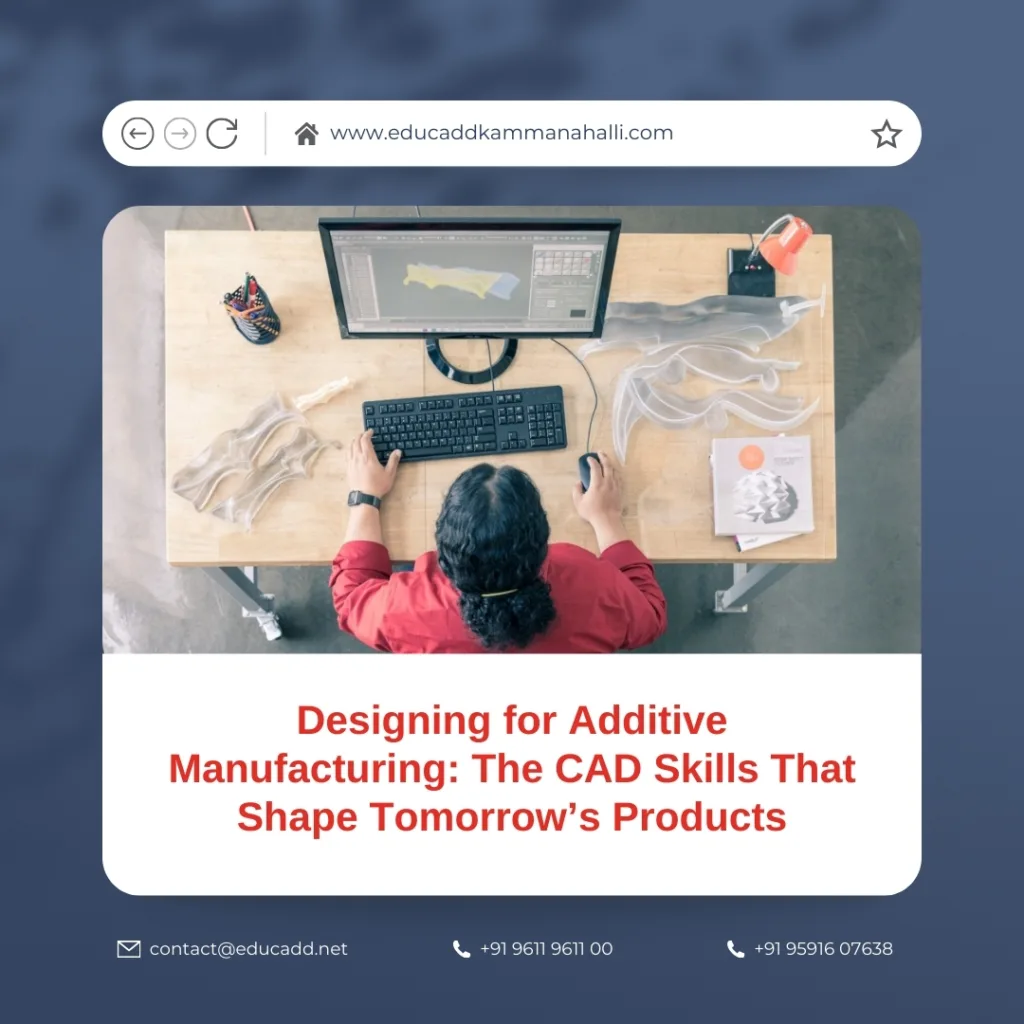
Additive Manufacturing CAD Design
Designing for Additive Manufacturing requires a new mindset. It blends creativity with engineering precision. Designers must understand materials, processes, and constraints while mastering advanced CAD techniques. This blog explores the essential CAD skills you need to excel in Designing for Additive Manufacturing. It explains how these skills improve printability, performance, and cost efficiency. By the end, you will understand why CAD proficiency sits at the heart of successful additive manufacturing projects.
1. Understanding Design for Additive Manufacturing Principles in CAD
Additive Manufacturing CAD Design starts with understanding how AM differs from traditional production. In conventional manufacturing, designers often simplify geometry to reduce machining time. In contrast, AM encourages complexity where it adds value. CAD professionals must design parts that exploit this advantage without compromising structural integrity or print success.
A critical CAD skill involves designing self-supporting geometries. Overhangs, bridges, and unsupported features behave differently in AM. Skilled designers use CAD tools to control angles, add fillets, and optimize orientations. This approach reduces the need for support structures. Fewer supports mean faster prints, lower material use, and cleaner surfaces.
Another key principle is part consolidation. CAD allows multiple components to merge into a single printable part. This reduces assembly time and eliminates fasteners. Designers must use parametric modeling to integrate functions seamlessly. When done correctly, Designing for Additive Manufacturing improves reliability and reduces long-term maintenance.
Transitioning from traditional CAD thinking to AM-focused design requires practice. However, once designers adopt these principles, their models become more efficient, innovative, and production-ready.
2. Mastering Parametric and Feature-Based Modeling for AM
Parametric modeling forms the backbone of modern CAD workflows. In Designing for Additive Manufacturing, this skill becomes even more valuable. Parametric models allow designers to adjust dimensions, tolerances, and features quickly. This flexibility supports rapid iteration, which aligns perfectly with the fast prototyping nature of AM.
Feature-based modeling helps designers control wall thickness, ribs, and internal structures. Consistent wall thickness improves print quality and mechanical performance. CAD tools enable designers to analyze and modify these features early. This prevents common AM issues such as warping or weak bonding between layers.
Moreover, parametric CAD supports mass customization. Designers can create adaptable templates that change based on user inputs. This capability drives one of the strongest advantages of additive manufacturing. Designing for Additive Manufacturing often involves producing variations without redesigning from scratch.
By mastering parametric and feature-based modeling, designers gain speed and precision. These skills reduce errors and improve collaboration with engineers and manufacturers. As a result, CAD models move smoothly from concept to printed reality.
3. Leveraging Advanced CAD Tools: Lattices, Topology Optimization, and Generative Design
One of the most powerful aspects of Designing for Additive Manufacturing lies in advanced CAD tools. Lattice structures, topology optimization, and generative design allow designers to create lightweight yet strong components. These geometries often cannot be manufactured using traditional methods.
Lattice design tools enable internal structures that reduce weight while maintaining strength. CAD professionals must understand how to control cell size, density, and orientation. Proper lattice design improves energy absorption, thermal performance, and material efficiency.
Topology optimization takes this concept further. CAD software analyzes load conditions and removes unnecessary material. The result is an organic-looking design optimized for performance. Designers must interpret these results carefully. They refine shapes to ensure printability and compliance with AM constraints.
Generative design introduces algorithm-driven exploration. Designers define goals, materials, and constraints. The software generates multiple design options. This process accelerates innovation and supports data-driven decisions. Designing for Additive Manufacturing benefits greatly from these tools because AM can produce complex outcomes without added cost.
Mastering advanced CAD capabilities positions designers at the forefront of digital manufacturing. These skills transform CAD from a drafting tool into a strategic design engine.
4. Designing with Materials, Tolerances, and Process Constraints in Mind
Successful Designing for Additive Manufacturing requires close attention to materials and processes. Different AM technologies behave differently. CAD designers must adapt models based on whether the process uses polymers, metals, or composites.
Material properties influence wall thickness, minimum feature size, and surface finish. CAD tools help simulate these factors during design. Designers can adjust geometries to account for shrinkage, anisotropy, and thermal stress. This proactive approach improves accuracy and reduces rework.
Tolerance management also plays a vital role. AM does not always match the precision of machining. Designers must specify realistic tolerances in CAD models. They also need to design assemblies that accommodate slight variations. Features such as snap-fits or compliant mechanisms work well in AM environments.
Process constraints, such as build volume and orientation, further affect design decisions. CAD professionals must visualize how a part will print. They choose orientations that balance strength, surface quality, and build time. Designing for Additive Manufacturing succeeds when CAD models align with real-world production conditions.
5. Validation, Simulation, and Collaboration Through CAD
Before printing, validation ensures that a design performs as intended. Modern CAD platforms include simulation tools that support Designing for Additive Manufacturing. Designers can test stress, thermal behavior, and deformation virtually. This reduces costly trial-and-error during printing.
Simulation also helps predict failure points. Designers adjust geometries early, which saves time and materials. These insights improve confidence in the final product and support faster approval cycles.
Collaboration represents another essential CAD skill. Additive manufacturing often involves cross-functional teams. Designers, engineers, and production specialists must work together. CAD files serve as a shared language. Clear naming, structured features, and documented parameters improve communication.
Cloud-based CAD platforms further enhance collaboration. Teams can review designs in real time and provide feedback instantly. This collaborative workflow aligns well with the agile nature of Designing for Additive Manufacturing.
When validation and collaboration integrate into the CAD process, designs become more robust. They move efficiently from digital models to functional printed parts.
Conclusion: Building Future-Ready Designers Through Additive Manufacturing CAD Skills
Additive Manufacturing CAD Design represents a fundamental shift in how products are created. It demands more than basic CAD knowledge. Designers must understand AM principles, master parametric modeling, and use advanced tools effectively. They must also design with materials, tolerances, and processes in mind.
As industries adopt additive manufacturing at scale, CAD skills will define competitive advantage. Designers who adapt will lead innovation. They will create lighter, stronger, and smarter products. By investing in the right CAD skills today, professionals prepare themselves for the future of manufacturing.
Ultimately, Designing for Additive Manufacturing is not just about making parts printable. It is about unlocking the full potential of design freedom. CAD sits at the center of this transformation, shaping how ideas become reality in the digital manufacturing era.

