
From Design to Precision: CAM Software Tools Every Mechanical Engineer Must Know
Manufacturing has evolved far beyond conventional machining methods. Today, industries demand speed, precision, repeatability, and cost efficiency at every stage of production. In this environment, CAM Software Tools Engineers has become an essential skill for mechanical engineers. CAM tools bridge the critical gap between digital design and physical production, enabling engineers to convert CAD models into accurate machine instructions. As manufacturing technologies continue to advance, mechanical engineers who master CAM software gain a strong competitive advantage in the job market. This comprehensive guide explores the most important CAM software tools every mechanical engineer must know, explaining their capabilities, applications, and relevance in modern manufacturing.
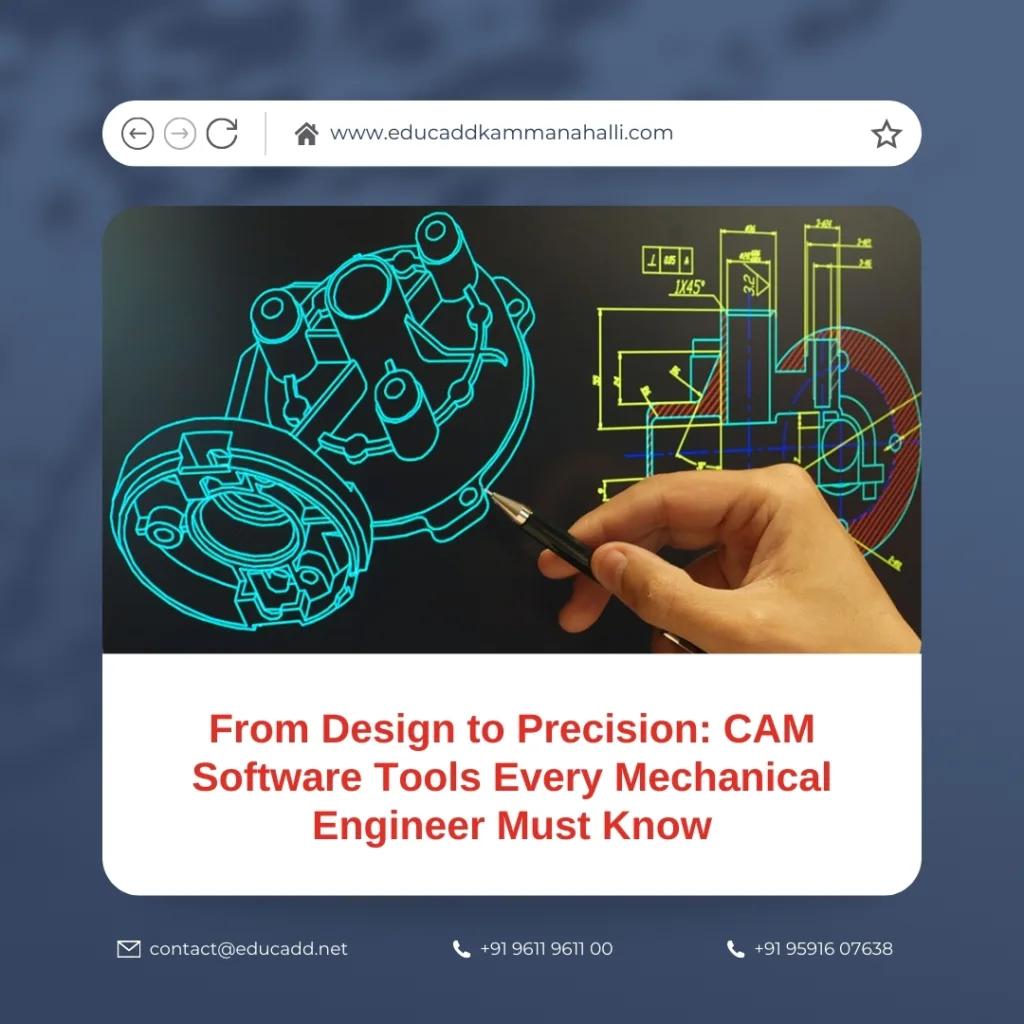
CAM Software Tools Engineers
Understanding CAM Software and Its Role in Mechanical Engineering
CAM software allows mechanical engineers to plan, simulate, and control manufacturing processes using computer systems. These tools generate toolpaths, select cutting strategies, and create G-code for CNC machines. As a result, manufacturing errors are minimized and productivity increases significantly. Moreover, CAM software ensures consistent quality across batches, which is essential for industries such as automotive, aerospace, medical devices, and industrial machinery. Mechanical engineers rely on CAM systems to optimize machining time, reduce material waste, and improve surface finish. Therefore, understanding CAM fundamentals is no longer optional but a core professional requirement.
Mastercam: Industry-Leading CAM Software for Precision Machining
Mastercam is one of the most widely used CAM software tools in the manufacturing industry. It supports 2D, 3D, and multi-axis machining, making it suitable for beginners and advanced users alike. Mechanical engineers prefer Mastercam because of its powerful toolpath generation and user-friendly interface. Additionally, it offers robust simulation features that help engineers visualize machining operations before actual production. As a result, costly errors are avoided. Mastercam is extensively used in CNC milling, turning, and wire EDM operations. Consequently, proficiency in Mastercam significantly improves employability in manufacturing-focused roles.
Siemens NX CAM: Advanced Manufacturing for Complex Engineering Needs
Siemens NX CAM is known for its high-end manufacturing capabilities and seamless integration with CAD and CAE modules. Mechanical engineers working on complex components benefit greatly from its advanced multi-axis machining features. Furthermore, NX CAM enables engineers to manage highly intricate geometries with exceptional accuracy. Its automation tools reduce programming time while maintaining precision. In addition, NX CAM supports digital twin concepts, allowing manufacturers to simulate complete production environments. Therefore, this software is especially valuable in aerospace, defense, and automotive industries where precision and reliability are critical.
SolidCAM: Seamless Integration with SolidWorks
SolidCAM is a powerful CAM solution that operates directly within SolidWorks. This integration eliminates the need for data translation, which often causes errors. Mechanical engineers appreciate SolidCAM because design changes automatically update machining operations. Moreover, its iMachining technology optimizes cutting conditions, extending tool life and reducing cycle times. As a result, productivity improves without compromising quality. SolidCAM supports CNC milling, turning, and Swiss-type machining. Hence, it is an excellent choice for engineers working in design-driven manufacturing environments.
Fusion 360 CAM: Cloud-Based Manufacturing for Modern Engineers
Fusion 360 CAM offers an all-in-one solution that combines CAD, CAM, and CAE in a single cloud-based platform. Mechanical engineers find this tool particularly useful for collaborative projects. Since data is stored in the cloud, teams can work together seamlessly from different locations. Fusion 360 CAM supports 2D, 3D, and 5-axis machining, making it suitable for startups and established manufacturers alike. Additionally, its affordability makes it accessible to students and professionals. Consequently, Fusion 360 CAM has gained widespread adoption across industries.
PowerMill: High-Speed Machining for Complex Surfaces
PowerMill, developed by Autodesk, specializes in high-speed and complex surface machining. Mechanical engineers use this software extensively for mold, die, and tooling applications. Its advanced toolpath strategies ensure smooth surface finishes and reduced machining time. Furthermore, PowerMill supports multi-axis CNC machines, enabling precise control over complex geometries. Engineers benefit from its powerful simulation tools, which help identify collisions before machining begins. Therefore, PowerMill plays a crucial role in high-precision manufacturing sectors.
Edgecam: Intelligent CAM for Production Efficiency
Edgecam focuses on automation and efficiency, making it ideal for production-oriented manufacturing. Mechanical engineers value its feature-based machining approach, which automatically recognizes part features and applies suitable machining strategies. As a result, programming time decreases significantly. Edgecam supports milling, turning, and mill-turn operations. Additionally, its simulation tools enhance process reliability. Consequently, Edgecam is widely used in automotive and industrial manufacturing environments where efficiency is paramount.
CATIA CAM: Integrated Manufacturing for Engineering Excellence
CATIA CAM is part of the CATIA ecosystem developed by Dassault Systèmes. Mechanical engineers working in aerospace and automotive industries frequently rely on this software. It supports complex surface machining and advanced manufacturing processes. Moreover, CATIA CAM ensures complete integration between design and manufacturing data. This integration reduces errors and improves overall workflow efficiency. Therefore, CATIA CAM remains a preferred choice for large-scale engineering projects requiring precision and consistency.
HyperMill: High-Performance CAM for Advanced Machining
HyperMill is known for its high-performance machining strategies and user-friendly interface. Mechanical engineers benefit from its efficient toolpath algorithms, which reduce machining time while maintaining accuracy. Additionally, HyperMill supports 5-axis machining and complex geometries. Its simulation capabilities provide clear visualization of machining processes. As a result, engineers can optimize operations before production. HyperMill is widely used in aerospace, medical, and mold-making industries.
GibbsCAM: Simplified CAM for Faster Programming
GibbsCAM emphasizes simplicity and speed in CNC programming. Mechanical engineers appreciate its intuitive interface, which reduces the learning curve. Despite its simplicity, GibbsCAM offers powerful machining capabilities for milling and turning operations. Furthermore, it supports multi-task machines and complex setups. As a result, engineers can program parts quickly without sacrificing accuracy. GibbsCAM is particularly suitable for job shops and small manufacturing units.
FeatureCAM: Automated CAM for Reduced Programming Time
FeatureCAM automates many aspects of CNC programming by recognizing part features directly from CAD models. Mechanical engineers benefit from faster programming and consistent machining strategies. Additionally, FeatureCAM supports milling, turning, and turn-mill operations. Its automation reduces human error and improves productivity. Consequently, FeatureCAM is widely adopted in production environments where speed and consistency are essential.
CAMWorks: Knowledge-Based Manufacturing Solutions
CAMWorks uses a knowledge-based approach to CNC programming. Mechanical engineers can store machining knowledge and reuse it across multiple projects. This capability ensures consistency and reduces programming time. CAMWorks integrates seamlessly with SolidWorks, providing a smooth workflow from design to manufacturing. Moreover, its simulation tools enhance machining accuracy. Therefore, CAMWorks is an excellent choice for companies aiming to standardize manufacturing processes.
The Importance of CAM Software in Career Growth
Mechanical engineers who master CAM Software Tools Engineers gain access to diverse career opportunities. Industries increasingly seek professionals who can handle both design and manufacturing responsibilities. CAM skills improve problem-solving abilities and technical confidence. Moreover, engineers with CAM expertise contribute more effectively to production optimization and cost reduction. As manufacturing technologies continue to evolve, CAM proficiency remains a long-term career asset.
Conclusion
CAM Software Tools Engineers play a vital role in transforming digital designs into high-quality manufactured products. From Mastercam and Siemens NX CAM to Fusion 360 and PowerMill, each tool offers unique advantages for mechanical engineers. By understanding and mastering these CAM systems, engineers enhance their technical capabilities and career prospects. In an increasingly competitive manufacturing landscape, CAM expertise is no longer optional but essential. Mechanical engineers who invest time in learning CAM software position themselves for long-term success in modern industry.

