
Master Revit for Plumbing & Fire Protection Systems: Design Smart, Build Safe
Modern buildings demand accuracy, safety, and efficiency at every stage of design and construction. Revit Plumbing Fire Protection systems sit at the heart of building performance, occupant safety, and regulatory compliance. As projects grow more complex, traditional 2D drafting methods struggle to keep pace with coordination demands, design changes, and clash-free execution. This is where Building Information Modeling, powered by Autodesk Revit, completely transforms the workflow. Learning Revit for plumbing and fire protection systems equips engineers, designers, and BIM professionals with the ability to model intelligent systems, coordinate seamlessly with other disciplines, and deliver construction-ready documentation with confidence. This guide explores why Revit matters, how it works for MEP design, and how mastering it can elevate your career and project outcomes.
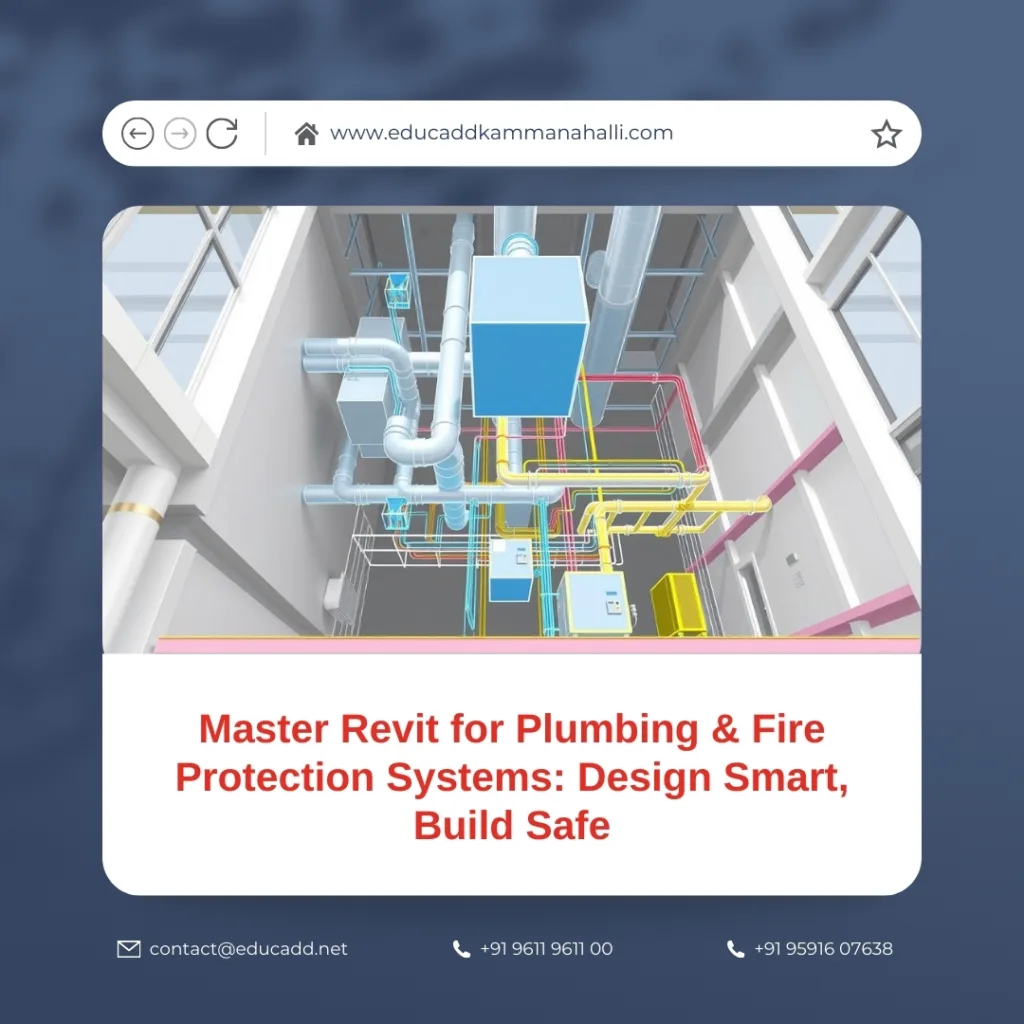
Revit Plumbing Fire Protection
Understanding BIM and Revit in MEP Design
Building Information Modeling is more than a 3D modeling process. It represents a data-rich approach where every component carries information about size, material, performance, and relationships. Revit serves as a powerful BIM authoring tool that allows plumbing and fire protection systems to exist within a coordinated digital building model. Instead of drawing isolated lines, designers create intelligent pipes, fittings, valves, pumps, and sprinklers that interact with architectural and structural elements. This interconnected environment improves accuracy, reduces errors, and supports informed decision-making across the project lifecycle.
Why Learn Revit for Plumbing Systems
Plumbing design involves complex networks for water supply, drainage, and vent systems. Revit simplifies this complexity by allowing designers to create parametric piping systems that automatically calculate slopes, sizes, and connections. When changes occur, Revit updates the entire model instantly, saving time and reducing rework. Learning Revit for plumbing systems also improves compliance with local codes and standards, as designers can validate layouts visually and through schedules. This capability enhances coordination with architects and contractors, ensuring efficient installation and long-term system performance.
Importance of Revit in Fire Protection Design
Fire protection systems play a critical role in safeguarding lives and property. Revit provides specialized tools for modeling sprinkler layouts, standpipes, fire pumps, and risers with precision. Designers can maintain correct spacing, coverage areas, and elevations while adhering to fire safety regulations. Learning Revit for fire protection systems allows professionals to visualize system performance within the building context. This clarity improves approvals, reduces site conflicts, and supports safer building outcomes.
Core Revit Interface for MEP Professionals
Before diving into advanced modeling, understanding the Revit interface is essential. The workspace includes views, levels, grids, and system browsers tailored for MEP workflows. Plumbing and fire protection designers benefit from system-specific toolsets that streamline pipe creation, fitting placement, and equipment selection. Mastering navigation, view controls, and worksets improves productivity and ensures models remain organized. A strong foundation in the interface enables designers to focus on engineering logic rather than software hurdles.
Setting Up Plumbing Systems in Revit
Creating plumbing systems in Revit begins with defining project settings, pipe types, and system classifications. Designers assign materials, diameters, and flow parameters that reflect real-world conditions. Revit supports domestic water, sanitary, stormwater, and vent systems within a single model. Learning how to connect fixtures, apply slopes, and manage vertical risers ensures accurate system behavior. These capabilities help teams deliver reliable plumbing designs that align with construction and operational requirements.
Modeling Fire Protection Systems with Accuracy
Fire protection modeling in Revit requires attention to detail and code awareness. Designers place sprinklers based on hazard classifications and coverage rules. Revit tools support automatic pipe routing, elevation control, and system tagging. Learning these features enables designers to produce compliant layouts efficiently. Accurate modeling also supports hydraulic calculations and coordination with ceilings, lighting, and structural elements. This level of detail reduces installation issues and enhances system reliability.
Coordination and Clash Detection Benefits
One of the strongest advantages of learning Revit for plumbing and fire protection systems lies in coordination. Revit models integrate with architectural, structural, and electrical disciplines within a shared environment. Designers can identify clashes early, resolve conflicts digitally, and avoid costly site changes. This proactive approach improves collaboration and strengthens trust among stakeholders. Clash-free models lead to smoother construction phases and improved project timelines.
Creating Construction Documentation
Revit excels in generating coordinated construction documents directly from the model. Plans, sections, elevations, and details update automatically as designs evolve. Plumbing and fire protection schedules extract accurate quantities and specifications, supporting procurement and cost control. Learning documentation workflows ensures that drawings remain consistent and reliable. This accuracy reduces RFIs and enhances contractor confidence during execution.
Advanced Revit Tools for MEP Professionals
Beyond basic modeling, Revit offers advanced features such as system analysis, custom families, and parameter management. Plumbing designers can analyze flow and pressure, while fire protection professionals can refine system layouts for efficiency. Learning these advanced tools elevates design quality and supports data-driven decisions. Mastery of Revit positions professionals as valuable contributors in high-performance building projects.
Industry Demand and Career Growth
The construction industry increasingly demands BIM-enabled professionals. Learning Revit for plumbing and fire protection systems opens doors to roles such as BIM Modeler, MEP Engineer, and BIM Coordinator. Employers value candidates who can deliver coordinated models and optimize workflows. As BIM adoption grows globally, Revit skills provide long-term career stability and growth opportunities. This expertise also supports freelance and consultancy paths.
Best Practices for Learning Revit Efficiently
Effective learning requires structured practice and real-world application. Beginners should start with fundamentals, progress to system modeling, and gradually explore advanced features. Working on sample projects reinforces understanding and builds confidence. Learning Revit for plumbing and fire protection systems becomes easier when supported by industry-focused training and mentorship. Consistent practice ensures lasting skill development.
Common Challenges and How to Overcome Them
New learners often face challenges such as understanding system connectivity, managing large models, and maintaining standards. These challenges reduce with experience and proper guidance. Using templates, following naming conventions, and leveraging Revit help resources improve efficiency. Learning problem-solving strategies ensures smoother workflows and professional results.
Future of Revit in MEP Design
As technology evolves, Revit continues to integrate with automation, cloud collaboration, and digital twins. Plumbing and fire protection systems will benefit from enhanced simulation and data analytics. Learning Revit today prepares professionals for future advancements in smart building design. Staying updated ensures relevance in a competitive industry.
Conclusion
Learning Revit Plumbing Fire Protection systems is no longer optional in modern construction workflows. It empowers professionals to design intelligent, coordinated, and compliant systems that perform reliably throughout a building’s lifecycle. From accurate modeling and seamless coordination to efficient documentation and career growth, Revit delivers unmatched value. By investing time in mastering Revit, designers and engineers position themselves at the forefront of BIM-driven innovation, ready to meet the demands of safer, smarter, and more efficient buildings.

