
From Raw Data to Real-Time Insights: A Step-by-Step Guide to Data Warehousing in the Cloud
In today’s digital-first economy, data drives every strategic decision. Organizations generate massive volumes of data from applications, websites, IoT devices, customer interactions, and operational systems. However, raw data alone does not create value. Businesses need structured, reliable, and accessible data to extract insights. This need has made Cloud Data Warehousing Guide a critical component of modern enterprise architecture.
Traditional on-premise data warehouses often struggle with scalability, cost efficiency, and maintenance complexity. In contrast, cloud data warehouses offer elasticity, high availability, and advanced analytics capabilities. They allow businesses to store, process, and analyze large datasets without investing heavily in physical infrastructure. As a result, companies can focus more on innovation and decision-making rather than system management.
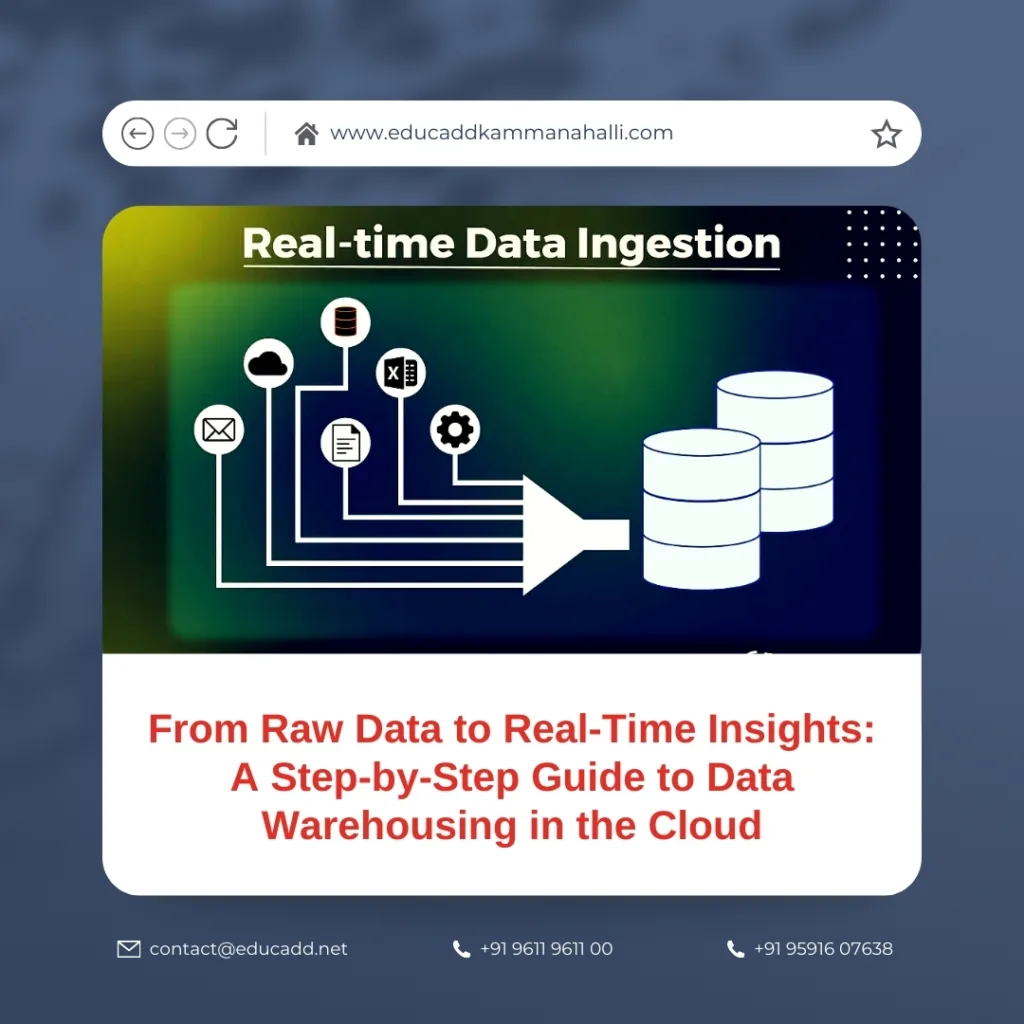
Cloud Data Warehousing Guide
This step-by-step guide explains how Cloud Data Warehousing Guide works, why it matters, and how organizations can implement it effectively. From foundational concepts to advanced optimization strategies, this blog covers the complete lifecycle in a structured and practical manner.
1. Understanding Data Warehousing in Cloud: Core Concepts Explained
Before implementing a solution, it is essential to understand what Data Warehousing in Cloud truly means. A cloud data warehouse is a centralized repository hosted on cloud infrastructure. It is designed to store structured and semi-structured data from multiple sources for reporting, analytics, and business intelligence.
Unlike transactional databases, cloud data warehouses optimize performance for read-heavy analytical queries. They support complex joins, aggregations, and historical analysis. Moreover, cloud platforms separate compute and storage, which allows users to scale resources independently based on workload requirements.
Additionally, cloud data warehouses integrate seamlessly with analytics tools, machine learning platforms, and visualization software. This integration enables faster insight generation and supports data-driven cultures across organizations. Understanding these fundamentals lays a strong foundation for successful implementation.
2. Key Benefits of Data Warehousing in Cloud for Modern Businesses
Organizations adopt Data Warehousing in Cloud because it delivers tangible business benefits. First, scalability stands out as a major advantage. Businesses can increase or decrease resources instantly without disrupting operations. This flexibility supports both small analytics teams and large enterprise workloads.
Second, cost efficiency plays a significant role. Cloud data warehouses follow a pay-as-you-go model. Companies pay only for the resources they use, which reduces upfront capital expenditure. Additionally, maintenance tasks such as patching, backups, and upgrades are handled by the cloud provider.
Furthermore, cloud data warehouses enhance collaboration. Teams can access the same datasets securely from different locations. As a result, decision-makers gain consistent insights across departments. These benefits collectively make cloud data warehousing a strategic investment rather than a technical upgrade.
3. Choosing the Right Cloud Platform for Data Warehousing
Selecting the right platform is a critical step in Data Warehousing in Cloud. Popular cloud providers offer specialized data warehouse services, each with unique strengths. The choice depends on factors such as performance requirements, ecosystem compatibility, budget constraints, and security needs.
Organizations should evaluate data volume, query complexity, and concurrency expectations. For instance, businesses with unpredictable workloads may prioritize elastic scaling. Meanwhile, companies with strict compliance requirements may focus on advanced security and governance features.
In addition, integration capabilities matter. The chosen platform should connect easily with data sources, ETL tools, and analytics applications. By aligning platform selection with business goals, organizations can avoid costly migrations and performance bottlenecks later.
4. Designing the Cloud Data Warehouse Architecture
A well-designed architecture ensures long-term success in Data Warehousing in Cloud. Architecture design starts with defining data sources, ingestion methods, storage layers, and access patterns. Each component must support scalability, performance, and reliability.
Typically, cloud data warehouse architecture includes a staging layer, a transformation layer, and a presentation layer. The staging layer stores raw data as it arrives. The transformation layer cleans and structures data. Finally, the presentation layer organizes data for analytics and reporting.
Moreover, modern architectures often adopt a modular approach. This design allows teams to modify individual components without impacting the entire system. As a result, organizations gain flexibility while maintaining stability.
5. Data Modeling Strategies for Cloud Data Warehousing
Data modeling plays a crucial role in Data Warehousing in Cloud. A well-structured model improves query performance and enhances data usability. Common modeling approaches include star schema, snowflake schema, and data vault modeling.
The star schema remains popular due to its simplicity and performance efficiency. It organizes data into fact tables and dimension tables, which simplifies analytical queries. Snowflake schemas normalize dimensions further, which can reduce storage usage.
Meanwhile, data vault modeling focuses on scalability and historical tracking. It suits organizations with rapidly changing data structures. Choosing the right modeling strategy depends on business requirements, data complexity, and future scalability needs.
6. Data Ingestion: Moving Data into the Cloud Warehouse
Data ingestion is a foundational step in Data Warehousing in Cloud. It involves extracting data from source systems and loading it into the cloud warehouse. Data can arrive in batch mode, real-time streams, or micro-batches.
Batch ingestion suits historical data and periodic updates. Real-time ingestion supports use cases like fraud detection and live dashboards. Organizations often use ETL or ELT pipelines depending on transformation requirements.
Automation plays a key role in reliable ingestion. Scheduled workflows, monitoring, and error handling ensure data consistency. A robust ingestion strategy prevents data gaps and supports accurate analytics.
7. Data Transformation and Processing in the Cloud
After ingestion, data must be transformed into an analytics-ready format. In Data Warehousing in Cloud, transformations often occur directly within the warehouse using SQL-based processing. This approach leverages the platform’s computational power.
Transformations include data cleansing, deduplication, normalization, and enrichment. They ensure data quality and consistency across datasets. Additionally, transformations align data with business definitions and metrics.
Using scalable cloud compute resources allows organizations to process large datasets efficiently. As data volumes grow, transformation workloads can scale without performance degradation.
8. Implementing Data Security and Governance
Security remains a top priority in Data Warehousing in Cloud. Cloud platforms offer robust security features, but organizations must configure them correctly. Access controls, encryption, and auditing form the foundation of a secure environment.
Role-based access ensures users see only relevant data. Encryption protects data at rest and in transit. Audit logs track data access and modifications, which supports compliance requirements.
Governance frameworks further enhance trust in data. They define data ownership, quality standards, and usage policies. Strong governance ensures that analytics outputs remain reliable and compliant.
9. Performance Optimization Techniques for Cloud Data Warehouses
Performance optimization ensures that Data Warehousing in Cloud delivers fast and reliable insights. Query optimization, indexing strategies, and partitioning techniques improve response times. Additionally, caching frequently accessed data reduces compute usage.
Monitoring tools help identify performance bottlenecks. By analyzing query patterns, teams can adjust resource allocation and schema design. Moreover, separating workloads prevents resource contention between analytics and reporting tasks.
Continuous optimization keeps the system efficient as data volumes and user demands increase. Performance tuning should remain an ongoing process rather than a one-time effort.
10. Integrating Analytics and Business Intelligence Tools
A cloud data warehouse delivers value only when users can analyze data easily. Data Warehousing in Cloud integrates seamlessly with BI tools, dashboards, and data science platforms. These integrations enable self-service analytics across teams.
Visualization tools convert complex datasets into intuitive charts and reports. Data scientists use the warehouse as a foundation for machine learning models. Business users access insights without technical dependencies.
This accessibility democratizes data and fosters informed decision-making. As a result, analytics becomes a shared capability rather than a specialized function.
11. Managing Costs in Cloud Data Warehousing
Cost management is essential for sustainable Data Warehousing in Cloud adoption. While cloud platforms offer flexibility, uncontrolled usage can increase expenses. Monitoring consumption helps organizations stay within budget.
Techniques such as query optimization, workload scheduling, and resource auto-scaling reduce unnecessary costs. Additionally, archiving cold data lowers storage expenses.
Financial governance aligns technical decisions with business objectives. By balancing performance and cost, organizations maximize return on investment.
12. Scaling and Future-Proofing the Cloud Data Warehouse
Scalability defines the long-term success of Data Warehousing in Cloud. As data sources expand, the warehouse must handle increased volume, velocity, and variety. Cloud platforms support horizontal and vertical scaling to meet these demands.
Future-proofing involves adopting flexible architectures and modular designs. It also includes staying updated with platform enhancements and analytics innovations.
By planning for growth, organizations avoid disruptive migrations and maintain continuous insight delivery.
13. Common Challenges and How to Overcome Them
Despite its advantages, Data Warehousing in Cloud presents challenges. Data quality issues, skill gaps, and governance complexity can hinder success. Addressing these challenges requires strategic planning.
Establishing data standards improves consistency. Training teams enhances adoption and efficiency. Clear governance frameworks prevent misuse and confusion.
Proactive problem-solving transforms challenges into learning opportunities. With the right approach, organizations can achieve stable and scalable cloud data warehousing.
14. Best Practices for Successful Cloud Data Warehousing Implementation
Best practices guide effective Data Warehousing in Cloud implementation. These include starting with clear business objectives, adopting incremental development, and prioritizing data quality.
Regular reviews ensure alignment with evolving needs. Collaboration between IT and business teams enhances relevance. Documentation supports knowledge transfer and scalability.
By following proven practices, organizations reduce risk and accelerate value realization.
Conclusion
Cloud Data Warehousing Guide represents more than a technological shift. It enables organizations to transform raw data into actionable insights with speed and confidence. Through scalable infrastructure, advanced analytics, and cost-effective operations, cloud data warehouses empower data-driven decision-making.
By following a structured, step-by-step approach, businesses can design, implement, and optimize cloud data warehouses successfully. From platform selection to performance tuning, every stage contributes to long-term value.
Ultimately, organizations that invest in cloud data warehousing position themselves for agility, innovation, and sustained growth in an increasingly data-centric world.

