
Scanning the Future: How Reverse Engineering with 3D Technology Is Redefining Modern Design
The design and manufacturing landscape has changed dramatically over the past decade. Companies no longer depend solely on traditional drawings, manual measurements, or archived blueprints to recreate components. Instead, they embrace intelligent digital workflows that connect the physical and virtual worlds. Among these innovations, Reverse Engineering 3D Technology stands out as a transformative method. It enables professionals to capture real-world objects and convert them into accurate, editable digital models.
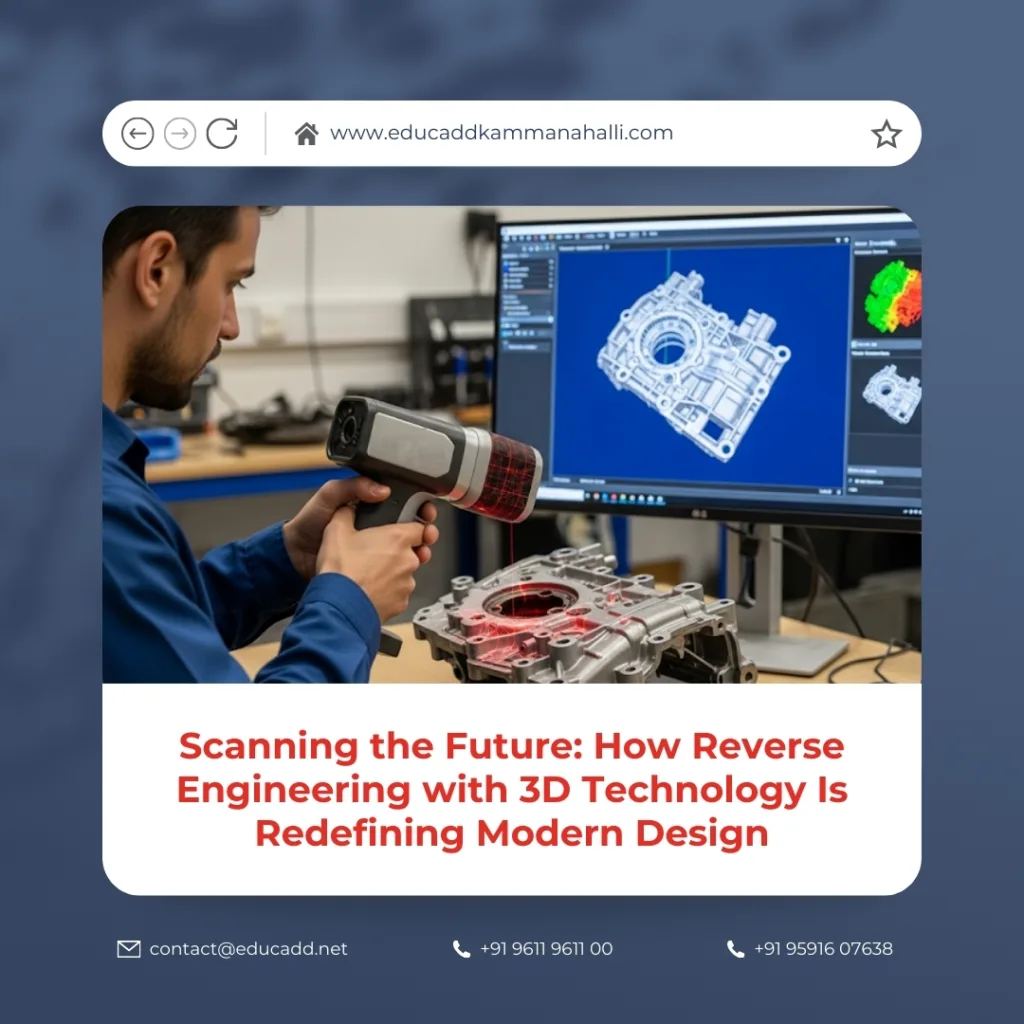
Reverse Engineering 3D Technology
Reverse engineering with 3D scanning empowers engineers, product designers, and manufacturers to analyze, modify, and enhance existing components without original CAD data. This approach reduces development time, improves precision, and supports innovation across industries. As digital manufacturing, automation, and smart production systems continue to expand, mastering reverse engineering with 3D scanning becomes an essential skill for forward-thinking professionals. The following in-depth guide explores every aspect of this technology, its applications, benefits, workflow, career potential, and future impact.
1. Defining Reverse Engineering with 3D Scanning in Today’s Context
Reverse Engineering 3D Technology refers to the structured process of capturing the geometry of a physical object and transforming it into a digital 3D model for analysis, redesign, or reproduction. Rather than designing a product from the ground up, engineers study an existing component and digitally reconstruct it using advanced scanning devices and CAD software.
This method becomes especially valuable when original design files are missing, outdated, or incompatible with modern systems. Through reverse engineering with 3D scanning, complex shapes, curved surfaces, and intricate details can be measured with remarkable accuracy. The scanner gathers millions of surface data points within minutes. These points create a dense digital dataset known as a point cloud.
After data acquisition, specialized software processes the point cloud into a mesh model. Engineers then convert the mesh into a fully parametric CAD model. This final model allows modifications, simulations, manufacturing preparation, and quality inspection. Consequently, reverse engineering with 3D scanning bridges the gap between legacy physical parts and modern digital engineering workflows.
2. Why Businesses Are Adopting Reverse Engineering with 3D Scanning
Organizations across sectors increasingly rely on reverse engineering with 3D scanning because it delivers measurable advantages. Traditional measurement techniques often consume time and introduce inconsistencies. Manual calipers and gauges cannot easily capture complex freeform surfaces. In contrast, scanning systems document even the most intricate geometries quickly and consistently.
For example, manufacturing companies often face downtime when machine components fail. If documentation is unavailable, recreating parts manually delays operations. However, reverse engineering with 3D scanning allows technicians to digitize the damaged component immediately and generate a production-ready model. This speed reduces operational losses and enhances productivity.
Moreover, product development teams use reverse engineering with 3D scanning to study competitor products. By examining structure, assembly techniques, and material distribution, companies identify opportunities for improvement. As a result, innovation accelerates while development costs decrease. Businesses that adopt this technology gain both technical and strategic advantages.
3. The Complete Workflow Explained in Detail
Understanding reverse engineering with 3D scanning requires a clear view of its workflow. Each stage contributes to precision and reliability. The process begins with object preparation. Professionals clean the surface, remove contaminants, and sometimes apply matte sprays to minimize reflection. Accurate preparation ensures optimal scan results.
Next, the scanning phase begins. Operators use handheld laser scanners or structured light scanners to capture surface geometry from multiple angles. They move around the object systematically to avoid missing areas. The scanner records millions of data points, building a comprehensive digital representation.
After scanning, the software aligns and merges multiple datasets into a unified point cloud. Engineers remove noise and fill gaps to refine the data. Then, the system generates a mesh model composed of interconnected triangles. Finally, professionals convert the mesh into a parametric CAD model using surface modeling and feature extraction tools. Through this structured workflow, reverse engineering with 3D scanning delivers precise and editable digital designs.
4. Exploring the Technology Behind 3D Scanners
Reverse engineering with 3D scanning depends heavily on advanced hardware systems. Laser scanners project beams onto surfaces and calculate geometry based on reflected signals. These devices excel in capturing detailed industrial components. Structured light scanners, on the other hand, project patterns of light and analyze distortions to map surfaces accurately.
Portable scanners allow flexibility on factory floors, while stationary systems offer high precision for laboratory environments. In addition, some scanners integrate color capture, which supports design visualization and inspection processes.
Understanding scanner specifications, resolution, and accuracy is essential when practicing reverse engineering with 3D scanning. Selecting the right equipment depends on object size, surface properties, and required precision levels. With technological advancements, scanning systems continue to become faster, lighter, and more accessible to professionals worldwide.
5. Software Tools That Power the Process
While hardware captures geometry, software transforms raw data into functional models. Reverse engineering with 3D scanning relies on specialized platforms such as Geomagic Design X, PolyWorks, and other CAD-integrated solutions. These tools process point clouds, generate meshes, and extract design features.
Engineers use surface fitting, curve creation, and solid modeling tools to rebuild accurate parametric models. Inspection modules compare scanned geometry with reference designs to identify deviations. This capability proves essential for quality assurance and product validation.
Learning reverse engineering with 3D scanning involves mastering both scanning hardware and digital modeling software. Together, they create a seamless workflow that connects physical objects to advanced engineering systems.
6. Industrial Applications Across Diverse Sectors
Reverse engineering with 3D scanning supports numerous industries. In automotive engineering, professionals scan engine blocks, transmission components, and body panels for redesign and optimization. This approach shortens product cycles and improves performance outcomes.
In aerospace manufacturing, engineers rely on reverse engineering with 3D scanning to inspect turbine blades, airframe structures, and precision components. Accurate digital models enable stress analysis and aerodynamic evaluation.
Healthcare applications also continue to grow. Medical specialists use scanning technology to design custom implants, orthotic devices, and prosthetics tailored to individual patients. Additionally, museums and heritage institutions digitize artifacts to preserve cultural history. These diverse applications demonstrate the adaptability of reverse engineering with 3D scanning in solving real-world challenges.
7. Key Advantages for Professionals and Companies
Developing expertise in reverse engineering with 3D scanning offers multiple benefits. First, it enhances employability in advanced manufacturing and engineering roles. Companies seek professionals capable of managing digital reconstruction projects efficiently.
Second, this skill improves problem-solving capabilities. Engineers analyze irregular shapes, interpret complex geometries, and reconstruct them accurately. This analytical mindset strengthens overall technical competence.
Third, reverse engineering with 3D scanning supports rapid prototyping and additive manufacturing. Once a digital model is ready, it can be produced using 3D printing technologies. Consequently, development cycles shorten, and experimentation becomes more efficient.
For organizations, the technology reduces downtime, improves product quality, and supports innovation initiatives.
8. Skills Required to Master Reverse Engineering with 3D Scanning
To excel in reverse engineering with 3D scanning, individuals must cultivate a combination of technical and analytical skills. Strong knowledge of CAD modeling remains fundamental. Understanding geometric dimensioning and tolerancing enhances reconstruction accuracy.
Professionals should also develop proficiency in surface modeling and mesh editing. Attention to detail ensures high-quality results during data cleaning and feature extraction. Communication skills further contribute to project success because reverse engineering tasks often involve collaboration across departments.
With consistent practice and structured training, these competencies transform learners into confident specialists in reverse engineering with 3D scanning.
9. Overcoming Technical Challenges Effectively
Although reverse engineering with 3D scanning offers many benefits, challenges sometimes arise. Reflective or transparent surfaces may disrupt scanning accuracy. Complex geometries can create incomplete data sets.
However, professionals overcome these issues through preparation and technique. Applying matte coatings reduces reflection. Scanning from multiple angles eliminates blind spots. Advanced software tools repair mesh imperfections and smooth irregularities.
Experience plays a crucial role in mastering reverse engineering with 3D scanning. As professionals handle diverse projects, they refine strategies and improve efficiency.
10. Integration with Industry 4.0 and Smart Manufacturing
Reverse engineering with 3D scanning aligns closely with Industry 4.0 initiatives. Smart factories depend on digital models for automation, robotic integration, and predictive maintenance. Scanned data contributes to digital twin creation, allowing companies to monitor equipment virtually.
Artificial intelligence further enhances feature recognition and mesh processing. Cloud-based collaboration platforms enable teams to share and modify digital models seamlessly. As industries adopt interconnected production systems, reverse engineering with 3D scanning becomes increasingly valuable.
This integration positions scanning technology as a core component of digital transformation strategies worldwide.
11. Educational Pathways and Certification Opportunities
Structured education accelerates mastery of reverse engineering with 3D scanning. Professional courses cover scanning fundamentals, software processing, CAD modeling, and inspection techniques. Hands-on projects provide practical exposure to real-world scenarios.
Certification programs validate technical competence and enhance professional credibility. Employers often prioritize candidates who demonstrate verified expertise.
Through systematic learning, individuals build strong foundations and transition confidently into advanced roles involving reverse engineering with 3D scanning.
12. Real-World Project Implementation Strategies
Successful implementation of reverse engineering with 3D scanning requires planning and precision. Professionals begin by defining project goals clearly. They determine required accuracy levels and select suitable scanning devices.
After reconstruction, they validate models through dimensional inspection and functional testing. Engineers may modify designs to improve durability or performance. This iterative process ensures high-quality outcomes.
By managing projects systematically, professionals maximize the effectiveness of reverse engineering with 3D scanning in industrial environments.
13. Future Innovations and Expanding Possibilities
The future of reverse engineering with 3D scanning appears promising. Portable devices continue to become more compact and user-friendly. AI-driven algorithms automate feature detection and surface reconstruction.
Sustainability efforts also benefit from this technology. Companies refurbish components rather than discarding them, reducing waste and conserving resources. Reverse engineering with 3D scanning supports circular economy initiatives by enabling accurate part reproduction.
As technological capabilities expand, professionals skilled in reverse engineering with 3D scanning will remain at the forefront of engineering innovation.
14. Begin Your Journey into Digital Reconstruction
The opportunity to master reverse engineering with 3D scanning has never been greater. Industries seek skilled professionals who can bridge physical and digital environments effectively. By learning scanning techniques, software processing, and CAD reconstruction, you position yourself for long-term career growth.
Through dedication and structured training, you can transform complex physical components into precise digital assets. Reverse engineering with 3D scanning opens pathways into advanced manufacturing, aerospace, automotive engineering, healthcare design, and beyond.
Conclusion
Reverse Engineering 3D Technology has reshaped modern engineering practices. It connects tangible objects with intelligent digital systems, enabling analysis, redesign, and innovation at unprecedented speed. From manufacturing plants to medical laboratories, its applications continue to expand.
As industries advance toward automation and smart production, professionals skilled in reverse engineering with 3D scanning will remain in high demand. By investing in education and practical experience today, you secure a competitive advantage for tomorrow’s engineering landscape. Embrace the technology, develop your expertise, and contribute to a future defined by precision, efficiency, and digital excellence.

