
Lines That Built the World: The Remarkable Shift from Manual Drafting to Civil CADD Mastery
Civil CADD Drafting Evolution has always depended on drawings to convert imagination into reality. Long before computers became common in offices, professionals relied on drawing boards, technical pens, and mechanical pencils to prepare construction layouts. Roads, dams, bridges, and buildings were once shaped by hand-drawn plans that demanded patience, concentration, and skill. Manual drafting defined the identity of engineering documentation for decades. It established discipline, accuracy, and a deep understanding of geometry.
However, the demands of modern infrastructure have expanded dramatically. Cities are growing faster. Projects are larger and more complex. Deadlines are tighter. Stakeholders expect clarity, speed, and precision. Under these evolving conditions, traditional drafting methods began to show limitations. Engineers required tools that could handle frequent revisions, large data sets, and collaborative workflows. This need gave rise to Civil CADD, a digital drafting solution that transformed how designs are created, modified, and managed.
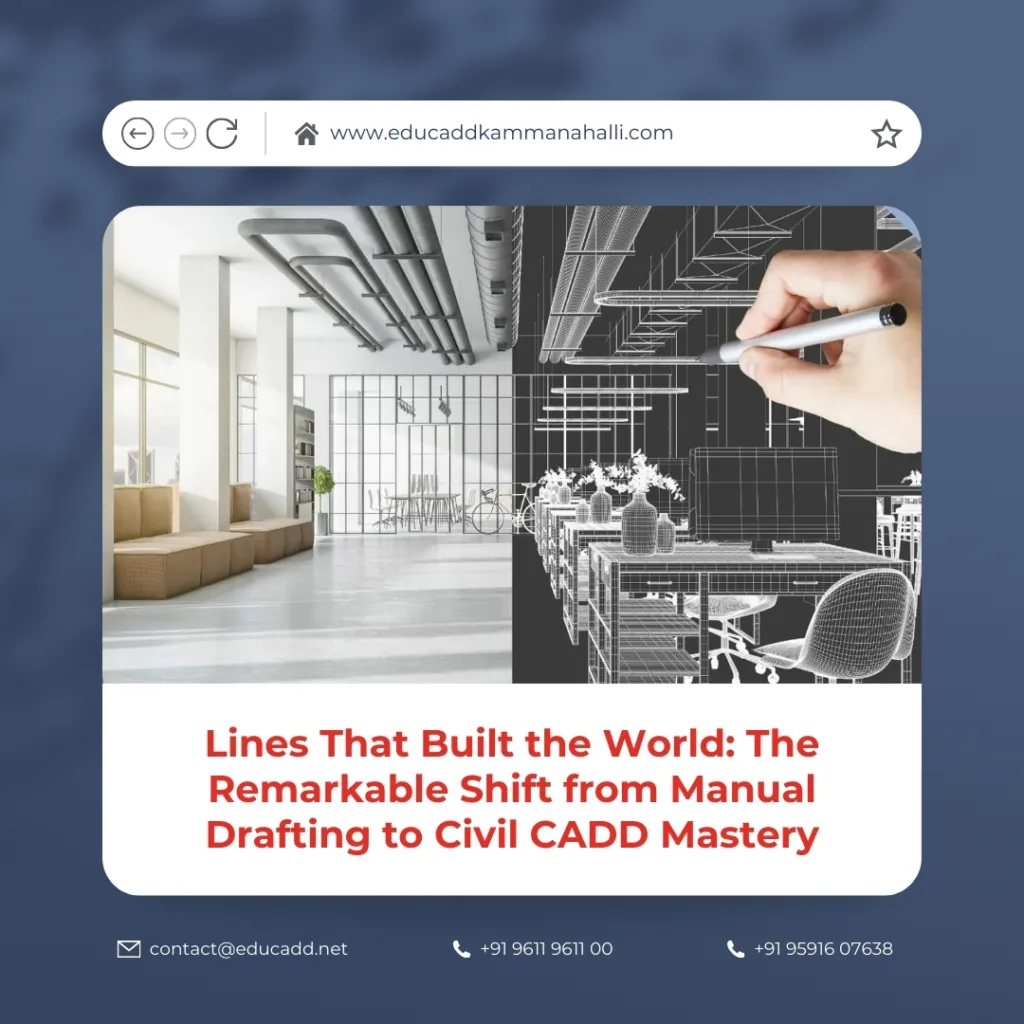
Civil CADD Drafting Evolution
The comparison between manual drafting and Civil CADD reveals more than a difference in tools. It highlights a fundamental transformation in productivity, visualization, storage, collaboration, and career growth. This comprehensive blog explores that transformation across fourteen detailed dimensions, explaining what truly changed and why Civil CADD now stands at the center of modern civil engineering practice.
1. The Discipline and Structure of Manual Drafting
Manual drafting represented a craft rooted in precision and patience. Draftsmen carefully mounted sheets on drawing boards and used T-squares, set squares, compasses, dividers, and scale rulers to produce accurate layouts. Every line was drawn deliberately. Every dimension was measured manually. Mistakes required careful erasing or complete redrawing.
This process built strong technical foundations. Professionals developed spatial imagination because they translated three-dimensional concepts into two-dimensional drawings without digital assistance. They also learned discipline, as rushing often resulted in visible errors. Furthermore, manual drafting encouraged thorough planning before execution.
Despite these strengths, the process consumed time and energy. Complex infrastructure drawings required hours of repetitive effort. Large projects demanded stacks of sheets that were difficult to organize. As construction complexity increased, the manual approach struggled to maintain efficiency.
2. The Birth of Civil CADD in Engineering Workflows
The introduction of computer-aided design marked a turning point in engineering documentation. Civil CADD emerged as a specialized solution tailored for Civil CADD Drafting Evolution applications such as road layouts, structural detailing, and site planning. Instead of drawing on paper, engineers began creating digital designs on computer screens.
Civil CADD provided tools that automated measurement, alignment, and scaling. Engineers entered precise coordinates, and the system generated accurate geometry instantly. Layers organized different components such as structural elements, utilities, and annotations. This structured digital environment enhanced clarity and consistency.
As firms adopted digital systems, Civil CADD became an essential skill. Training programs expanded, and industry expectations shifted toward digital proficiency. Consequently, Civil CADD gradually replaced manual drafting as the standard method for professional documentation.
3. Accuracy and Precision in Modern Design
Precision is critical in civil engineering because even minor deviations can affect safety and cost. Manual drafting depended heavily on human steadiness and instrument calibration. Although experienced draftsmen achieved remarkable accuracy, small measurement errors occasionally occurred.
Civil CADD significantly improved precision through automated calculations and coordinate-based drawing. The software ensures exact scaling and consistent dimensions. It also allows users to verify distances, angles, and areas instantly. Because designs exist in digital form, distortion during resizing does not occur.
This level of control reduces discrepancies between drawings and construction outcomes. Engineers trust digital outputs more confidently. As a result, Civil CADD has established new benchmarks for accuracy in comparison to traditional manual drafting techniques.
4. Speed and Project Efficiency
Time influences profitability and competitiveness in the construction industry. Manual drafting required repetitive tasks, especially when revisions became necessary. Redrawing sections consumed valuable hours. Project timelines often extended due to correction cycles.
Civil CADD dramatically accelerates drafting workflows. Engineers duplicate standard components using blocks and templates. They edit specific elements without disturbing the entire drawing. Commands allow quick adjustments in scale, orientation, and alignment.
Because changes can be implemented instantly, project turnaround improves significantly. Teams allocate more time to design innovation rather than repetitive corrections. Therefore, Civil CADD enhances productivity in ways manual drafting could never fully achieve.
5. Managing Revisions and Dynamic Changes
Construction projects rarely remain static from start to finish. Client preferences evolve. Site conditions reveal unexpected challenges. Regulations require adjustments. Manual drafting struggled with such fluid scenarios.
Civil CADD provides flexibility through editable digital layers and parametric modifications. Designers update measurements or relocate components without redrawing the entire layout. Linked elements adjust automatically when changes occur.
Additionally, digital systems maintain revision histories. Engineers compare earlier versions with updated designs efficiently. This structured revision management improves transparency and reduces confusion. Consequently, Civil CADD transforms the handling of project changes into a streamlined process.
6. Storage, Archiving, and Accessibility
In the era of manual drafting, offices stored physical drawings in cabinets and archives. Large infrastructure projects generated extensive documentation that required careful preservation. Retrieving old files sometimes involved time-consuming searches.
Civil CADD introduced digital storage solutions. Files are organized systematically in folders or cloud-based platforms. Engineers access archived drawings within seconds. Digital backups prevent data loss due to physical damage.
Furthermore, sharing digital files eliminates printing expenses and physical transportation. Teams across locations access the same data instantly. This transformation in documentation management highlights a major advantage of Civil CADD over manual drafting.
7. Collaboration in a Connected World
Manual drafting limited collaboration because teams needed physical presence to review drawings. Sharing updates required printed copies or courier services. Communication delays affected coordination.
Civil CADD enables seamless collaboration through electronic file sharing and cloud integration. Engineers work simultaneously on different components of a project. Project managers review updates remotely and provide feedback in real time.
This interconnected workflow accelerates decision-making. Architects, structural engineers, and contractors coordinate efficiently without geographical barriers. Therefore, Civil CADD fosters teamwork in ways that manual drafting could not support.
8. Advanced Visualization and 3D Modeling
Traditional drafting relied primarily on two-dimensional plans and sections. While skilled professionals created detailed views, clients sometimes struggled to interpret complex layouts.
Civil CADD introduces three-dimensional modeling capabilities that enhance clarity. Engineers visualize terrain profiles, building elevations, and structural frameworks interactively. They rotate and inspect models from various perspectives.
This enhanced visualization improves communication with stakeholders. It identifies design conflicts before construction begins. As a result, Civil CADD reduces misunderstandings and costly on-site modifications.
9. Integration with Engineering Analysis Tools
Manual drafting functioned independently from analytical calculations. Engineers conducted structural analysis separately and incorporated results manually into drawings. This separation increased the possibility of inconsistency.
Civil CADD Drafting Evolution with surveying equipment, structural analysis software, and Building Information Modeling platforms. Data transfers seamlessly between systems. Engineers generate quantity takeoffs and cost estimates directly from digital drawings.
Such integration streamlines workflows and ensures consistency across project stages. Consequently, Civil CADD strengthens the overall design ecosystem compared to traditional drafting methods.
10. Economic Impact on Organizations
Although manual drafting required minimal technological investment, hidden costs accumulated through extended labor hours and revision cycles. Delays affected profitability.
Civil CADD involves initial software licensing and training expenses. However, digital workflows reduce man-hours significantly. They minimize errors that could lead to costly construction changes.
Over time, organizations experience improved efficiency and better resource allocation. Therefore, Civil CADD offers long-term financial advantages despite upfront investments.
11. Skill Evolution and Career Advancement
Manual drafting emphasized hand-drawing expertise and instrument handling. Those skills built strong engineering foundations but limited scalability in digital environments.
Civil CADD requires command knowledge, digital navigation, and modeling proficiency. Engineers learn to manage layers, annotations, and coordinate systems effectively.
Employers now prioritize candidates with Civil CADD expertise because digital proficiency aligns with industry demands. As infrastructure projects expand globally, mastering Civil CADD significantly enhances career prospects.
12. Environmental Sustainability
Manual drafting consumed large volumes of paper and ink. Archival storage required physical infrastructure. Disposal generated waste.
Civil CADD supports environmentally responsible practices by minimizing paper usage. Digital sharing reduces transportation needs. Electronic documentation conserves resources.
As sustainability becomes central to engineering practice, Civil CADD aligns with modern environmental goals and corporate responsibility standards.
13. Industry Standards and Global Expectations
Modern infrastructure projects often involve multinational collaboration. Standardized digital documentation ensures compatibility across teams. Manual drafting lacked such uniform integration capabilities.
Civil CADD complies with global documentation standards and supports file sharing across platforms. This compatibility enhances project transparency and quality assurance.
Therefore, organizations seeking international competitiveness rely heavily on Civil CADD as an essential drafting solution.
14. The Road Ahead for Drafting Technology
Technological innovation continues to reshape civil engineering. Automation, artificial intelligence, and cloud computing influence design methodologies. Civil CADD adapts seamlessly to these advancements.
Future developments may include predictive modeling and smart optimization features. Digital collaboration will likely expand further. While manual drafting remains valuable for conceptual understanding, Civil CADD defines the future of engineering documentation.
Professionals who embrace digital tools position themselves at the forefront of innovation. The industry continues to evolve, and Civil CADD stands as a cornerstone of that transformation.
Conclusion
The Civil CADD Drafting Evolution represents a profound transformation in civil engineering. Traditional drafting built discipline, patience, and foundational knowledge. However, Civil CADD introduced unmatched efficiency, flexibility, and precision.
Accuracy improved. Workflow accelerated. Collaboration expanded beyond physical offices. Visualization advanced into interactive modeling. Sustainability gained importance through reduced resource consumption.
Although manual drafting retains historical significance, Civil CADD defines contemporary engineering practice. As infrastructure demands continue to grow, digital drafting will shape the world’s future landscapes. Embracing Civil CADD is not merely an option; it is a strategic necessity for professionals who aspire to excel in a competitive and technology-driven industry.

