
Marketing Funnel Optimization Using Data Analytics: Turn Insights into Predictable Revenue Growth
In today’s competitive digital landscape, businesses cannot rely on assumptions or outdated marketing tactics. Every click, scroll, sign-up, and purchase generates valuable data. However, raw data alone does not drive results. Strategic interpretation and intelligent execution transform that data into measurable growth. This is where Marketing Funnel Data Analytics using data analytics becomes a game-changer.
Marketing teams often struggle with low conversion rates, high customer acquisition costs, and inconsistent revenue. Many campaigns attract traffic, yet few visitors convert into loyal customers. The gap between attention and action usually exists because companies do not analyze behavioral signals properly. When marketers leverage analytics effectively, they identify friction points, improve engagement, and design seamless user journeys.
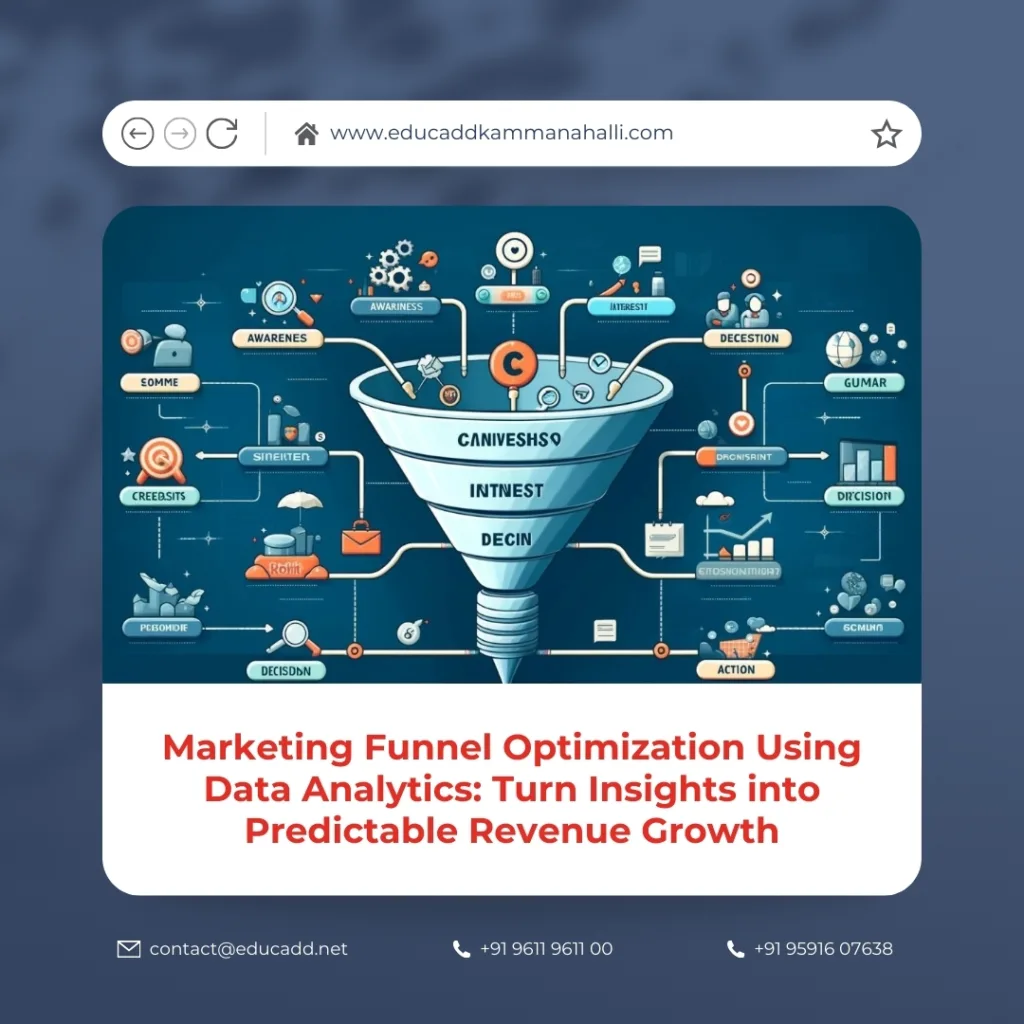
Marketing Funnel Data Analytics
Therefore, Marketing Funnel Data Analytics using data analytics is no longer optional. It is essential for sustainable growth. In this comprehensive guide, you will explore how to structure, measure, analyze, and refine each stage of the funnel using actionable insights. You will also discover frameworks, metrics, tools, and real-world strategies that transform performance marketing into a predictable revenue engine.
1. Understanding the Modern Marketing Funnel
The traditional marketing funnel consisted of awareness, interest, desire, and action. While this framework still provides value, the modern digital environment demands a more dynamic approach. Today’s funnel includes awareness, consideration, conversion, retention, and advocacy. Each stage represents a different psychological state of the customer.
At the awareness stage, prospects discover your brand through search engines, social media, paid advertising, or referrals. During consideration, they compare solutions, read reviews, and evaluate alternatives. The conversion stage involves purchasing or completing a key action. After that, retention focuses on engagement and repeat purchases. Finally, advocacy turns satisfied customers into brand promoters.
Marketing Funnel Data Analytics allows businesses to understand user movement across these stages. Instead of guessing why users drop off, marketers can analyze bounce rates, click-through rates, time on page, and customer lifetime value. As a result, they identify weak links and implement targeted improvements.
Moreover, digital funnels are not linear. Customers may enter at different stages or revisit multiple touchpoints before converting. Therefore, data-driven funnel analysis becomes crucial for mapping non-linear journeys accurately.
2. Why Data Analytics Is the Backbone of Funnel Optimization
Data analytics provides clarity in an environment filled with uncertainty. Without data, marketing decisions rely on intuition. While experience matters, measurable insights produce consistent outcomes.
Marketing funnel optimization using data analytics helps teams track performance metrics across channels. For example, marketers can measure acquisition costs from paid ads, organic traffic growth, and email campaign engagement. These insights reveal which channels generate high-quality leads and which waste budget.
Furthermore, analytics supports evidence-based experimentation. Instead of redesigning entire campaigns blindly, marketers can test small changes and measure impact. They can compare headline variations, landing page layouts, and call-to-action buttons using A/B testing frameworks.
Additionally, data analytics connects marketing efforts to revenue outcomes. By integrating CRM systems and analytics platforms, teams can trace customer journeys from first click to final purchase. Consequently, leadership gains visibility into return on investment and overall profitability.
3. Setting Clear Funnel Metrics and KPIs
Before optimizing anything, businesses must define measurable objectives. Without clear metrics, optimization efforts lack direction. Marketing funnel optimization using data analytics begins with identifying key performance indicators for each stage.
At the awareness stage, marketers track impressions, reach, website visits, and engagement rates. These metrics indicate how effectively campaigns attract attention. During consideration, they monitor time on site, page views per session, and lead generation rates.
Conversion metrics include conversion rate, cost per acquisition, and revenue per visitor. For retention, companies measure churn rate, repeat purchase rate, and customer lifetime value. Advocacy metrics involve referral rates and net promoter scores.
Moreover, aligning KPIs with business goals ensures strategic focus. For instance, a startup may prioritize acquisition growth, while a mature company may focus on retention profitability. Therefore, defining stage-specific KPIs provides structure to optimization efforts.
4. Collecting and Integrating Data from Multiple Sources
Data exists across various platforms. Website analytics tools track behavior. Advertising platforms measure campaign performance. CRM systems store customer interactions. Email marketing tools record engagement metrics. However, siloed data limits insights.
Marketing funnel optimization using data analytics requires integration across systems. By connecting platforms through APIs or centralized dashboards, marketers gain a unified view of customer journeys. This integration allows them to identify patterns that isolated tools cannot reveal.
For example, combining Google Analytics data with CRM data reveals which traffic sources generate high-value customers. Similarly, merging social media insights with conversion metrics highlights audience segments that convert best.
Furthermore, clean and structured data improves decision-making accuracy. Teams should remove duplicates, correct inconsistencies, and standardize naming conventions. Data quality determines optimization effectiveness.
5. Analyzing Customer Behavior at Each Funnel Stage
Behavioral analysis provides deep insight into user intent. Instead of focusing solely on traffic numbers, marketers should analyze how users interact with content.
At the awareness stage, scroll depth and video completion rates reveal engagement quality. During consideration, heatmaps and session recordings show navigation patterns. These insights highlight friction areas that hinder progression.
Marketing Funnel Data Analytics encourages segmentation. For example, marketers can compare behavior between new and returning visitors. They can analyze device-specific patterns to optimize mobile experiences.
Additionally, behavioral cohorts help identify trends over time. By grouping users based on acquisition date, marketers can measure long-term engagement and retention performance. This analysis supports strategic adjustments that enhance customer experience.
6. Optimizing the Awareness Stage with Data
The awareness stage often consumes the largest portion of marketing budgets. However, high traffic alone does not guarantee conversions. Data-driven awareness strategies focus on attracting qualified audiences.
Marketers can analyze keyword performance to refine search engine optimization strategies. They can also assess audience demographics to tailor advertising creatives. If analytics reveal low engagement from certain segments, teams can reallocate budgets toward higher-performing audiences.
Marketing funnel optimization using data analytics enables precise targeting. Platforms such as Facebook Ads and Google Ads provide detailed audience insights. By evaluating click-through rates and cost per click, marketers identify winning combinations of messaging and targeting.
Moreover, content performance analysis highlights topics that resonate most with audiences. By doubling down on high-performing themes, businesses increase engagement and improve funnel entry quality.
7. Enhancing the Consideration Stage through Personalization
During consideration, prospects seek information and reassurance. Personalization significantly increases engagement at this stage. Data analytics supports personalized experiences based on behavior, demographics, and purchase history.
For example, dynamic website content can display tailored recommendations. Email campaigns can trigger automated sequences based on browsing behavior. These strategies improve relevance and build trust.
Marketing funnel optimization using data analytics also leverages predictive modeling. By analyzing historical behavior, marketers can anticipate user needs and recommend appropriate solutions. This proactive approach reduces hesitation and accelerates decision-making.
Furthermore, retargeting campaigns keep prospects engaged. Analytics reveal which pages users visited before dropping off. Marketers can then design targeted ads addressing specific concerns or benefits.
8. Improving Conversion Rates with Data-Driven Experiments
Conversion optimization focuses on turning interest into action. Small adjustments can significantly impact revenue. Therefore, continuous testing becomes essential.
A/B testing compares variations of headlines, images, or call-to-action buttons. Multivariate testing analyzes combinations of elements. Marketing funnel optimization using data analytics ensures experiments rely on statistically significant results.
Additionally, analyzing checkout abandonment rates uncovers obstacles. High drop-off may indicate complex forms, unclear pricing, or technical issues. By simplifying processes and clarifying value propositions, businesses improve conversions.
Moreover, trust signals such as testimonials, reviews, and guarantees influence purchase decisions. Analytics measure how these elements affect behavior. Data-driven decisions replace guesswork, leading to consistent improvements.
9. Strengthening Retention and Customer Lifetime Value
Acquiring customers requires substantial investment. Therefore, retention strategies deliver higher profitability. Data analytics reveals patterns that influence repeat purchases and loyalty.
Marketing Funnel Data Analytics tracks churn rates and purchase frequency. By identifying customers at risk of disengagement, businesses can deploy re-engagement campaigns. Personalized offers, loyalty programs, and timely reminders increase retention.
Furthermore, analyzing lifetime value helps prioritize high-value segments. Companies can allocate resources toward nurturing customers who generate long-term revenue. Predictive analytics also estimates future spending patterns.
Consequently, retention-focused optimization creates sustainable growth rather than short-term gains.
10. Leveraging Automation and AI for Smarter Decisions
Automation tools enhance efficiency and precision. Marketing platforms integrate artificial intelligence to analyze large datasets quickly.
Marketing funnel optimization using data analytics benefits from machine learning algorithms that identify patterns humans may overlook. For example, predictive scoring models rank leads based on conversion probability. This insight enables sales teams to focus on high-potential prospects.
Chatbots and automated workflows also improve customer experiences. By analyzing previous interactions, automated systems provide relevant responses instantly. This responsiveness increases engagement and reduces friction.
Moreover, AI-driven recommendations personalize product suggestions and content delivery. These features increase average order value and engagement metrics.
11. Attribution Modeling and Channel Optimization
Attribution modeling determines how credit is assigned to marketing touchpoints. Traditional last-click attribution often undervalues upper-funnel activities.
Marketing funnel optimization using data analytics explores multi-touch attribution models. These models distribute credit across interactions, providing a comprehensive understanding of customer journeys.
For instance, a customer may discover a brand through social media, research via search engines, and convert through email. Multi-touch analysis reveals the contribution of each channel.
As a result, marketers can allocate budgets more effectively. They invest in channels that drive meaningful engagement rather than focusing solely on final clicks.
12. Real-Time Dashboards and Continuous Monitoring
Optimization requires ongoing evaluation. Static reports provide limited insight. Real-time dashboards empower teams to monitor performance continuously.
Marketing funnel optimization using data analytics thrives on agility. When dashboards display live metrics, marketers can respond quickly to performance shifts. For example, sudden drops in conversion rates may indicate technical issues or messaging misalignment.
Moreover, visual dashboards simplify complex data for stakeholders. Clear visualizations improve communication and decision-making alignment across departments.
Continuous monitoring also supports iterative improvements. Instead of conducting quarterly reviews only, teams can refine strategies weekly or even daily.
13. Overcoming Common Funnel Optimization Challenges
Despite its benefits, funnel optimization presents challenges. Data overload often confuses teams. Too many metrics can distract from core objectives. Therefore, focusing on actionable KPIs remains essential.
Marketing funnel optimization using data analytics also requires cross-functional collaboration. Marketing, sales, and analytics teams must share insights and align goals. Misalignment can hinder performance improvements.
Additionally, privacy regulations demand responsible data usage. Businesses must comply with data protection laws while collecting user information. Transparent communication builds trust and ensures compliance.
Finally, cultural resistance to data-driven change may slow progress. Leadership must promote experimentation and evidence-based decisions.
14. Building a Sustainable Data-Driven Optimization Framework
Sustainable success depends on structured processes. Marketing funnel optimization using data analytics should not rely on sporadic experiments. Instead, organizations should establish repeatable frameworks.
First, define clear objectives aligned with revenue goals. Next, collect and integrate reliable data sources. Then, analyze performance regularly and identify bottlenecks. After that, design targeted experiments and measure results. Finally, implement successful strategies and repeat the cycle.
This iterative approach creates continuous improvement. Over time, incremental gains compound into significant revenue growth.
Moreover, fostering a culture of curiosity encourages innovation. Teams that embrace analytics-driven experimentation adapt quickly to market changes.
Conclusion
Marketing success no longer depends solely on creative campaigns or increased spending. Sustainable growth emerges from strategic insight and disciplined execution. Marketing Funnel Data Analytics empowers businesses to understand customer journeys, identify inefficiencies, and implement precise improvements.
By analyzing each stage of the funnel, integrating data sources, and conducting structured experiments, organizations transform marketing into a predictable revenue system. Furthermore, retention and personalization strategies increase customer lifetime value and brand loyalty.
Ultimately, companies that embrace marketing funnel optimization using data analytics build competitive advantages that competitors cannot easily replicate. Data provides clarity, direction, and measurable progress. When businesses leverage it strategically, they move beyond guesswork and achieve consistent, scalable growth.

