
Engineering Electrical Safety: Advanced Earthing & Lightning Protection Design Using CADD
Modern infrastructure depends on uninterrupted power, intelligent automation, and highly sensitive electronic systems. However, without a robust earthing and lightning protection system, even the most advanced building can face severe equipment damage, operational downtime, and life-threatening hazards. Electrical faults, transient surges, and lightning strikes create enormous risks for industrial facilities, commercial complexes, residential towers, data centers, and infrastructure projects. Therefore, Electrical Earthing Lightning Design is not optional; it is essential.
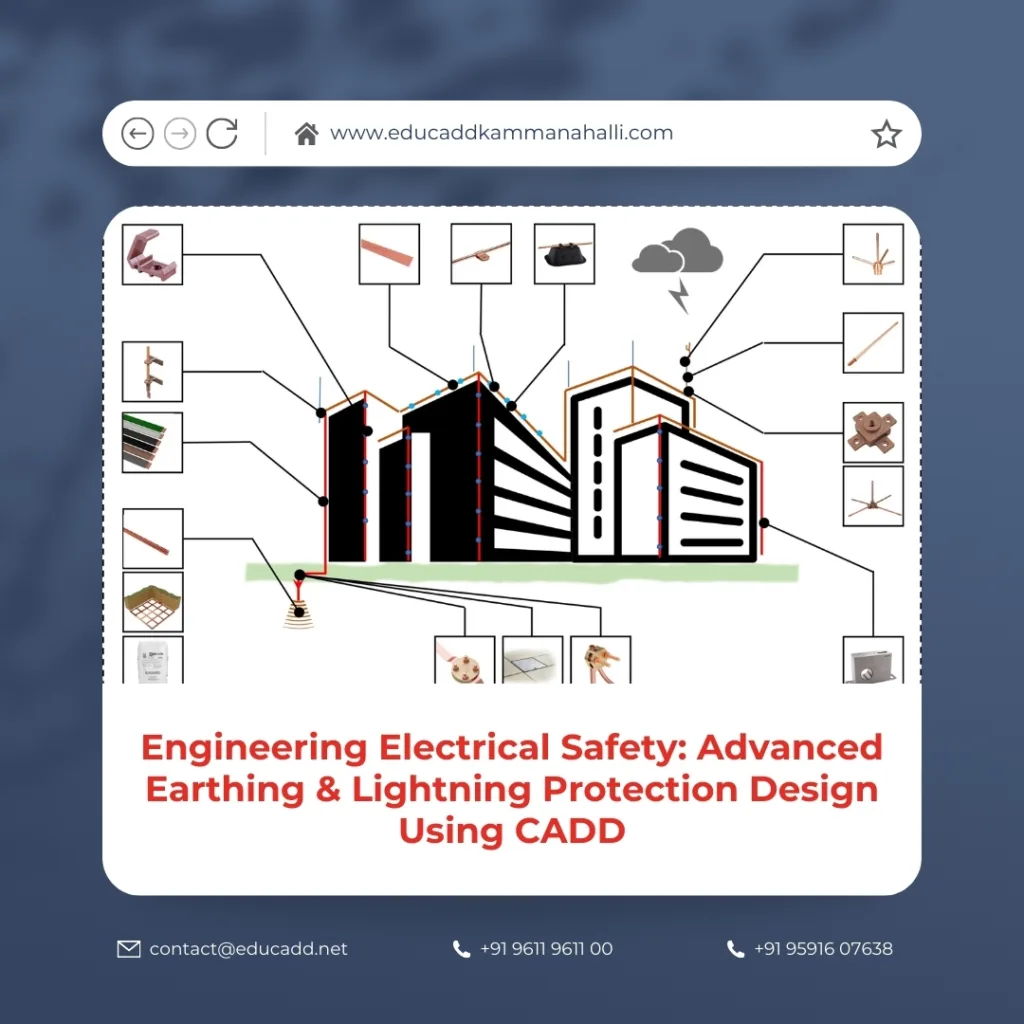
Electrical Earthing Lightning Design
Electrical Earthing Lightning Design Using CADD has transformed the way engineers conceptualize, analyze, and execute grounding systems. Instead of relying solely on manual calculations and schematic sketches, professionals now use advanced computer-aided design tools to model soil resistivity, conductor layouts, electrode placements, bonding networks, and surge protection systems with exceptional accuracy. As a result, the design process becomes faster, safer, and more compliant with international standards. This blog explores every critical aspect of earthing and lightning protection systems, while explaining how CADD-based methodologies enhance safety, efficiency, and long-term reliability.
1. Understanding the Importance of Earthing in Electrical Systems
Earthing serves as the foundation of electrical safety. It provides a low-resistance path for fault current to flow safely into the ground. Consequently, it prevents electric shock, equipment failure, and fire hazards. In addition, it stabilizes voltage levels during transient conditions.
When a fault occurs, current seeks the easiest path to the ground. If a proper grounding system does not exist, the current may pass through equipment enclosures or structural components. This situation increases the risk of injury and operational damage. Therefore, effective grounding protects both human life and assets.
Earthing & Lightning Protection Design Using CADD helps engineers calculate ground resistance, electrode spacing, and conductor sizing accurately. Because the software simulates real-time electrical behavior, designers can predict system performance under fault conditions. Moreover, the visual representation improves coordination between electrical, civil, and structural teams. As a result, projects move forward with fewer design conflicts and higher safety assurance.
2. Fundamentals of Lightning Protection Systems
Lightning carries millions of volts and can generate currents exceeding 200 kiloamperes. When it strikes a structure, it creates thermal, mechanical, and electromagnetic effects. Therefore, buildings require dedicated lightning protection systems to intercept and safely dissipate this energy.
A typical lightning protection system includes air terminals, down conductors, bonding networks, and grounding electrodes. First, air terminals capture the strike. Then, down conductors channel the energy toward the grounding system. Finally, the earthing network disperses the energy into the soil.
Through Earthing & Lightning Protection Design Using CADD, engineers create accurate layout drawings of air termination systems and down conductor routing. Furthermore, CADD tools allow calculation of protection angles and rolling sphere analysis. This process ensures complete coverage of the structure. Consequently, designers can optimize protection while minimizing material usage.
3. Soil Resistivity Analysis and Its Impact on Design
Soil resistivity significantly influences the performance of grounding systems. High-resistivity soil increases ground resistance, which reduces system effectiveness. Therefore, soil testing becomes the first step in grounding design.
Engineers conduct soil resistivity tests using methods such as the Wenner four-pin method. The collected data helps determine electrode length, spacing, and configuration. However, manual interpretation often leads to inaccuracies.
With Earthing & Lightning Protection Design Using CADD, soil data can be entered into simulation software. The system then generates graphical soil models and calculates resistance values automatically. Moreover, engineers can compare multiple design alternatives quickly. As a result, the final design achieves optimal performance under varying soil conditions.
4. Types of Earthing Systems and Their Applications
Different applications require different earthing configurations. Common types include plate earthing, pipe earthing, strip earthing, and grid earthing. Industrial plants and substations often use grid systems, while residential buildings rely on simpler arrangements.
Grid earthing distributes fault current over a large area, thereby reducing step and touch potential. This approach improves safety in high-voltage installations. Conversely, smaller facilities may require only vertical electrodes and bonding conductors.
By implementing Electrical Earthing Lightning Design Using CADD, engineers can create detailed layouts of grids, rods, and bonding connections. Additionally, 3D modeling ensures correct spacing and depth placement. Consequently, installation errors decrease, and compliance with safety standards increases.
5. Design Standards and Regulatory Compliance
Grounding and lightning protection systems must comply with national and international standards such as IEC, IEEE, and IS codes. These standards specify conductor sizes, spacing requirements, and acceptable resistance levels.
Compliance ensures reliability and legal safety. Moreover, authorities often demand detailed documentation before project approval. Manual drafting consumes time and increases the risk of omissions.
Earthing & Lightning Protection Design Using CADD simplifies compliance documentation. Engineers can generate standardized drawings, calculation sheets, and material schedules automatically. Therefore, approval processes become smoother and more efficient. Additionally, audit readiness improves because documentation remains well organized.
6. Load Calculations and Fault Current Analysis
Accurate fault current analysis determines conductor size and electrode configuration. If the conductor cross-section remains undersized, overheating may occur during a fault. Consequently, the system could fail at a critical moment.
CADD-integrated software allows simulation of short-circuit scenarios. Engineers can analyze temperature rise, current density, and voltage distribution. Furthermore, they can adjust parameters instantly to observe performance changes.
Through Earthing & Lightning Protection Design Using CADD, designers achieve optimized conductor sizing without excessive material use. This balance ensures both safety and cost efficiency. In addition, predictive analysis reduces the risk of post-installation modifications.
7. Step and Touch Potential Control
Step and touch potentials pose serious hazards in substations and industrial zones. When fault current enters the ground, voltage gradients form around grounding electrodes. If a person stands within that gradient, electric shock may occur.
Designers must maintain voltage levels within permissible limits. Therefore, grounding grids often include surface layers such as crushed rock to increase surface resistivity.
Using Earthing & Lightning Protection Design Using CADD, engineers model voltage distribution across the site. They identify high-risk zones and modify grid spacing accordingly. As a result, safety margins improve significantly. Moreover, simulations help verify compliance before construction begins.
8. Integration with Building Information Modeling (BIM)
Modern construction projects demand multidisciplinary coordination. Electrical, mechanical, civil, and architectural teams must align their designs seamlessly. Consequently, integration with BIM platforms becomes essential.
CADD-based earthing models can be incorporated into BIM environments. This integration ensures clash detection with foundations, underground utilities, and structural reinforcements. Therefore, conflicts are resolved during design rather than construction.
Earthing & Lightning Protection Design Using CADD enhances collaboration by providing precise 3D models and data-driven documentation. Additionally, real-time updates keep all stakeholders aligned. This approach reduces rework, delays, and cost overruns.
9. Surge Protection and Bonding Coordination
Lightning strikes generate transient overvoltages that damage electronic equipment. Therefore, surge protection devices (SPDs) must coordinate with grounding systems effectively.
Bonding ensures all metallic components remain at the same potential. Consequently, differential voltages decrease during lightning events. Without proper bonding, even a well-designed grounding system may fail.
Through Earthing & Lightning Protection Design Using CADD, engineers plan bonding layouts and SPD placements strategically. Simulation tools evaluate surge paths and potential imbalances. As a result, the entire system works cohesively to protect sensitive installations.
10. Material Selection and Cost Optimization
Material choice affects both performance and budget. Copper offers excellent conductivity but increases project cost. Galvanized steel provides affordability but may require corrosion protection.
CADD software generates bill of quantities automatically. Engineers compare alternative materials and evaluate lifecycle cost. Therefore, they achieve a balance between safety, durability, and investment.
Earthing & Lightning Protection Design Using CADD improves procurement planning. Additionally, digital quantity takeoffs reduce estimation errors. Consequently, project budgeting becomes more accurate and transparent.
11. Installation Drawings and Construction Support
Clear construction drawings prevent misinterpretation at site level. Installation teams require precise dimensions, depth references, and routing details.
CADD platforms produce scaled drawings with annotations and legends. Moreover, they enable quick revisions if site conditions change.
By using Earthing & Lightning Protection Design Using CADD, project managers maintain consistency between design intent and field execution. This alignment reduces delays and ensures quality control throughout installation.
12. Testing, Commissioning, and Maintenance Planning
After installation, grounding systems require resistance testing and periodic inspection. Over time, soil conditions and corrosion may affect performance.
CADD documentation assists maintenance teams in locating electrodes and conductors easily. Additionally, digital records preserve test data for future reference.
Earthing & Lightning Protection Design Using CADD supports lifecycle management. Engineers can update models after inspection and plan enhancements proactively. Therefore, system reliability remains consistent over decades.
13. Risk Assessment and Safety Enhancement
Risk assessment identifies critical zones where lightning impact probability remains high. Engineers analyze building height, surrounding terrain, and occupancy levels.
CADD simulations provide visual representation of risk exposure. Consequently, designers adjust air terminal placement and grounding reinforcement accordingly.
Through Earthing & Lightning Protection Design Using CADD, risk mitigation strategies become data-driven. Moreover, predictive modeling enhances decision-making accuracy. This proactive approach strengthens overall infrastructure resilience.
14. Future Trends in Digital Grounding Design
Technology continues to evolve rapidly. Artificial intelligence, cloud collaboration, and IoT-based monitoring systems are reshaping electrical safety design.
Future systems may include real-time ground resistance monitoring and predictive maintenance alerts. Furthermore, cloud-based CADD platforms enable remote teamwork and instant data sharing.
Earthing & Lightning Protection Design Using CADD will continue advancing with automation and smart analytics. As digital engineering expands, grounding systems will become more intelligent, adaptive, and reliable.
Conclusion
Electrical safety demands precision, foresight, and compliance with rigorous standards. Earthing and lightning protection systems form the backbone of secure infrastructure. When designed incorrectly, they expose facilities to serious hazards. However, when executed with accuracy and advanced digital tools, they provide dependable protection for decades.
Electrical Earthing Lightning Design Using CADD empowers engineers to move beyond traditional drafting toward intelligent modeling, simulation, and optimization. It enhances accuracy, improves collaboration, reduces cost, and ensures regulatory compliance. Moreover, it strengthens safety by enabling predictive analysis and risk assessment. As infrastructure becomes more complex and technologically advanced, digital grounding design will remain a critical component of sustainable and resilient development.

