
2D Drafting vs 3D Modeling – Which Is Better for Modern Manufacturing Success?
Manufacturing has evolved dramatically over the last few decades. From hand-drawn technical sketches to fully immersive digital simulations, the way products are designed and developed has transformed at a rapid pace. Yet one question continues to spark discussion across design studios and production floors alike: 2D vs 3D Manufacturing – Which Is Better for Manufacturing?
Both approaches play a significant role in product development. While 2D drafting has supported engineering processes for generations, 3D modeling has redefined visualization, prototyping, and collaboration. As industries adopt advanced technologies such as automation, CNC machining, and additive manufacturing, the choice between these two design methods becomes even more important.
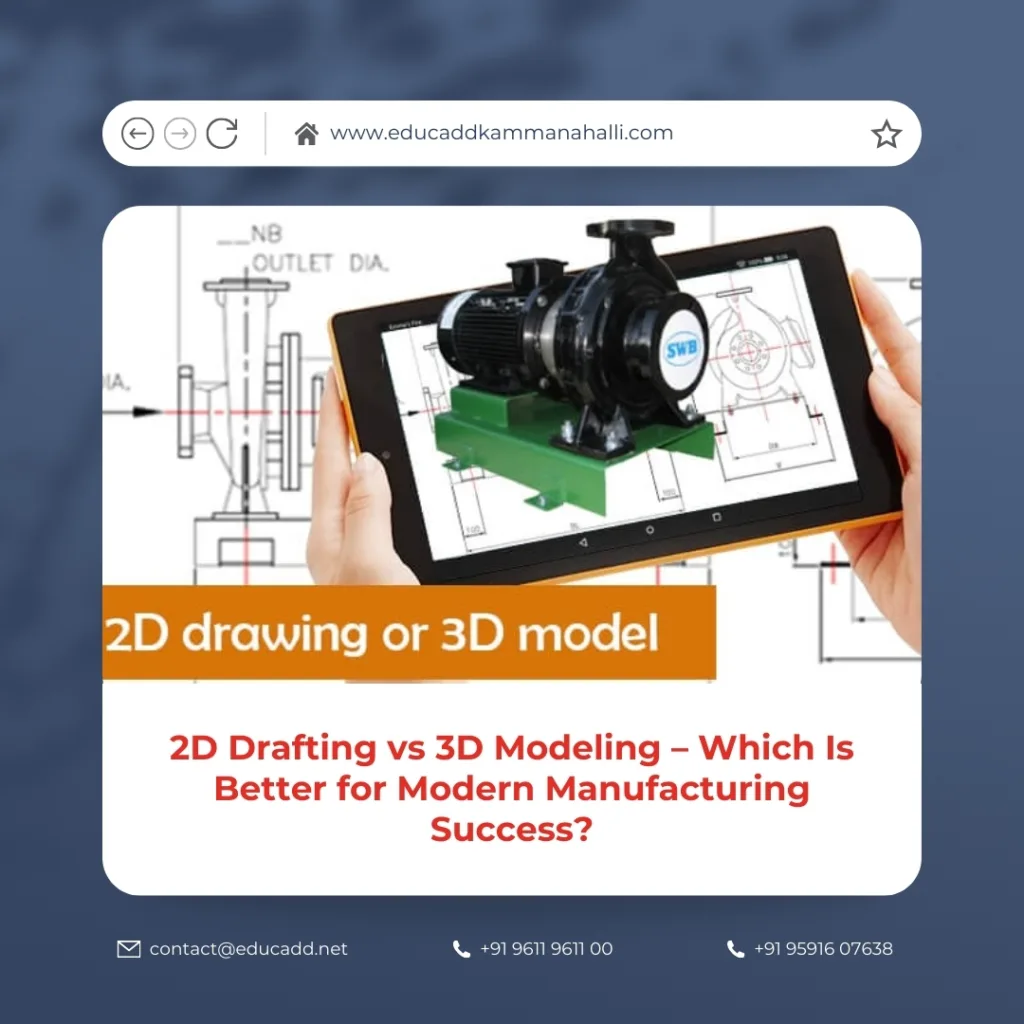
2D vs 3D Manufacturing
In this comprehensive guide, we will explore the strengths, limitations, practical applications, cost implications, and future outlook of 2D vs 3D Manufacturing. By the end, you will gain a clear understanding of which method suits specific production needs and how businesses can make the right strategic decision.
Understanding 2D Drafting in Manufacturing
2D drafting refers to the creation of flat technical drawings that represent objects using lines, symbols, dimensions, and annotations. Designers typically use specialized CAD software to generate precise orthographic projections, sections, and detailed layouts.
For decades, manufacturers have relied on 2D drafting to communicate design intent. These drawings include top, front, and side views, along with measurements and tolerances. Because of its simplicity and clarity, 2D drafting remains widely used in industries such as sheet metal fabrication, construction detailing, and mechanical component manufacturing.
One major advantage of 2D drafting lies in its straightforward approach. Engineers can quickly create production-ready drawings without complex modeling steps. Additionally, technicians on the shop floor often prefer 2D prints because they are easy to interpret and annotate.
However, 2D drafting requires multiple views to explain a single object. As a result, understanding spatial relationships may take more time, especially for complex assemblies.
Exploring 3D Modeling in Modern Production
3D modeling allows designers to create a three-dimensional digital representation of a product. Instead of relying on flat drawings, engineers build parametric models that replicate real-world geometry. These models can be rotated, analyzed, and tested before manufacturing begins.
With 3D modeling, every component exists within a virtual environment. Designers can evaluate fit, movement, interference, and material behavior. Moreover, changes can be implemented quickly by adjusting parameters rather than redrawing entire layouts.
Because of these advantages, industries such as automotive, aerospace, consumer electronics, and medical device manufacturing have embraced 3D modeling extensively. The ability to simulate stress, thermal performance, and assembly processes reduces errors and accelerates product development cycles.
Although 3D modeling offers advanced capabilities, it demands higher computational power and skilled professionals. Therefore, companies must consider resource availability before transitioning fully to 3D workflows.
Accuracy and Precision Comparison
Accuracy plays a critical role in manufacturing success. Even minor dimensional errors can lead to production delays and financial losses.
In 2D drafting, precision depends on correct dimensioning and manual interpretation. While CAD tools improve measurement accuracy, human oversight remains essential. If a view is misread or a dimension is overlooked, mistakes may occur during fabrication.
On the other hand, 3D modeling integrates dimensions directly into the model. Parametric systems maintain consistency across the design. When one feature changes, related dimensions update automatically. Consequently, the likelihood of inconsistency decreases significantly.
Therefore, when evaluating 2D vs 3D Manufacturing – Which Is Better for Manufacturing, 3D modeling often delivers superior dimensional reliability, especially for complex parts.
Visualization and Design Clarity
Visualization affects communication among engineers, clients, and production teams.
2D drafting relies on multiple technical views. Skilled professionals can interpret these views accurately, but non-technical stakeholders may struggle. This limitation can slow decision-making during product reviews.
In contrast, 3D modeling provides realistic renderings and interactive previews. Stakeholders can examine the product from every angle. Furthermore, exploded views and animations illustrate assembly sequences clearly.
Because of enhanced visualization, 3D modeling supports better collaboration between departments. Marketing teams, suppliers, and manufacturers understand the design without confusion. As a result, project approvals happen faster.
Design Modification and Flexibility
Manufacturing projects often require design revisions. Market feedback, cost adjustments, or performance testing may lead to modifications.
With 2D drafting, revisions involve manual updates across multiple drawings. Each related view must be checked carefully to maintain consistency. This process can consume significant time.
3D modeling simplifies changes through parametric editing. Designers adjust a dimension or feature, and the entire model updates automatically. Associated drawings also reflect the change instantly.
Therefore, when flexibility becomes a priority, 3D modeling offers a more efficient workflow. Companies seeking faster turnaround times often benefit from this adaptability.
Cost Considerations and Investment
Budget constraints influence every manufacturing decision.
2D drafting typically requires lower initial investment. Software costs are moderate, and hardware requirements remain minimal. Additionally, many experienced professionals already possess 2D drafting skills.
In contrast, 3D modeling software often involves higher licensing fees. Workstations must support complex rendering and simulation processes. Moreover, training expenses increase because advanced modeling skills are necessary.
However, long-term savings should also be considered. 3D modeling reduces prototype costs, minimizes rework, and shortens development cycles. Although initial investment appears higher, overall project efficiency may offset these expenses.
Impact on Prototyping and Testing
Prototyping allows manufacturers to validate designs before full-scale production.
In a 2D drafting workflow, physical prototypes are usually created to test form and fit. While effective, this method increases material and labor costs.
3D modeling enables virtual prototyping. Engineers conduct simulations to evaluate stress, motion, and durability. Digital testing reduces the need for multiple physical prototypes. Consequently, companies save time and resources.
For industries that prioritize rapid innovation, 3D modeling provides a significant advantage in prototyping efficiency.
Production Integration and CNC Compatibility
Modern manufacturing relies heavily on CNC machines and automated systems.
2D drafting supports CNC programming through DXF or similar file formats. For simple components, this approach works efficiently.
However, 3D modeling integrates directly with CAM software. Toolpaths can be generated automatically from the model. Complex surfaces and multi-axis machining operations benefit greatly from this integration.
Therefore, in high-precision manufacturing environments, 3D modeling streamlines production processes more effectively.
Learning Curve and Skill Requirements
Workforce capability influences technology adoption.
2D drafting involves a relatively gentle learning curve. Technicians can master basic drafting principles within a short period.
On the other hand, 3D modeling requires deeper understanding of geometry, parametric constraints, and simulation tools. Training programs demand more time and structured guidance.
Nevertheless, as digital transformation accelerates, many educational institutions emphasize 3D modeling skills. Over time, workforce readiness continues to improve.
Collaboration and Data Management
Manufacturing projects often involve cross-functional teams.
2D drafting files can be shared easily, but managing revisions across multiple documents may create confusion. Version control becomes challenging in large projects.
3D modeling platforms support centralized data management systems. Teams collaborate within shared environments, ensuring everyone works on updated models. Cloud integration further enhances real-time communication.
As global supply chains expand, collaborative capabilities become increasingly valuable.
Industry-Specific Applications
Different industries adopt design tools based on complexity and production scale.
For example, small fabrication workshops often prefer 2D drafting due to simplicity. Structural steel detailing and layout planning also rely heavily on 2D drawings.
Meanwhile, aerospace and automotive sectors depend on 3D modeling for aerodynamic analysis, structural integrity testing, and complex assembly management. Medical device manufacturers also benefit from detailed 3D simulations.
Therefore, the answer to 2D Drafting vs 3D Modeling – Which Is Better for Manufacturing depends partly on industry requirements.
Time Efficiency in Product Development
Speed-to-market determines competitive advantage.
2D drafting may work well for straightforward components. However, complex projects require extensive drawing coordination. This process may slow development.
3D modeling accelerates conceptualization, validation, and documentation. Because errors are identified earlier, production delays decrease significantly. Faster development leads to improved profitability.
Environmental and Sustainability Considerations
Sustainable manufacturing practices reduce waste and conserve resources.
When relying solely on 2D drafting, multiple physical prototypes may be produced. Material usage increases, contributing to waste.
3D modeling minimizes physical trials through digital simulation. Fewer material resources are consumed during development. Consequently, companies reduce environmental impact while maintaining efficiency.
Future Trends in Manufacturing Design
Technology continues to reshape industrial practices.
Additive manufacturing, digital twins, and smart factories depend heavily on 3D modeling data. Real-time performance monitoring integrates seamlessly with digital models.
Although 2D drafting will remain relevant for documentation and simple projects, future innovations favor 3D ecosystems. As artificial intelligence and automation expand, digital modeling becomes central to manufacturing strategies.
Conclusion
Choosing between 2D drafting and 3D modeling requires careful evaluation of project scope, budget, workforce skills, and production complexity. 2D drafting remains valuable for straightforward components, cost-sensitive operations, and traditional documentation needs. It offers simplicity, clarity, and lower initial investment.
However, 3D modeling delivers enhanced visualization, faster modifications, integrated simulation, and improved collaboration. For complex assemblies and innovation-driven industries, it often provides greater long-term benefits.
Ultimately, the debate around 2D Drafting vs 3D Modeling – Which Is Better for Manufacturing does not result in a single universal answer. Instead, the optimal solution may involve combining both methods strategically. By understanding their strengths and aligning them with organizational goals, manufacturers can achieve greater efficiency, accuracy, and sustainable growth in today’s competitive landscape.

