
Precision Perfected: How Mechanical CADD Elevates Design Accuracy in Modern Engineering
In today’s competitive engineering landscape, accuracy defines success. Even a minor deviation in dimensions can lead to costly errors, delays, and performance failures. Engineers must therefore rely on tools that enhance precision, streamline workflows, and eliminate guesswork. Mechanical CADD has emerged as a transformative solution in this context. By combining computer-aided design with detailed drafting capabilities, Mechanical CADD Design Accuracy empowers professionals to create highly accurate models and drawings.
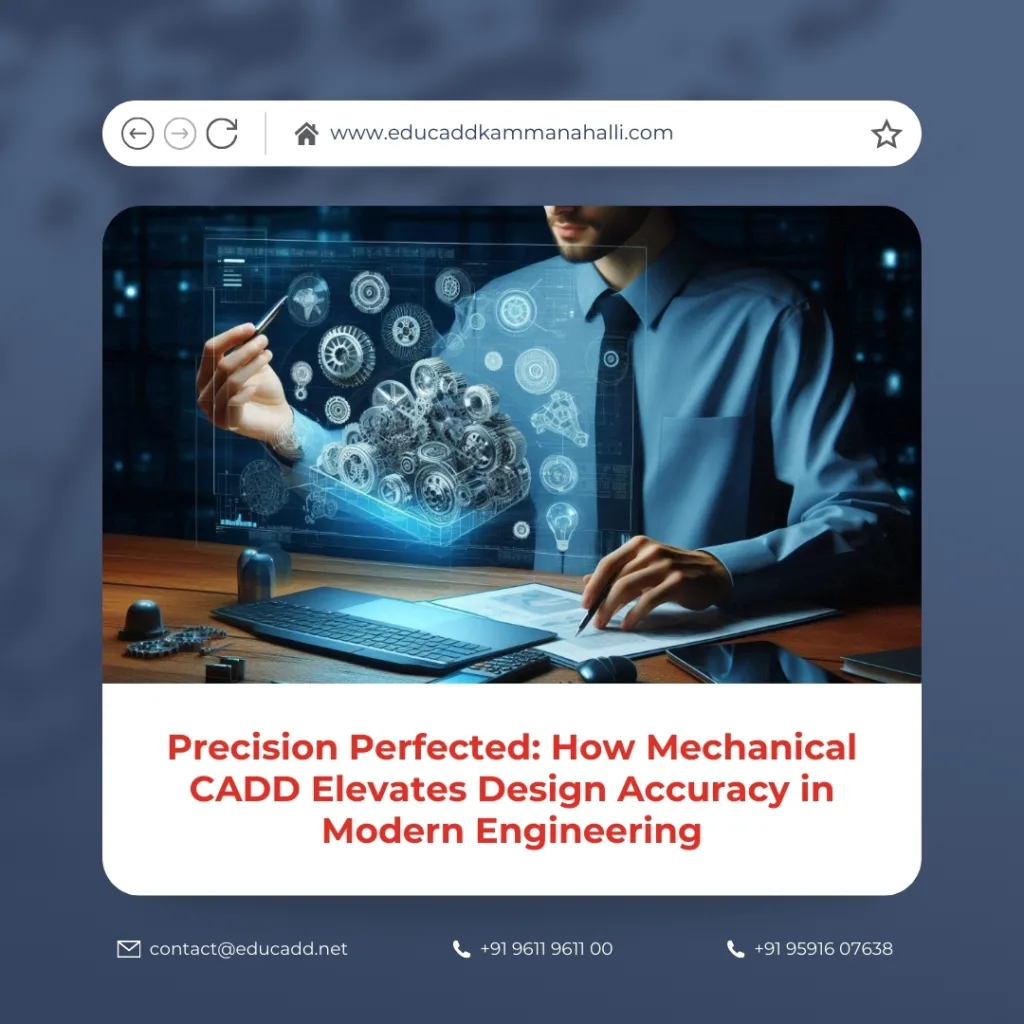
Mechanical CADD Design Accuracy
It reduces manual errors, improves visualization, and strengthens collaboration across teams. As industries demand faster delivery and tighter tolerances, Mechanical CADD stands at the center of modern design excellence. This article explores how Mechanical CADD Design Accuracy improves design accuracy through structured processes, advanced modeling, simulation, and seamless integration across engineering stages.
1. Digital Precision Replaces Manual Drafting Errors
Traditional drafting relied heavily on manual calculations and hand-drawn sketches. Human error often affected measurements, scaling, and alignment. Mechanical CADD eliminates these inconsistencies by introducing digital precision into every stage of design. Engineers can define exact dimensions, tolerances, and geometric constraints within the software environment. The system automatically maintains proportional accuracy across views and assemblies.
Because Mechanical CADD operates on mathematical algorithms, it ensures that lines remain aligned and dimensions remain consistent. Designers can zoom into micro-level details without losing clarity. Moreover, automatic snapping and grid features prevent misplacement of components. This digital environment dramatically reduces rework. As a result, design accuracy improves significantly while productivity increases. Engineers gain confidence in their drawings because the software validates geometric relationships in real time.
2. Parametric Modeling Enhances Dimensional Control
Parametric modeling forms the backbone of Mechanical CADD. Engineers define relationships between dimensions so that changes in one parameter update the entire model automatically. This feature improves consistency across complex designs. Instead of redrawing components, designers modify a single value, and the system adjusts related parts instantly.
Mechanical CADD allows engineers to apply constraints such as symmetry, concentricity, and parallelism. These constraints ensure structural integrity and dimensional harmony. When a design evolves, the software maintains proportional relationships without compromising accuracy. Furthermore, parametric modeling supports design iterations. Teams can test multiple configurations without introducing errors. This controlled flexibility strengthens accuracy while reducing development time. Engineers therefore achieve optimized designs that meet functional requirements precisely.
3. Advanced 3D Modeling Improves Visualization Accuracy
Two-dimensional drawings often leave room for interpretation. Misunderstandings can arise during fabrication or assembly. Mechanical CADD Design Accuracy addresses this challenge through advanced 3D modeling capabilities. Engineers can build fully detailed three-dimensional representations of parts and assemblies.
These 3D models offer realistic visualization from every angle. Designers can rotate, section, and inspect components before production begins. Mechanical CADD highlights interferences and spatial conflicts automatically. This proactive detection prevents costly manufacturing mistakes. Additionally, detailed 3D modeling supports accurate representation of complex geometries. Curves, fillets, and intricate mechanical features maintain precise measurements within the digital space.
Because stakeholders can visualize the final product clearly, communication improves across departments. Consequently, errors decrease and design intent remains intact throughout the development cycle.
4. Tolerance Management Ensures Manufacturing Readiness
Manufacturing demands strict adherence to tolerances. Even slight deviations can affect performance and safety. Mechanical CADD integrates tolerance management tools directly into the drafting process. Engineers can specify geometric dimensioning and tolerancing (GD&T) within the software.
Mechanical CADD Design Accuracy ensures that all tolerances align with industry standards. The system checks compatibility between mating components and identifies potential misalignments. Designers can simulate worst-case tolerance conditions to assess fit and function. This analytical capability enhances reliability before physical production begins.
Moreover, digital tolerance analysis reduces dependence on manual calculations. Engineers gain immediate feedback on dimensional variations. As a result, products move from design to manufacturing with greater confidence. Accuracy becomes measurable and verifiable rather than assumed.
5. Automated Error Detection Minimizes Rework
Manual drafting rarely provides instant error alerts. Engineers often discover mistakes during fabrication. Mechanical CADD changes this process by offering automated validation tools. The software detects missing constraints, overlapping entities, and incorrect dimensions in real time.
Mechanical CADD also performs clash detection in assemblies. When components intersect improperly, the system flags the issue instantly. Designers can correct errors before releasing drawings. This proactive approach saves time and reduces material waste.
Furthermore, automated checks maintain compliance with predefined design rules. Organizations can embed standards into the software to enforce consistency. By preventing errors at the design stage, Mechanical CADD strengthens accuracy and reliability throughout the project lifecycle.
6. Seamless Integration with Simulation Tools
Design accuracy extends beyond geometry. Engineers must ensure that components perform under real-world conditions. Mechanical CADD integrates seamlessly with simulation and analysis tools. Designers can conduct stress analysis, thermal studies, and motion simulations directly from the model.
This integration eliminates the need to recreate geometry in separate platforms. Mechanical CADD maintains data consistency between design and analysis environments. Engineers can evaluate performance metrics and adjust parameters accordingly. Simulation results guide informed decision-making.
By validating designs digitally, teams avoid costly physical prototypes. They identify structural weaknesses early and refine the model. Consequently, Mechanical CADD enhances both dimensional accuracy and functional reliability. Engineers achieve optimized designs backed by data-driven insights.
7. Standardized Libraries Promote Consistency
Engineering projects often rely on standardized components such as bolts, bearings, and gears. Mechanical CADD provides access to extensive part libraries that comply with industry norms. Designers can insert pre-defined components with guaranteed specifications.
Using standardized libraries reduces measurement errors and ensures compatibility. Mechanical CADD maintains accurate metadata for each component, including dimensions and material properties. Engineers avoid duplication and inconsistencies across assemblies.
Additionally, standardized elements accelerate workflow. Teams spend less time drafting repetitive parts and more time refining critical features. By leveraging trusted libraries, Mechanical CADD supports uniformity and precision across projects.
8. Enhanced Collaboration Through Digital Documentation
Accuracy improves when teams communicate effectively. Mechanical CADD facilitates collaboration by enabling shared digital environments. Engineers, architects, and manufacturers can access centralized design files.
Version control features track every modification. Mechanical CADD records changes and maintains revision history. This transparency prevents confusion and ensures that all stakeholders work with the latest data. Comments and annotations further clarify design intent.
Cloud-based integration allows teams to collaborate across locations. Designers can review updates in real time and resolve discrepancies promptly. As communication strengthens, design accuracy increases. Mechanical CADD thus supports coordinated efforts that minimize misunderstandings and rework.
9. Rapid Prototyping and Additive Manufacturing Support
Modern manufacturing increasingly relies on rapid prototyping and additive processes. Mechanical CADD generates precise digital models suitable for 3D printing and CNC machining. Accurate geometry ensures seamless transition from design to prototype.
Mechanical CADD exports files in compatible formats without losing dimensional integrity. Engineers can test physical models quickly and compare them with digital designs. Any deviations become easier to identify and correct.
This tight integration between digital design and physical production strengthens feedback loops. Designers refine features based on prototype results. As iterations progress, accuracy improves continuously. Mechanical CADD therefore bridges the gap between concept and tangible product.
10. Improved Assembly Modeling and Fit Analysis
Complex machinery consists of numerous interdependent components. Ensuring proper fit and alignment becomes critical. Mechanical CADD provides advanced assembly modeling tools that replicate real-world conditions digitally.
Engineers can simulate movement, rotation, and interaction between parts. Mechanical CADD identifies clearance issues and mechanical conflicts automatically. Designers adjust dimensions before manufacturing begins. This proactive validation reduces assembly errors significantly.
Moreover, exploded views and dynamic simulations clarify installation sequences. Production teams understand how components integrate within the system. By addressing assembly challenges early, Mechanical CADD safeguards accuracy and operational efficiency.
11. Data-Driven Design Optimization
Accurate design depends on informed decision-making. Mechanical CADD captures detailed data about geometry, materials, and constraints. Engineers analyze this data to optimize performance and reduce weight or cost.
Optimization tools evaluate multiple design scenarios efficiently. Mechanical CADD compares outcomes based on predefined objectives. Designers select the best configuration while maintaining dimensional integrity.
This analytical approach minimizes guesswork. Engineers rely on measurable parameters rather than intuition alone. As a result, Mechanical CADD enhances both precision and innovation. Products meet functional requirements without compromising structural accuracy.
12. Compliance with Industry Standards
Engineering designs must align with international standards and regulations. Mechanical CADD incorporates templates and drafting guidelines that support compliance. Engineers can apply standardized symbols, annotations, and dimensioning practices.
Mechanical CADD ensures uniform representation across drawings. This consistency reduces interpretation errors during manufacturing and inspection. Regulatory audits become smoother because documentation meets established norms.
Furthermore, built-in validation tools check adherence to drafting standards. Designers receive alerts if specifications deviate from accepted practices. By embedding compliance into the workflow, Mechanical CADD reinforces design accuracy and credibility.
13. Scalability for Complex Engineering Projects
As projects grow in complexity, maintaining accuracy becomes more challenging. Mechanical CADD scales effectively to handle large assemblies and intricate systems. Engineers can manage thousands of components within a structured digital environment.
Layer management and hierarchical modeling organize data efficiently. Mechanical CADD allows teams to isolate sections without affecting the entire assembly. This structured approach prevents accidental modifications.
Additionally, performance optimization ensures smooth navigation within large files. Designers can work confidently without compromising precision. Mechanical CADD thus supports complex engineering initiatives while preserving detailed accuracy at every level.
14. Continuous Learning and Skill Development
Technology evolves rapidly, and engineers must adapt accordingly. Mechanical CADD platforms offer extensive training resources and user communities. Professionals continuously enhance their skills and stay updated with new features.
As users gain proficiency, they leverage advanced tools more effectively. Mechanical CADD becomes not just a drafting solution but a comprehensive design ecosystem. Engineers learn to automate repetitive tasks and refine workflows.
This commitment to skill development directly influences design accuracy. Skilled users maximize the capabilities of Mechanical CADD, ensuring precise outputs and efficient processes. Over time, organizations cultivate a culture of digital excellence and innovation.
Conclusion
Design accuracy remains the cornerstone of successful engineering projects. From conceptual sketches to final production, precision determines performance, safety, and cost efficiency. Mechanical CADD Design Accuracy has revolutionized this journey by integrating digital precision, parametric modeling, simulation, and collaborative workflows into a unified platform. It reduces manual errors, enhances visualization, and supports compliance with industry standards. Moreover, Mechanical CADD bridges the gap between design and manufacturing through seamless integration and data-driven optimization. As industries continue to demand faster delivery and higher quality, Mechanical CADD empowers engineers to meet these expectations confidently. By embracing this technology, organizations secure not only improved accuracy but also sustained competitive advantage in an increasingly digital world.

