
Engineering Confidence: How CAE Software for Mechanical Design Validation Transforms Product Development
Modern mechanical products must perform flawlessly under demanding conditions, tight tolerances, and strict safety regulations. A single design flaw can lead to expensive recalls, production delays, or safety risks. Because of this, engineering teams rely heavily on digital tools that can predict real-world behavior before physical prototypes are built. CAE Software for Validation plays a central role in this transformation by allowing engineers to test, refine, and optimize designs in virtual environments. Instead of relying only on trial-and-error prototyping, companies can now simulate stress, motion, temperature, vibration, and fluid flow with high accuracy. This reduces uncertainty and shortens development cycles. As industries move toward smarter manufacturing and rapid innovation, simulation-driven validation has become essential for competitive product design.
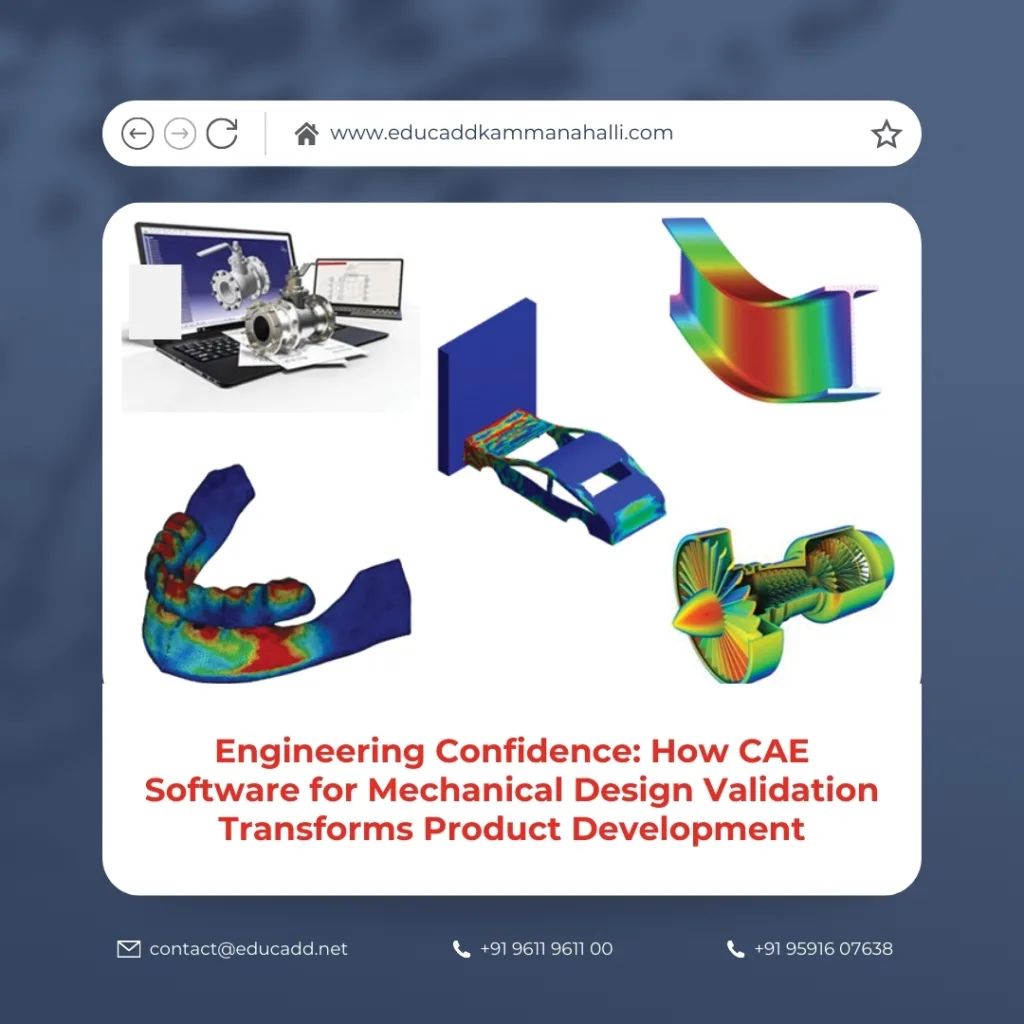
CAE Software for Validation
1. Understanding the Role of CAE in Modern Mechanical Engineering
Computer-Aided Engineering has reshaped the way mechanical systems are designed and validated. Engineers no longer depend solely on physical experiments because simulation tools provide deep performance insights at early stages. CAE Software for Validation enables virtual testing that mirrors real operational conditions, helping engineers detect potential failures before production begins.
By integrating simulation into the design workflow, engineers can study how components behave under loads, pressure, thermal variations, and dynamic motion. This predictive capability reduces uncertainty and helps teams make confident engineering decisions. Furthermore, digital validation promotes innovation because designers can test multiple concepts quickly without excessive material costs. As product complexity grows, simulation becomes more critical for ensuring reliability and compliance with industry standards.
2. Why Mechanical Design Validation Is Essential for Product Success
Every mechanical component must meet strict functional and safety requirements. Validation ensures that products perform as intended throughout their lifecycle. Without proper testing, small design miscalculations can result in performance inefficiencies or catastrophic mechanical failures.
CAE Software for Validation provides a structured approach to verifying strength, durability, and performance. Engineers can evaluate material behavior, fatigue life, and environmental effects in controlled digital scenarios. This minimizes risks associated with field failures and warranty claims. Additionally, validated designs improve customer trust and brand reputation. Manufacturers also benefit from reduced redesign cycles, as problems are identified before tooling and mass production begin.
3. Core Simulation Techniques Used in CAE Platforms
Different engineering problems require specialized simulation methods. Modern CAE environments combine multiple techniques to provide accurate and reliable results.
Key simulation approaches include:
-
Finite Element Analysis (FEA) for stress, strain, and deformation prediction
-
Computational Fluid Dynamics (CFD) for fluid flow, pressure distribution, and heat transfer
-
Multibody Dynamics (MBD) for motion analysis of mechanical assemblies
-
Thermal Simulation for temperature distribution and cooling efficiency
-
Fatigue and Durability Analysis for lifecycle performance estimation
Each technique supports CAE Software for Mechanical Design Validation by modeling real-world physics in virtual space. Engineers often combine these analyses to simulate complex systems such as engines, turbines, robotics, and automotive assemblies.
4. Finite Element Analysis: The Backbone of Structural Validation
Finite Element Analysis remains one of the most powerful tools for structural engineering. It divides complex geometries into small elements and calculates how each element reacts to forces and constraints. This method allows engineers to identify stress concentrations, deformation patterns, and structural weaknesses.
FEA helps engineers:
-
Predict material deformation under static and dynamic loads
-
Detect structural weaknesses before manufacturing
-
Optimize material distribution to reduce weight
-
Improve safety margins through accurate stress analysis
-
Validate weld joints, bolts, and contact regions
Using CAE Software for Mechanical Design Validation, engineers can simulate crash impacts, pressure loads, and mechanical vibrations with high precision. This ensures that final products maintain structural integrity even under extreme operating conditions.
5. Computational Fluid Dynamics in Mechanical System Optimization
Fluid behavior significantly affects mechanical performance in industries such as automotive, aerospace, and energy. CFD simulation helps engineers analyze airflow, heat transfer, turbulence, and pressure distribution without constructing physical prototypes.
CFD simulations support:
-
Aerodynamic optimization of vehicles and aircraft
-
Cooling system design for engines and electronics
-
Pump and turbine performance analysis
-
HVAC airflow management in industrial systems
-
Fluid-structure interaction studies
CAE Software for Validation uses CFD models to visualize invisible flow patterns and temperature variations. Engineers can improve efficiency, reduce drag, and enhance thermal management while minimizing experimental costs.
6. Multibody Dynamics for Motion and Mechanism Analysis
Mechanical assemblies often consist of interconnected moving components. Multibody Dynamics simulation evaluates how these parts interact under motion, force, and torque. This helps engineers understand kinematics, vibration, and load transfer within machines.
MBD simulation advantages include:
-
Motion path prediction for robotic systems
-
Gear and transmission performance validation
-
Suspension system behavior analysis
-
Noise and vibration reduction studies
-
Mechanism optimization for smoother operation
By incorporating CAE Software for Mechanical Design Validation, engineers can visualize mechanical motion realistically and prevent issues like excessive wear or unexpected collisions between parts.
7. Thermal and Fatigue Analysis for Long-Term Durability
Temperature variations and repetitive loading gradually weaken materials. Thermal simulation predicts heat distribution, while fatigue analysis estimates how long components can withstand cyclic stresses. These evaluations are vital for industries that demand high durability.
Thermal analysis helps engineers design efficient cooling systems and prevent overheating. Fatigue simulations determine lifecycle expectancy by analyzing stress fluctuations over time. CAE Software for Mechanical Design Validation allows engineers to combine these analyses, ensuring mechanical components remain reliable during extended service periods. This approach improves safety while lowering maintenance costs and downtime.
8. Benefits of Virtual Prototyping Over Physical Testing
Traditional product development relied heavily on physical prototypes. While physical testing remains important, virtual simulation dramatically reduces dependency on expensive prototypes.
Digital validation accelerates development cycles because multiple design iterations can be tested quickly. Engineers can modify parameters, rerun simulations, and compare results within hours. CAE Software for Mechanical Design Validation also reduces material waste and laboratory expenses. Furthermore, virtual environments allow testing under extreme conditions that may be difficult to recreate physically. This improves product quality while supporting sustainable engineering practices.
9. Integration of CAE with CAD and PLM Systems
Modern engineering workflows demand seamless data exchange between design, analysis, and lifecycle management platforms. CAD tools create geometric models, while CAE tools validate performance. PLM systems manage product data across departments.
CAE Software for Mechanical Design Validation integrates smoothly with these systems, ensuring real-time design updates and simulation feedback. Engineers can modify CAD geometry and immediately test updated designs without rebuilding models from scratch. This integration promotes collaboration between design teams, analysts, and manufacturers. As a result, organizations achieve faster innovation, fewer errors, and improved product traceability.
10. Industry Applications of CAE in Mechanical Design
Simulation-driven validation supports diverse industries where mechanical reliability is critical.
Major application sectors include:
-
Automotive for crash testing, aerodynamics, and engine performance
-
Aerospace for structural integrity and thermal protection systems
-
Manufacturing for machine design and production line optimization
-
Energy for turbine efficiency and pipeline safety
-
Consumer Electronics for thermal control and drop-test simulation
CAE Software for Mechanical Design Validation ensures that industry-specific requirements are met efficiently. Companies use simulation to meet safety regulations, improve energy efficiency, and shorten product launch timelines.
11. Reducing Product Development Costs Through Simulation
Cost reduction remains a major goal in engineering projects. Simulation-driven validation significantly lowers expenses associated with materials, testing equipment, and late-stage redesigns.
Digital testing minimizes manufacturing errors because engineers detect issues before production begins. CAE Software for Mechanical Design Validation reduces the number of prototype iterations, saving both time and resources. Additionally, optimized designs consume less material and energy, improving overall operational efficiency. Companies that invest in simulation technologies often achieve faster returns due to streamlined product development processes.
12. Enhancing Design Innovation with Advanced Simulation
Innovation thrives when engineers can experiment freely without high financial risks. Simulation tools enable creative exploration by allowing rapid design variations and performance comparisons.
Engineers can test unconventional materials, lightweight structures, and complex geometries using CAE Software for Mechanical Design Validation. Optimization algorithms further enhance innovation by suggesting performance improvements automatically. This encourages engineers to develop high-performance products that meet modern sustainability and efficiency standards. As computational power increases, simulation accuracy continues to improve, unlocking new possibilities in mechanical design.
13. Challenges in Implementing CAE Tools Effectively
Despite numerous benefits, organizations may face challenges when adopting advanced simulation tools. High software costs, computational requirements, and training needs can slow implementation.
Engineers must develop strong analytical skills to interpret simulation results accurately. Inadequate material data or incorrect boundary conditions may produce misleading outputs. CAE Software for Mechanical Design Validation also demands robust hardware to handle large simulations efficiently. However, companies can overcome these barriers through structured training programs, cloud-based simulation platforms, and collaboration with experienced analysts.
14. Future Trends in Mechanical Design Validation Technologies
Emerging technologies continue to enhance simulation capabilities. Artificial intelligence now assists in design optimization by predicting performance trends and suggesting improvements automatically. Cloud computing enables large-scale simulations without expensive local infrastructure.
Digital twins replicate physical systems in real time, allowing continuous performance monitoring and predictive maintenance. Additive manufacturing also benefits from simulation-driven validation, ensuring printed components meet structural requirements. CAE Software for Mechanical Design Validation will increasingly incorporate automation, real-time analytics, and smart material modeling. These advancements will further reduce development cycles while improving engineering precision.
Conclusion
Mechanical engineering is evolving toward a simulation-first approach where digital validation guides every design decision. CAE Software for Validation empowers engineers to predict performance, reduce risks, and optimize products before manufacturing begins. By integrating structural, thermal, fluid, and motion analysis into a unified workflow, organizations achieve higher reliability and faster innovation. Although implementation requires skilled professionals and computational resources, long-term benefits far outweigh initial investments. As industries continue to demand safer, lighter, and more efficient products, simulation-driven validation will remain the cornerstone of modern mechanical design excellence.

