
Future-Ready Careers: Job-Oriented Mechanical Design Courses That Guarantee Industry Success
The mechanical design industry is evolving rapidly with the integration of advanced technologies, automation, and digital engineering tools. As industries continue to demand skilled professionals who can design, analyze, and innovate, Job Oriented Mechanical Design courses have become essential for students and professionals aiming to secure stable and high-paying careers. These courses not only bridge the gap between academic knowledge and practical skills but also prepare learners to meet real-world industry challenges.
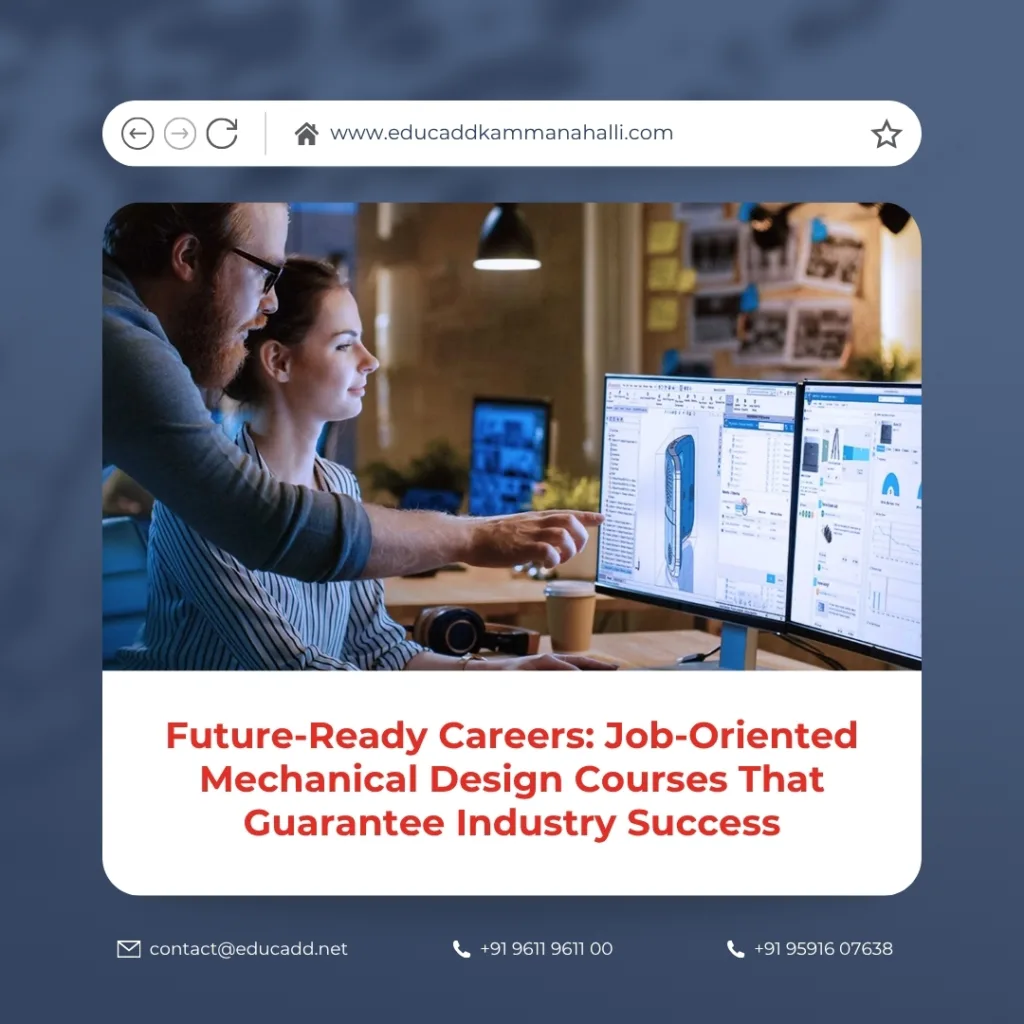
Job Oriented Mechanical Design
Today, companies are actively seeking candidates who are proficient in tools like CAD, CAM, CAE, and simulation software. Therefore, choosing the right Job Oriented Mechanical Design course can significantly impact career growth. In this blog, you will explore comprehensive insights into job-oriented mechanical design courses, their benefits, career opportunities, and how they help in building a successful future.
1. Understanding Mechanical Design Courses
Mechanical design courses focus on teaching the principles of designing mechanical components, systems, and machinery. These courses cover both theoretical and practical aspects, ensuring that learners understand how concepts are applied in real-world scenarios. Students are trained to create precise designs using modern software tools.
Moreover, these programs emphasize problem-solving skills, technical drawing, and product development. As a result, learners gain the confidence to handle complex engineering projects. With industries becoming more competitive, acquiring such specialized skills is no longer optional but necessary.
2. Importance of Job-Oriented Training
Job-oriented training plays a crucial role in preparing candidates for the industry. Unlike traditional education, these courses are designed with a focus on employability. They include hands-on projects, case studies, and industry exposure, which help learners understand workplace expectations.
Additionally, job-oriented programs often collaborate with industries to align their curriculum with current trends. This ensures that students are learning relevant skills that are in demand. Consequently, candidates who complete such training have a higher chance of getting placed quickly.
3. Core Modules Covered in Mechanical Design Courses
A well-structured mechanical design course includes various modules that build a strong foundation. These modules ensure that students gain both conceptual clarity and practical expertise.
Some key modules include:
- Computer-Aided Design (CAD)
- Computer-Aided Engineering (CAE)
- Finite Element Analysis (FEA)
- Product Design and Development
- Manufacturing Processes
Each module contributes to developing a well-rounded skill set. Therefore, mastering these areas is essential for career advancement.
4. Popular Software Tools You Will Learn
Mechanical design courses are incomplete without training in industry-standard software. These tools are widely used across engineering sectors, making them highly valuable for job seekers.
Common software tools include:
- AutoCAD for drafting and design
- SolidWorks for 3D modeling
- CATIA for product design
- ANSYS for simulation and analysis
By learning these tools, students become capable of handling professional design tasks. Furthermore, proficiency in multiple software increases job opportunities.
5. Benefits of Enrolling in Job-Oriented Courses
Enrolling in job-oriented mechanical design courses offers several advantages. First, these courses provide practical knowledge that is directly applicable in the workplace. Students gain hands-on experience, which enhances their confidence and skills.
Second, such programs often include placement assistance. This support helps learners connect with potential employers. As a result, they can secure jobs faster compared to traditional graduates.
6. Career Opportunities After Mechanical Design Courses
Mechanical design courses open the door to a wide range of career opportunities. Industries such as automotive, aerospace, manufacturing, and energy actively hire skilled designers.
Some popular job roles include:
- Mechanical Design Engineer
- CAD Engineer
- Product Design Engineer
- Simulation Engineer
- Quality Analyst
Each of these roles offers growth potential and competitive salaries. Therefore, choosing the right course can lead to a rewarding career path.
7. Industry Demand for Mechanical Designers
The demand for skilled mechanical designers is consistently increasing. With the rise of automation and smart manufacturing, companies require professionals who can design efficient systems.
Additionally, industries are focusing on innovation and sustainability. This creates more opportunities for designers who can develop advanced solutions. Hence, pursuing a job-oriented course ensures long-term career stability.
8. Importance of Practical Training and Projects
Practical training is one of the most important aspects of mechanical design courses. Students work on real-time projects that simulate industry scenarios. This approach helps them understand how theoretical concepts are applied in practice.
Furthermore, project-based learning enhances problem-solving abilities. Students learn how to handle challenges, meet deadlines, and deliver quality results. Consequently, they become job-ready professionals.
9. Certification and Its Value in the Job Market
Certifications play a vital role in enhancing a candidate’s profile. Employers often prefer candidates who have completed certified courses from recognized institutions.
A certification demonstrates that the candidate possesses the required skills and knowledge. It also adds credibility to the resume. Therefore, obtaining a certification can significantly improve job prospects.
10. How to Choose the Right Mechanical Design Course
Selecting the right course is essential for achieving career goals. Several factors should be considered before making a decision.
Important factors include:
- Course curriculum and modules
- Industry relevance
- Availability of practical training
- Placement support
By evaluating these aspects, students can choose a course that aligns with their career aspirations.
11. Role of Internships in Career Development
Internships provide valuable industry exposure. They allow students to work in real-world environments and gain practical experience. This experience is highly beneficial when applying for jobs.
Moreover, internships help in building professional networks. Students get the opportunity to interact with industry experts and learn from them. As a result, they gain insights that cannot be acquired through classroom learning alone.
12. Salary Expectations and Career Growth
Mechanical design professionals can expect competitive salaries, especially after gaining experience. Entry-level salaries may vary depending on skills and location. However, with experience and expertise, salaries increase significantly.
Additionally, career growth opportunities are abundant. Professionals can move into senior roles, management positions, or even start their own ventures. Therefore, the field offers both financial stability and growth.
13. Future Trends in Mechanical Design
The future of mechanical design is shaped by emerging technologies. Trends such as artificial intelligence, automation, and additive manufacturing are transforming the industry.
Engineers are now required to adapt to these changes. Learning advanced tools and technologies is essential to stay relevant. Consequently, job-oriented courses are continuously updated to include these trends.
14. Why Mechanical Design Skills Are Essential Today
Mechanical design skills are essential in almost every industry. From manufacturing to healthcare, the need for efficient and innovative designs is increasing. Skilled designers contribute to improving product quality and performance.
Furthermore, these skills enhance problem-solving abilities and creativity. Professionals who possess such skills are highly valued by employers. Therefore, investing in mechanical design education is a wise decision.
Conclusion
In conclusion, Job Oriented Mechanical Design courses are a gateway to a successful and fulfilling career. They equip learners with the necessary skills, knowledge, and practical experience required to excel in the industry. With increasing demand for skilled professionals, these courses offer excellent opportunities for growth and stability.
By choosing the right course and continuously upgrading skills, individuals can achieve their career goals and stay ahead in the competitive job market. Mechanical design is not just a profession; it is a pathway to innovation and progress.

