
Tools for Reverse Engineering in CADD: Transforming Physical Products into Intelligent Digital Designs
Reverse Engineering CADD Tools has become one of the most valuable processes in modern product development. Industries constantly seek ways to improve existing products, reduce development time, and create accurate digital models from physical components. This is where reverse engineering plays a crucial role. It enables engineers and designers to analyze a physical object and recreate it as a digital model for modification, optimization, or manufacturing.
Computer-Aided Design and Drafting (CADD) has significantly enhanced the efficiency of reverse engineering. Advanced software tools, high-precision scanners, and powerful modeling platforms allow engineers to capture complex geometries and convert them into detailed CAD models. As a result, organizations can accelerate innovation while maintaining high levels of accuracy.
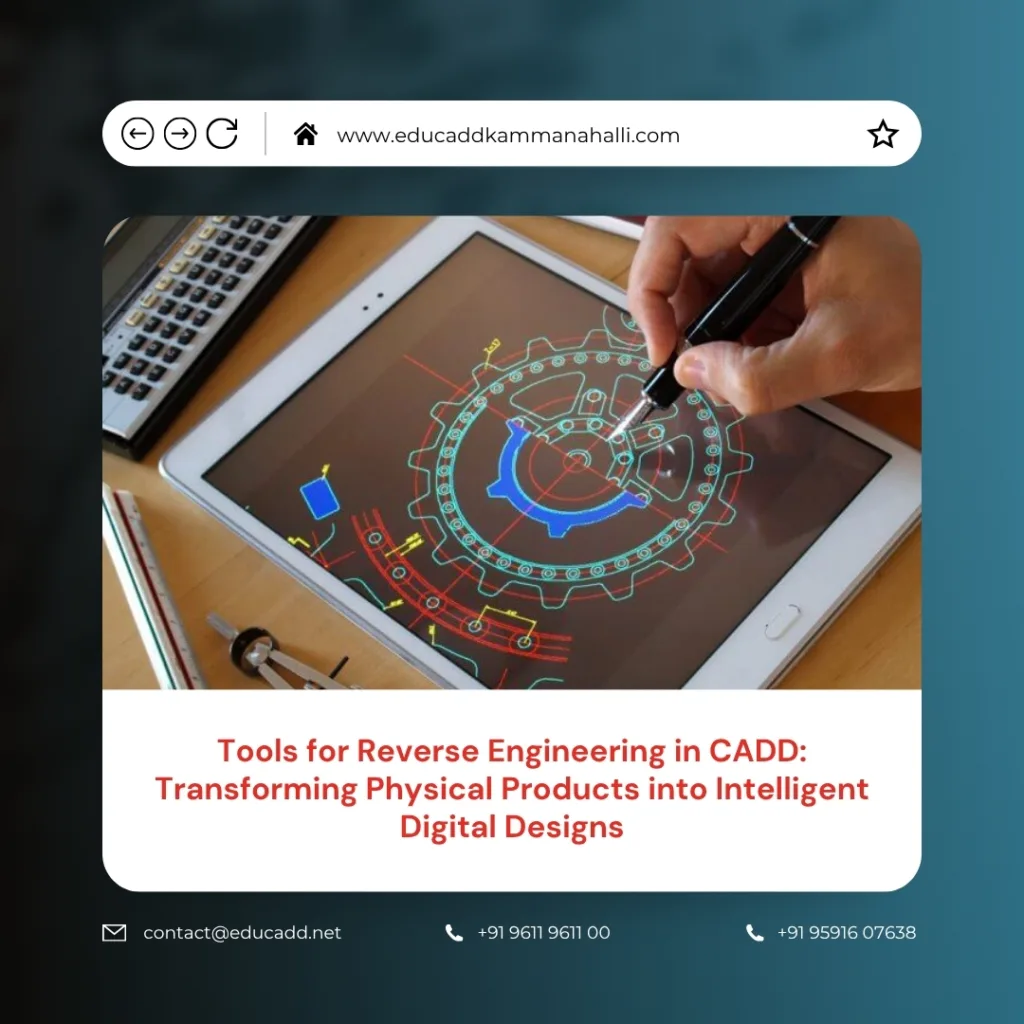
Reverse Engineering CADD Tools
Today, Reverse Engineering CADD Tools is widely used in automotive, aerospace, medical equipment, industrial machinery, consumer products, and manufacturing industries. Understanding the tools involved in this process helps professionals improve productivity and deliver superior design solutions. This article explores the most important tools used for reverse engineering in CADD and explains how they contribute to successful product development.
Understanding Reverse Engineering in CADD
Reverse Engineering CADD Tools is the process of extracting design information from an existing product and recreating it in a digital format. Instead of designing a product from scratch, engineers begin with a physical object and work backward to understand its geometry, dimensions, and functionality.
The process generally starts with data acquisition through scanning technologies. Once the physical object is scanned, the collected data is transformed into a digital representation. Engineers then use CADD software to refine, analyze, and modify the model according to project requirements.
This approach is especially useful when original design documentation is unavailable. It also helps companies redesign obsolete parts, improve product performance, and create compatible replacements for aging equipment.
3D Scanners: The Foundation of Reverse Engineering
A 3D scanner serves as the starting point of most reverse engineering projects. It captures the physical shape of an object and converts it into digital data known as a point cloud.
Modern scanners can collect millions of measurement points within minutes. These points accurately represent the geometry of the object and form the basis for CAD model creation. Depending on the application, engineers may use laser scanners, structured light scanners, or handheld scanners.
The accuracy of a reverse engineering project largely depends on the quality of scanning. Therefore, selecting the right scanner is essential for obtaining reliable results. High-quality scanning reduces errors and minimizes the time required for model reconstruction.
Benefits of 3D Scanners
- Capture complex geometries with exceptional accuracy.
- Reduce manual measurement time significantly.
Laser Scanning Technology for Precision Modeling
Laser scanning technology has become one of the most trusted methods for reverse engineering. Laser scanners project a laser beam onto an object’s surface and measure the reflected light to determine precise coordinates.
This technology works exceptionally well for components with intricate details and complex surfaces. Engineers often use laser scanning in aerospace and automotive industries where dimensional accuracy is critical.
Furthermore, laser scanners can capture hard-to-reach areas that traditional measuring tools cannot access. As a result, they provide comprehensive data that supports highly accurate digital model creation.
The integration of laser scanning with CADD software has streamlined the entire reverse engineering workflow. Engineers can quickly import scanned data into modeling platforms and begin reconstructing designs without unnecessary delays.
Structured Light Scanners for High-Speed Data Collection
Structured light scanners represent another important category of reverse engineering tools. These devices project a pattern of light onto an object’s surface and analyze distortions in the pattern to calculate geometry.
One of the major advantages of structured light scanning is speed. These scanners can capture large amounts of data within a short period, making them ideal for projects with tight deadlines.
Additionally, structured light scanners offer excellent accuracy for small and medium-sized components. Their ability to generate detailed surface information makes them popular in medical device manufacturing, consumer product design, and industrial engineering applications.
As technology continues to advance, structured light scanners are becoming more portable, user-friendly, and cost-effective, increasing their adoption across industries.
Geomagic Design X: A Leading Reverse Engineering CADD Tools Software
Among the many software solutions available today, Geomagic Design X stands out as a powerful reverse engineering platform. It enables engineers to convert scanned point cloud data directly into feature-based CAD models.
The software provides advanced tools for mesh editing, surface reconstruction, and parametric modeling. Engineers can create accurate CAD geometry while maintaining complete control over design features.
Geomagic Design X also integrates seamlessly with major CAD platforms, allowing users to transfer models efficiently between different systems. This compatibility improves workflow efficiency and eliminates unnecessary data conversion challenges.
Organizations that frequently perform reverse engineering projects often rely on this software because it combines scanning data processing and CAD model creation within a single environment.
Autodesk Inventor for Reverse Engineering CADD Tools Applications
Autodesk Inventor has become a popular choice for engineers involved in reverse engineering projects. The software offers robust modeling capabilities and supports imported scan data for design reconstruction.
Engineers use Inventor to generate solid models, create assemblies, and perform design modifications. Its intuitive interface simplifies the process of transforming scanned geometry into production-ready designs.
Another significant advantage of Autodesk Inventor is its simulation functionality. Designers can test product performance before manufacturing begins, helping identify potential issues early in the development cycle.
Because of its versatility and user-friendly tools, Autodesk Inventor remains a valuable asset in modern reverse engineering workflows.
SolidWorks and Reverse Engineering Workflows
SolidWorks is widely recognized as one of the most powerful CAD platforms for reverse engineering. The software supports imported scan data and provides extensive tools for creating precise digital models.
Engineers can reconstruct surfaces, generate solid bodies, and develop complex assemblies using SolidWorks. Its advanced surfacing capabilities make it especially useful for products with organic shapes and intricate contours.
Furthermore, SolidWorks enables users to analyze geometry and validate design accuracy. This ensures that reconstructed models accurately represent the original physical component.
Many organizations choose SolidWorks because it combines powerful design tools with excellent usability, making reverse engineering projects more efficient and productive.
CATIA for Complex Industrial Reverse Engineering
CATIA is extensively used in industries that require sophisticated design and engineering solutions. Aerospace, automotive, and industrial manufacturing companies often depend on CATIA for reverse engineering applications.
The software excels at handling highly complex geometries and large assemblies. Engineers can use CATIA to create detailed surface models and perform advanced engineering analyses.
Its reverse engineering tools support point cloud processing, surface generation, and parametric design creation. Consequently, organizations can reproduce highly accurate digital representations of physical products.
CATIA’s comprehensive functionality makes it particularly valuable for projects involving advanced engineering requirements and strict quality standards.
Mesh Processing Tools in Reverse Engineering
After scanning an object, engineers typically work with mesh data before creating CAD models. Mesh processing tools help clean, optimize, and prepare scanned data for further development.
Raw scan data often contains noise, gaps, and unnecessary points. Mesh editing software removes these imperfections and improves data quality.
Common mesh processing tasks include:
- Mesh repair and hole filling.
- Surface smoothing and optimization.
Effective mesh processing ensures that subsequent CAD modeling activities proceed smoothly. It also improves overall model accuracy and reduces reconstruction time.
Coordinate Measuring Machines (CMMs) for Validation
Coordinate Measuring Machines, commonly known as CMMs, play an important role in reverse engineering projects. These machines measure physical objects with exceptional precision and verify dimensional accuracy.
Engineers frequently use CMMs to validate scanned data and compare digital models against original components. This verification process ensures that reconstructed designs meet required specifications.
CMMs are particularly useful for applications where even minor dimensional deviations can impact product performance. Their ability to provide highly accurate measurements enhances quality assurance throughout the reverse engineering process.
As manufacturing tolerances become increasingly demanding, CMM technology continues to support accurate and reliable design reconstruction.
Point Cloud Processing Software
Point cloud processing software serves as a bridge between scanning and CAD modeling. It transforms raw scan data into organized datasets that engineers can easily interpret and manipulate.
These tools allow users to filter unnecessary information, align multiple scans, and generate usable digital representations. Efficient point cloud processing improves workflow speed and reduces modeling complexity.
Modern software solutions offer automated functions that simplify data preparation. As a result, engineers can focus more on design reconstruction and less on data management.
The growing capabilities of point cloud processing platforms continue to enhance the effectiveness of reverse engineering projects across industries.
Integration Between Reverse Engineering CADD Tools and CAD Platforms
One of the biggest advancements in modern reverse engineering involves seamless integration between scanning systems and CAD software. Engineers can now transfer data directly from scanners into modeling environments without complex conversion procedures.
This integration reduces workflow interruptions and improves overall project efficiency. It also minimizes data loss and preserves geometric accuracy throughout the design process.
Cloud-based collaboration features further enhance productivity by allowing teams to share models and review designs in real time. Consequently, organizations can complete reverse engineering projects faster and more effectively.
The continued development of integrated solutions is shaping the future of digital engineering and product innovation.
Future Trends in Reverse Engineering Technology
The future of reverse engineering is closely linked to advancements in artificial intelligence, automation, and digital manufacturing. AI-powered software can already identify geometric features automatically and accelerate CAD model creation.
Additionally, improved scanning technologies are delivering higher accuracy and faster data acquisition. Portable devices are becoming more powerful, enabling engineers to perform reverse engineering tasks directly on-site.
Digital twins, additive manufacturing, and Industry 4.0 initiatives are also increasing the demand for advanced reverse engineering solutions. As these technologies evolve, organizations will gain even greater capabilities for product development and innovation.
Engineers who stay updated with emerging tools will be better positioned to meet future industry requirements and maintain a competitive advantage.
Conclusion
Reverse Engineering CADD Tools has transformed the way organizations analyze, improve, and recreate physical products. By combining advanced scanning technologies with powerful CADD software, engineers can generate accurate digital models that support innovation, maintenance, and product development. Tools such as 3D scanners, laser scanners, structured light scanners, Geomagic Design X, Autodesk Inventor, SolidWorks, CATIA, mesh processing software, point cloud processing platforms, and Coordinate Measuring Machines have become essential components of modern reverse engineering workflows.
As industries continue to embrace digital transformation, the importance of reverse engineering tools will only increase. These technologies not only reduce development time but also improve design accuracy, manufacturing efficiency, and product quality. Organizations that effectively leverage reverse engineering in CADD can accelerate innovation, optimize existing products, and remain competitive in an increasingly technology-driven marketplace.

