
Advanced Electrical CADD Course in India: Build a Future-Ready Career in Modern Electrical Design and Engineering
The demand for skilled electrical design professionals continues to grow as industries adopt advanced technologies and smart infrastructure. An Advanced Electrical CADD Course in India prepares aspiring engineers, diploma holders, working professionals, and graduates with the practical knowledge needed to excel in electrical drafting, designing, and project execution. Unlike traditional classroom learning, this specialized course combines theoretical concepts with real-world software applications, enabling students to create professional electrical layouts, control systems, panel designs, and industrial drawings with confidence.
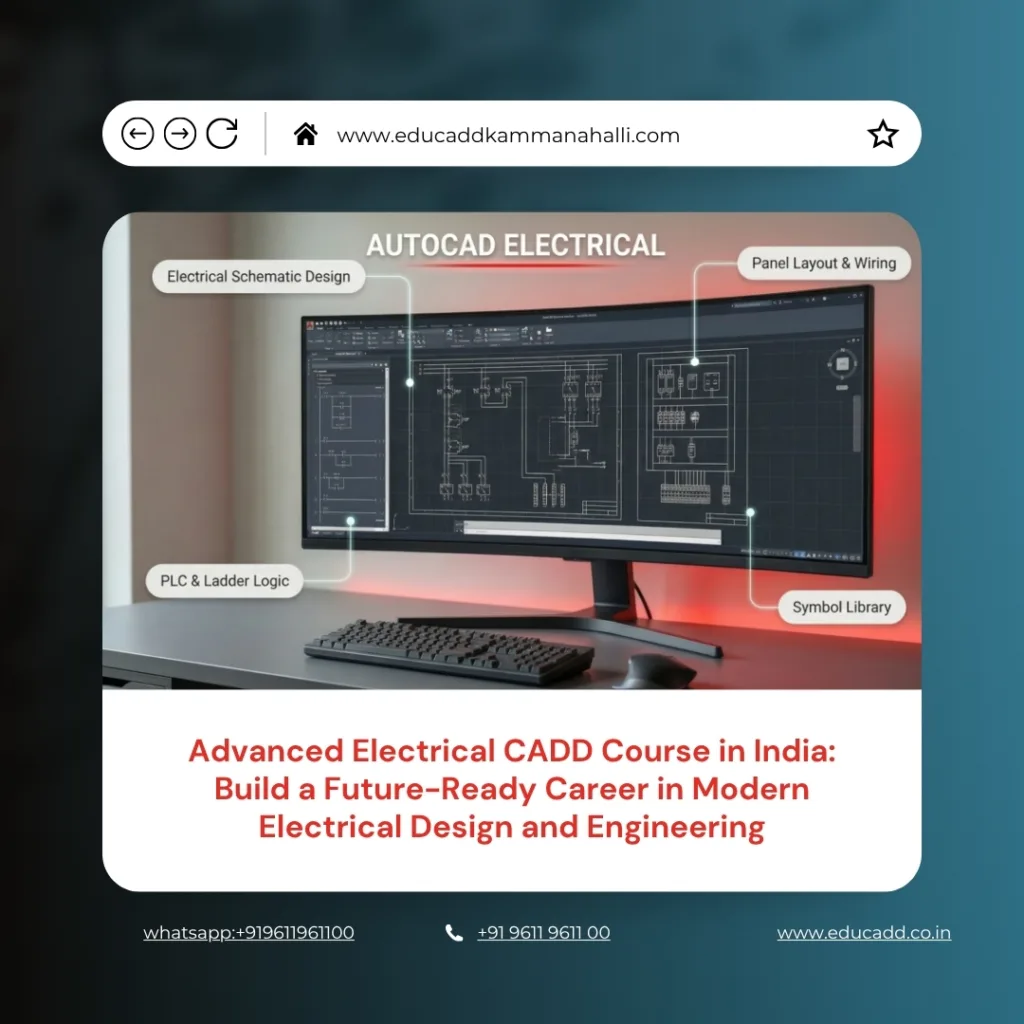
Advanced Electrical CADD Course
Today, organizations across construction, manufacturing, power generation, automation, oil and gas, renewable energy, and infrastructure development seek professionals who can deliver accurate electrical designs while meeting international standards. As a result, completing an Advanced Electrical CADD Course opens doors to diverse career opportunities with excellent salary prospects. Furthermore, learners gain industry-recognized skills that improve employability and help them stay competitive in the evolving engineering landscape.
1. Understanding the Importance of Advanced Electrical CADD
Electrical Computer-Aided Design and Drafting (CADD) has transformed the way engineers plan, design, and document electrical systems. Gone are the days of manually preparing electrical layouts that required significant time and effort. Modern software allows engineers to develop highly accurate drawings, identify errors early, and improve project efficiency.
An advanced course focuses on practical implementation rather than just theoretical concepts. Students learn to create electrical schematics, lighting layouts, power distribution systems, cable routing, earthing plans, panel schedules, and detailed engineering documentation. Every project requires precision, and Electrical CADD software ensures that every drawing follows industry standards while minimizing costly mistakes.
Moreover, companies increasingly depend on digital design solutions because they improve collaboration among architects, civil engineers, mechanical engineers, and project managers. Therefore, mastering Electrical CADD has become an essential skill for engineering professionals aiming for long-term career growth.
2. Why Choose an Advanced Electrical CADD Course in India?
India has emerged as one of the fastest-growing engineering and infrastructure markets. New commercial buildings, smart cities, manufacturing plants, renewable energy projects, and industrial facilities require skilled electrical designers. Consequently, the demand for trained Electrical CADD professionals continues to rise every year.
Choosing an Advanced Electrical CADD Course offers several advantages. First, students receive training based on industry requirements rather than outdated academic syllabi. Second, the curriculum emphasizes practical assignments, live projects, and software-based learning. Finally, many institutes provide placement assistance, helping students secure jobs immediately after course completion.
The affordability of technical education in India also makes professional training accessible to students from different educational backgrounds. Whether someone has completed engineering, polytechnic, or ITI, advanced Electrical CADD training creates valuable career opportunities across multiple industries.
3. Core Software Covered During the Course
Professional Electrical CADD training introduces students to the most widely used engineering software applications. Each software plays a unique role in designing modern electrical systems.
Students generally learn:
- AutoCAD Electrical for electrical drafting and schematic design.
- Revit MEP for Building Information Modeling (BIM) and coordinated electrical layouts.
In addition to these major platforms, learners often explore software for cable tray design, panel layouts, lighting calculations, electrical load estimation, and documentation. Practical exposure to these tools improves productivity and helps students adapt quickly to professional working environments.
As technology evolves, software knowledge becomes equally important as engineering fundamentals. Therefore, learning multiple industry-standard applications significantly increases employability.
4. Practical Skills Students Develop During Training
Technical knowledge alone cannot guarantee success in today’s competitive engineering industry. Employers expect professionals who can apply concepts efficiently while solving real project challenges.
During the course, students develop practical skills such as electrical drafting, wiring diagrams, panel board layouts, lighting design, power distribution planning, cable sizing, transformer layouts, switchgear design, load calculations, single-line diagrams, and electrical estimation.
Furthermore, learners gain experience in reading engineering drawings, coordinating multidisciplinary projects, identifying design conflicts, and preparing professional documentation. These practical assignments simulate real industrial projects, allowing students to understand workplace expectations before entering the job market.
Consequently, graduates become more confident while attending interviews and handling engineering responsibilities from their very first job.
5. Industries That Recruit Electrical CADD Professionals
Electrical design professionals are required in almost every infrastructure and manufacturing sector. Since every modern building and industrial facility depends on reliable electrical systems, qualified Electrical CADD engineers enjoy excellent career flexibility.
Some of the major industries include:
- Construction and Infrastructure Development
- Power Generation Companies
- Renewable Energy Projects
- Oil and Gas Industries
- Manufacturing Industries
- Industrial Automation
- Building Services Engineering
- Smart City Projects
- Metro Rail Projects
- Data Centers
- Electrical Consulting Firms
- EPC Companies
These industries consistently seek professionals capable of designing safe, efficient, and cost-effective electrical systems. Therefore, completing professional training creates opportunities across both domestic and international markets.
6. Career Opportunities After Completing the Course
One of the biggest advantages of pursuing an Advanced Electrical CADD Course is the wide range of career opportunities available after certification. Organizations actively recruit professionals who possess both engineering knowledge and software expertise.
Graduates can work as Electrical CADD Engineers, Electrical Design Engineers, AutoCAD Electrical Designers, MEP Electrical Engineers, Project Engineers, Electrical Draftsmen, BIM Electrical Modelers, Electrical Estimation Engineers, Site Coordination Engineers, Panel Design Engineers, and Technical Consultants.
Moreover, professionals with experience can advance into project management, engineering consultancy, quality assurance, or design leadership positions. Some individuals even establish their own design consulting firms after gaining sufficient industry experience.
Since infrastructure development continues to expand globally, career growth remains steady for qualified Electrical CADD professionals.
7. Advantages of Learning Through Project-Based Training
Project-based learning bridges the gap between classroom education and industrial practice. Instead of memorizing theoretical concepts, students actively participate in designing real engineering projects.
This practical approach offers several benefits:
- Improves confidence through hands-on experience.
- Enhances problem-solving and analytical thinking.
- Develops teamwork and communication skills.
- Builds a strong professional portfolio.
- Strengthens interview preparation.
- Familiarizes students with industry workflows.
Additionally, live project exposure enables students to understand client requirements, project documentation standards, quality checks, and engineering coordination. As a result, employers often prefer candidates who have completed project-oriented Electrical CADD training because they require minimal additional training after recruitment.
Modern engineering companies value productivity from the very first day. Therefore, practical learning provides a significant competitive advantage over traditional theoretical education.
8. Industry-Oriented Curriculum That Matches Current Market Requirements
One of the biggest strengths of an Advanced Electrical CADD Course is its industry-oriented curriculum. Unlike conventional academic programs that focus heavily on theory, this course emphasizes practical knowledge that aligns with current engineering practices. Students work on real-world design assignments that reflect the requirements of commercial buildings, industrial plants, residential projects, hospitals, educational institutions, and infrastructure developments.
The curriculum usually begins with electrical drafting fundamentals before progressing to advanced topics such as electrical panel design, power distribution systems, lighting layouts, cable tray routing, earthing systems, load calculations, transformer installations, and circuit protection. Every module builds technical confidence while strengthening problem-solving abilities.
In addition, learners become familiar with national and international electrical standards. They understand how to prepare accurate documentation that complies with engineering guidelines. This practical exposure ensures graduates can contribute effectively from the first day of employment. Consequently, employers value candidates who have completed an Advanced Electrical CADD Course in India because they require less training and can quickly integrate into ongoing engineering projects.
9. Certification Adds Value to Your Professional Profile
Professional certification plays an important role in today’s competitive job market. It demonstrates that a candidate possesses the technical knowledge and practical skills required by modern industries. Completing an Advanced Electrical CADD Course provides a recognized certification that strengthens your resume and increases your credibility during interviews.
Recruiters often receive applications from candidates with similar educational qualifications. However, certified professionals stand out because they have invested time in developing specialized technical skills. Certification reflects commitment to continuous learning and professional development, making employers more confident in the candidate’s abilities.
Furthermore, certification supports career advancement. Whether you are applying for your first job or planning to switch organizations, industry-recognized credentials improve your chances of securing better opportunities. As engineering technologies continue to evolve, certified professionals remain more competitive in the employment market.
10. Who Should Enroll in an Advanced Electrical CADD Course in India?
The Advanced Electrical CADD Course is suitable for learners from various educational and professional backgrounds. The course accommodates beginners while also helping experienced professionals upgrade their technical expertise.
Ideal candidates include:
- Electrical Engineering students
- Diploma holders in Electrical Engineering
- ITI Electrician graduates
- Electrical Design Engineers
- Site Engineers
- Maintenance Engineers
- Project Engineers
- Working professionals seeking career advancement
- Fresh graduates looking for placement opportunities
- Entrepreneurs planning to start engineering consultancy services
Since the curriculum combines theory with practical application, students at different career stages can benefit equally. Freshers develop job-ready skills, while experienced professionals enhance their design capabilities and improve their career prospects. Therefore, this course serves as an excellent investment for anyone interested in building a successful engineering career.
11. Salary Prospects and Career Growth
One of the primary reasons students choose an Advanced Electrical CADD Course in India is the promising salary potential. The growing demand for skilled electrical designers has created attractive employment opportunities across both public and private sectors.
Fresh graduates usually begin their careers with competitive entry-level salaries depending on their technical skills, software proficiency, location, and employer. As professionals gain practical experience, their earning potential increases significantly. Engineers who specialize in electrical design, BIM coordination, industrial automation, or MEP projects often receive higher compensation packages.
Career growth also depends on continuous learning. Professionals who regularly upgrade their technical knowledge and master emerging design technologies become eligible for senior engineering positions, project management roles, and international assignments. Consequently, Electrical CADD offers not only immediate employment but also long-term financial stability and career progression.
12. The Role of Electrical CADD in Smart Infrastructure and Future Technologies
The engineering industry is rapidly embracing digital transformation. Smart buildings, intelligent power management systems, renewable energy integration, electric vehicle charging infrastructure, and industrial automation have increased the importance of accurate electrical design. As a result, professionals trained through an Advanced Electrical CADD Course in India are becoming essential contributors to modern engineering projects.
Electrical CADD supports efficient planning by allowing engineers to visualize complete electrical systems before construction begins. This approach reduces design conflicts, minimizes material wastage, and improves project coordination. Additionally, digital models help engineers perform modifications quickly without recreating entire drawings.
Future technologies will continue to expand the role of Electrical CADD. Artificial Intelligence, Building Information Modeling, cloud-based collaboration, and digital engineering workflows are already transforming project execution. Therefore, students who master advanced design software today will remain highly relevant as engineering practices continue to evolve over the coming years.
13. Essential Skills That Employers Look For
Technical software knowledge alone is not enough to succeed in today’s engineering environment. Employers seek professionals who combine design expertise with strong communication, analytical thinking, and teamwork. Fortunately, an Advanced Electrical CADD Course in India helps learners develop these essential competencies alongside technical training.
Important skills include:
- Electrical drafting accuracy
- Design interpretation
- Load calculation and analysis
- Problem-solving ability
- Project documentation
- Team collaboration
- Time management
- Attention to detail
- Software proficiency
- Communication skills
- Engineering standards compliance
- Quality-focused work approach
These competencies enable professionals to work efficiently in multidisciplinary engineering teams. Moreover, they help engineers handle complex projects while maintaining accuracy and meeting project deadlines. Therefore, employers highly appreciate candidates who possess both technical expertise and professional workplace skills.
14. Choosing the Right Training Institute for Maximum Career Success
Selecting the right institute significantly influences your learning experience and career outcomes. Although many institutions offer technical courses, students should carefully evaluate the quality of training before making a decision. A reputed institute offering an Advanced Electrical CADD Course focuses on practical education, experienced faculty, updated software, industry-relevant curriculum, and placement assistance.
Students should also consider laboratory facilities, project-based assignments, certification value, internship opportunities, flexible class schedules, and student support services. Institutes that collaborate with industries often provide better exposure through live projects and guest lectures conducted by experienced professionals.
Additionally, placement support plays a crucial role in launching a successful career. Resume preparation, mock interviews, aptitude training, and recruitment drives improve employment opportunities after course completion. Therefore, investing time in selecting the right training institute can produce long-term career benefits and accelerate professional growth.
Conclusion
The engineering industry continues to evolve with rapid technological advancements, increasing infrastructure development, and growing demand for energy-efficient electrical systems. Consequently, professionals equipped with advanced design skills enjoy excellent career opportunities across multiple sectors. An Advanced Electrical CADD Course in India provides the perfect combination of engineering knowledge, software expertise, and practical project experience required by modern employers.
From mastering industry-standard software to understanding complex electrical systems, the course prepares students to handle real engineering challenges with confidence. It also develops analytical thinking, technical accuracy, and professional communication skills that are essential for long-term success. Furthermore, certification enhances credibility and improves employability in both domestic and international markets.
Whether you are a student beginning your engineering journey, a diploma holder seeking specialized skills, or a working professional aiming for career advancement, enrolling in an Advanced Electrical CADD Course in India is a strategic decision. By choosing quality training, gaining hands-on project experience, and continuously upgrading your knowledge, you can build a rewarding career in electrical design, contribute to innovative engineering projects, and achieve sustained professional growth in one of the fastest-growing industries in the world.

