
Master V-Ray Rendering Course to Create Stunning Photorealistic Designs and Advance Your Career
The world of architecture, interior design, product visualization, and 3D animation continues to evolve with realistic digital presentations becoming an essential part of every project. Clients no longer rely only on technical drawings because they expect lifelike visuals before approving a design. This growing demand has made professional rendering skills highly valuable across industries. A Master V-Ray Rendering Course equips learners with the knowledge to transform ordinary 3D models into breathtaking photorealistic images using advanced lighting, materials, textures, and camera settings.
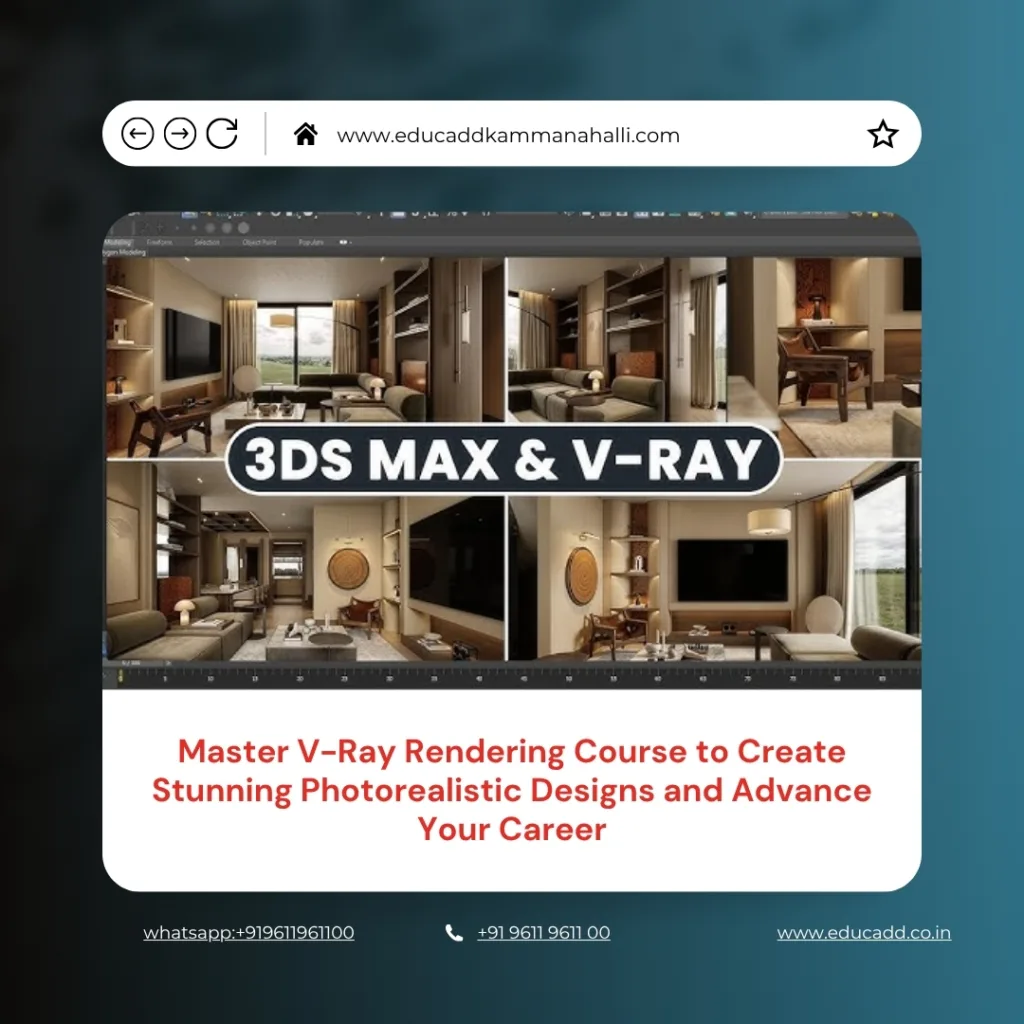
Master V-Ray Rendering Course
Whether you are an architecture student, interior designer, civil engineer, mechanical designer, freelancer, or working professional, mastering V-Ray can significantly improve your career opportunities. This comprehensive guide explains why learning V-Ray has become a smart investment, what you will learn during the training, and how it can help you build a rewarding future in the visualization industry.
Why a V-Ray Rendering Course Is Essential for Modern Designers
The demand for realistic architectural and product visualization has increased rapidly over the past few years. Designers must present ideas that clients can easily understand before construction or manufacturing begins. A Master V-Ray Rendering Course helps professionals produce high-quality images that showcase every design detail with impressive realism.
Moreover, companies prefer candidates who can create professional renderings because these visuals improve communication with clients and reduce costly design revisions. As a result, V-Ray has become one of the most sought-after rendering software solutions across architecture, engineering, interior design, and product design industries.
Understanding the Power of V-Ray Rendering Software
V-Ray is one of the world’s leading rendering engines known for producing highly realistic images with exceptional lighting accuracy. It integrates seamlessly with software such as SketchUp, 3ds Max, Revit, Rhino, Cinema 4D, and other popular 3D modeling platforms.
Furthermore, V-Ray combines speed, flexibility, and advanced rendering technology. Users can generate both interior and exterior visualizations while maintaining high image quality. Consequently, professionals choose V-Ray because it delivers outstanding results for residential, commercial, industrial, and landscape projects.
Skills You Learn During a Professional V-Ray Rendering Course
A comprehensive Master V-Ray Rendering Course covers both beginner and advanced concepts. Students start with the software interface before progressing toward professional rendering techniques.
The training includes creating realistic materials, adjusting textures, setting up natural and artificial lighting, configuring cameras, optimizing rendering quality, managing environments, applying HDRI lighting, creating reflections, rendering animations, and performing post-production improvements. Additionally, learners gain practical experience by working on real-world projects that strengthen both technical and creative skills.
Mastering Realistic Lighting Techniques
Lighting determines the overall quality of every rendering. Even the most detailed 3D model looks unrealistic without proper illumination. Therefore, understanding lighting principles becomes one of the most important sections of any Master V-Ray Rendering Course.
Students learn daylight systems, artificial lighting placement, sun positioning, exposure adjustments, global illumination, and shadow optimization. They also understand how different lighting conditions influence mood, realism, and presentation quality. Consequently, their renderings become visually appealing and highly convincing.
Creating High-Quality Materials and Textures
Materials bring every object to life. Walls, furniture, metals, glass, fabrics, and wooden surfaces all require realistic material settings. A professional Master V-Ray Rendering Course teaches learners how to build accurate materials using reflection, glossiness, bump maps, displacement maps, opacity settings, and procedural textures.
Moreover, students understand texture mapping techniques that eliminate stretching and distortion. As their material creation skills improve, they produce renderings that closely resemble real-world objects and environments.
Camera Settings That Produce Professional Visualizations
Professional renderings require more than attractive materials and lighting. Camera composition also plays an important role in storytelling and presentation quality. A Master V-Ray Rendering Course explains camera positioning, focal length, field of view, depth of field, exposure control, and white balance adjustments.
Additionally, learners understand cinematic composition techniques that guide the viewer’s attention toward key design elements. These camera skills significantly improve the visual impact of every rendered image.
HDRI Environment and Exterior Rendering Techniques
Exterior rendering requires realistic skies, environmental reflections, and natural lighting conditions. During a Master V-Ray Rendering Course, students learn to use HDRI environments for creating convincing outdoor scenes.
Furthermore, they explore weather conditions, seasonal lighting, landscape elements, vegetation placement, water effects, and atmospheric settings. These advanced techniques produce exterior visualizations that appear highly realistic while maintaining rendering efficiency.
Interior Rendering for Residential and Commercial Projects
Interior visualization requires careful attention to lighting balance, furniture placement, material selection, and decorative elements. A quality Master V-Ray Rendering Course teaches students how to create inviting interior spaces that showcase every design feature effectively.
They also practice rendering kitchens, bedrooms, offices, restaurants, retail stores, hotels, and corporate spaces. Consequently, learners develop confidence in producing professional interior presentations suitable for client approvals and marketing materials.
Rendering Optimization for Faster Performance
Many beginners struggle with long rendering times. However, an experienced instructor explains optimization methods that reduce waiting periods without compromising image quality. A V-Ray Rendering Course introduces rendering presets, adaptive sampling, denoising, memory optimization, and GPU rendering techniques.
Additionally, students learn troubleshooting methods that improve workflow efficiency. These optimization skills increase productivity and help professionals complete projects within deadlines.
Building an Impressive Rendering Portfolio
Technical knowledge alone does not guarantee career success. Employers and clients also evaluate your portfolio before assigning projects. Therefore, a professional V-Ray Rendering Course encourages students to create diverse rendering projects that demonstrate their abilities.
Portfolio projects may include villas, apartments, office interiors, commercial buildings, product visualizations, landscape designs, furniture renderings, and conceptual architectural presentations. A strong portfolio greatly improves employment opportunities and freelance success.
Career Opportunities After Completing a V-Ray Rendering Course
The visualization industry offers excellent career prospects for skilled rendering professionals. After completing a V-Ray Rendering Course, learners can work as architectural visualizers, interior rendering specialists, 3D artists, product visualization experts, BIM visualization professionals, rendering consultants, animation artists, and freelance designers.
Furthermore, construction companies, architectural firms, interior design studios, engineering consultants, furniture manufacturers, gaming companies, and advertising agencies actively recruit professionals with advanced rendering expertise. Therefore, learning V-Ray opens multiple career pathways.
Benefits of Learning V-Ray Alongside Other Design Software
Although V-Ray functions as a rendering engine, its true strength comes from integrating with popular modeling software. A V-Ray Rendering Course becomes even more valuable when combined with AutoCAD, SketchUp, Revit, Rhino, 3ds Max, or Blender.
This combination allows designers to create complete project workflows from modeling and drafting to photorealistic rendering and client presentation. Consequently, professionals become more versatile and competitive in today’s design industry.
Choosing the Right V-Ray Rendering Course
Selecting the right training institute directly influences your learning experience. Before enrolling in a V-Ray Rendering Course, students should evaluate the curriculum, trainer expertise, practical assignments, software versions, laboratory facilities, certification, placement support, and industry projects.
Moreover, institutes offering hands-on training with real client-based scenarios provide better learning outcomes. Regular practice sessions and personalized mentoring also help students master advanced rendering techniques much faster.
Why Continuous Practice Makes You a Better Rendering Artist
Rendering is both a technical skill and a creative art. Even after completing a V-Ray Rendering Course, consistent practice remains essential for improving quality and speed. Every project introduces new challenges involving materials, lighting, composition, or rendering optimization.
Therefore, professionals should continuously experiment with different environments, camera angles, textures, and lighting setups. They should also analyze high-quality renderings created by industry experts and apply new techniques in their own projects. Continuous learning ensures long-term career growth in the rapidly evolving visualization industry.
Conclusion
A Master V-Ray Rendering Course is one of the most valuable investments for anyone pursuing a career in architecture, interior design, engineering visualization, product design, or 3D graphics. It develops practical skills that enable professionals to create photorealistic renderings capable of impressing clients and accelerating project approvals. From mastering lighting and materials to optimizing rendering speed and building an outstanding portfolio, every aspect of the training contributes to professional success.
As visualization technology continues to advance, skilled V-Ray professionals will remain in high demand across multiple industries. By choosing quality training, practicing consistently, and applying industry-standard techniques, you can establish yourself as a highly sought-after rendering specialist and build a successful, future-ready career.

