
BIM Modeling and Coordination Course: Build the Skills That Shape Tomorrow’s Smart Construction Projects
The construction industry is evolving faster than ever, and digital technologies are leading this remarkable transformation. Among these innovations, Building Information Modeling (BIM) has become an essential part of modern architecture, engineering, and construction. A BIM Modeling Coordination Course equips aspiring professionals with practical knowledge, industry-relevant software skills, and collaborative workflows required to deliver successful projects.
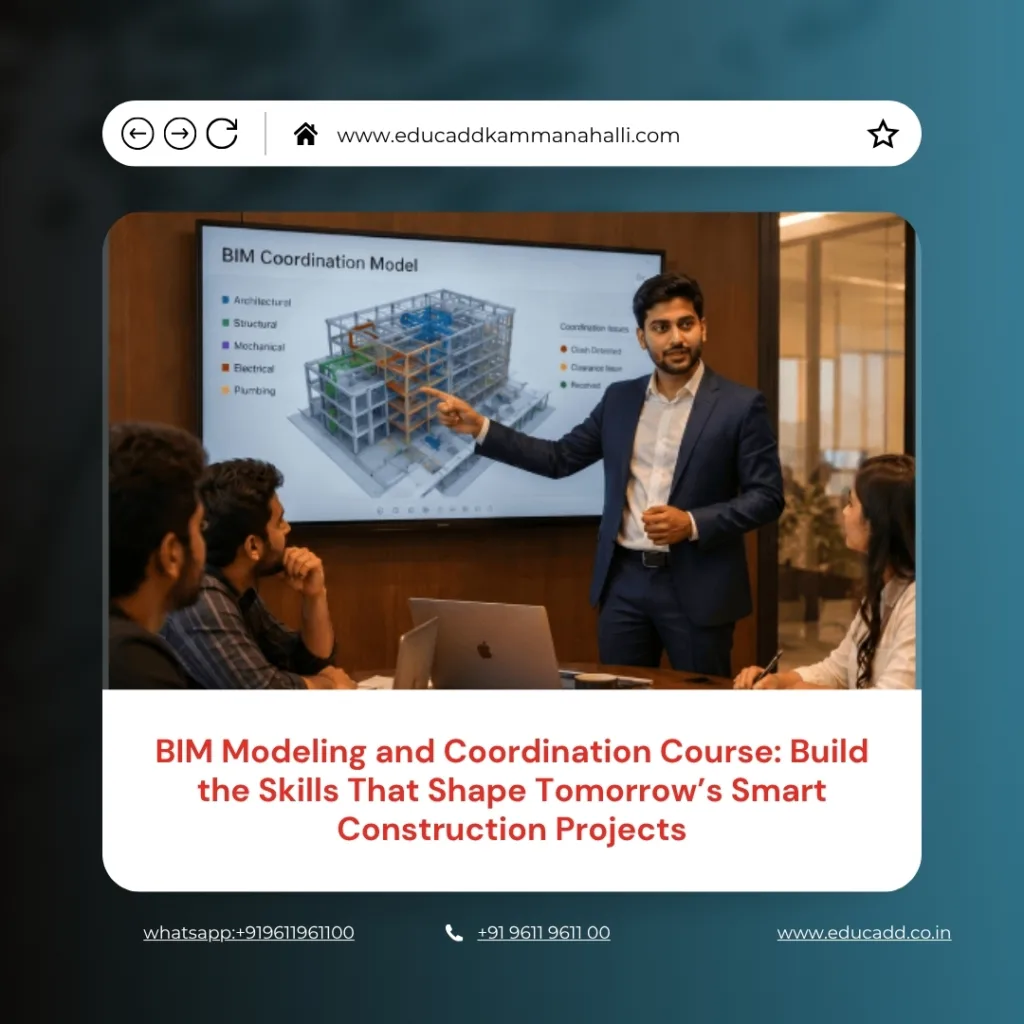
BIM Modeling Coordination Course
Whether you are a student, engineer, architect, or working professional, mastering BIM opens the door to rewarding career opportunities across the globe. As organizations increasingly adopt BIM-driven project delivery, learning modeling and coordination has become a valuable investment for long-term professional growth.
Understanding the Importance of a BIM Modeling and Coordination Course
A BIM Modeling Coordination Course provides learners with the technical expertise required to create intelligent 3D models while coordinating multiple building disciplines. Unlike traditional drafting methods, BIM enables architects, structural engineers, and MEP professionals to collaborate on a unified digital platform. This collaborative environment significantly improves project quality and minimizes communication gaps.
Moreover, learners understand how digital models represent real-world building components with accurate information. As a result, professionals can identify potential issues before construction begins. Consequently, companies reduce project delays, improve productivity, and optimize resource management. Therefore, BIM education has become an essential requirement for professionals seeking a competitive advantage.
Why the Construction Industry Depends on BIM Coordination
Modern construction projects involve several disciplines working together simultaneously. Without proper coordination, design conflicts often result in expensive modifications during construction. Fortunately, BIM coordination allows project teams to detect and resolve clashes before execution begins.
Furthermore, coordinated BIM workflows improve communication among architects, civil engineers, structural consultants, electrical designers, and plumbing specialists. Every stakeholder works with updated project information, ensuring consistency throughout the project lifecycle. Consequently, construction companies achieve greater efficiency while reducing rework and material wastage. This practical approach explains why BIM coordination has become a global industry standard.
Core Skills You Learn During BIM Training
A professional BIM course focuses on both technical knowledge and project coordination skills. Students learn to develop intelligent 3D models using industry-leading software while understanding international BIM standards. Additionally, they gain practical experience in architectural, structural, and MEP modeling.
The course also introduces model coordination, clash detection, quantity takeoff, documentation, visualization, and project collaboration techniques. Furthermore, learners understand how information flows throughout different project stages. These practical skills prepare students to contribute effectively to real construction projects from the very beginning of their careers.
Architectural Modeling Creates the Project Foundation
Architectural modeling forms one of the most important modules in a BIM program. Students learn how to create walls, floors, roofs, windows, doors, ceilings, staircases, and other architectural components with high precision. Every element contains intelligent information that supports project planning and facility management.
Additionally, architectural models provide accurate visualizations that help clients understand project designs before construction begins. Designers can easily update models whenever modifications become necessary. Consequently, project documentation remains consistent while reducing manual drafting efforts. This intelligent workflow greatly improves design accuracy and project efficiency.
Structural BIM Modeling Improves Design Accuracy
Structural modeling plays a significant role in ensuring the safety and stability of buildings. During the course, learners develop structural components including columns, beams, slabs, foundations, reinforcement details, and steel structures using BIM software.
Moreover, structural BIM integrates seamlessly with architectural and MEP models, allowing engineers to verify compatibility between different systems. Since every discipline works within a coordinated environment, structural conflicts become easier to identify and resolve. As a result, construction teams experience fewer site issues, improved quality, and better project performance.
MEP Coordination Enhances Building Performance
Mechanical, Electrical, and Plumbing systems are among the most complex aspects of modern buildings. A BIM Modeling and Coordination Course teaches students how these systems integrate within the overall building structure while maintaining design accuracy.
Furthermore, BIM coordination enables professionals to detect clashes between ducts, pipes, cable trays, structural elements, and architectural components before construction starts. Consequently, contractors avoid costly modifications and unnecessary project delays. This proactive coordination process significantly improves installation efficiency while supporting sustainable building practices.
Clash Detection Minimizes Construction Errors
One of the most valuable features of BIM coordination involves clash detection. Students learn how specialized coordination software identifies conflicts between multiple building systems before actual construction begins. Instead of discovering problems on-site, project teams resolve issues digitally during the design stage.
Additionally, clash detection improves communication among all project stakeholders. Every detected conflict receives proper documentation, allowing teams to implement corrective actions efficiently. Consequently, projects maintain higher quality standards while reducing construction risks and unexpected expenses.
BIM Collaboration Improves Team Productivity
Construction projects require continuous collaboration between architects, engineers, contractors, consultants, and project managers. BIM technology creates a centralized digital environment where every stakeholder accesses updated project information in real time.
Furthermore, cloud-based collaboration platforms simplify communication while maintaining data consistency across different teams. Changes made by one discipline become visible to others immediately. Therefore, project coordination becomes smoother, decision-making becomes faster, and productivity improves significantly throughout the construction lifecycle.
Quantity Takeoff and Cost Estimation Become More Accurate
An important advantage of BIM lies in its ability to generate precise quantities directly from intelligent building models. During training, students learn how BIM automates quantity takeoff processes, minimizing manual calculations and improving estimation accuracy.
Moreover, accurate material quantities help project managers prepare realistic budgets while reducing resource wastage. Contractors can also forecast procurement requirements more effectively. Consequently, projects achieve better financial control, improved planning, and increased profitability from the early design stages until project completion.
Software Covered in a BIM Modeling and Coordination Course
Professional BIM programs introduce learners to globally recognized software widely used by leading construction companies. Students typically gain hands-on experience with Autodesk Revit, Navisworks Manage, AutoCAD, BIM 360, and other project collaboration platforms depending on the curriculum.
Additionally, practical assignments help learners understand how different software applications work together within a BIM workflow. This integrated learning approach develops confidence while preparing students for real industry projects. Therefore, graduates become capable of handling multidisciplinary BIM coordination tasks with greater efficiency.
Career Opportunities After Completing BIM Training
The demand for BIM professionals continues to grow across architecture, engineering, infrastructure, manufacturing, and facility management sectors. After completing a BIM Modeling and Coordination Course, learners can pursue roles such as BIM Modeler, BIM Coordinator, BIM Engineer, BIM Technician, BIM Consultant, Design Coordinator, or BIM Manager.
Furthermore, multinational companies increasingly prefer professionals with BIM expertise because digital construction has become a global standard. Consequently, certified BIM professionals enjoy attractive salary packages, faster career progression, and opportunities to work on international projects across various industries.
Industries That Benefit from BIM Professionals
Although BIM originated within the construction sector, its applications now extend across multiple industries. Residential buildings, commercial complexes, hospitals, airports, railway stations, industrial plants, educational institutions, smart cities, and infrastructure projects all rely heavily on BIM workflows.
Additionally, governments around the world continue introducing BIM mandates for public infrastructure development. This growing adoption creates consistent demand for trained BIM professionals. Therefore, learners who acquire BIM coordination skills position themselves for stable and long-term career opportunities in both domestic and international markets.
Choosing the Right BIM Training Institute
Selecting the right training institute plays a major role in professional success. A quality BIM course should offer experienced trainers, practical projects, updated software, industry-oriented curriculum, placement support, and recognized certification. Hands-on learning remains essential because employers value practical experience alongside theoretical knowledge.
Furthermore, students should evaluate laboratory facilities, project-based assignments, internship opportunities, and trainer expertise before enrolling. A well-designed training program not only develops technical skills but also builds confidence in handling complex multidisciplinary construction projects successfully.
The Future of BIM and Digital Construction
The future of construction is becoming increasingly digital, and BIM continues to evolve alongside technologies such as Artificial Intelligence, Digital Twins, Virtual Reality, Augmented Reality, cloud collaboration, and automation. These innovations are transforming how buildings are designed, constructed, operated, and maintained throughout their lifecycle.
Moreover, organizations continue investing in intelligent project delivery systems that improve efficiency and sustainability. Consequently, professionals equipped with BIM expertise will remain highly valuable in the years ahead. Continuous learning and adaptation will further strengthen career growth as digital construction becomes the global industry norm.
Conclusion
A BIM Modeling Coordination Course is far more than a software training program; it is a gateway to a future-ready career in the rapidly advancing construction industry. By mastering architectural, structural, and MEP modeling along with coordination, clash detection, collaboration, and project management workflows, learners develop the expertise required by leading employers worldwide. As the adoption of BIM continues to accelerate, skilled professionals will remain in high demand across diverse sectors. Investing in comprehensive BIM training today enables individuals to build successful careers, contribute to smarter construction projects, and become an integral part of the digital transformation shaping the future of the built environment.

