
CATIA Design Training: Build World-Class Product Design Skills for a Future-Ready Engineering Career
Engineering design is evolving faster than ever, and companies now expect professionals to create accurate, intelligent, and production-ready digital models. Industries such as automotive, aerospace, industrial machinery, consumer products, and manufacturing rely on advanced CAD software to develop innovative products with greater speed and precision. This growing demand has made CATIA Design Training Course one of the most valuable investments for engineering students and working professionals. By mastering CATIA, learners gain practical skills in 3D modeling, product design, assembly creation, surface modeling, and drafting while improving their career opportunities in highly competitive industries.
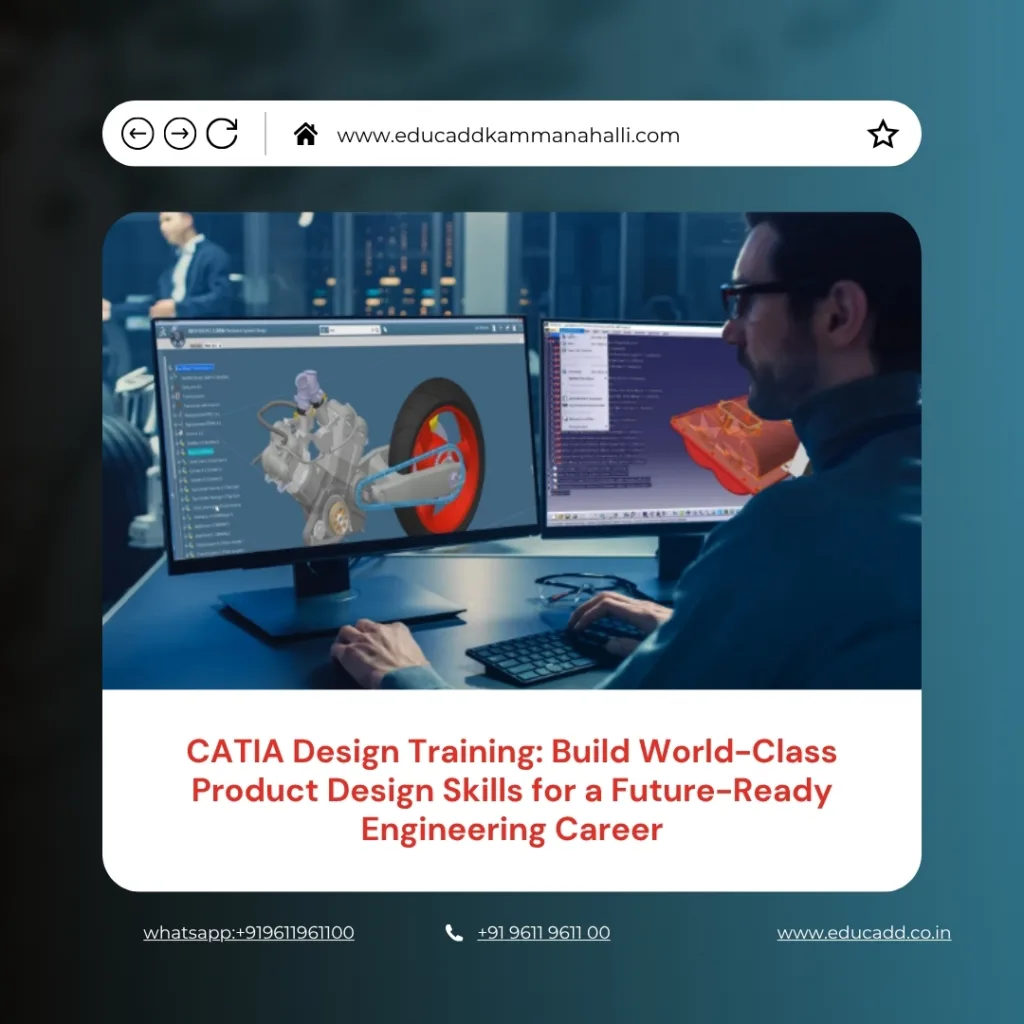
CATIA Design Training Course
Whether you are beginning your engineering journey or planning to upgrade your technical expertise, professional CATIA training provides the knowledge and confidence needed to succeed in modern product development.
Why CATIA Design Training Matters in Modern Engineering
Modern engineering demands more than theoretical knowledge because industries now require professionals who can transform ideas into practical and manufacturable products. CATIA Design Training Course helps learners understand the complete product development process, from concept creation to detailed engineering documentation. Instead of focusing only on software commands, quality training develops analytical thinking, design accuracy, and industry-standard workflows.
As organizations continue to adopt digital engineering solutions, skilled CATIA professionals remain highly valuable. Companies look for engineers who can create reliable models, reduce design errors, and collaborate with cross-functional teams. Therefore, learning CATIA strengthens both technical knowledge and professional confidence while opening doors to exciting engineering careers.
Understanding CATIA Software and Its Capabilities
CATIA, developed by Dassault Systèmes, is one of the world’s leading computer-aided design applications used for complex engineering projects. It provides powerful tools for creating solid models, advanced surfaces, assemblies, sheet metal components, and manufacturing drawings. Unlike basic CAD software, CATIA supports the complete product lifecycle through integrated design, engineering, simulation, and manufacturing capabilities.
The software enables engineers to visualize products before manufacturing begins. Consequently, organizations can identify design issues early, reduce production costs, and improve product quality. Because of these advantages, industries worldwide continue to invest in CATIA-based design environments.
Core Skills You Learn During CATIA Design Training
Professional CATIA Design Training Course covers a wide range of practical skills that prepare learners for real engineering projects. Students begin with interface navigation before progressing to sketch creation, part modeling, assemblies, drafting, and advanced design techniques. Every module builds confidence through practical exercises and industry-focused assignments.
Learners also develop problem-solving abilities by working on real product models. Moreover, they understand design intent, feature relationships, dimensional control, and parametric modeling. These practical experiences help students become job-ready rather than simply software users.
Essential CATIA Modules Covered in Professional Training
A structured training program introduces learners to multiple CATIA workbenches that are widely used in engineering industries. Part Design teaches solid modeling techniques, while Assembly Design focuses on creating complex mechanical assemblies. Drafting converts three-dimensional models into manufacturing drawings that comply with industrial standards.
Surface Design plays a significant role in automotive and aerospace product development because it allows engineers to create complex and aesthetically refined shapes. Furthermore, Sheet Metal Design, Weld Design, and Generative Shape Design provide specialized knowledge required for advanced manufacturing projects.
Industries That Depend on CATIA Professionals
Many leading industries rely on CATIA for designing sophisticated products with exceptional accuracy. Automotive manufacturers use CATIA to design engines, body structures, suspension systems, and interior components. Aerospace companies utilize the software for aircraft structures, turbine components, and lightweight assemblies that demand precise engineering.
The industrial machinery sector also benefits from CATIA because engineers can design machines with improved efficiency and reduced manufacturing complexity. Additionally, consumer electronics, heavy equipment manufacturing, shipbuilding, medical device development, and defense engineering frequently require professionals with advanced CATIA expertise.
Career Opportunities After CATIA Design Training
Completing CATIA Design Training Course creates numerous career opportunities across engineering sectors. Graduates often begin their careers as CAD Design Engineers, Mechanical Design Engineers, Product Design Engineers, Tool Design Engineers, or Automotive Design Engineers. These positions provide excellent opportunities to work on innovative projects involving advanced technology.
With experience, professionals can move into senior engineering, product development, research, technical consulting, or project leadership roles. Since industries continue expanding their digital engineering capabilities, skilled CATIA professionals enjoy strong career growth and competitive salary packages in domestic as well as international markets.
Benefits of Practical Project-Based Learning
Practical experience remains one of the strongest advantages of professional CATIA education. Instead of memorizing software commands, learners work on real engineering components that closely resemble industrial applications. This approach improves design accuracy while strengthening logical thinking and technical decision-making skills.
Project-based learning also enhances portfolio development because students complete multiple design assignments before entering the workforce. Consequently, recruiters can evaluate practical capabilities rather than theoretical knowledge alone. This significantly improves employability and interview performance.
Importance of Parametric Modeling in Product Development
Parametric modeling represents one of CATIA’s most valuable capabilities because it allows engineers to modify designs efficiently without rebuilding complete models. Design parameters remain connected, enabling automatic updates whenever dimensions or features change. This intelligent approach saves valuable engineering time while maintaining design consistency.
Engineers working with evolving product requirements greatly benefit from this flexibility. Furthermore, organizations achieve faster design revisions, reduced engineering costs, and improved collaboration between design and manufacturing departments throughout the product development cycle.
Surface Modeling Enhances Design Innovation
Surface modeling has become increasingly important because modern products require complex curves, attractive aesthetics, and aerodynamic performance. CATIA offers advanced surface design tools that help engineers create sophisticated product geometries with exceptional precision. Automotive exteriors, aircraft components, and consumer products often depend on these capabilities.
Professional CATIA Design Training Course teaches learners how to generate, modify, trim, and analyze complex surfaces effectively. As a result, students gain specialized skills that distinguish them from professionals with only basic CAD knowledge.
Drafting Skills Bridge Design and Manufacturing
Engineering drawings remain essential because manufacturing teams require accurate documentation for production. CATIA Drafting enables engineers to generate standardized technical drawings directly from three-dimensional models. This process improves consistency while minimizing manual drafting errors.
Training also covers dimensioning, tolerancing, annotations, section views, exploded views, and bill of materials preparation. Therefore, learners understand how engineering documentation supports manufacturing, inspection, assembly, and quality assurance activities across industries.
Industry-Oriented Training Improves Job Readiness
Employers consistently prefer candidates who understand practical engineering workflows rather than software alone. Professional CATIA Design Training Course incorporates industrial standards, real manufacturing practices, and design methodologies that align with workplace expectations. Students gain exposure to engineering documentation, product lifecycle concepts, and collaborative design processes.
Additionally, experienced trainers share practical insights from industry projects, helping learners understand professional responsibilities and engineering best practices. This combination of technical knowledge and practical exposure significantly improves workplace readiness.
Certification Adds Value to Your Engineering Profile
A recognized CATIA certification strengthens professional credibility by validating practical software skills and engineering competence. Recruiters often consider certified candidates because certifications demonstrate commitment to continuous learning and technical excellence. They also provide confidence that applicants possess industry-relevant capabilities.
Beyond employment opportunities, certification supports career advancement by improving professional recognition within engineering organizations. Consequently, certified professionals often enjoy better growth prospects, expanded responsibilities, and increased opportunities for specialized design roles.
How to Choose the Right CATIA Design Training Institute
Selecting the right training institute plays a major role in achieving successful learning outcomes. A quality institute should offer experienced trainers, updated course content, practical laboratory sessions, industry-oriented projects, placement assistance, and recognized certification. These factors collectively improve both learning quality and career opportunities.
Prospective learners should also evaluate training infrastructure, software versions, classroom facilities, student reviews, and post-training support before enrolling. A well-structured institute creates an environment where students develop confidence through consistent practical learning and professional guidance.
Future Trends Driving Demand for CATIA Professionals
Engineering industries continue embracing digital transformation, automation, artificial intelligence, and smart manufacturing technologies. These advancements increase the need for professionals capable of designing intelligent products using advanced CAD platforms. CATIA Design Training prepares engineers to adapt to these changing industry requirements while maintaining strong technical competence.
Digital twins, collaborative engineering, cloud-based product development, and sustainable manufacturing will further expand the importance of CATIA expertise. Therefore, professionals who continuously update their skills will remain highly competitive in the evolving engineering landscape.
Conclusion
The engineering industry rewards professionals who combine creativity with advanced technical expertise, and CATIA Design Training Course provides the perfect foundation for achieving both. From mastering 3D modeling and assembly design to developing production-ready engineering drawings and complex surface models, CATIA equips learners with skills valued across automotive, aerospace, manufacturing, industrial machinery, and product development sectors.
More importantly, practical training builds confidence, improves problem-solving abilities, and prepares students for real-world engineering challenges. As technology continues transforming product development, investing in comprehensive CATIA Design Training is a strategic decision that enhances employability, accelerates career growth, and positions aspiring engineers for long-term success in the global engineering industry.

