
Master Mechanical CADD in Bangalore
Modern manufacturing relies on precision digital engineering to bring complex machines to life. Therefore, choosing to Master Mechanical CADD in Bangalore gives aspiring engineers a direct advantage in today’s competitive industrial market. Across India’s leading technology and aerospace hub, top employers actively recruit professionals who can turn conceptual sketches into production-ready prototypes. Furthermore, enrolling in practical job oriented courses bridges the gap between academic theory and factory-floor execution. When you train at a dedicated CADD training institute, you build the exact software fluency that global design firms demand.
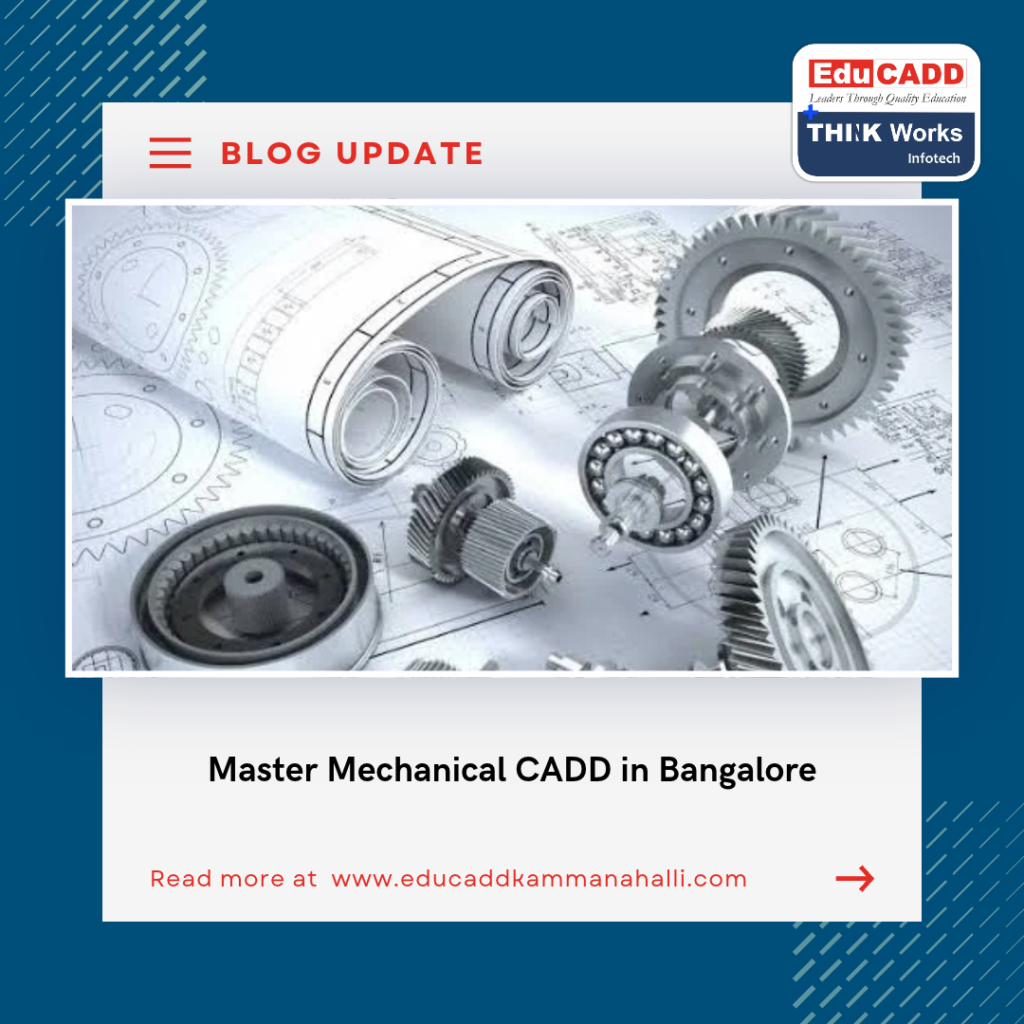
Why Mechanical Engineering Design Demands Digital Mastery
Traditional manual drafting cannot keep pace with modern product lifecycles. Today, every automotive component, aerospace turbine, and consumer appliance begins as a parametric digital model. Consequently, engineers must validate structural integrity and assembly tolerances long before physical manufacturing starts.
Moreover, companies save substantial production costs by spotting design flaws in virtual environments. Completing structured CADD training empowers you to simulate real-world mechanical stresses accurately. As a result, you enter the workforce ready to contribute to live research and development teams immediately.
Core Software Pillars of a Mechanical CADD Course
A comprehensive mechanical CADD course covers multiple specialized platforms. Each tool handles a distinct phase of product creation, from initial 2D layouts to advanced finite element simulations.
-
AutoCAD course: You master foundational 2D orthographic projections, isometric views, layer management, and industrial schematics.
-
SolidWorks course: You build parametric 3D solid parts, sheet metal enclosures, weldment frames, and detailed manufacturing drawings.
-
CATIA training: You create complex Class-A surface models and massive assemblies tailored for automotive and aerospace giants.
-
Creo training: You design dynamic mechanisms, core mold cavities, and structural simulations for heavy machinery.
-
HyperMesh training: You generate high-fidelity finite element meshes to prepare prototypes for thermal and crash-test analyses.
-
GD&T training: You apply Geometric Dimensioning and Tolerancing standards so components assemble seamlessly across global supply chains.
Mastering these integrated platforms ensures that you handle every stage of product engineering smoothly.
Bridging Mechanical Design with Cross-Disciplinary Engineering
Modern industrial facilities rarely operate in isolation. Instead, mechanical engineers collaborate daily with electrical, civil, and software teams to deliver complete turnkey projects. Studying at a multidisciplinary technical training institute allows you to understand how adjacent engineering domains interact with your designs.
For instance, automated assembly lines require synchronized control panels and sensor wiring. Learning schematic layouts through an Electrical CADD course helps you coordinate equipment clearances with electrical engineers. Similarly, heavy machinery requires reinforced foundations and factory floor planning. Familiarity with a civil CADD course alongside an Architectural CADD course ensures your equipment fits seamlessly within industrial plants.
Additionally, modern building projects integrate mechanical ventilation and piping within 3D environments. Exposure to a Revit course and a BIM course lets you detect spatial clashes early. You can also see how structural teams use a STAAD Pro course and an ETABS course to calculate load dynamics for industrial structures. Even workspace ergonomics benefit from principles taught in an Interior design course.
Enhancing Engineering Workflows with Full Stack Programming
Digital transformation has merged hardware engineering with software automation. Forward-thinking engineers write custom scripts to automate repetitive modeling tasks and build internal web calculators. Studying at a reputed skill development institute gives you access to modern coding tracks alongside core design programs.
For example, taking a Full Stack Web Development course teaches you how to build interactive browser tools for engineering teams. Likewise, completing a Python Full Stack course equips you to write clean automation scripts and manage component databases. Combining mechanical design fluency with software programming makes you an invaluable asset to modern R&D departments.
Growing Engineering Consultancies Through Digital Marketing
Many experienced mechanical designers eventually launch independent prototyping studios or step into technical sales leadership. However, technical excellence alone does not guarantee a steady pipeline of corporate clients. You also need strong online visibility to attract international manufacturing contracts.
Enrolling in a digital marketing course at a recognized digital marketing institute teaches you how to position your engineering brand online. Through structured digital marketing training, you learn how to generate consistent B2B inquiries without relying solely on traditional trade shows.
-
SEO course: You optimize your engineering portfolio website to rank high when procurement managers search for design vendors.
-
Google Ads course: You run targeted search campaigns that capture high-intent commercial leads immediately.
-
Social media marketing course: You showcase 3D CAD animations and prototype renders on LinkedIn and YouTube to build industry authority.
-
Content marketing course: You publish technical whitepapers and engineering case studies that prove your problem-solving expertise.
-
Email marketing course: You nurture long-term relationships with corporate buyers through automated technical newsletters.
-
AI digital marketing course: You use generative AI tools to streamline market research, technical copywriting, and campaign analytics.
Career-Focused Marketing Tracks for Technical Leaders
Professionals who transition into product management or growth roles often pursue deeper specialization in online customer acquisition. Taking a job oriented digital marketing course gives you practical experience managing real advertising budgets and measuring conversion metrics.
Furthermore, choosing a digital marketing course with placement connects graduates directly with corporate hiring networks. Experienced managers aiming for executive leadership frequently enroll in a professional digital marketing course alongside an advanced Master’s in digital marketing.
-
Performance marketing course: You track customer acquisition costs, return on ad spend, and multi-channel attribution funnels.
-
Digital marketing internship: You gain hands-on agency experience while managing active client accounts under expert supervision.
-
Digital marketing live project training: You practice real-time campaign optimization on live websites to build verifiable case studies.
These practical skills help technical professionals diversify their capabilities and build a resilient digital marketing career alongside their engineering background.
Industrial Career Roles for Mechanical CADD Specialists
Graduating from a respected professional training institute unlocks diverse career paths across automotive, aerospace, defense, and consumer product sectors. Recruiters actively seek candidates who demonstrate verified software proficiency through real project portfolios.
| Engineering Specialization | Primary Software Stack | Targeted Industry Roles |
| Product Design & R&D | SolidWorks, Creo, GD&T | Product Design Engineer, Mechanical R&D Specialist |
| Automotive & Aerospace | CATIA, HyperMesh, AutoCAD | Class-A Surface Modeler, CAE Meshing Analyst |
| Tooling & Sheet Metal | AutoCAD, SolidWorks, Creo | Tool and Die Designer, Sheet Metal Design Engineer |
| Industrial Automation | AutoCAD, Electrical CADD, Python | Mechatronics Designer, CAD Automation Developer |
Each role offers clear upward mobility into senior design lead, project manager, and chief engineering positions.
Essential Criteria for Selecting Your Training Program
Not all training programs deliver equal career outcomes. Before enrolling, verify that your chosen center emphasizes practical execution over passive classroom lectures.
First, ensure the curriculum centers on live industrial assignments. You should model real gearbox assemblies, automotive brackets, and sheet metal enclosures from scratch. Second, confirm that you graduate with a structured digital portfolio containing 2D production drawings, 3D parametric assemblies, and tolerance stack-up reports. Finally, look for dedicated pre-placement grooming that includes aptitude practice, resume structuring, and mock technical interviews.
Accelerate Your Mechanical Engineering Career Today
The global manufacturing sector rewards engineers who combine solid theoretical fundamentals with hands-on digital prototyping skills. Building fluency across 3D modeling, surface design, and tolerance analysis gives you the confidence to excel in technical interviews and deliver immediate value on the factory floor. Connecting with an established local learning center like EduCADD Kammanahalli provides expert mentorship, licensed software labs, and dedicated placement support. Start your training today and build a thriving, future-ready career in mechanical engineering design!

