
Top SolidWorks Course in Bangalore for Engineers
Modern mechanical engineering demands rapid digital prototyping to transform innovative ideas into market-ready products. Therefore, enrolling in the Top SolidWorks Course in Bangalore for Engineers gives aspiring designers a decisive edge in today’s competitive manufacturing sector. Across India’s leading aerospace, automotive, and industrial automation hub, engineering firms rely on parametric 3D modeling to accelerate product development. Consequently, recruiters actively seek graduates who can build complex assemblies, run stress simulations, and generate error-free manufacturing blueprints. Joining practical job oriented courses at a dedicated CADD training institute bridges the gap between university textbooks and real factory-floor production.
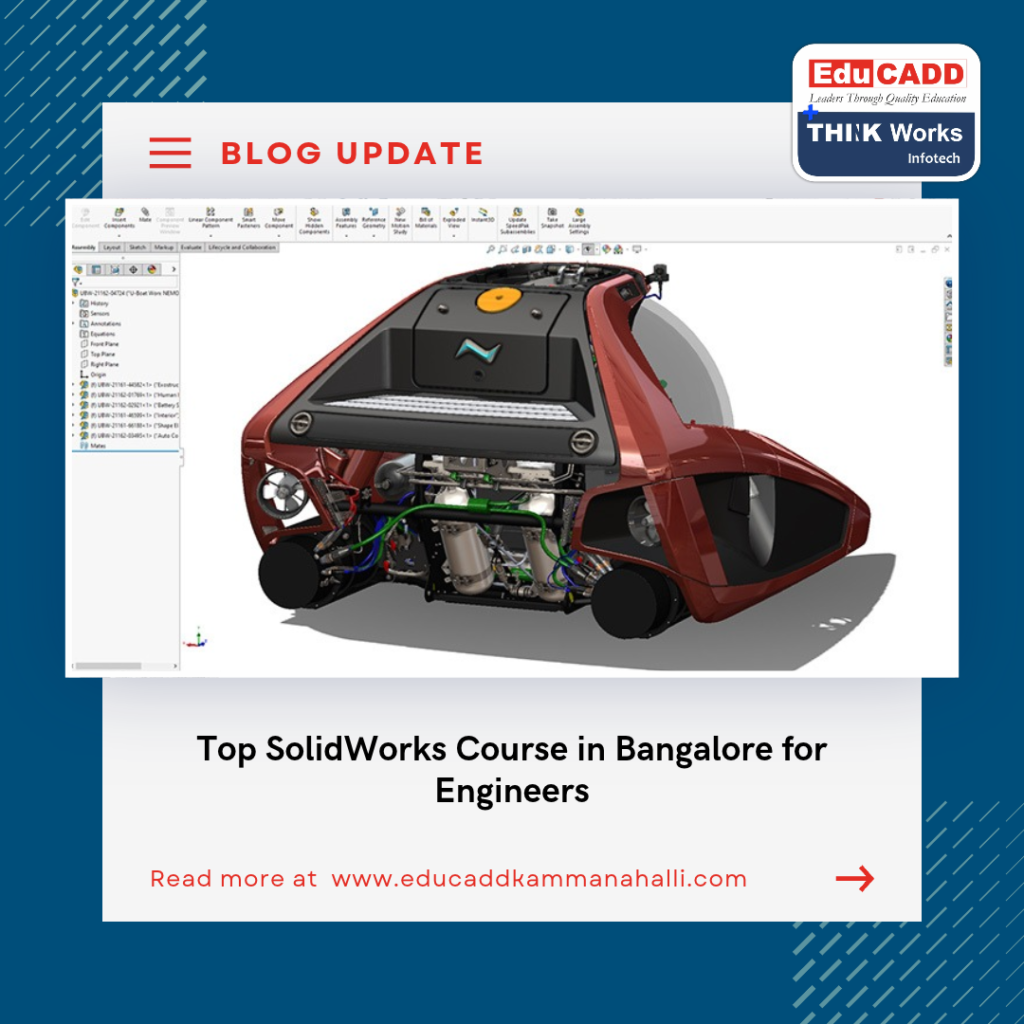
Why SolidWorks Mastery Accelerates Engineering Careers
Traditional 2D drafting alone cannot capture the intricate geometry of modern mechanical assemblies. Instead, parametric 3D modeling allows engineers to visualize part interactions, detect physical interferences, and modify dimensions dynamically across entire assemblies. As a result, companies cut prototyping costs and bring reliable products to market much faster.
Moreover, employers value engineers who understand how digital models translate into real CNC machining and sheet metal fabrication. Completing structured CADD training teaches you how to validate structural strength, calculate mass properties, and produce standardized manufacturing drawings. You enter technical interviews with verified project proof rather than mere theoretical knowledge.
Core Modules Covered in a SolidWorks Course
A comprehensive SolidWorks course guides you systematically from basic sketch constraints to advanced surface modeling and assembly simulations. You build real mechanical components at every stage of the curriculum.
-
Parametric Part Modeling: You master 2D sketching, extrusions, sweeps, lofts, and feature trees to build easily editable 3D solid parts.
-
Complex Assembly Design: You apply concentric, coincident, and mechanical mates to assemble moving mechanisms and detect component collisions.
-
Sheet Metal and Weldments: You design bent sheet metal enclosures, generate flat-pattern laser cutting layouts, and build structural weldment frames.
-
Production Detailing and BOM: You generate orthographic, section, and exploded assembly views complete with automated bill-of-materials tables.
-
Motion and Static Simulation: You apply real-world forces, material properties, and fixtures to test stress distribution and part deflection virtually.
Mastering these core capabilities ensures that you can handle complete product design lifecycles inside professional R&D environments.
Expanding Your Mechanical Engineering Software Toolkit
While parametric solid modeling forms the heart of product design, leading manufacturing firms often use multiple specialized platforms across different departments. Enrolling in a comprehensive mechanical CADD course lets you pair solid modeling with complementary engineering tools.
For example, starting with an AutoCAD course builds rock-solid 2D schematic and orthographic drafting speed. Furthermore, completing CATIA training prepares you for advanced Class-A surface modeling in aerospace and automotive body design. Taking Creo training strengthens your expertise in heavy machinery linkages and injection mold design.
Additionally, simulation analysts rely on HyperMesh training to generate high-fidelity finite element meshes for crash and thermal testing. Finally, mastering GD&T training ensures that your manufacturing drawings communicate exact geometric tolerances across global supply chains. Combining these tools makes you an exceptionally versatile mechanical design engineer.
Cross-Disciplinary Collaboration Across Engineering Fields
Modern industrial plants and turnkey engineering projects require seamless teamwork across mechanical, electrical, civil, and software teams. Studying at a multidisciplinary technical training institute or skill development institute helps you understand how adjacent disciplines connect with mechanical design.
For instance, automated machinery depends on integrated electrical control cabinets and sensor wiring. Learning schematic layouts through an Electrical CADD course enables you to coordinate panel clearances cleanly. Similarly, heavy industrial equipment requires reinforced concrete foundations and factory floor planning. Familiarity with a civil CADD course alongside an Architectural CADD course helps you align machinery layouts with building plans.
Furthermore, modern commercial facilities integrate HVAC piping and equipment inside 3D building models. Exposure to a Revit course and a BIM course lets you resolve spatial clashes early. You can also see how structural teams use a STAAD Pro course and an ETABS course to verify building load capacities, while spatial planners apply principles from an Interior design course. Meanwhile, engineers who complete a Full Stack Web Development course or a Python Full Stack course can write custom CAD automation scripts and build internal engineering calculators.
Growing Design Consultancies Through Digital Marketing
Many experienced mechanical designers eventually launch independent prototyping consultancies or step into technical sales leadership. However, superior CAD skills alone will not generate a steady flow of corporate contracts without strong online visibility.
Enrolling in a digital marketing course at a recognized digital marketing institute teaches technical leaders how to attract global B2B clients. Through hands-on digital marketing training, you learn how to position your engineering services effectively across search and social channels.
-
SEO course: You optimize your engineering website so procurement managers find your design studio on top search results.
-
Google Ads course: You run targeted search campaigns that capture high-intent industrial leads immediately.
-
Social media marketing course: You showcase 3D CAD animations and prototype renders on LinkedIn and YouTube to build industry trust.
-
Content marketing course: You publish technical whitepapers and engineering case studies that demonstrate your problem-solving expertise.
-
Email marketing course: You nurture relationships with manufacturing buyers through automated technical newsletters.
-
AI digital marketing course: You leverage generative AI tools to streamline market research, technical copywriting, and campaign reporting.
Professionals seeking deeper specialization can also pursue a job oriented digital marketing course, a digital marketing course with placement, a professional digital marketing course, or an executive Master’s in digital marketing. Practical tracks featuring a performance marketing course, a digital marketing internship, and digital marketing live project training help technical entrepreneurs build a resilient digital marketing career alongside their engineering practice.
Lucrative Career Roles for SolidWorks Certified Engineers
Graduating from a respected professional training institute opens doors to high-growth engineering roles across automotive, medical devices, robotics, and consumer electronics. Recruiters actively value candidates who demonstrate verified modeling speed and manufacturing awareness.
| Engineering Role | Primary Tool Focus | Key Daily Responsibilities |
| Product Design Engineer | SolidWorks, GD&T, AutoCAD | Conceptualize 3D parts, build assemblies, release production blueprints |
| Sheet Metal Design Engineer | SolidWorks Sheet Metal, AutoCAD | Design enclosures, generate flat patterns, optimize laser-cut nesting |
| Tool & Fixture Designer | SolidWorks, Creo, GD&T | Create custom jigs, manufacturing fixtures, and precision tooling |
| CAE & Simulation Engineer | SolidWorks Simulation, HyperMesh | Run stress, thermal, and motion analyses to validate part durability |
Each position offers clear career progression into senior design lead, R&D manager, and principal product architect roles.
What to Look for in a SolidWorks Training Program
Before enrolling in any CAD program, verify that the center prioritizes hands-on industrial modeling over passive slide presentations. First, confirm that you will build real gearbox assemblies, sheet metal cabinets, and mechanical linkages from scratch. Second, ensure you graduate with a structured digital portfolio showcasing 3D parametric models, exploded views, and tolerance drawings. Finally, look for dedicated pre-placement grooming that includes aptitude practice, resume building, and mock technical interviews.
Accelerate Your Mechanical Design Career Today
Mastering parametric 3D modeling gives you the technical confidence and practical portfolio needed to thrive in modern product engineering. Building fluency across part modeling, assembly mates, sheet metal design, and manufacturing drawings prepares you to deliver immediate value on any R&D team. Connecting with an established local learning hub like EduCADD Kammanahalli provides expert mentorship, licensed design workstations, and dedicated placement support. Enroll today and build a rewarding, future-ready career in mechanical engineering design!

