
Advanced BIM Training for Civil Engineers: The Future-Ready Skill That Transforms Modern Construction Projects
The construction industry is experiencing a major digital transformation, and Advanced BIM Training Civil Engineers has become one of the most valuable professional development opportunities in today’s market. Building Information Modeling, commonly known as BIM, has changed how engineers design, plan, execute, and manage construction projects. As infrastructure projects become more complex, organizations seek professionals who can handle digital workflows, improve collaboration, and deliver projects with greater accuracy. Consequently, civil engineers who invest in advanced BIM skills gain a competitive advantage in their careers.
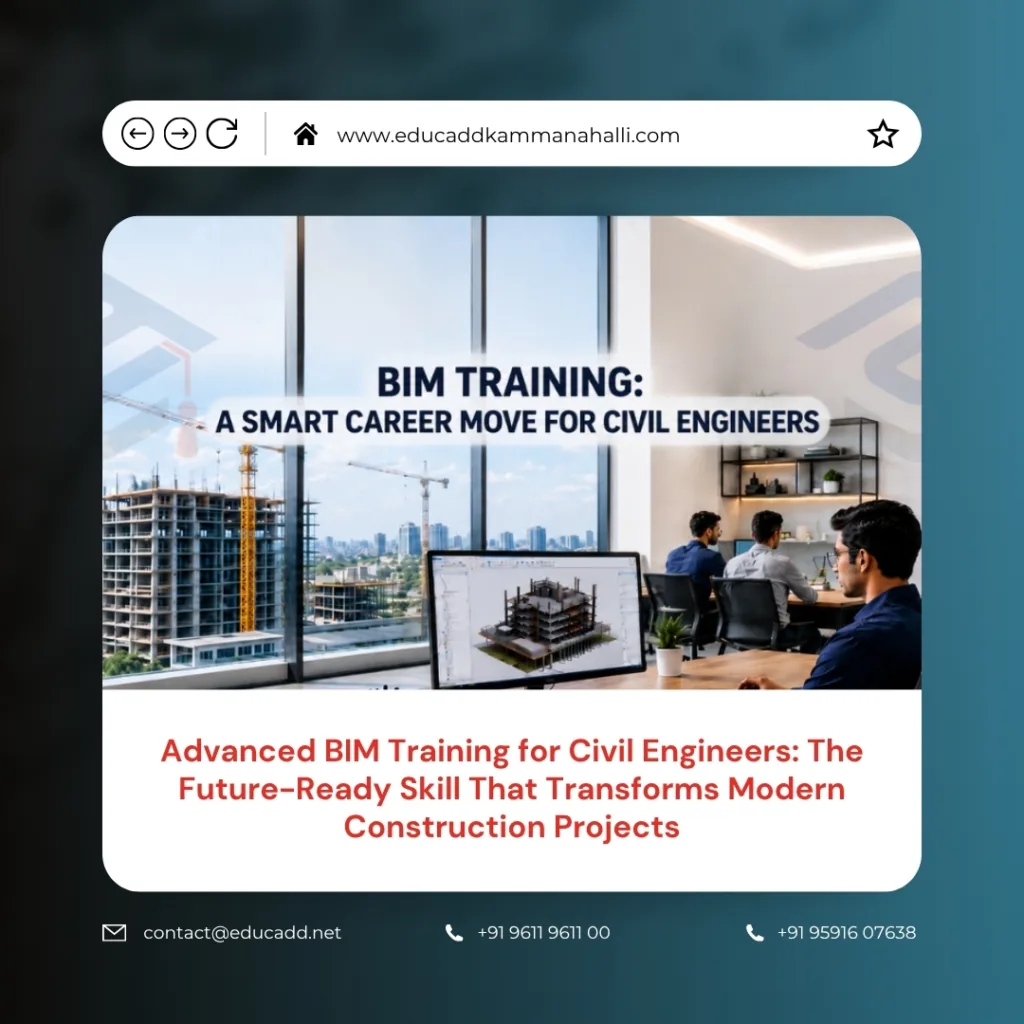
Advanced BIM Training Civil Engineers
Furthermore, these skills help professionals reduce project risks, enhance productivity, and contribute to smarter construction practices. As a result, advanced BIM knowledge is no longer an optional skill but an essential requirement for engineers aiming to excel in modern construction environments.
Understanding the Evolution of BIM Technology
Building Information Modeling has evolved significantly over the past decade. Initially, engineers used BIM primarily for creating three-dimensional models. However, modern BIM platforms now support project planning, cost estimation, scheduling, facility management, and sustainability analysis. This evolution has expanded the role of civil engineers beyond traditional design responsibilities.
Today, BIM integrates multiple project disciplines into a single digital environment. Engineers can visualize project components, detect conflicts before construction begins, and coordinate with stakeholders more effectively. Moreover, organizations increasingly rely on BIM-driven workflows to improve project outcomes and reduce costly errors. Therefore, advanced BIM training equips civil engineers with the knowledge required to manage these sophisticated digital processes confidently and efficiently.
Why Civil Engineers Need Advanced BIM Skills Today
The demand for BIM professionals continues to grow across construction, infrastructure, transportation, and real estate sectors. Companies are searching for engineers who can work within collaborative digital environments and contribute to project success through data-driven decision-making.
Advanced BIM Training Civil Engineers enables engineers to understand complex project workflows and coordinate multiple disciplines simultaneously. In addition, it helps professionals analyze project performance using intelligent models rather than relying solely on traditional drawings. Consequently, engineers become more valuable assets to employers and clients alike. Furthermore, the ability to manage BIM processes often opens doors to leadership roles and specialized career opportunities within the construction industry.
The Core Components Covered in Advanced BIM Training
A comprehensive BIM training program covers a wide range of technical and management-oriented concepts. These modules help engineers develop expertise in both modeling and project coordination.
Key learning areas often include:
- Advanced 3D modeling and parametric design techniques
- Clash detection, coordination, and project collaboration workflows
Beyond these areas, trainees also learn data management, model validation, project documentation, and BIM standards implementation. Additionally, advanced courses focus on integrating BIM with real-world construction practices. Therefore, engineers gain practical skills that can be immediately applied to professional projects, making their learning experience highly valuable and industry relevant.
Enhancing Design Accuracy Through BIM Methodologies
One of the greatest advantages of BIM lies in its ability to improve design accuracy. Traditional design methods often involve separate drawings and disconnected information sources. As a result, inconsistencies and errors can emerge during project execution.
Advanced BIM training teaches engineers how to create intelligent models that automatically update across all project views. Consequently, design modifications become easier to manage and verify. Furthermore, engineers can identify conflicts and inconsistencies early in the design stage. This proactive approach reduces rework, minimizes delays, and improves overall project quality. Therefore, organizations benefit from more reliable project outcomes and better resource utilization throughout the construction lifecycle.
Improving Project Collaboration and Communication
Construction projects involve architects, structural engineers, MEP professionals, contractors, and project managers. Effective collaboration among these stakeholders is critical for project success. However, communication challenges often create delays and misunderstandings.
Advanced BIM Training Civil Engineers establish collaborative workflows that improve information sharing and coordination. Engineers learn how to work within centralized project environments where all stakeholders access updated project data. Moreover, BIM platforms provide visualization tools that make complex technical information easier to understand. Consequently, project teams can make informed decisions faster and resolve issues before they escalate into major problems. This collaborative approach ultimately enhances project efficiency and stakeholder satisfaction.
The Role of BIM in Infrastructure Development
Infrastructure projects require extensive planning, coordination, and long-term management. Roads, bridges, railways, airports, and utility networks involve numerous technical complexities that demand accurate project information.
Advanced BIM training prepares civil engineers to manage these large-scale infrastructure developments using digital technologies. Engineers learn how to model terrain, analyze site conditions, and coordinate infrastructure systems within a unified environment. Furthermore, BIM supports lifecycle management by maintaining accurate asset information long after construction ends. Therefore, infrastructure owners gain better control over maintenance, operations, and future upgrades, ensuring long-term project value and sustainability.
Integrating BIM with Construction Scheduling
Modern construction projects require careful schedule management to meet deadlines and budget targets. BIM introduces advanced scheduling capabilities through 4D modeling, where time-related information becomes integrated with project models.
Through Advanced BIM Training Civil Engineers, engineers learn to connect project schedules with digital models. This integration enables teams to visualize construction sequences before work begins. As a result, potential scheduling conflicts become easier to identify and resolve. Moreover, project managers can evaluate alternative construction strategies and optimize resource allocation. Consequently, projects experience improved planning accuracy and greater operational efficiency throughout the execution phase.
Cost Management and 5D BIM Applications
Cost control remains a top priority for every construction project. Traditional estimation methods often involve manual calculations and fragmented data sources, increasing the risk of inaccuracies.
Advanced BIM training introduces engineers to 5D BIM, where cost information integrates directly into project models. This capability allows engineers to generate accurate quantity takeoffs and cost estimates more efficiently. Furthermore, any design modification automatically updates related cost information. Therefore, stakeholders gain real-time visibility into project budgets and financial implications. This enhanced transparency supports better decision-making and helps organizations maintain stronger financial control throughout project delivery.
BIM and Sustainable Construction Practices
Sustainability has become a major focus within the global construction industry. Governments, clients, and communities increasingly expect projects to minimize environmental impact while maximizing resource efficiency.
Advanced BIM training enables civil engineers to evaluate sustainability factors during project development. Engineers can analyze energy performance, material consumption, and environmental impacts using digital models. Moreover, BIM facilitates the selection of sustainable design alternatives based on measurable data. Consequently, organizations can achieve environmental objectives while maintaining project quality and profitability. This capability makes BIM an important tool for supporting responsible and future-focused construction practices.
Career Opportunities After Advanced BIM Training
Professionals with advanced BIM expertise enjoy access to diverse career opportunities across multiple industries. Employers actively seek candidates who can contribute to digital transformation initiatives and improve project performance.
Some popular career paths include:
- BIM Engineer
- BIM Coordinator
- BIM Manager
- Digital Construction Specialist
- Infrastructure Modeling Expert
- Project Information Manager
In addition, multinational companies and large infrastructure organizations frequently prioritize BIM-certified professionals during recruitment. Consequently, engineers with advanced BIM qualifications often experience stronger career growth and improved earning potential. This increasing demand makes BIM training a strategic investment for long-term professional success.
The Importance of BIM Standards and Compliance
Successful BIM implementation requires adherence to established standards and best practices. Without standardized processes, project teams may encounter inconsistencies that reduce efficiency and create confusion.
Advanced BIM training introduces engineers to international BIM standards, documentation requirements, and compliance frameworks. Engineers learn how to structure project information, maintain data quality, and ensure consistent model development. Furthermore, compliance with industry standards promotes smoother collaboration among project participants. As a result, organizations achieve greater reliability, improved quality control, and enhanced project transparency. Therefore, understanding BIM standards is essential for professionals working on modern construction projects.
Future Trends Shaping BIM Technology
The BIM landscape continues to evolve as emerging technologies create new possibilities for the construction industry. Artificial intelligence, digital twins, cloud computing, and automation are transforming how projects are planned and managed.
Advanced BIM training helps engineers stay prepared for these technological advancements. Engineers learn how BIM integrates with innovative tools that support predictive analysis, real-time monitoring, and intelligent decision-making. Moreover, digital twins are enabling asset owners to manage facilities more effectively throughout their operational lifespan. Consequently, professionals who understand these emerging trends position themselves at the forefront of industry innovation and technological leadership.
Selecting the Right Advanced BIM Training Program
Choosing the right training program plays a crucial role in achieving meaningful learning outcomes. Not all BIM courses provide the same level of depth, practical exposure, or industry relevance.
Engineers should evaluate training providers based on curriculum quality, software coverage, instructor expertise, and hands-on project experience. Additionally, certification recognition and industry alignment should be considered during the selection process. A strong training program combines theoretical knowledge with practical application, enabling participants to develop real-world skills. Therefore, investing time in selecting the right course can significantly influence professional growth and future career opportunities.
How BIM Training Creates Long-Term Professional Value
The benefits of BIM training extend far beyond immediate job responsibilities. Engineers who master BIM become capable of leading digital transformation initiatives within their organizations. Furthermore, they contribute to improved project delivery, stronger collaboration, and enhanced operational efficiency.
As construction technologies continue to evolve, organizations will increasingly rely on BIM-driven workflows. Consequently, professionals with advanced BIM expertise will remain highly relevant in the marketplace. Their ability to manage information-rich digital environments positions them as key contributors to organizational success. Therefore, BIM training creates lasting professional value that supports career advancement for years to come.
Conclusion
The construction industry is rapidly embracing digital technologies, making Advanced BIM Training Civil Engineers an essential investment for future success. BIM empowers engineers to improve design accuracy, strengthen collaboration, optimize scheduling, manage costs, and support sustainable construction practices. Furthermore, it provides access to exciting career opportunities and prepares professionals for emerging technological trends. As infrastructure and construction projects become increasingly complex, organizations will continue to seek engineers who possess advanced BIM expertise. Therefore, civil engineers who develop these skills today position themselves as future-ready professionals capable of leading innovation, improving project outcomes, and driving the next generation of construction excellence.

