
Advanced Building Information Modeling Training: Master BIM Skills and Build a Successful Career in the Digital Construction Industry
The construction industry is rapidly embracing digital technologies to improve planning, design, execution, and project management. Among these innovations, Advanced Building Information Modeling Training has become one of the most valuable learning programs for students, engineers, architects, designers, and construction professionals who want to stay ahead in this competitive field. Building Information Modeling (BIM) is no longer limited to creating three-dimensional models. Instead, it has evolved into a comprehensive digital process that integrates architecture, structural engineering, mechanical systems, electrical layouts, plumbing, quantity estimation, project scheduling, facility management, and lifecycle maintenance into one intelligent model.
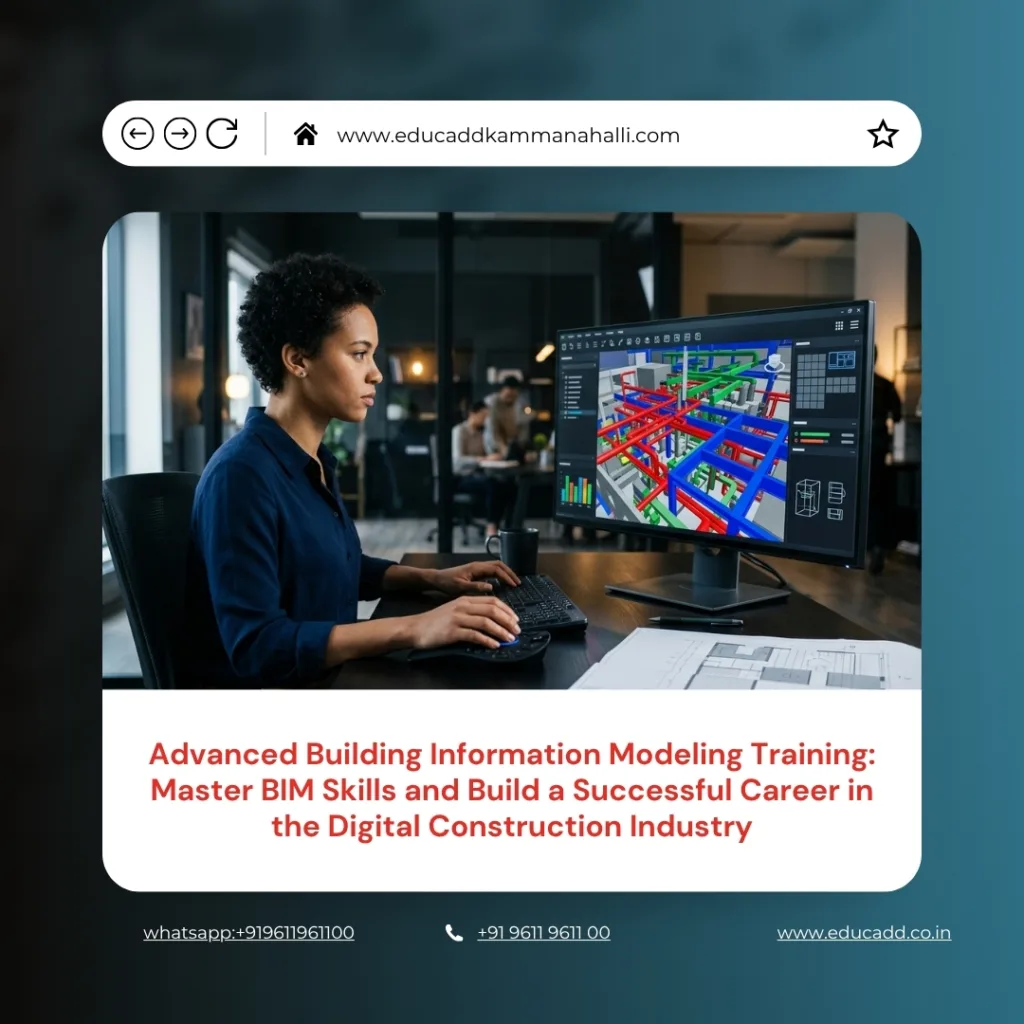
Advanced Building Information Modeling Training
As organizations continue to adopt BIM-based workflows, professionals with advanced BIM expertise enjoy better career opportunities, higher salaries, and stronger industry recognition. Therefore, enrolling in Advanced Building Information Modeling Training is an excellent investment for anyone looking to build a rewarding career in modern construction and infrastructure development.
Understanding the Importance of Advanced Building Information Modeling Training
Modern construction projects involve multiple teams working together on complex designs, tight schedules, and strict budgets. Traditional drafting methods often lead to communication gaps, design conflicts, and costly project delays. However, Advanced Building Information Modeling Training equips learners with the practical knowledge required to eliminate these challenges through collaborative digital workflows.
Unlike conventional CAD drafting, BIM creates intelligent models that contain detailed information about every component of a building. Every wall, beam, pipe, duct, electrical panel, and structural element is connected within a unified database. Whenever one change is made, all related drawings and schedules update automatically, reducing manual errors and saving valuable time.
Students also learn how BIM improves collaboration between architects, structural engineers, MEP professionals, contractors, consultants, and project managers. This collaborative environment increases productivity while ensuring that every stakeholder works using the latest project information.
Why BIM Skills Are Becoming Essential Across the Construction Industry
The demand for BIM professionals has increased significantly because governments, private developers, and multinational construction companies now prefer digital project delivery. Large infrastructure projects require seamless coordination between different engineering disciplines, and BIM provides the perfect platform to achieve this objective.
Advanced Building Information Modeling Training prepares learners to meet these evolving industry requirements by developing technical expertise alongside practical project management skills.
Professionals with BIM knowledge contribute to projects in various ways:
- They improve design accuracy by identifying clashes before construction begins.
- They reduce project costs through better planning, coordination, and resource management.
As industries continue their digital transformation, BIM professionals become valuable assets capable of handling increasingly complex construction challenges.
Comprehensive Knowledge You Gain Through Advanced Building Information Modeling Training
One of the greatest strengths of Advanced Building Information Modeling Training is its comprehensive curriculum. Instead of focusing on a single software application, advanced BIM programs introduce learners to an integrated workflow that covers the complete building lifecycle.
Students begin by understanding BIM concepts, modeling standards, project coordination techniques, and digital collaboration practices. They then progress toward advanced architectural modeling, structural detailing, mechanical system design, electrical layouts, plumbing coordination, documentation, scheduling, quantity take-offs, and visualization.
The training also introduces cloud collaboration, interdisciplinary coordination, model validation, clash detection, and project documentation. Learners gain confidence by working on industry-based projects that simulate real construction environments.
This practical approach helps students understand how every engineering discipline contributes to the successful completion of a construction project.
Mastering Architectural Modeling for Smarter Building Design
Architectural modeling forms the foundation of every BIM project. During Advanced Building Information Modeling Training, students learn how to create intelligent architectural models that accurately represent real-world buildings.
Instead of simply drawing walls and doors, learners create information-rich building elements containing dimensions, material specifications, construction details, cost information, and performance characteristics. These intelligent models allow architects and engineers to make informed decisions during every project stage.
Students also develop expertise in designing residential buildings, commercial complexes, educational institutions, hospitals, hotels, shopping malls, industrial facilities, and mixed-use developments. They understand how proper architectural modeling improves coordination with structural and MEP teams while reducing design revisions.
As their skills improve, learners become capable of producing professional documentation that meets international BIM standards.
Learning Structural BIM Modeling for Better Engineering Accuracy
Structural engineering plays a crucial role in ensuring the safety and stability of any construction project. Advanced Building Information Modeling Training enables students to create highly accurate structural models that integrate seamlessly with architectural designs.
Learners model foundations, columns, beams, slabs, retaining walls, trusses, staircases, steel members, and reinforced concrete structures. Every structural component contains engineering data that improves project analysis and construction planning.
Furthermore, structural BIM minimizes errors by allowing engineers to detect design conflicts before construction starts. Instead of solving problems at the construction site, teams resolve them digitally during the design phase.
This proactive approach saves time, reduces material waste, and significantly lowers project costs while improving overall construction quality.
Understanding MEP BIM Coordination for Complete Project Integration
Mechanical, Electrical, and Plumbing systems are among the most complicated components of any building. Coordinating these services manually often creates installation conflicts that delay project completion.
Advanced Building Information Modeling Training teaches students how to integrate MEP services within a coordinated BIM environment. Mechanical ducts, electrical conduits, cable trays, plumbing pipelines, fire protection systems, HVAC equipment, lighting fixtures, and electrical panels are modeled with exceptional precision.
Students also gain expertise in:
- Performing clash detection between architectural, structural, and MEP disciplines.
- Creating coordinated construction documentation that minimizes installation errors.
By learning interdisciplinary coordination, professionals become capable of managing highly complex building services while improving project efficiency and reducing costly rework.
Exploring BIM Collaboration and Digital Project Management
One of the defining advantages of Advanced Building Information Modeling Training is its focus on collaboration. Modern construction projects involve architects, engineers, contractors, consultants, clients, and facility managers working simultaneously on the same digital model.
Students learn how collaborative BIM platforms allow multiple teams to contribute without disrupting project workflows. They understand version control, model sharing, issue tracking, project coordination meetings, document management, and cloud-based collaboration.
Digital project management also improves communication between departments. Design updates become visible immediately, reducing misunderstandings and accelerating decision-making.
Moreover, collaborative BIM environments create transparency throughout the project lifecycle. Every stakeholder has access to accurate information, allowing faster approvals, improved coordination, and better construction outcomes.
Enhancing Construction Efficiency Through Clash Detection and Model Validation
One of the biggest advantages of Advanced Building Information Modeling Training is learning how to identify design issues before construction begins. In traditional projects, different engineering teams often work independently, which increases the chances of clashes between structural elements, HVAC systems, plumbing pipelines, electrical conduits, and architectural components. These conflicts can cause expensive delays, material wastage, and frequent redesigns during construction. Advanced BIM training teaches learners how to use intelligent coordination techniques to detect these issues digitally, allowing teams to resolve them during the design stage rather than at the construction site. This proactive approach minimizes risks, improves communication, and keeps projects on schedule.
Model validation is another critical aspect covered during the training. Students learn how to verify dimensions, check component accuracy, validate engineering standards, and ensure compliance with project specifications. Furthermore, they understand how quality control procedures improve project reliability while maintaining consistency across every discipline. As a result, organizations save both time and money while delivering better construction outcomes. Professionals who master clash detection and validation become valuable contributors to projects that demand high precision and efficient execution.
Learning Quantity Take-Offs and Cost Estimation with BIM
Accurate quantity estimation is essential for successful project planning and financial management. Advanced Building Information Modeling Training introduces learners to digital quantity take-offs that automatically calculate material quantities directly from intelligent BIM models. Unlike manual calculations, BIM-generated quantities update instantly whenever design modifications occur. This feature eliminates repetitive work while reducing the possibility of human error.
Students learn how to estimate concrete volumes, reinforcement quantities, brickwork, flooring, ceilings, finishes, steel structures, piping, ductwork, cable lengths, and numerous construction materials. Additionally, they understand how accurate quantity estimation improves procurement planning, inventory management, budgeting, and cost control throughout the construction lifecycle.
The integration of BIM with estimation software also enables organizations to prepare competitive project bids with greater confidence. Consequently, construction companies gain better financial control while minimizing unexpected project expenses. These practical estimation skills significantly enhance the employability of BIM professionals across various engineering sectors.
Understanding 4D and 5D BIM for Smarter Project Planning
Modern construction projects require more than accurate drawings. They demand intelligent planning that integrates design, scheduling, budgeting, and project monitoring. Advanced Building Information Modeling Training introduces learners to 4D and 5D BIM technologies, which transform traditional project management into a highly efficient digital process.
4D BIM combines three-dimensional building models with project schedules. Students learn how to visualize construction sequences, monitor project progress, optimize resource allocation, and identify scheduling conflicts before work begins. This visualization helps project managers make informed decisions while ensuring timely completion.
Similarly, 5D BIM incorporates cost information into digital models. Every design change automatically updates project budgets, material costs, and financial reports. This integration enables better forecasting and more effective cost management throughout construction.
By mastering these advanced BIM dimensions, professionals become capable of managing projects with greater accuracy, improving productivity, and supporting successful project delivery from planning to completion.
Building Expertise in BIM Software and Industry Workflows
A major strength of Advanced Building Information Modeling Training lies in its practical approach to software applications and industry workflows. Instead of learning isolated tools, students develop a complete understanding of how different BIM platforms work together within real engineering projects. This integrated knowledge prepares learners to adapt quickly to professional environments where multiple software solutions are used throughout the design and construction process.
During the course, students gain experience with industry-standard BIM applications for architectural design, structural modeling, MEP coordination, documentation, visualization, project collaboration, and construction planning. They also understand how data flows between different platforms while maintaining model accuracy and consistency.
Practical assignments, live case studies, and project-based exercises help learners strengthen their technical confidence. Every project encourages problem-solving, teamwork, and efficient digital collaboration. By the end of the training, students are well prepared to handle real construction projects using internationally accepted BIM workflows.
Career Opportunities After Completing Advanced Building Information Modeling Training
The growing adoption of BIM across the construction industry has created excellent employment opportunities for skilled professionals. Completing Advanced Building Information Modeling Training opens doors to careers in architecture, civil engineering, structural engineering, mechanical engineering, electrical engineering, plumbing design, construction management, infrastructure development, and facility management.
Graduates can pursue various professional roles, including:
- BIM Modeler
- BIM Coordinator
- BIM Engineer
- BIM Manager
- Architectural BIM Specialist
- Structural BIM Engineer
- MEP BIM Engineer
- BIM Consultant
- Project Coordinator
- Digital Construction Specialist
Many multinational companies actively recruit BIM professionals because digital construction has become an industry standard. Additionally, infrastructure projects such as airports, metro rail systems, hospitals, smart cities, commercial complexes, manufacturing plants, and residential developments increasingly rely on BIM-based project delivery. Therefore, professionals with advanced BIM expertise often enjoy better salary packages, faster career progression, and greater job security.
Why Practical Training Makes the Difference
While theoretical knowledge introduces BIM concepts, practical learning transforms students into confident professionals. Advanced Building Information Modeling Training emphasizes hands-on project experience because employers expect graduates to contribute immediately to real-world projects. Working on industry-oriented assignments allows learners to understand project workflows, client requirements, design standards, coordination techniques, and documentation practices.
Students gain confidence by creating complete BIM models from concept to final documentation. They also learn how to solve coordination challenges, manage revisions, generate reports, and prepare construction-ready drawings. These practical experiences improve analytical thinking and technical decision-making, both of which are highly valued in the engineering industry.
Furthermore, project-based learning strengthens communication and teamwork. Since BIM involves collaboration between multiple disciplines, professionals must coordinate effectively with architects, engineers, consultants, contractors, and project managers. Practical exposure prepares learners for these collaborative environments while improving their professional confidence.
Future Trends Shaping the BIM Industry
The future of construction continues to evolve through technological innovation, making Advanced Building Information Modeling Training more relevant than ever before. Emerging technologies such as artificial intelligence, digital twins, cloud computing, virtual reality, augmented reality, automation, laser scanning, and the Internet of Things are expanding the capabilities of BIM beyond traditional modeling.
Digital twin technology enables real-time monitoring of building performance throughout its lifecycle. Artificial intelligence assists in design optimization, predictive maintenance, and automated clash detection. Cloud-based collaboration allows project teams across different countries to work on the same model simultaneously. Virtual reality and augmented reality enhance project visualization, enabling clients and stakeholders to experience buildings before construction even begins.
Professionals who understand these evolving technologies will remain highly competitive in the global construction market. Continuous learning and advanced BIM expertise will play a significant role in shaping the future of sustainable infrastructure, smart buildings, and digital construction management.
Conclusion
The construction industry is undergoing a remarkable digital transformation, and Advanced Building Information Modeling Training has become one of the most effective pathways for building a successful career in this rapidly evolving sector. From intelligent architectural modeling and structural coordination to MEP integration, quantity estimation, project scheduling, and facility management, BIM provides a comprehensive solution for every stage of the building lifecycle. Professionals equipped with advanced BIM knowledge contribute to improved project quality, enhanced collaboration, reduced construction costs, and faster project delivery.
As organizations continue adopting digital construction practices, the demand for skilled BIM professionals will only continue to grow. Investing in Advanced Building Information Modeling Training allows students and working professionals to develop practical expertise, master industry-standard workflows, and stay competitive in an increasingly technology-driven marketplace. Whether your goal is to work with leading engineering firms, multinational construction companies, infrastructure developers, or architectural consultancies, advanced BIM skills can unlock rewarding career opportunities and long-term professional success. By embracing continuous learning and keeping pace with industry innovations, you position yourself as a valuable asset capable of shaping the future of modern construction with confidence and excellence.

