
Mastering Beam, Column, and Slab Drafting in Civil CADD: The Backbone of Structural Excellence
Structural drafting forms the foundation of every successful construction project. Among all structural components, beams, columns, and slabs define the stability, strength, and serviceability of a building. When professionals handle Beam Column Slab Drafting, they translate engineering concepts into precise construction drawings that guide site execution. These drawings communicate reinforcement details, dimensions, load paths, and structural connections clearly and accurately.
Today, the construction industry depends heavily on digital drafting tools. Civil CADD has transformed how structural engineers and drafters prepare, modify, and manage drawings. Instead of relying on manual drafting, professionals now use advanced CAD tools to improve accuracy, reduce errors, and save time.
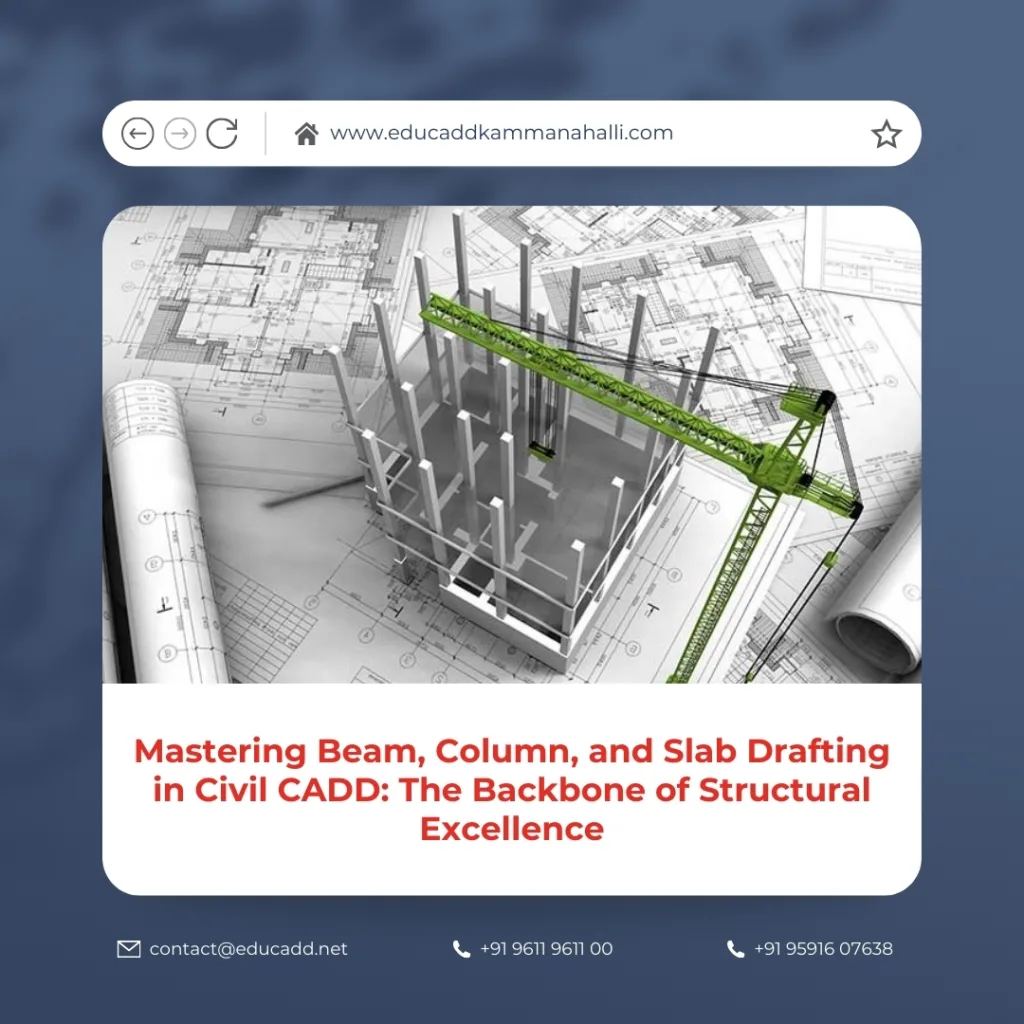
Beam Column Slab Drafting
In this comprehensive guide, you will understand the principles, process, standards, and best practices involved in Beam, Column, and Slab Drafting in Civil CADD. You will also learn how this skill enhances structural safety, improves coordination, and increases career opportunities in the civil engineering field.
1. Understanding the Role of Structural Drafting in Civil Engineering
Structural drafting converts engineering calculations into visual construction documents. Engineers design structural members based on load analysis and safety standards. However, construction teams cannot build from calculations alone. They require detailed drawings.
This is where Beam Column Slab Drafting in Civil CADD plays a critical role. Drafters prepare structural layout drawings, reinforcement details, sectional views, and bar bending schedules. These drawings communicate exact dimensions, spacing, and material specifications.
Moreover, structural drafting ensures coordination between architects, structural engineers, and contractors. Without proper drafting, misinterpretation can cause delays and cost overruns. Therefore, accuracy in drafting directly influences project success.
Civil CADD allows professionals to maintain standardization, layer management, and proper annotation. As a result, drawings remain clean, readable, and professional.
2. Fundamentals of Beam Drafting in Civil CADD
Beams transfer loads from slabs to columns and foundations. They resist bending, shear, and torsion forces. Therefore, beam drafting requires careful attention to detail.
In Beam, Column, and Slab Drafting in Civil CADD, beam drafting includes:
-
Beam layout plans
-
Longitudinal sections
-
Cross sections
-
Reinforcement detailing
-
Stirrup spacing details
First, the drafter prepares a structural beam layout plan. This plan shows beam positions, sizes, and connections. Then, the drafter creates detailed drawings showing top bars, bottom bars, crank bars, and stirrups.
Accuracy matters greatly here. Even minor dimension errors can affect reinforcement placement. Civil CADD tools help maintain scale, alignment, and uniformity. Additionally, layering systems separate beams, reinforcement, and dimensions clearly.
As a result, contractors can read drawings easily and implement them correctly on-site.
3. Column Drafting Techniques and Best Practices
Columns support vertical loads and transfer them safely to foundations. They must align correctly through all floors.
In Beam Column Slab Drafting in Civil CADD, column drafting involves:
-
Column layout plans
-
Column schedules
-
Reinforcement detailing
-
Cross-sectional views
-
Lap length and splice details
Drafters start by marking column grids. Then they assign unique column numbers. These numbers correspond to column schedules, which specify dimensions and reinforcement details.
Civil CADD simplifies column drafting through block creation and reuse. Professionals create standard column blocks and modify them as needed. This approach saves time and maintains consistency.
Moreover, proper dimensioning and clear labeling improve clarity. Clear column drafting reduces construction errors and prevents misalignment issues during execution.
4. Slab Drafting and Reinforcement Detailing
Slabs distribute loads to beams and columns. They form floors and roofs in most buildings. Slab drafting requires precision because reinforcement distribution must follow structural design guidelines.
In Beam Column Slab Drafting in Civil CADD, slab drafting includes:
-
Slab layout plan
-
Reinforcement direction marking
-
Main and distribution bar detailing
-
Opening details
-
Sectional views
Drafters prepare slab panel markings based on beam positions. They show reinforcement spacing and bar diameters clearly. They also provide detailed sections at critical areas.
Civil CADD allows quick modification of slab thickness, reinforcement spacing, and annotation styles. Therefore, designers can adjust drawings easily when structural revisions occur.
Clear slab drafting ensures uniform load distribution and structural safety.
5. Step-by-Step Process of Beam, Column, and Slab Drafting in Civil CADD
Professionals follow a structured workflow to maintain accuracy and efficiency.
First, they import architectural drawings. Next, they create structural grids and layers. Then, they draft beams, columns, and slabs according to structural calculations.
After drafting layouts, they add reinforcement details. They annotate bar diameters, spacing, and lengths. Finally, they prepare sections and schedules.
Throughout Beam, Column, and Slab Drafting in Civil CADD, layer management plays a major role. Drafters organize drawings using separate layers for structural elements, dimensions, and text.
This organized approach reduces confusion and improves drawing readability.
6. Importance of Standardization and Codes
Structural drafting must follow national and international standards. Engineers design structures based on specific building codes. Drafters must reflect these requirements accurately in drawings.
In Beam, Column, and Slab Drafting in Civil CADD, professionals follow IS codes or other relevant standards depending on project location. These codes define reinforcement spacing, cover requirements, and detailing practices.
Standardization ensures safety and compliance. It also improves coordination among project stakeholders.
Therefore, understanding structural codes is essential for accurate drafting.
7. Tools and Commands Used in Civil CADD for Structural Drafting
Civil CADD provides numerous commands that streamline drafting work.
Commonly used commands include:
-
Line and polyline
-
Offset
-
Trim and extend
-
Hatch
-
Dimension
-
Text and Mtext
-
Block creation
In Beam, Column, and Slab Drafting in Civil CADD, block usage improves efficiency. For example, column sections can be saved as reusable blocks.
Additionally, layer properties help maintain drawing clarity. Professionals use different colors and line types for beams, columns, and reinforcement.
These tools enhance productivity and reduce drafting time.
8. Reinforcement Detailing and Bar Bending Schedule Preparation
Reinforcement detailing ensures structural strength. Drafters show exact bar placements, lengths, and bends.
In Beam, Column, and Slab Drafting in Civil CADD, reinforcement details include development length, hook length, and lap length.
After detailing, professionals prepare a Bar Bending Schedule (BBS). This schedule lists bar marks, diameters, lengths, quantities, and total weight.
Accurate BBS preparation reduces material wastage and improves cost estimation.
9. Common Mistakes in Structural Drafting and How to Avoid Them
Even experienced drafters can make errors. However, systematic checking reduces mistakes significantly.
Common mistakes include:
-
Incorrect dimensions
-
Missing reinforcement details
-
Improper layer management
-
Misaligned columns
-
Incomplete sectional views
In Beam, Column, and Slab Drafting in Civil CADD, professionals must review drawings thoroughly. They should cross-check with structural design calculations before final submission.
Regular quality checks ensure drawing accuracy and reliability.
10. Coordination Between Structural and Architectural Drawings
Coordination prevents conflicts during construction. Structural layouts must align with architectural plans.
In Beam, Column, and Slab Drafting in Civil CADD, professionals overlay architectural drawings to ensure alignment. They verify beam placements and slab thickness against room layouts.
Early coordination avoids costly modifications later.
Therefore, teamwork and communication remain essential.
11. Benefits of Using Civil CADD for Structural Drafting
Civil CADD offers numerous advantages over manual drafting.
It improves accuracy through precise measurement tools. It saves time through reusable templates. It enhances readability through clean formatting.
Moreover, Beam, Column, and Slab Drafting in Civil CADD allows quick revisions when design changes occur.
Digital drafting also simplifies storage and sharing of drawings.
12. Career Opportunities in Structural Drafting
Structural drafting skills open many career opportunities. Construction companies, design consultancies, and infrastructure firms require skilled CADD professionals.
By mastering Beam, Column, and Slab Drafting in Civil CADD, individuals can work as:
-
Structural Drafter
-
CAD Technician
-
Site Coordinator
-
BIM Technician
The demand for skilled professionals continues to grow due to increasing infrastructure development.
13. Future Scope of Structural Drafting with BIM Integration
The construction industry is evolving rapidly. Building Information Modeling (BIM) integrates 3D modeling with structural detailing.
However, fundamental drafting knowledge remains essential. Beam, Column, and Slab Drafting in Civil CADD provides the foundation for advanced BIM tools.
Professionals who understand both CADD and BIM enjoy better career growth.
Therefore, learning structural drafting remains highly valuable.
14. Best Practices for Improving Drafting Efficiency
Efficiency increases productivity and reduces project delays.
To improve Beam, Column, and Slab Drafting in Civil CADD skills, professionals should:
-
Practice regularly
-
Use templates
-
Maintain proper layer naming
-
Follow standard text styles
-
Perform regular quality checks
Consistent practice enhances speed and precision.
Conclusion
Beam, columns, and slabs form the structural backbone of every building. Accurate drafting of these components ensures structural integrity, safety, and construction efficiency.
Beam Column Slab Drafting in Civil CADD transforms engineering designs into clear, precise, and professional drawings that guide successful project execution. By mastering drafting principles, reinforcement detailing, and code compliance, professionals can significantly improve construction quality.
Moreover, as digital tools continue to evolve, structural drafting remains a core skill in civil engineering. Whether you are a student, engineer, or working professional, investing time in learning Beam, Column, and Slab Drafting in Civil CADD will strengthen your technical expertise and expand your career opportunities in the construction industry.

