
BIM Applications in Interior Design: Transforming Creative Vision into Intelligent, Build-Ready Spaces
BIM in Interior Design has evolved far beyond sketches, mood boards, and manual drafting. Today, designers operate in a fast-paced environment where clients expect precision, visualization, cost clarity, and quick revisions. As projects grow more complex, traditional tools often fail to keep up with demands for coordination and efficiency. This shift has created a strong need for smarter digital solutions.
BIM Applications in Interior Design now play a central role in redefining how designers conceptualize, develop, and execute projects. Building Information Modeling is not just a drafting tool. Instead, it acts as an intelligent process that integrates data, design, visualization, and construction details within a single coordinated platform. Designers can visualize spaces in 3D, manage materials, calculate quantities, and collaborate seamlessly with architects and engineers.
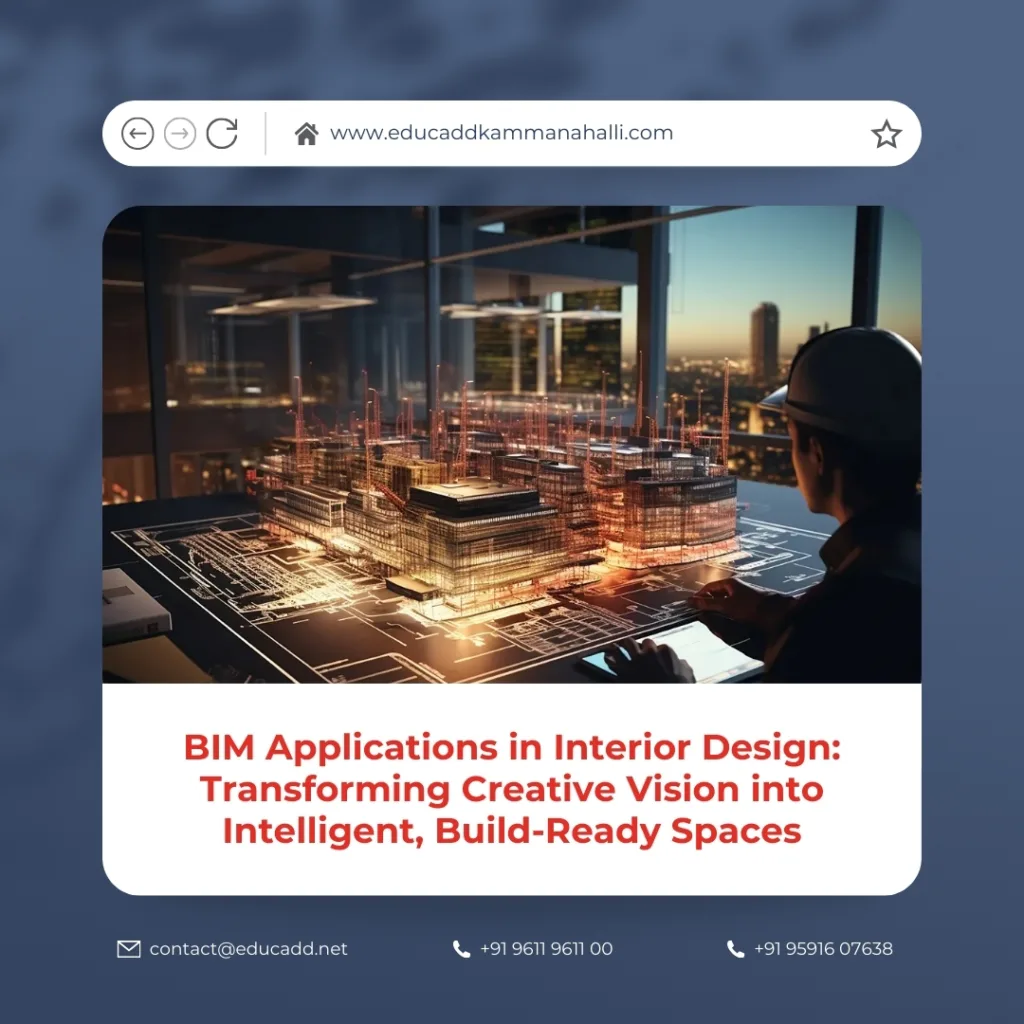
BIM in Interior Design
In this comprehensive blog, we will explore how BIM Applications in Interior Design enhance creativity, improve collaboration, reduce errors, and deliver measurable business value. Each section highlights practical insights and real-world relevance, ensuring clarity and professional depth.
1. Understanding the Foundation of BIM in Interior Design
BIM in Interior Design revolve around the concept of intelligent modeling. Unlike traditional CAD drawings that rely on lines and layers, BIM models consist of data-rich objects. Every wall, ceiling, lighting fixture, and furniture element contains embedded information. This includes dimensions, materials, finishes, and performance details.
Interior designers benefit from this structured approach because they gain complete control over project data. When they modify a layout, the system updates related sections automatically. Plans, elevations, schedules, and 3D views remain synchronized. As a result, designers reduce manual errors and save valuable time.
Moreover, BIM enhances design clarity. Clients can view realistic visualizations instead of abstract drawings. Designers can simulate lighting, textures, and material combinations. This transparency improves decision-making and builds client confidence early in the project lifecycle.
2. Enhancing Space Planning with Intelligent Modeling
Space planning forms the backbone of any interior project. With BIM Applications in Interior Design, designers analyze spatial relationships more accurately. They can evaluate circulation paths, furniture placement, and functional zoning in real time.
The intelligent model allows designers to test multiple layout options quickly. Instead of redrawing plans, they adjust elements directly in the 3D environment. Consequently, productivity increases while design quality improves.
Furthermore, BIM supports ergonomic analysis. Designers can verify clearances, accessibility standards, and furniture dimensions within the model. This ensures compliance with building codes and user comfort requirements. Such accuracy significantly reduces costly revisions during construction.
3. Improved Visualization and Client Presentation
Visualization strongly influences client approvals. BIM Applications in Interior Design enable photorealistic rendering and walkthrough experiences. Designers can showcase lighting effects, material finishes, and furniture arrangements before execution begins.
This approach eliminates guesswork. Clients understand the spatial feel of the project and provide informed feedback. Designers, therefore, refine concepts efficiently without repeated miscommunication.
In addition, BIM supports virtual reality integration. Stakeholders can experience interiors immersively. This strengthens trust and accelerates project approvals. Ultimately, designers gain a competitive edge in presentations and proposals.
4. Accurate Quantity Take-Off and Cost Estimation
Budget control remains critical in interior projects. BIM Applications in Interior Design allow automated quantity extraction from the model. Designers generate accurate material schedules for flooring, ceilings, partitions, and finishes.
Because the model contains real-time data, any change updates the quantity schedule instantly. This reduces estimation errors and prevents financial surprises. Contractors and clients both benefit from transparent cost tracking.
Additionally, designers can link BIM models with cost databases. This integration provides instant budget forecasts. As a result, project teams maintain financial control throughout the design process.
5. Seamless Coordination with Architects and Engineers
Interior design rarely operates in isolation. Projects involve architects, structural engineers, and MEP consultants. BIM Applications in Interior Design support multidisciplinary collaboration through shared models.
Designers can detect clashes between ceiling designs and mechanical ducts before construction begins. Early coordination prevents on-site conflicts and delays. Consequently, project timelines remain intact.
Cloud-based BIM platforms further improve communication. Team members access updated models in real time. This collaborative environment fosters accountability and precision across all stakeholders.
6. Streamlining Documentation and Drafting
Documentation consumes significant project time. However, BIM Applications in Interior Design automate much of this process. When designers create a 3D model, the system generates plans, sections, and elevations automatically.
Because all drawings derive from one central model, consistency remains intact. Designers avoid repetitive drafting tasks and focus more on creative refinement.
Moreover, revisions become easier to manage. A single change reflects across every drawing sheet. This ensures accuracy and reduces documentation discrepancies during tendering or execution stages.
7. Material Management and Sustainability Analysis
Sustainable design has become a priority. BIM in Interior Design help evaluate material performance and environmental impact. Designers can analyze energy efficiency, daylight penetration, and material lifecycle data.
This data-driven approach supports informed decisions. Designers select eco-friendly materials while maintaining aesthetic appeal. Additionally, BIM assists in waste reduction through precise quantity estimation.
By integrating sustainability metrics, interior projects align with green building standards. Clients increasingly value environmentally responsible solutions, making BIM a strategic advantage.
8. Facility Management Integration
The benefits of BIM extend beyond construction. BIM Applications in Interior Design support facility management by storing maintenance information within the model.
Once the project completes, building managers access data about finishes, fixtures, and equipment. This improves maintenance scheduling and lifecycle planning.
Interior designers who deliver BIM-enabled projects add long-term value. They provide clients with digital assets that simplify building operations and renovations.
9. Reducing Errors and Rework
Errors often arise from miscommunication or outdated drawings. BIM Applications in Interior Design minimize these risks through centralized data management.
Because all stakeholders work on synchronized models, discrepancies reduce significantly. Automated clash detection further prevents installation conflicts.
As a result, contractors execute projects with greater confidence. Reduced rework translates into cost savings and improved client satisfaction.
10. Supporting Custom Furniture and Millwork Design
Interior projects frequently include custom furniture and joinery. BIM Applications in Interior Design enable detailed modeling of millwork components. Designers can specify dimensions, materials, and assembly details precisely.
This level of detail ensures accurate fabrication. Manufacturers receive clear information, which reduces production errors.
Moreover, BIM supports parametric modeling. Designers adjust dimensions easily without recreating components. This flexibility accelerates design iterations and enhances customization capabilities.
11. Enhancing Project Timeline Management
Time management determines project success. BIM Applications in Interior Design integrate scheduling features that align design elements with timelines.
By linking model components to project schedules, designers visualize construction phases. This approach improves planning and coordination.
Consequently, teams anticipate delays and adjust resources proactively. Efficient timeline management strengthens overall project performance.
12. Improving Quality Control and Standards Compliance
Quality assurance becomes more systematic with BIM Applications in Interior Design. Designers verify dimensions, clearances, and compliance within the digital environment.
Automated rule checks ensure alignment with safety and accessibility standards. Designers identify issues early and implement corrections immediately.
This proactive approach strengthens professional credibility and reduces legal risks. Clients appreciate the assurance of compliance-driven design practices.
13. Driving Business Growth and Competitive Advantage
Interior design firms must differentiate themselves in a competitive market. BIM Applications in Interior Design offer a strong strategic advantage.
By delivering accurate visualizations, precise documentation, and collaborative workflows, firms enhance their reputation. Clients prefer professionals who combine creativity with technological expertise.
Furthermore, BIM reduces project turnaround time. Faster delivery allows firms to handle more projects annually. This directly impacts revenue growth and operational efficiency.
14. Future Trends in BIM for Interior Design
Technology continues to evolve rapidly. BIM Applications in Interior Design will integrate artificial intelligence, automation, and cloud-based collaboration more deeply.
Designers will leverage predictive analytics to optimize layouts and materials. Augmented reality will further enhance client experiences. Additionally, digital twins will support real-time building performance monitoring.
As digital transformation accelerates, interior professionals must adapt. Embracing BIM ensures relevance in an increasingly technology-driven industry.
Conclusion
BIM in Interior Design represent a transformative shift in how designers plan, visualize, document, and execute projects. This intelligent modeling process enhances creativity while maintaining technical precision. Designers gain improved collaboration, cost control, sustainability analysis, and lifecycle management capabilities.
Moreover, BIM reduces errors, streamlines documentation, and strengthens client communication. It empowers professionals to deliver projects that combine aesthetic excellence with operational efficiency.
As interior design becomes more complex and data-driven, adopting BIM Applications in Interior Design is no longer optional. Instead, it stands as a strategic necessity for firms aiming to lead in innovation and quality. By integrating technology with creative vision, designers shape smarter, more sustainable, and highly coordinated interior spaces for the future.

