
BIM Modeling Course with Real-Time Projects: Build Industry-Ready Skills for a Successful AEC Career
The Architecture, Engineering, and Construction (AEC) industry has experienced a major transformation over the last decade. Traditional drafting methods have gradually given way to intelligent digital workflows that improve collaboration, accuracy, and project delivery. At the center of this transformation stands Building Information Modeling (BIM), a technology-driven approach that allows professionals to create, manage, and analyze building data throughout a project’s lifecycle. As companies increasingly adopt BIM processes, the demand for skilled BIM Modeling Course Projects continues to rise across the globe.
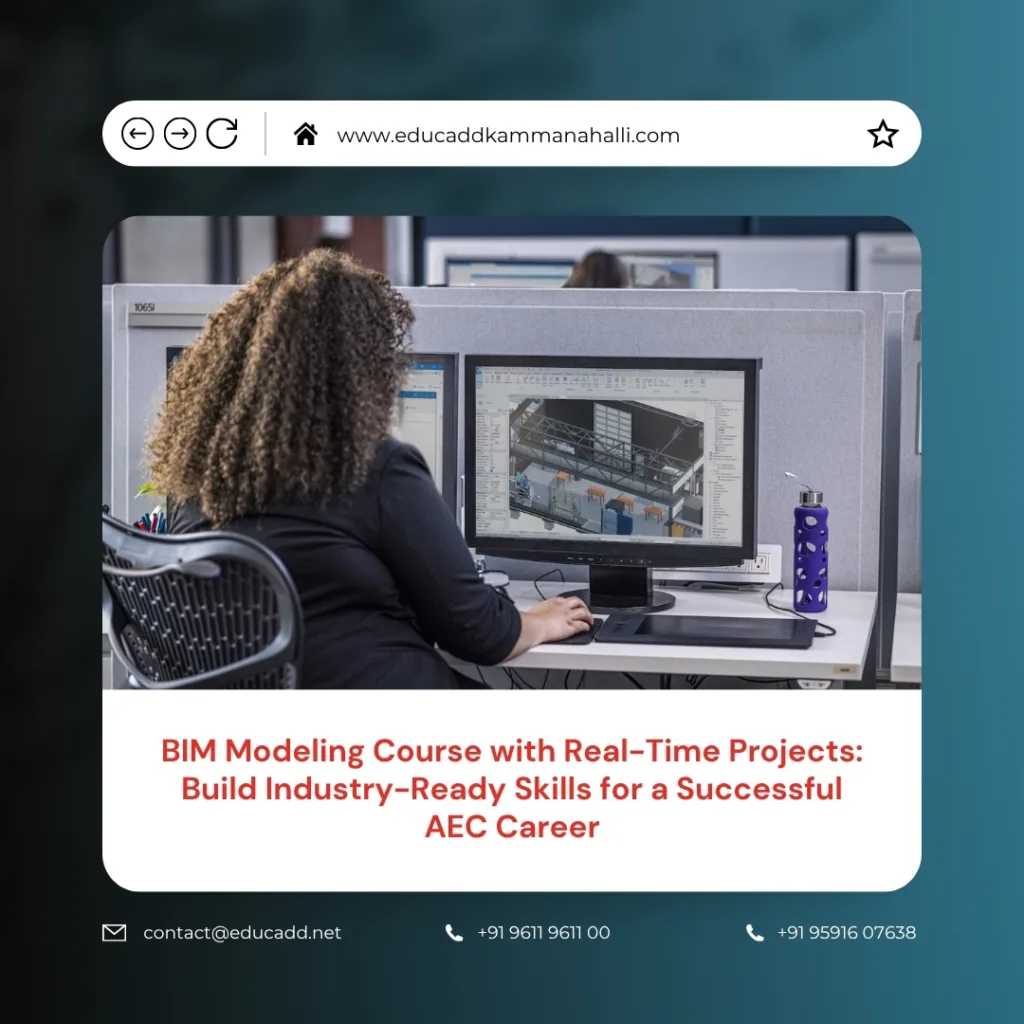
BIM Modeling Course Projects
A BIM Modeling Course Projects offers one of the most effective ways to enter this growing field. Unlike conventional training programs that focus only on theory, practical BIM training enables learners to work on actual project scenarios. As a result, students gain technical expertise, problem-solving abilities, and industry exposure that employers actively seek. Whether you are a student, civil engineer, architect, mechanical engineer, or working professional, mastering BIM can significantly enhance your career prospects and earning potential.
Why BIM Has Become Essential in Modern Construction
The construction industry faces constant challenges related to project delays, budget overruns, communication gaps, and design conflicts. BIM addresses these issues by creating a centralized digital model that contains detailed information about every building component. Team members can access, modify, and coordinate project data in real time, reducing errors and improving efficiency.
Furthermore, BIM enables stakeholders to visualize projects before construction begins. This capability helps identify potential issues early in the design phase. Consequently, organizations save time, reduce costs, and improve project quality. Due to these benefits, BIM has become a standard requirement in many construction projects worldwide.
Understanding the Scope of a BIM Modeling Course
A comprehensive BIM Modeling Course covers much more than creating 3D models. Students learn how to develop intelligent building models that integrate architectural, structural, and MEP systems. Additionally, they understand how different disciplines collaborate within a unified BIM environment.
The course typically introduces industry-standard software and workflows used by leading engineering and construction companies. Through practical exercises and project-based learning, participants gain confidence in handling complex building models. More importantly, they develop skills that directly align with current industry demands.
The Importance of BIM Modeling Course Projects
Real-time projects bridge the gap between classroom learning and professional practice. While theoretical knowledge provides a foundation, practical implementation develops true expertise. When students work on actual building projects, they encounter real-world challenges that require critical thinking and technical problem-solving.
Moreover, project-based learning improves understanding of design coordination, model management, and construction workflows. Students learn how different project stakeholders interact and how BIM facilitates seamless communication among teams. This practical exposure creates a stronger learning experience and prepares candidates for workplace responsibilities from day one.
Key Software Covered in BIM Modeling Programs
Modern BIM training programs introduce learners to industry-recognized software platforms that support various project requirements. Each tool serves a unique purpose within the BIM ecosystem and contributes to overall project success.
Common software applications include:
- Autodesk Revit for architectural, structural, and MEP modeling.
- Navisworks for clash detection, coordination, and project review.
These tools help students understand how digital construction workflows operate in professional environments. As organizations continue to embrace digital transformation, software proficiency remains a valuable asset for career advancement.
Architectural BIM Modeling Skills Developed During Training
Architectural BIM modeling forms a fundamental component of BIM education. Students learn to create intelligent building models that accurately represent architectural elements such as walls, doors, windows, roofs, floors, and interior components. They also gain experience in generating detailed documentation directly from the model.
In addition, architectural BIM training focuses on design visualization and presentation techniques. Learners understand how to communicate design intent effectively through 3D models, renderings, and construction drawings. These skills help professionals contribute more effectively to multidisciplinary project teams.
Structural BIM Modeling and Engineering Coordination
Structural BIM modeling focuses on developing detailed digital representations of structural systems. Students learn how to model foundations, columns, beams, slabs, trusses, and reinforcement elements using BIM tools. They also understand the relationship between structural integrity and design efficiency.
Furthermore, coordination between structural and architectural disciplines becomes easier through BIM workflows. Engineers can detect conflicts before construction begins and implement corrective actions early in the project lifecycle. As a result, projects achieve better accuracy and reduced rework costs.
MEP BIM Modeling: A High-Demand Specialization
Mechanical, Electrical, and Plumbing (MEP) systems play a critical role in building performance. Therefore, MEP BIM modeling has become one of the most sought-after specializations in the construction industry. Students learn how to design and coordinate HVAC systems, electrical layouts, plumbing networks, and fire protection systems within a BIM environment.
Real-time projects allow learners to understand space constraints, routing challenges, and interdisciplinary coordination requirements. Consequently, they gain practical expertise that directly aligns with industry expectations and project demands.
Learning Clash Detection and Project Coordination
One of BIM’s greatest advantages lies in its ability to identify design conflicts before construction begins. Clash detection helps project teams discover overlapping systems, design inconsistencies, and coordination issues that could otherwise lead to costly delays.
Students learn how to perform clash analysis using specialized software and generate coordination reports. Additionally, they develop strategies for resolving conflicts efficiently. These skills are highly valued because they contribute directly to project success and operational efficiency.
How BIM Supports Sustainable Construction Practices
Sustainability has become a key priority in modern construction projects. BIM enables professionals to analyze building performance, energy consumption, and environmental impact during the design phase. Therefore, project teams can make informed decisions that support sustainable development goals.
Benefits of BIM in sustainable construction include:
- Improved energy analysis and resource optimization.
- Better material planning and waste reduction strategies.
As governments and organizations increasingly emphasize green building practices, BIM professionals with sustainability knowledge gain a competitive advantage in the job market.
Career Opportunities After Completing a BIM Modeling Course
The growing adoption of BIM has created numerous career opportunities across various sectors. Companies seek professionals who can contribute to digital construction workflows and support project coordination efforts. Consequently, qualified BIM specialists enjoy strong demand in domestic and international markets.
Career options include BIM Modeler, BIM Coordinator, BIM Engineer, BIM Specialist, BIM Manager, Revit Technician, Structural BIM Engineer, and MEP BIM Engineer. Many professionals also explore opportunities in infrastructure projects, industrial facilities, and smart city developments.
Industry Benefits of BIM Expertise
Organizations that employ BIM professionals gain significant operational advantages. Efficient coordination reduces project risks, while improved visualization enhances decision-making. Additionally, digital workflows support better resource management and project tracking.
For employees, BIM expertise increases employability and career growth potential. Since many organizations prioritize digital construction methodologies, skilled BIM professionals often secure better job opportunities and competitive compensation packages. Therefore, investing in BIM education can deliver long-term professional benefits.
Why Employers Prefer Candidates with Real Project Experience
Employers consistently prioritize candidates who possess hands-on project experience. While theoretical understanding remains important, practical skills demonstrate an individual’s ability to perform effectively in real work environments. Real-time project exposure provides evidence of technical competence, teamwork, and problem-solving capabilities.
Moreover, candidates who have worked on live projects require less onboarding and adapt more quickly to organizational workflows. This advantage often improves hiring prospects and accelerates career progression. As a result, project-based BIM training significantly enhances employability.
Future Trends and the Expanding Role of BIM
The future of BIM continues to evolve alongside advancements in technology. Emerging innovations such as digital twins, artificial intelligence, cloud collaboration, augmented reality, and virtual reality are expanding BIM capabilities. These technologies create new opportunities for project planning, monitoring, and asset management.
As construction projects become increasingly complex, BIM will play an even greater role in facilitating collaboration and data-driven decision-making. Professionals who develop BIM expertise today position themselves for success in a rapidly changing industry landscape. Therefore, acquiring advanced BIM skills remains a strategic career investment.
Conclusion
A BIM Modeling Course Projects provides the ideal combination of technical knowledge, practical exposure, and industry relevance. Through hands-on training, learners gain valuable experience in architectural, structural, and MEP modeling while developing essential project coordination skills. Real-time projects strengthen confidence, improve problem-solving abilities, and prepare students for professional responsibilities in the AEC sector.
As the construction industry continues its digital transformation, BIM expertise has become a powerful career asset. Organizations increasingly rely on BIM-driven workflows to improve efficiency, reduce risks, and enhance project outcomes. By enrolling in a BIM Modeling Course with Real-Time Projects, aspiring professionals can build industry-ready skills, expand career opportunities, and establish a strong foundation for long-term success in the evolving world of construction and engineering.

