
Build the Future of Construction with a BIM Professional Certification Program
The construction industry has entered a new digital era where technology drives every stage of a project. Traditional drafting methods no longer meet the demands of modern infrastructure. Today, companies rely on intelligent digital models to improve planning, design, collaboration, and execution. This shift has created a massive demand for professionals with advanced Building Information Modeling (BIM) skills. A BIM Professional Certification Program equips aspiring engineers, architects, designers, and construction professionals with practical knowledge and industry-recognized expertise.
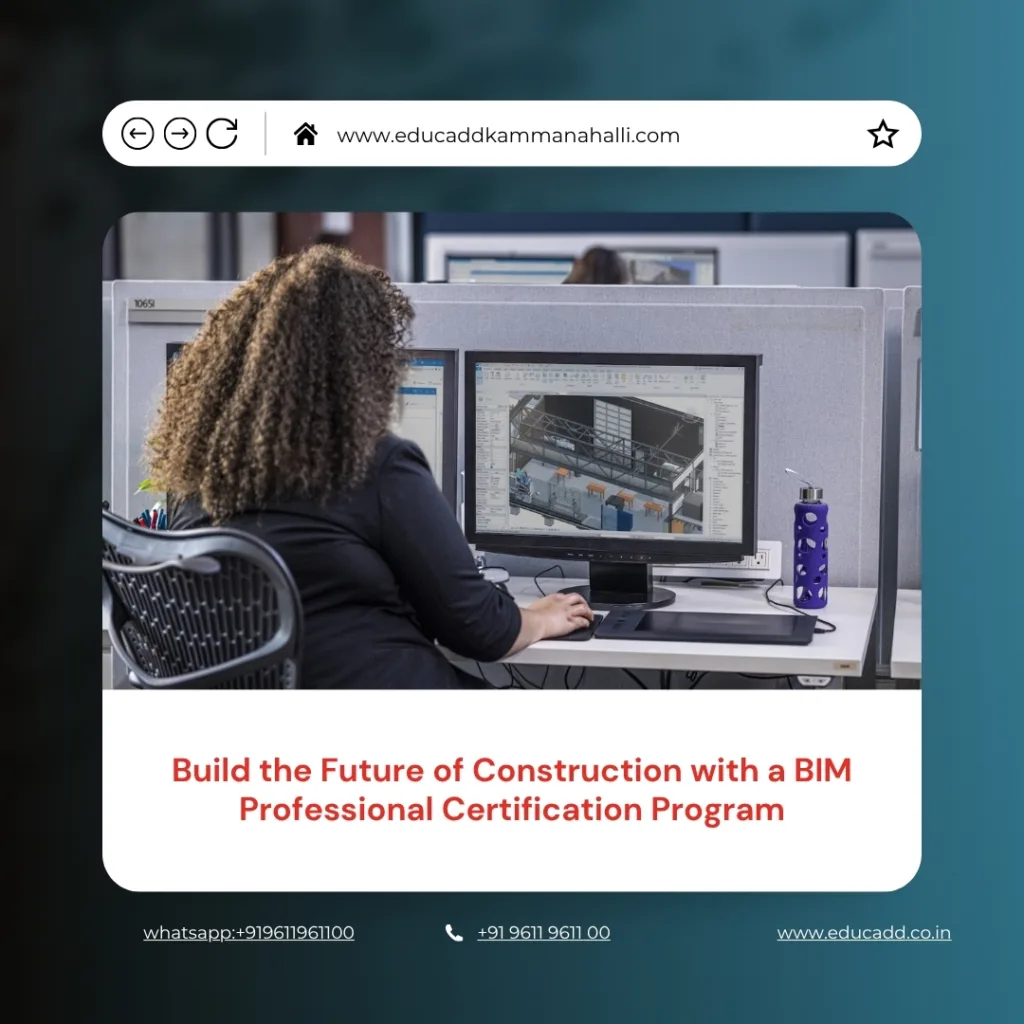
BIM Professional Certification Program
Whether you are a student or a working professional, earning a BIM certification can help you secure rewarding career opportunities in India and across the world. Let’s explore why BIM certification has become one of the most valuable qualifications in today’s construction industry.
Why BIM Is Transforming the Construction Industry
Building Information Modeling is more than a software application. It is a smart process that integrates design, engineering, construction, and facility management into one collaborative digital environment. BIM enables every stakeholder to work with accurate project information from concept to completion.
Moreover, BIM reduces errors before construction begins, saving both time and money. Organizations across residential, commercial, industrial, and infrastructure projects increasingly depend on BIM professionals to deliver projects with higher quality and greater efficiency.
What Is a BIM Professional Certification Program?
A BIM Professional Certification Program is a structured training course designed to teach modern BIM concepts, workflows, software applications, and project coordination. Students gain both theoretical knowledge and practical experience through real-world projects.
The program typically covers Autodesk Revit, Navisworks, AutoCAD, BIM collaboration, clash detection, quantity take-off, 4D scheduling, 5D cost estimation, documentation, and project management. By completing certification, learners become job-ready for the rapidly evolving construction sector.
Essential Skills You Develop Through BIM Training
Professional BIM training develops technical expertise alongside problem-solving abilities. Learners understand how different engineering disciplines collaborate throughout the construction lifecycle.
Students also learn architectural modeling, structural modeling, MEP modeling, BIM standards, coordination techniques, model validation, cloud collaboration, documentation, and project visualization. These practical skills improve confidence and prepare professionals to handle complex construction projects effectively.
Industry Software Covered During Certification
One major advantage of enrolling in a BIM Professional Certification Program is learning industry-standard software. Employers actively seek candidates who possess practical software knowledge instead of only theoretical understanding.
Most comprehensive BIM courses include Autodesk Revit Architecture, Revit Structure, Revit MEP, Navisworks Manage, AutoCAD, BIM 360, Autodesk Construction Cloud, Dynamo, and project coordination tools. Exposure to multiple platforms significantly increases employment opportunities across different engineering sectors.
Career Opportunities After BIM Certification
The global adoption of BIM has created thousands of employment opportunities for certified professionals. Construction companies, design consultants, infrastructure developers, real estate firms, and multinational organizations continuously recruit skilled BIM experts.
Graduates can pursue careers as BIM Modeler, BIM Coordinator, BIM Engineer, BIM Consultant, Revit Specialist, Structural BIM Engineer, MEP BIM Engineer, Architectural BIM Designer, BIM Manager, Project Coordinator, or Digital Construction Specialist. Many professionals also explore international careers where BIM expertise commands attractive salary packages.
How BIM Improves Project Efficiency
One of the biggest advantages of BIM lies in improving project efficiency from planning to completion. Every project stakeholder works using the same intelligent digital model, which minimizes communication gaps.
Furthermore, BIM enables early clash detection, better quantity estimation, accurate scheduling, faster approvals, and improved resource management. These benefits reduce project delays while enhancing overall construction quality and client satisfaction.
Importance of Practical Project Experience
Learning software alone does not make someone a successful BIM professional. Practical project exposure helps learners understand industry workflows and real construction challenges.
During a quality BIM Professional Certification Program, students work on residential buildings, commercial complexes, hospitals, industrial facilities, and infrastructure projects. Hands-on experience builds technical confidence and strengthens professional portfolios for interviews.
Why Employers Prefer Certified BIM Professionals
Recruiters value certified candidates because certification demonstrates verified technical competence and professional commitment. Companies often prefer applicants who can contribute immediately without extensive training.
Additionally, certified professionals understand global BIM standards, project documentation, collaboration workflows, and quality management practices. Their productivity helps organizations complete projects faster while maintaining industry compliance.
Global Demand for BIM Experts
Countries worldwide have made BIM mandatory for government and large-scale construction projects. This widespread adoption has significantly increased the need for trained BIM professionals across international markets.
Engineers with recognized BIM certification can explore career opportunities in the United States, Canada, the United Kingdom, Australia, Germany, Singapore, the Middle East, and many other countries. International demand continues to grow as digital construction becomes the industry standard.
Who Should Join a BIM Professional Certification Program?
A BIM Professional Certification Program suits a wide range of learners. Civil engineers, architects, mechanical engineers, electrical engineers, interior designers, construction professionals, diploma holders, and engineering students all benefit from BIM education.
Working professionals can also upgrade their skills to remain competitive in the digital construction industry. Fresh graduates gain an advantage by entering the job market with practical BIM expertise that employers actively seek.
Choosing the Right BIM Training Institute
Selecting the right training institute plays an important role in career success. A quality institute provides experienced trainers, updated software, practical projects, placement assistance, and industry-oriented curriculum.
Students should also evaluate certification value, infrastructure, laboratory facilities, learning resources, flexible schedules, and internship opportunities. These factors contribute significantly to developing strong technical and professional capabilities.
Future Scope of BIM Technology
The future of BIM extends beyond digital modeling. Emerging technologies such as Artificial Intelligence, Digital Twins, Virtual Reality, Augmented Reality, cloud collaboration, and automation continue to expand BIM capabilities.
Construction companies increasingly invest in digital transformation, creating even greater demand for certified BIM professionals. Those who master evolving technologies will enjoy excellent long-term career growth and leadership opportunities within the engineering industry.
Why a BIM Professional Certification Program Is a Smart Investment
Investing in a BIM Professional Certification Program offers benefits that extend far beyond technical knowledge. The certification improves employability, enhances earning potential, builds industry credibility, and prepares professionals for future technological advancements.
As organizations adopt smarter construction practices, certified BIM experts become valuable assets capable of managing complex digital workflows. Continuous learning and certification help professionals stay relevant in an increasingly competitive engineering environment.
Conclusion
The construction industry is rapidly embracing digital innovation, making BIM one of the most sought-after skills in engineering and architecture. A BIM Professional Certification Program provides comprehensive knowledge, practical experience, and globally recognized expertise that employers highly value. From mastering industry-leading software to understanding collaborative project delivery, BIM certification prepares professionals for successful careers in modern construction.
Whether you are beginning your professional journey or planning to advance your existing career, investing in a BIM certification is a strategic decision. With increasing global demand, excellent salary potential, and opportunities across multiple industries, BIM professionals are shaping the future of construction. By developing the right skills today, you can position yourself at the forefront of tomorrow’s digital building revolution.

