
From Blueprints to Intelligent Living Spaces: How BIM Is Redefining Residential Design
BIM Residential Design Innovation is no longer defined only by bricks, mortar, and floor plans. It is increasingly shaped by data, collaboration, and digital intelligence. Homebuyers today expect better quality, faster delivery, cost transparency, and sustainable living environments. Traditional methods struggle to meet these expectations consistently. This gap has accelerated the adoption of Building Information Modeling. BIM in residential projects has emerged as a powerful methodology that connects design intent with construction execution and long-term building performance. Rather than treating design, construction, and maintenance as separate phases, BIM integrates them into a continuous and coordinated process. This shift represents a significant step forward in home design, enabling smarter decisions, reduced risk, and enhanced value for all stakeholders.
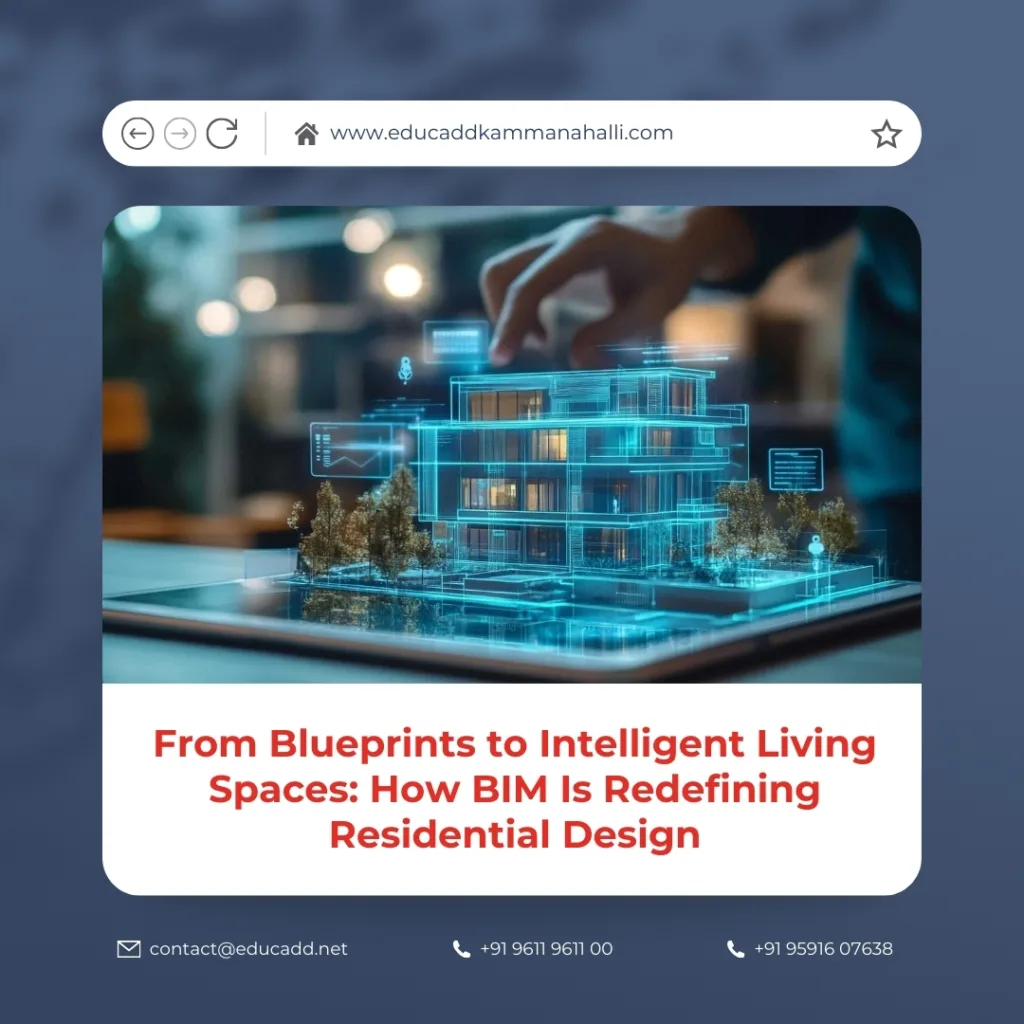
BIM Residential Design Innovation
Understanding BIM in Residential Projects
Building Information Modeling is both a technology and a process. In residential projects, BIM creates a digital twin of the house that contains geometric data and detailed information about materials, systems, costs, and schedules. Unlike conventional drawings, a BIM model is intelligent and dynamic. Each component knows what it is, where it belongs, and how it interacts with other elements. BIM in residential projects allows architects and engineers to design with precision while keeping constructability in focus. Because the model acts as a single source of truth, errors caused by inconsistent documentation reduce dramatically. This clarity strengthens confidence across the entire project team.
Evolution from 2D Drawings to Integrated BIM Workflows
BIM Residential Design Innovation traditionally relied on 2D plans, elevations, and sections. These drawings often required interpretation, which increased the risk of misunderstanding. BIM introduces a model-based workflow where drawings generate automatically from the coordinated model. When a wall moves or a window changes, all related views update instantly. BIM in residential projects eliminates repetitive manual revisions and improves consistency. This evolution supports faster approvals and smoother coordination. Designers can focus more on quality and creativity rather than administrative corrections.
Design Precision and Realistic Visualization
Design accuracy plays a crucial role in residential projects, where space optimization and aesthetics matter deeply. BIM offers highly detailed 3D visualization that reflects real-world dimensions and finishes. Homeowners can explore their future homes virtually and understand spatial relationships clearly. BIM in residential projects enables informed design discussions early in the process. When clients visualize layouts accurately, decision-making becomes faster and more confident. This early clarity reduces late design changes that often disrupt schedules and budgets.
Collaborative Design Environment for Residential Teams
Residential construction involves architects, structural engineers, MEP consultants, contractors, and suppliers. BIM provides a shared digital environment where all stakeholders collaborate in real time. Instead of exchanging disconnected files, teams work within a coordinated model. BIM in residential projects improves communication and accountability. Everyone sees the same information, which reduces conflicts and duplicated efforts. This collaborative approach fosters trust and strengthens teamwork, leading to better project outcomes.
Clash Detection and Design Validation
Clashes between architectural, structural, and service elements represent a common challenge in residential construction. BIM software detects these clashes digitally before construction begins. This capability allows teams to resolve issues proactively. BIM in residential projects reduces on-site rework and material wastage. By validating designs early, project teams maintain construction momentum and protect quality standards. This proactive risk management approach significantly improves predictability.
Accurate Quantity Take-Offs and Cost Planning
Cost certainty is vital for residential developers and individual homeowners alike. BIM links model components directly to quantities and cost data. This integration produces accurate estimates from the early design stage. BIM in residential projects allows teams to assess cost implications instantly when design changes occur. Transparent cost visibility supports better financial planning and reduces disputes. Ultimately, this precision helps projects stay within approved budgets.
Construction Scheduling and Time Optimization
Time overruns can disrupt residential projects and impact buyer satisfaction. BIM integrates scheduling data with the 3D model to create 4D simulations. These simulations visualize construction sequences and identify potential delays. BIM in residential projects supports efficient resource allocation and site planning. By aligning design and construction timelines, teams improve productivity and reduce idle time. Timely project delivery becomes more achievable and predictable.
Sustainability and Energy-Conscious Home Design
Sustainability has become a core priority in residential development. BIM supports energy analysis, daylight studies, and material optimization during design. Designers can test multiple scenarios and select environmentally responsible solutions. BIM in residential projects enables data-driven sustainability decisions rather than assumptions. Homes designed with BIM often achieve better energy performance and lower operational costs. These benefits enhance long-term value for homeowners while supporting environmental responsibility.
Flexibility and Personalization in Residential Design
Modern homeowners seek personalized living spaces that adapt to their lifestyles. BIM allows designers to explore variations efficiently without disrupting coordination. BIM in residential projects supports customization while maintaining accuracy and consistency. Design options can be evaluated quickly, enabling informed choices. This flexibility enhances customer satisfaction and strengthens the emotional connection to the home.
Construction Accuracy and Quality Assurance
Quality execution depends on clear and coordinated information. BIM generates detailed construction documentation directly from the model. Contractors receive precise guidance on dimensions, materials, and installation details. BIM in residential projects minimizes ambiguity on-site. Improved clarity leads to higher workmanship standards and reduced defects. Quality assurance becomes a continuous process rather than a corrective measure.
Post-Construction Value and Facility Management
The benefits of BIM extend beyond project completion. The BIM model serves as a digital asset containing maintenance and operational data. Homeowners and facility managers can access information about equipment, warranties, and service schedules. BIM in residential projects supports efficient long-term asset management. This lifecycle value transforms the home into a well-documented and manageable investment.
Adoption Challenges and Industry Readiness
Despite its advantages, BIM adoption in residential projects faces challenges. Initial investment in technology and training can appear significant. Resistance to change also slows adoption. However, as tools become more accessible and industry standards mature, barriers continue to reduce. BIM in residential projects gains momentum as stakeholders recognize its long-term benefits and return on investment.
Future Outlook of BIM in Residential Housing
The future of residential construction aligns closely with digital innovation. BIM integrates with virtual reality, augmented reality, and smart home technologies. These advancements enhance design communication and occupant experience. BIM in residential projects will continue to evolve as regulations and sustainability requirements grow. Its role as a central platform for design, construction, and operation will only strengthen.
Conclusion
BIM Residential Design Innovation marks a transformative step forward in home design. It improves accuracy, collaboration, cost control, scheduling, and sustainability while enhancing homeowner satisfaction. By connecting all phases of a project within a single intelligent model, BIM delivers measurable value across the residential lifecycle. As the housing industry embraces digital transformation, BIM stands as a foundational approach for creating efficient, resilient, and future-ready homes. The shift toward BIM-driven residential design is not just a technological upgrade but a strategic evolution shaping the future of living.

