
BIM for Sustainable Construction: Building Smarter, Greener, and Future-Ready Infrastructure
BIM Sustainable Construction Infrastructure has become one of the most important innovations in the architecture, engineering, and construction industry. It allows professionals to design, plan, and manage projects with better accuracy and improved coordination. At the same time, BIM helps reduce material waste, energy consumption, and project delays. Because of these advantages, many organizations now prefer skilled professionals who understand BIM-based sustainable construction methods.
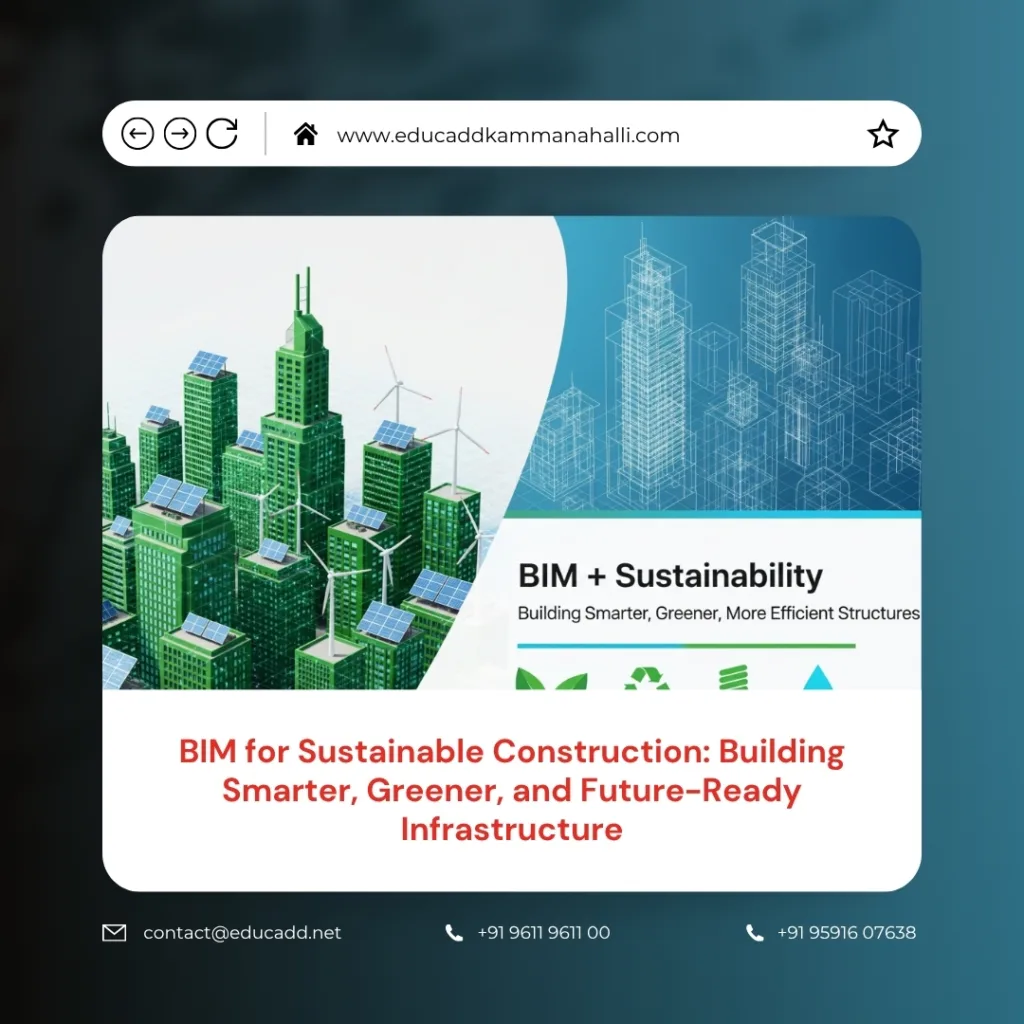
BIM Sustainable Construction Infrastructure
A BIM Sustainable Construction Infrastructure course helps students and professionals gain practical knowledge about green building concepts, digital construction workflows, energy-efficient design, and smart project management. The course prepares learners for modern industry requirements while supporting environmentally responsible construction practices. As sustainability becomes a global priority, BIM expertise offers excellent career opportunities in the construction sector.
Understanding BIM in Modern Construction
Building Information Modeling is a digital process used for planning, designing, constructing, and managing buildings and infrastructure projects. Unlike traditional drafting methods, BIM creates intelligent 3D models that contain detailed project information. These models help teams collaborate more effectively throughout the project lifecycle.
BIM improves communication between architects, structural engineers, MEP consultants, contractors, and project managers. Every team member can access updated project data in real time. Because of this transparency, errors and conflicts are identified early in the design phase. As a result, construction companies save both time and money.
In sustainable construction, BIM provides additional benefits by helping professionals analyze energy performance, material efficiency, water management, and environmental impact before construction begins. This proactive approach supports smarter decision-making and reduces unnecessary resource consumption.
Importance of Sustainable Construction in Today’s World
Sustainable construction focuses on reducing the negative environmental impact of buildings while improving energy efficiency and occupant comfort. Traditional construction practices often generate excessive waste, pollution, and carbon emissions. Therefore, the industry now aims to adopt greener and more efficient solutions.
Modern sustainable buildings use eco-friendly materials, renewable energy systems, water conservation techniques, and efficient waste management strategies. BIM supports these goals by offering accurate simulations and performance analysis tools during the design stage.
Several factors make sustainable construction more important today:
- Increasing environmental concerns and climate change awareness
- Rising demand for energy-efficient and eco-friendly buildings
Governments across the world also encourage green construction through regulations, certifications, and sustainability standards. Consequently, professionals with BIM sustainability skills are becoming highly valuable in the construction industry.
How BIM Supports Green Building Design
BIM helps create environmentally friendly buildings by enabling accurate planning and analysis from the beginning of the project. Designers can evaluate different design options and select the most sustainable solutions before actual construction starts. This process minimizes costly modifications later.
Energy analysis tools integrated with BIM software allow professionals to study building performance under different environmental conditions. Engineers can optimize natural lighting, ventilation, insulation, and HVAC systems for better efficiency. As a result, buildings consume less energy throughout their lifecycle.
BIM also helps reduce material wastage by providing precise quantity estimations and clash detection. When project teams coordinate effectively, fewer construction errors occur on-site. This improves productivity while supporting sustainable resource management.
Moreover, BIM contributes to better lifecycle management. Facility managers can use BIM data to maintain buildings efficiently, monitor performance, and reduce long-term operational costs.
Role of BIM in Reducing Construction Waste
Construction waste remains one of the biggest challenges in the building industry. Poor planning, inaccurate estimates, and design conflicts often lead to unnecessary material usage. However, BIM significantly reduces these issues through advanced digital coordination.
With BIM, teams can visualize the complete project before construction begins. Clash detection tools identify conflicts between structural, architectural, and MEP components. Therefore, rework and demolition are minimized during execution.
BIM-generated quantity takeoffs also improve procurement planning. Contractors order only the required materials, which prevents over-purchasing and reduces waste generation. In addition, accurate scheduling improves logistics management and minimizes delays.
The environmental benefits of reduced waste are substantial. Less material disposal means lower landfill usage, reduced transportation emissions, and better sustainability performance. Consequently, BIM has become a key technology for environmentally responsible construction projects.
Energy Efficiency Through BIM Technology
Energy-efficient buildings play a major role in sustainable urban development. BIM technology supports energy optimization by allowing professionals to analyze building performance during the early design stage. This approach helps teams make informed decisions that improve efficiency.
BIM software can simulate heating, cooling, lighting, and ventilation performance based on local climate conditions. Architects can compare multiple design alternatives and choose the most efficient solution. Consequently, buildings achieve better thermal performance and lower operational costs.
Several energy-saving features can be optimized using BIM:
- Natural daylight utilization and reduced artificial lighting demand
- Efficient HVAC system planning for lower energy consumption
Additionally, BIM enables integration with renewable energy systems such as solar panels and smart building technologies. These features contribute to reduced carbon emissions and improved environmental performance.
As global energy costs continue to rise, companies increasingly invest in BIM-based energy modeling to achieve sustainable and cost-effective construction outcomes.
Benefits of Enrolling in a BIM for Sustainable Construction Course
A BIM Sustainable Construction Infrastructure course offers students practical knowledge and industry-relevant skills that match current market demands. The course combines digital construction technology with green building concepts, making it highly valuable for future construction professionals.
Learners gain hands-on experience with BIM software tools used in architecture, engineering, and construction projects. They also understand sustainability principles, energy analysis, project coordination, and lifecycle management techniques.
One of the biggest advantages of the course is career growth. Companies actively seek BIM professionals who can contribute to sustainable construction initiatives. Therefore, certified BIM experts often receive better job opportunities and higher salary potential.
The course also improves problem-solving abilities and technical understanding. Students learn how to manage complex projects efficiently while minimizing environmental impact. As sustainability becomes a major industry focus, BIM training provides long-term professional benefits.
Essential Skills Covered in the Course
A well-structured BIM for sustainable construction course includes both technical and practical learning modules. Students develop expertise in BIM software applications while understanding modern sustainable construction practices.
The course generally covers 3D modeling, clash detection, quantity estimation, project coordination, and construction documentation. In addition, learners explore green building standards, energy analysis, and environmental performance evaluation.
Students also improve collaboration and project management skills. Since BIM involves teamwork across multiple disciplines, communication and coordination become essential components of training.
Another important aspect is real-world project exposure. Many training institutes provide live project examples, case studies, and industry-oriented assignments. This practical learning approach helps students understand actual construction workflows and professional expectations.
As technology continues to evolve, BIM professionals with sustainability knowledge remain highly competitive in the global job market.
Career Opportunities After Completing the Course
The demand for BIM professionals continues to grow rapidly across the construction and infrastructure sectors. Companies now prefer candidates who can combine digital construction expertise with sustainable building practices. Therefore, completing a BIM for sustainable construction course opens multiple career opportunities.
Graduates can work as BIM modelers, BIM coordinators, sustainability consultants, energy analysts, project engineers, or construction managers. Many multinational companies also recruit BIM specialists for smart city and infrastructure projects.
Countries investing heavily in urban development and green infrastructure require skilled BIM professionals to manage large-scale projects efficiently. Consequently, international career opportunities are expanding for trained candidates.
Freelancing and consulting opportunities are also increasing. Experienced BIM professionals can provide design coordination, sustainability analysis, and project optimization services for construction firms worldwide.
With continuous advancements in construction technology, BIM expertise offers long-term career stability and professional growth.
BIM and Smart Cities Development
Smart cities focus on creating sustainable, efficient, and technologically advanced urban environments. BIM plays a crucial role in achieving these goals by improving infrastructure planning, resource management, and urban development strategies.
Through BIM, planners can design integrated infrastructure systems that support transportation, water management, energy efficiency, and environmental sustainability. Digital models provide accurate project visualization and data management for better decision-making.
BIM also supports smart city maintenance and operational efficiency. City authorities can monitor infrastructure performance, predict maintenance needs, and optimize resource utilization through digital information systems.
As urban populations continue to increase, governments invest heavily in smart city projects worldwide. Therefore, professionals with BIM and sustainability expertise are becoming essential for future urban development initiatives.
The integration of BIM with technologies such as IoT, AI, and digital twins further enhances the efficiency and sustainability of modern cities.
Challenges in Sustainable Construction and BIM Solutions
BIM Sustainable Construction Infrastructure offers many advantages, several challenges still exist in the industry. High initial investment costs, lack of skilled professionals, and resistance to technological adoption often slow down implementation.
However, BIM helps overcome many of these challenges through improved planning and collaboration. Accurate digital models reduce costly design errors and improve project efficiency. As a result, companies achieve better returns on investment over time.
Training and education also play a critical role in overcoming skill shortages. BIM courses prepare professionals to handle advanced construction technologies confidently. Consequently, organizations can implement sustainable practices more effectively.
Another challenge involves managing complex project data. BIM solves this issue by centralizing information and improving communication between stakeholders. This streamlined workflow reduces confusion and enhances project coordination.
As awareness continues to grow, more companies are adopting BIM-driven sustainable construction practices to remain competitive in the industry.
Future Trends in BIM for Sustainable Construction
The future of BIM and sustainable construction looks extremely promising. Emerging technologies continue to improve digital construction processes and environmental performance. As innovation advances, BIM will become even more essential for modern infrastructure development.
Artificial intelligence and machine learning now integrate with BIM systems to automate project analysis and optimize design decisions. These technologies improve efficiency while reducing human errors.
Cloud-based BIM platforms also enhance collaboration between global project teams. Professionals can access real-time project information from anywhere, which improves communication and productivity.
Virtual reality and augmented reality further strengthen BIM visualization capabilities. These tools help clients and construction teams better understand project designs before execution begins.
Sustainability regulations and green building standards are also becoming stricter worldwide. Consequently, organizations increasingly depend on BIM technology to achieve compliance and environmental goals.
Why Industries Prefer BIM-Certified Professionals
Construction companies prefer BIM-certified professionals because they bring technical expertise, efficiency, and sustainability knowledge to projects. Certified candidates understand modern construction workflows and can contribute immediately to project execution.
BIM-certified professionals improve project coordination and reduce costly mistakes. Their ability to work with digital models enhances communication between different departments. Therefore, companies experience smoother project delivery and better productivity.
Employers also value professionals who understand sustainable construction concepts. As green building demand increases, organizations require skilled experts capable of implementing environmentally responsible practices.
Certification additionally demonstrates practical software knowledge and industry readiness. This gives candidates a competitive advantage during recruitment and career advancement opportunities.
Because of rapid digital transformation in the construction industry, BIM-certified professionals continue to remain in high demand across domestic and international markets.
Choosing the Right BIM for Sustainable Construction Course
Selecting the right training program is essential for building a successful career in BIM and sustainable construction. Students should choose institutes that provide practical training, industry-oriented curriculum, and experienced faculty support.
A good BIM course must include software training, live projects, sustainability concepts, and placement assistance. Practical exposure helps learners understand real construction workflows and professional expectations.
It is also important to check whether the institute provides certification recognized by industry employers. Reputed training centers often collaborate with construction companies and software providers to deliver updated learning programs.
Students should additionally consider factors such as lab facilities, project-based learning, internship opportunities, and career guidance support. These elements significantly improve learning outcomes and job readiness.
By selecting a high-quality BIM course, students can build strong technical foundations and prepare for successful careers in sustainable construction.
Growing Global Demand for Sustainable BIM Expertise
The global construction industry is rapidly shifting toward digitalization and sustainability. Governments, developers, and infrastructure companies increasingly prioritize green construction practices to reduce environmental impact and improve operational efficiency.
As a result, BIM professionals with sustainable construction expertise are highly sought after across the world. Countries investing in smart infrastructure and eco-friendly development require skilled experts capable of managing complex digital construction projects.
Large-scale commercial buildings, hospitals, airports, metro systems, and industrial facilities now rely heavily on BIM-driven workflows. This growing adoption creates enormous employment opportunities for trained professionals.
Educational institutions and training centers also continue expanding BIM programs to meet rising industry demand. Therefore, students entering this field today can expect strong career growth and international opportunities in the coming years.
The future clearly belongs to professionals who can combine technology, sustainability, and efficient construction management skills.
Conclusion
BIM Sustainable Construction Infrastructure has transformed the way modern buildings and infrastructure projects are designed, executed, and managed. By combining advanced digital technology with environmentally responsible construction practices, BIM helps reduce waste, improve energy efficiency, and enhance project coordination. As sustainability becomes a major global priority, the importance of BIM continues to grow across every sector of the construction industry.
A BIM for sustainable construction course provides valuable technical knowledge, practical experience, and career-oriented skills that match current industry requirements. Students learn how to create smarter, greener, and more efficient construction solutions while preparing for exciting professional opportunities.
With increasing investments in green buildings, smart cities, and digital infrastructure, BIM professionals remain in high demand worldwide. Therefore, gaining expertise in BIM and sustainable construction can help individuals build a successful and future-ready career in the rapidly evolving construction industry.

