
CAD for Aerospace Components: Designing the Future of Flight and High-Tech Careers
The aerospace industry stands at the intersection of innovation, precision, and advanced engineering. From commercial aircraft to space exploration vehicles, every component must meet extreme standards of safety, performance, and efficiency. At the core of this innovation lies CAD for Aerospace Components, a skill set that has become a direct gateway to high-tech and high-value careers. Computer-Aided Design empowers engineers and designers to transform complex ideas into accurate digital models that can withstand real-world aerospace demands.
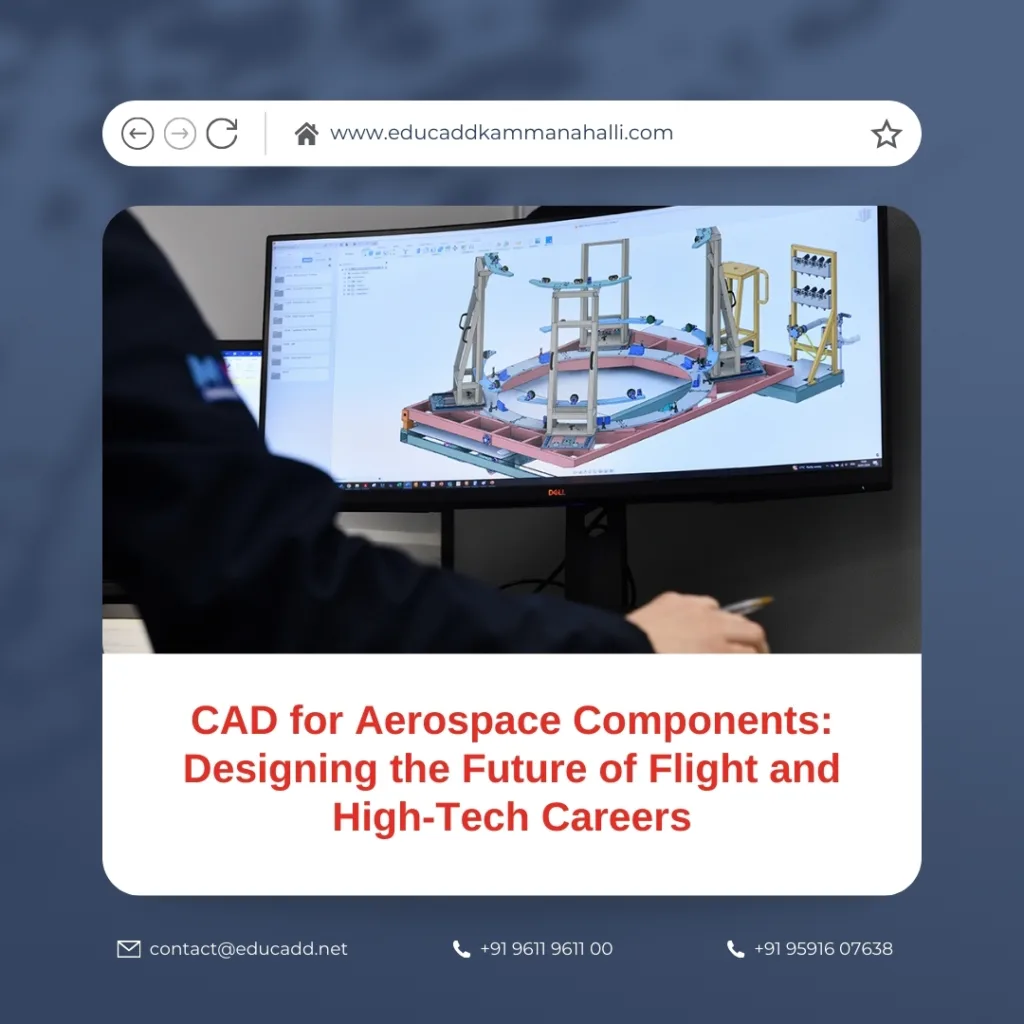
CAD for Aerospace Components
As global investment in aviation, defense, and space technology continues to rise, professionals skilled in aerospace CAD find themselves in strong demand. This blog explores how CAD shapes aerospace components, why it is critical for the industry, and how mastering it can lead to rewarding, future-ready jobs.
1. Understanding CAD for Aerospace Components
CAD for Aerospace Components refers to the use of advanced design software to create, modify, analyze, and optimize parts used in aircraft, spacecraft, satellites, and defense systems. Unlike general mechanical design, aerospace CAD focuses on extreme precision, lightweight structures, and compliance with strict regulatory standards.
Aerospace components operate under high stress, temperature variations, and dynamic loads. Therefore, CAD models must represent real-world behavior accurately. Engineers use CAD tools to design wings, fuselage sections, turbine blades, landing gear parts, and internal systems with micron-level accuracy. This process reduces errors and improves reliability long before physical production begins.
Moreover, CAD integrates seamlessly with simulation and manufacturing tools. Designers can test aerodynamics, thermal behavior, and structural strength within the same digital environment. As a result, development cycles become faster and more cost-effective. This integration makes CAD for aerospace components a foundational skill rather than an optional one.
From a career perspective, professionals who understand aerospace design standards gain a strong advantage. Companies seek individuals who can design parts that meet safety regulations while maintaining innovation. Therefore, learning aerospace-specific CAD practices opens doors to specialized and well-paid roles.
2. Why CAD Is Critical in Aerospace Engineering
The aerospace industry demands zero compromise on safety and accuracy. CAD plays a critical role in meeting these expectations. Through digital modeling, engineers visualize complex assemblies before manufacturing begins. This approach minimizes design flaws and reduces expensive rework.
One major benefit of CAD for Aerospace Components is precision. Every curve, angle, and tolerance must align with strict specifications. CAD software ensures consistency across designs, even in large and complex assemblies. As a result, teams maintain quality throughout the production process.
In addition, CAD supports lightweight design strategies. Aerospace engineers constantly aim to reduce weight without sacrificing strength. CAD tools help optimize material distribution and geometry. This optimization improves fuel efficiency and overall performance.
Collaboration also improves through CAD platforms. Multiple teams can work on the same model across locations. Changes update in real time, which enhances coordination and reduces miscommunication. Consequently, project timelines shorten while accuracy improves.
Because of these advantages, aerospace companies rely heavily on CAD expertise. Professionals who master these tools become essential contributors to innovation and safety.
3. Key CAD Tools Used in the Aerospace Industry
Several advanced CAD tools dominate the aerospace sector. Each tool offers unique capabilities tailored to complex engineering needs. Understanding these platforms strengthens career prospects significantly.
CATIA remains one of the most widely used tools for aerospace design. Major aircraft manufacturers rely on it for surface modeling and large assemblies. Its ability to manage complex geometry makes it ideal for aircraft structures.
Siemens NX also plays a vital role. It combines CAD, CAM, and CAE in one environment. Aerospace companies use it for integrated design and manufacturing workflows. This integration improves efficiency and reduces data transfer errors.
SolidWorks supports conceptual design and smaller aerospace components. While it serves more general mechanical design, many aerospace suppliers depend on it for precision parts.
In addition, tools like PTC Creo and Autodesk Fusion contribute to specialized tasks. These platforms support parametric modeling and rapid design iteration.
Mastering these tools enhances employability. Employers prefer candidates who adapt quickly to their design ecosystems. Therefore, hands-on experience with industry-standard software is crucial for anyone pursuing CAD for aerospace components as a career.
4. Career Opportunities in Aerospace CAD Design
A strong foundation in CAD for aerospace components unlocks diverse career paths. Aerospace organizations require skilled designers at every stage of product development. These roles extend beyond traditional engineering positions.
CAD design engineers focus on creating detailed component models. They collaborate with analysis and manufacturing teams to ensure feasibility. Structural designers specialize in load-bearing parts and safety-critical components. Tooling and manufacturing designers develop molds, fixtures, and assembly aids.
In addition, aerospace CAD skills support roles in research and development. R&D teams explore new materials, configurations, and technologies. CAD allows them to test concepts digitally before physical trials.
The demand extends to defense, space agencies, drone manufacturers, and private space companies. With the rise of space exploration startups, opportunities continue to expand. These roles often offer competitive salaries and long-term stability.
Freelancing and consulting also emerge as viable options. Experienced professionals provide design services to global clients. Thus, CAD for aerospace components offers flexibility along with career growth.
5. Skills and Learning Path for Aspiring Aerospace CAD Professionals
Building a successful career in aerospace CAD requires a structured learning approach. Technical skills must align with industry expectations and standards.
First, a strong understanding of engineering fundamentals is essential. Knowledge of materials, mechanics, and aerodynamics supports better design decisions. CAD software proficiency alone does not guarantee success without this foundation.
Next, learners should focus on aerospace design standards. Familiarity with GD&T, tolerance analysis, and certification requirements adds credibility. These skills ensure designs comply with regulatory frameworks.
Practical experience plays a critical role. Projects, internships, and simulations bridge the gap between theory and application. Hands-on exposure builds confidence and problem-solving ability.
Continuous learning remains important as technology evolves. Advanced modules in simulation, digital twins, and model-based definition enhance career longevity. Professionals who adapt remain relevant in competitive markets.
By following this path, aspiring designers position themselves for high-tech aerospace roles with long-term growth potential.
Conclusion
CAD for Aerospace Components represents more than a technical skill. It serves as a gateway to innovation, responsibility, and high-tech careers in one of the world’s most advanced industries. Aerospace design demands precision, creativity, and deep technical knowledge. CAD enables professionals to meet these demands while shaping the future of aviation and space exploration.
As the industry expands, the need for skilled CAD professionals continues to grow. Those who invest in learning aerospace-specific CAD tools and standards gain a strong competitive edge. With dedication and continuous development, CAD expertise can lead to rewarding careers that contribute to safer, more efficient, and more advanced aerospace systems.

