
CAD vs CADD in Mechanical Engineering: A Complete Guide to Understanding the Real Difference
In modern design environments, digital tools shape how engineers think, create, and innovate. Mechanical engineering, in particular, depends heavily on advanced drafting and modeling software to convert ideas into practical products. Yet, many students and professionals often feel confused when they encounter two closely related terms: CAD and CADD. At first glance, both seem identical. However, subtle distinctions create ongoing debates in academic and professional circles. This detailed guide explores the CAD vs CADD Difference in a structured and practical manner. By the end, you will clearly understand how these terms evolved, how they function, and why recognizing the Difference Between CAD and CADD in Mechanical Engineering matters in today’s industry.
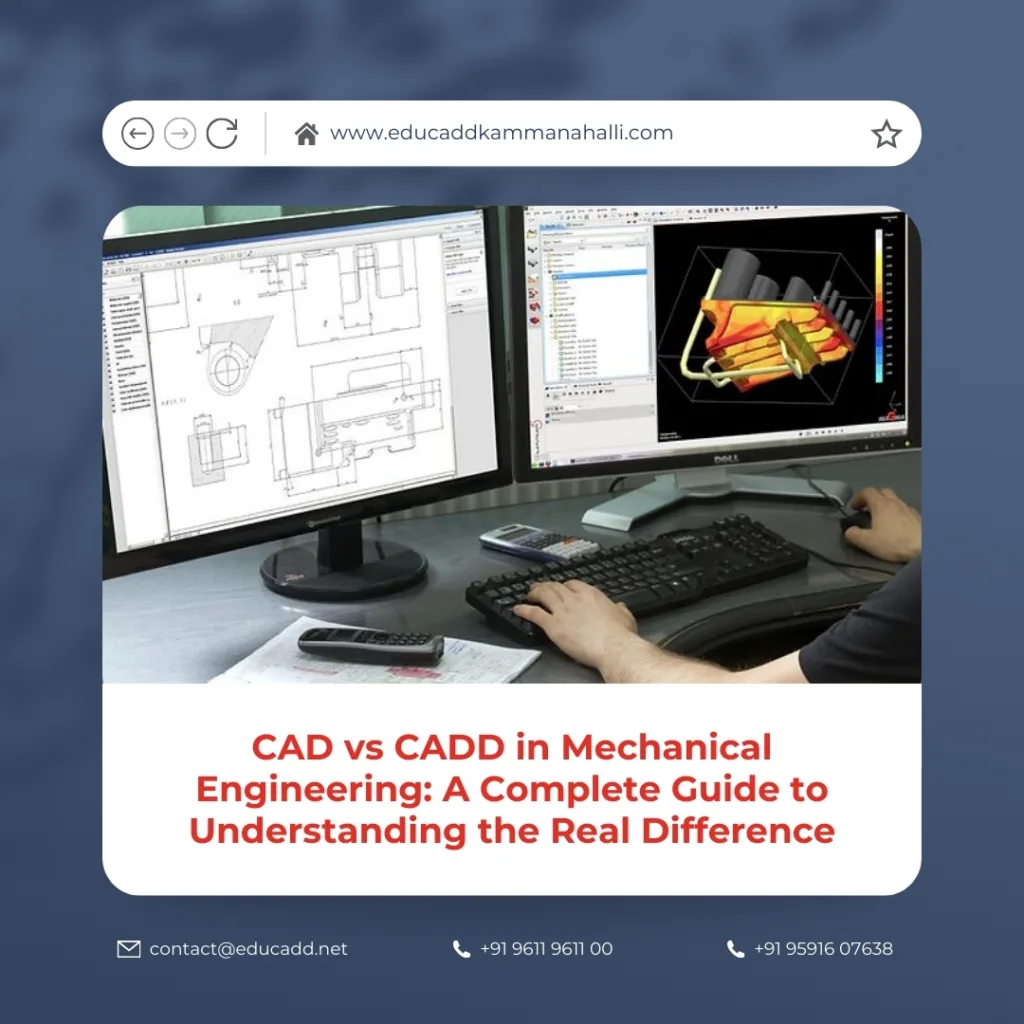
CAD vs CADD Difference
1. Understanding the Fundamentals of CAD
Computer-Aided Design, commonly known as CAD, refers to the use of computer software to create, modify, analyze, and optimize designs. Engineers rely on CAD tools to develop precise 2D drawings and 3D models. Instead of drawing on paper, designers now use digital platforms that allow quick edits and accurate measurements. CAD systems enhance productivity because they reduce human error and save time. When exploring the CAD vs CADD Difference, it becomes important to first understand that CAD primarily focuses on the design aspect. Mechanical engineers use CAD to create machine parts, assemblies, tools, and systems with detailed geometry and dimensions. Moreover, CAD software supports simulation and visualization, which helps engineers evaluate performance before manufacturing begins.
2. Defining CADD and Its Broader Scope
CADD stands for Computer-Aided Design and Drafting. While many people use CAD and CADD interchangeably, CADD includes drafting as an explicit component. Drafting involves preparing detailed technical drawings that communicate manufacturing specifications. Therefore, when discussing the CAD vs CADD Difference, the key point lies in the additional “Drafting” element. CADD systems not only help engineers design components but also produce standardized technical drawings with annotations, tolerances, and symbols. Mechanical industries rely on these detailed drawings to guide fabrication and assembly. As a result, CADD emphasizes documentation alongside design development.
3. Historical Evolution of CAD and CADD
To fully understand the Difference Between CAD and CADD in Mechanical Engineering, we must examine their historical development. Early engineering drawings were created manually using drafting boards and instruments. This process required immense skill and time. During the 1960s and 1970s, computer graphics technology began to transform engineering practices. Early CAD systems replaced manual drafting with digital tools. Over time, engineers started using the term CADD to highlight the drafting function integrated within CAD platforms. As software evolved, 3D modeling became standard, and the distinction between CAD and CADD started fading. However, educational institutions continued to use both terms, which preserved the discussion about the Difference Between CAD and CADD in Mechanical Engineering.
4. Core Functional Differences
When analyzing the Difference Between CAD and CADD in Mechanical Engineering, functionality offers clear insight. CAD primarily focuses on creating digital models. Engineers use it to build 3D representations, test fitment, and analyze motion. In contrast, CADD emphasizes both modeling and technical documentation. For example, a mechanical engineer designing a gearbox may use CAD to develop the 3D assembly. Later, the engineer generates detailed dimensioned drawings using drafting tools, which fall under CADD functions. Therefore, while CAD centers on design creativity and modeling, CADD ensures that the design translates into manufacturing-ready documentation.
5. Role in Mechanical Product Development
Mechanical product development involves multiple stages, including conceptual design, modeling, analysis, and production documentation. The Difference Between CAD and CADD in Mechanical Engineering becomes evident across these stages. CAD tools support conceptual modeling and simulation. Engineers test stress distribution, thermal performance, and motion dynamics using integrated analysis modules. Meanwhile, CADD tools refine the final design into standardized drawings. These drawings include material specifications, surface finishes, and geometric tolerances. Because manufacturing teams rely on these documents, CADD plays a critical role in bridging design and production.
6. Software Tools and Industry Usage
Most modern software platforms combine CAD and drafting features into one integrated environment. Programs such as SolidWorks, AutoCAD, CATIA, and Creo allow engineers to model and draft within the same system. However, when discussing the Difference Between CAD and CADD in Mechanical Engineering, professionals often use CAD to describe advanced 3D modeling tools and CADD to describe drafting-focused applications. In practice, industries do not strongly separate the two. Instead, they emphasize skill in both modeling and documentation. Mechanical engineers must understand design intent and also prepare accurate drawings for manufacturing.
7. Educational Perspective in Mechanical Engineering
Academic institutions often teach CAD and CADD as separate modules. Students learn 2D drafting basics before moving to advanced 3D modeling. This teaching method reinforces the Difference Between CAD and CADD in Mechanical Engineering for beginners. CAD courses typically focus on parametric modeling, assembly creation, and simulations. CADD courses emphasize dimensioning standards, orthographic projections, sectional views, and annotation techniques. By mastering both areas, students develop a comprehensive understanding of digital design workflows. This structured approach ensures graduates can handle both creative design and technical documentation.
8. Precision and Accuracy Considerations
Precision defines success in mechanical engineering. A minor dimensional error can cause assembly failure or safety risks. The Difference Between CAD and CADD in Mechanical Engineering also appears in how precision gets applied. CAD models ensure geometric accuracy through parametric constraints. Engineers modify dimensions, and the entire model updates automatically. Meanwhile, CADD ensures documentation accuracy by applying standardized tolerances and notes. Drafting standards such as ISO and ASME guide drawing preparation. Therefore, CAD guarantees design integrity, while CADD ensures communication clarity.
9. Productivity and Workflow Efficiency
Digital tools have drastically improved engineering productivity. Understanding the Difference Between CAD and CADD in Mechanical Engineering helps organizations streamline workflow. CAD accelerates design iteration because engineers can quickly test multiple concepts. Instead of redrawing from scratch, they adjust parameters. CADD enhances efficiency by automating dimension placement, title blocks, and bill of materials generation. Together, these capabilities reduce project timelines. Companies benefit from faster product launches and lower operational costs. Consequently, professionals who grasp both aspects contribute significantly to team performance.
10. Integration with Manufacturing Technologies
Modern mechanical engineering integrates closely with manufacturing technologies such as CNC machining and 3D printing. The Difference Between CAD and CADD in Mechanical Engineering influences this integration. CAD models directly feed into CAM software for toolpath generation. Engineers export 3D models for prototyping and production. On the other hand, CADD drawings provide machinists with detailed references, including tolerances and surface finish requirements. Without accurate drafting, manufacturing teams may misinterpret design intent. Therefore, while CAD drives digital production workflows, CADD ensures precise communication on the shop floor.
11. Collaboration and Communication Impact
Mechanical projects often involve multidisciplinary teams. Designers, analysts, production engineers, and quality inspectors must collaborate effectively. The Difference Between CAD and CADD in Mechanical Engineering plays a role in communication. CAD files allow team members to visualize assemblies in 3D. This visualization improves understanding and reduces design conflicts. Meanwhile, CADD drawings act as formal documentation that teams use during reviews and audits. Clear drafting prevents misunderstandings and supports quality control. As projects grow more complex, the ability to manage both modeling and documentation becomes essential.
12. Career Opportunities and Skill Requirements
Employers expect mechanical engineers to possess strong digital design skills. When evaluating the Difference Between CAD and CADD in Mechanical Engineering, hiring managers often look for proficiency in modeling as well as drafting standards. CAD expertise demonstrates creative and analytical capability. CADD expertise reflects attention to detail and documentation accuracy. Professionals who combine both skills secure better career opportunities in automotive, aerospace, manufacturing, and energy sectors. Furthermore, engineers who understand the Difference Between CAD and CADD in Mechanical Engineering can adapt quickly to evolving technologies.
13. Misconceptions and Common Confusion
Many professionals believe that CAD and CADD are completely different technologies. However, the Difference Between CAD and CADD in Mechanical Engineering often lies in terminology rather than functionality. Modern CAD software already includes drafting features. Therefore, some experts argue that CADD simply emphasizes documentation within CAD systems. Another misconception suggests that CAD focuses only on 2D drawings. In reality, CAD heavily supports 3D modeling and simulation. Clarifying these misunderstandings helps students and engineers approach digital tools with confidence.
14. Future Trends and Technological Advancements
The future of mechanical engineering design continues to evolve rapidly. Technologies such as generative design, artificial intelligence, and cloud collaboration are transforming workflows. In this context, the CAD vs CADD Difference may become less pronounced. Advanced CAD platforms now automate drafting processes using model-based definitions. Engineers increasingly rely on 3D models that contain embedded manufacturing data. Nevertheless, documentation will always remain essential. Even as digital transformation progresses, understanding the Difference Between CAD and CADD in Mechanical Engineering ensures engineers maintain strong foundational knowledge.
Conclusion
The CAD vs CADD Difference may seem subtle, yet it holds significant importance for students and professionals alike. CAD primarily emphasizes digital design and modeling, enabling engineers to visualize, simulate, and optimize mechanical systems. CADD expands this scope by incorporating detailed drafting and technical documentation that guide manufacturing processes. While modern software integrates both functions seamlessly, recognizing the Difference Between CAD and CADD in Mechanical Engineering helps clarify workflow roles, educational pathways, and industry expectations. Ultimately, successful mechanical engineers master both modeling and drafting skills, ensuring their designs move smoothly from concept to production.

