
From Virtual Testing to Real-World Success: How CAE Software Prevents Product Failures
Product failure is one of the most expensive challenges faced by modern industries. Despite advanced manufacturing methods and improved materials, companies still encounter breakdowns, recalls, safety risks, and dissatisfied customers. These failures often occur because issues are discovered too late in the development cycle. Physical testing alone cannot always predict real-world conditions. This is where CAE Software Prevents Failures plays a transformative role. By enabling engineers to simulate, analyze, and optimize products before manufacturing, CAE software significantly reduces the risk of failure. It replaces assumptions with data, intuition with insight, and guesswork with precision. As industries move toward faster innovation cycles, CAE software has become a strategic necessity rather than a technical option.
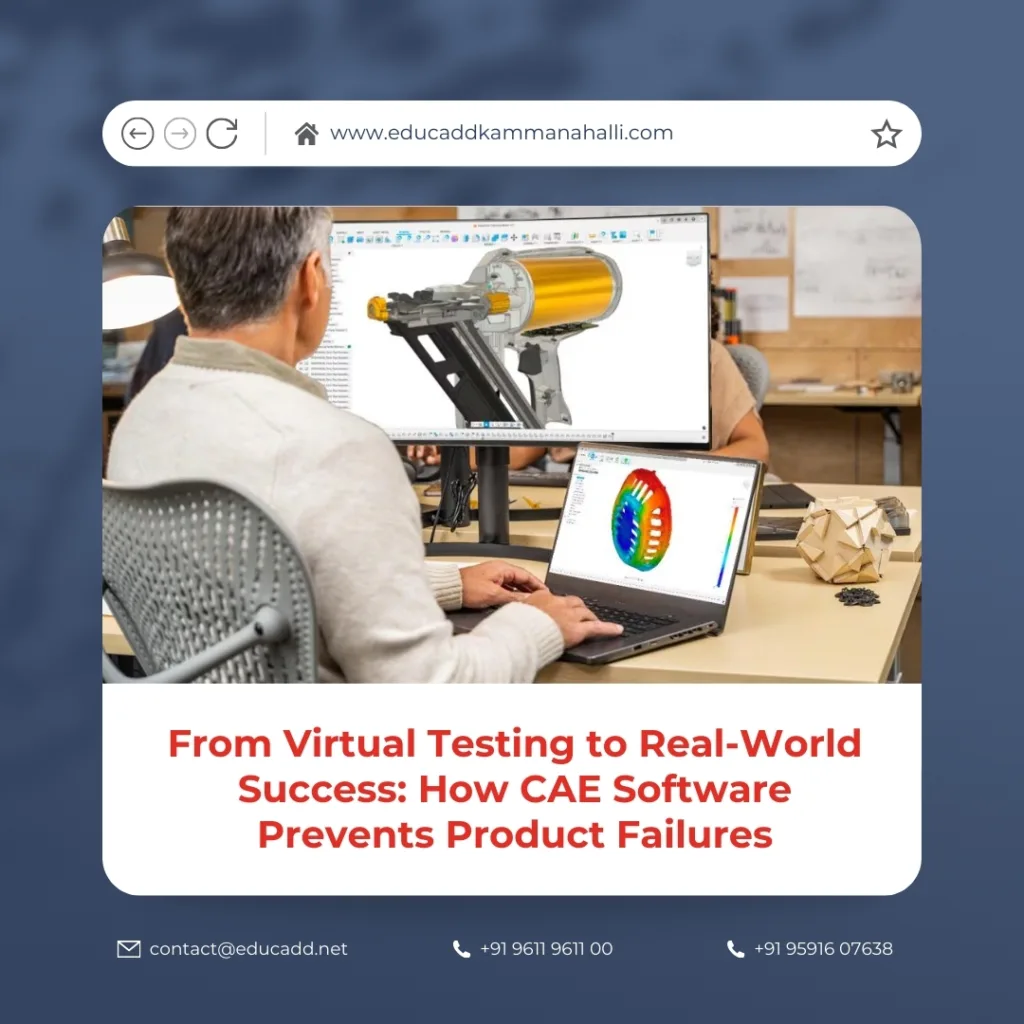
CAE Software Prevents Failures
1. Understanding Product Failure and Its Business Impact
Product failure goes beyond broken components or poor performance. It affects brand reputation, customer trust, regulatory compliance, and long-term profitability. Even a minor defect can lead to recalls, legal action, and lost market share. Traditionally, companies relied heavily on physical prototypes to detect issues. However, this approach increases development costs and delays product launches. Moreover, physical testing cannot easily replicate extreme conditions or long-term usage. CAE Software Prevents Failures addresses these gaps by enabling virtual testing under thousands of scenarios. As a result, organizations gain a deeper understanding of failure mechanisms before committing to production.
2. What Is CAE Software and Why It Matters
CAE software, or Computer-Aided Engineering software, refers to simulation tools used to analyze how products behave under real-world conditions. These tools include structural analysis, thermal analysis, fluid dynamics, fatigue analysis, and multi-physics simulations. Engineers use CAE software to predict stress, deformation, vibration, heat transfer, and airflow. This predictive capability allows teams to identify weaknesses early. Instead of reacting to failures after production, engineers proactively design against them. Consequently, CAE software shifts product development from reactive problem-solving to preventive engineering.
3. Early Design Validation Through Virtual Prototyping
One of the strongest advantages of CAE software is early design validation. Engineers can evaluate multiple design concepts without creating physical prototypes. Virtual prototyping helps teams compare materials, geometries, and load conditions efficiently. Because simulations run faster than physical tests, design iterations become quicker and more cost-effective. Additionally, early validation reduces design rework later in the process. When potential failure points are identified during the conceptual stage, corrective actions become simpler and cheaper. Therefore, CAE software supports smarter decisions from the very beginning of product development.
4. Accurate Stress and Structural Analysis
Structural failure remains a leading cause of product breakdown. Components often fail due to excessive stress, fatigue, or unexpected load paths. CAE software enables precise stress and strain analysis across complex geometries. Engineers can visualize stress concentrations that are invisible during physical inspection. Moreover, simulations allow testing under extreme conditions that may be unsafe or impractical in real life. By understanding how forces travel through a product, designers can reinforce critical areas and eliminate unnecessary material. This balance between strength and efficiency directly reduces the likelihood of structural failure.
5. Predicting Fatigue and Long-Term Durability
Many products fail not immediately, but after prolonged use. Fatigue failure occurs when materials weaken under repeated loading cycles. CAE software excels at predicting fatigue life by simulating real usage patterns. Engineers can estimate how long a component will last under operational conditions. This insight enables better material selection and geometry optimization. Additionally, fatigue analysis helps companies meet safety standards and warranty expectations. As a result, CAE software protects both users and manufacturers from unexpected long-term failures.
6. Thermal Analysis to Prevent Heat-Related Failures
Heat is a silent contributor to many product failures. Overheating can degrade materials, reduce performance, and cause complete system breakdowns. CAE software allows engineers to simulate heat generation and dissipation within a product. Thermal analysis identifies hotspots and inefficient cooling paths. With this information, designers can improve ventilation, select better materials, or redesign layouts. Furthermore, CAE software helps ensure that products perform reliably under varying environmental conditions. This capability is especially critical in electronics, automotive, and aerospace industries.
7. Fluid Dynamics Simulation for Performance Reliability
Products interacting with fluids, such as air or liquids, face unique failure risks. Poor airflow can cause overheating, noise, or vibration issues. CAE software uses Computational Fluid Dynamics to analyze fluid behavior around and inside products. Engineers can visualize flow patterns, pressure zones, and turbulence. These insights help optimize performance while avoiding failure scenarios. For example, better airflow design can prevent premature component wear. Therefore, CAE software improves both functionality and durability through fluid analysis.
8. Material Optimization and Failure Prevention
Material selection plays a critical role in product reliability. Choosing the wrong material can lead to cracking, corrosion, or deformation. CAE software enables engineers to evaluate how different materials behave under identical conditions. Virtual testing reduces dependency on trial-and-error methods. Engineers can balance strength, weight, cost, and durability more effectively. Moreover, CAE software supports advanced materials, including composites and alloys. This capability ensures that materials perform as expected throughout the product lifecycle.
9. Reducing Human Error in Engineering Decisions
Human judgment, while valuable, can introduce bias and oversight. CAE software reduces reliance on assumptions by providing data-driven insights. Simulations highlight potential issues that engineers may overlook during manual calculations. Additionally, standardized simulation workflows improve consistency across projects. As teams collaborate using shared models and results, communication becomes clearer. Consequently, CAE software minimizes misinterpretation and design errors that often lead to failure.
10. Enhancing Safety and Regulatory Compliance
Many industries operate under strict safety and regulatory standards. Product failure can result in non-compliance and severe penalties. CAE Software Prevents Failures helps engineers validate designs against regulatory requirements early in the process. Virtual testing demonstrates compliance without excessive physical testing. Furthermore, simulation results provide documented evidence during audits and certifications. This proactive approach reduces approval delays and ensures safer products reach the market.
11. Cost Reduction Through Failure Avoidance
Failure prevention directly impacts cost savings. Physical prototypes, redesigns, and recalls are expensive. CAE software significantly reduces these costs by identifying problems early. Virtual simulations cost less than repeated physical tests. Additionally, optimized designs often require less material and fewer manufacturing adjustments. Over time, these savings accumulate and improve profitability. Therefore, investing in CAE software delivers measurable financial benefits alongside technical advantages.
12. Faster Time-to-Market With Reliable Designs
Speed is critical in competitive markets. However, rushing development increases failure risk. CAE software allows companies to move fast without compromising reliability. Rapid simulations accelerate decision-making and reduce iteration cycles. Teams can confidently approve designs knowing they have been thoroughly tested virtually. As a result, products reach the market faster while maintaining high quality standards.
13. Supporting Innovation Without Increasing Risk
Innovation often introduces uncertainty. New designs, materials, or technologies carry unknown risks. CAE software provides a safe environment to experiment and innovate. Engineers can test bold ideas virtually without financial or safety consequences. This freedom encourages creativity while controlling failure risk. Consequently, CAE software enables innovation that is both ambitious and responsible.
14. Industry-Wide Adoption and Real-World Success
Industries such as automotive, aerospace, manufacturing, electronics, and construction widely adopt CAE software. These sectors rely on simulation to prevent catastrophic failures. Real-world success stories consistently show reduced recalls, improved performance, and higher customer satisfaction. As digital engineering evolves, CAE software continues to integrate with CAD, PLM, and digital twin technologies. This integration further strengthens failure prevention strategies across the product lifecycle.
Conclusion
Product failure is no longer an unavoidable risk. With the right tools and processes, companies can predict, prevent, and eliminate most failure scenarios. CAE Software Prevents Failures stands at the center of this transformation. It empowers engineers with visibility, accuracy, and confidence throughout product development. From early design validation to long-term durability analysis, CAE software replaces uncertainty with insight. Organizations that embrace simulation-driven design not only reduce failures but also build trust, innovation, and competitive advantage. In today’s demanding market, CAE software is not just a technical solution. It is the foundation of reliable, safe, and successful products.

