
Mastering CATIA for Sheet Metal Design: Industry-Focused Training in Kammanahalli
The manufacturing sector continues to evolve at an extraordinary pace. Industries now demand accuracy, speed, and innovation in every stage of product development. Sheet metal components form the structural backbone of automobiles, aerospace systems, industrial machinery, electrical enclosures, and consumer products. Because of this growing demand, engineers must possess advanced design skills that align with modern production standards. CATIA has become one of the most powerful tools for mechanical design professionals. Through structured programs like CATIA Sheet Metal Training – Training in Kammanahalli, students and working professionals gain practical expertise that directly connects with industry requirements.
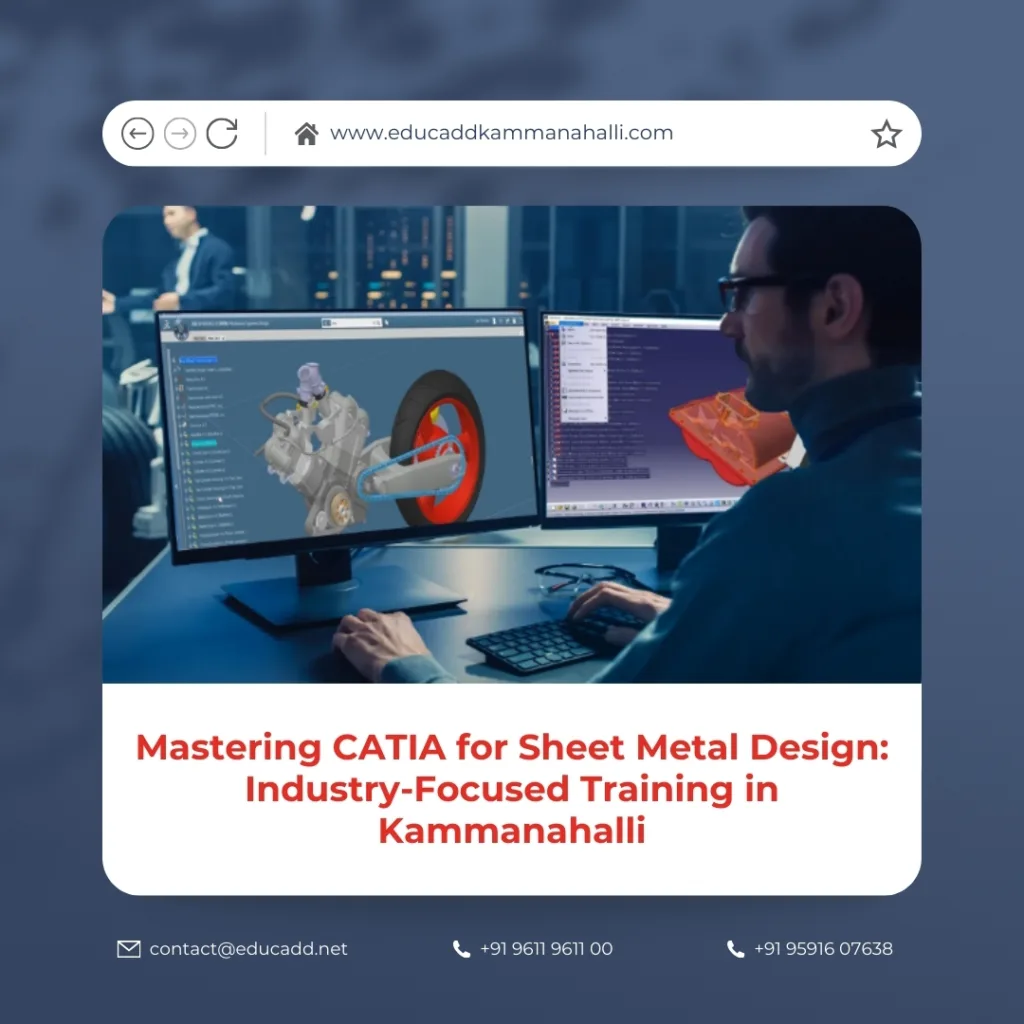
CATIA Sheet Metal Training
Kammanahalli, located in Bangalore, offers a vibrant learning ecosystem. With its proximity to industrial hubs and educational institutions, it has become a preferred location for technical training. This comprehensive blog explores every dimension of CATIA sheet metal design training, including its importance, curriculum structure, industry relevance, career growth, and long-term benefits. This training not only builds technical competence but also enhances confidence, employability, and long-term career prospects.
The Growing Importance of Sheet Metal Design in Engineering
CATIA Sheet Metal Training plays a crucial role in modern mechanical engineering. Thin metal sheets are shaped, bent, cut, and assembled to form durable components. These components appear in vehicle bodies, aircraft panels, machine covers, brackets, cabinets, and structural frames. Because these parts must meet strict dimensional tolerances, engineers must understand material behavior and fabrication processes.
Designing sheet metal parts involves careful planning. Engineers consider bend radius, thickness, K-factor, neutral axis, relief cuts, and manufacturing constraints. Even a small calculation error can lead to material wastage or misalignment during assembly. Therefore, professionals must rely on accurate digital tools rather than traditional drafting methods.
When learners enroll in CATIA for Sheet Metal Design – Training in Kammanahalli, they develop a solid understanding of these critical principles. They learn how theoretical concepts translate into practical manufacturing outcomes. This knowledge strengthens their ability to create production-ready designs.
Why CATIA Leads in Advanced Mechanical Design
CATIA stands among the most advanced 3D CAD platforms in the world. Developed by Dassault Systèmes, CATIA supports product design, engineering analysis, and lifecycle management. Many global automotive and aerospace companies rely on CATIA for complex product development.
The sheet metal workbench in CATIA offers specialized tools that simplify modeling. Designers can create walls, flanges, bends, cutouts, hems, beads, and stiffeners with precision. The software automatically calculates bend allowances and generates flat patterns. Because of this capability, engineers can evaluate manufacturability before production begins.
CATIA also maintains full associativity between 3D models and 2D drawings. When designers update a model, drawings reflect changes instantly. This feature improves productivity and reduces errors. Through CATIA for Sheet Metal Design – Training in Kammanahalli, students master these powerful features in a structured manner.
Core Fundamentals Covered in Sheet Metal Training
Every effective training program begins with foundational concepts. Students first learn about sheet metal parameters such as material thickness, bend radius, and K-factor. Trainers explain how these factors influence final dimensions after bending operations.
Next, learners explore sketcher tools and parametric modeling techniques. They understand constraints, dimensions, and design intent. This foundation ensures that models remain editable and adaptable. After mastering basics, students enter the sheet metal design module.
In CATIA for Sheet Metal Design – Training in Kammanahalli, learners practice creating base walls and adding flanges. They also apply bend reliefs and corner reliefs to prevent tearing during manufacturing. Trainers emphasize design accuracy and logical workflow. This step-by-step approach builds strong conceptual clarity.
Advanced Modeling Techniques and Applications
Once students gain confidence in basic modeling, they move to advanced features. They learn to create complex geometries using joggles, hems, beads, and stiffeners. These elements enhance structural strength and functionality.
Additionally, learners work on multi-body designs and sheet metal assemblies. They analyze how individual parts interact within larger systems. Trainers also introduce surface conversion techniques for converting surface models into sheet metal components.
Through CATIA for Sheet Metal Design – Training in Kammanahalli, participants work on real-time case studies. These projects simulate industrial challenges and strengthen analytical thinking. By practicing repeatedly, students develop efficiency and accuracy.
Real-Time Projects and Industry Simulation
Practical exposure plays a decisive role in skill development. During training, students design components such as electrical enclosures, automotive brackets, machine guards, and structural panels. Each project mirrors real manufacturing requirements.
Learners also generate flat patterns and production drawings. They understand how design changes affect material usage and fabrication processes. Trainers demonstrate how improper bend calculations lead to dimensional errors. Students then correct these issues using systematic methods.
CATIA for Sheet Metal Design – Training in Kammanahalli ensures that learners do not merely operate software tools. Instead, they understand the logic behind every modeling decision. This approach builds problem-solving capabilities and industry readiness.
Industry Demand for CATIA Sheet Metal Professionals
Manufacturing industries in Bangalore, Pune, Chennai, and other industrial hubs consistently seek skilled CAD professionals. Employers prefer candidates who can design sheet metal parts with precision and speed.
Digital manufacturing and automation have transformed production workflows. Companies now expect engineers to deliver accurate digital models that integrate seamlessly with CNC and laser cutting machines. Professionals trained in CATIA for Sheet Metal Design – Training in Kammanahalli meet these expectations effectively.
Career opportunities include Design Engineer, CAD Engineer, Mechanical Designer, and Product Development Engineer. Because CATIA holds global recognition, professionals also gain opportunities abroad. This demand continues to grow as industries adopt advanced digital systems.
Learning Environment in Kammanahalli
Kammanahalli has developed into a dynamic educational and commercial locality within Bangalore. Its accessibility and infrastructure make it ideal for professional training programs.
Training centers in this region provide updated software versions and well-equipped labs. Students benefit from structured classroom sessions combined with dedicated lab hours. Trainers encourage interaction, practical exercises, and consistent feedback.
Because Kammanahalli connects conveniently to major industrial areas, learners also gain exposure to industry seminars and networking events. This environment enhances professional growth and confidence.
Step-by-Step Structured Curriculum
A systematic curriculum ensures progressive learning. Initially, students explore the CATIA interface and navigation tools. They practice sketching and parametric modeling techniques.
Next, they enter the sheet metal workbench and create fundamental components. Trainers explain design intent and manufacturing logic at every stage. Gradually, students move toward complex assemblies and drafting.
Assignments and periodic assessments reinforce understanding. In CATIA for Sheet Metal Design – Training in Kammanahalli, the final module typically includes a capstone project. This project integrates all learned concepts into a comprehensive design solution.
Benefits of Instructor-Led Training
Self-learning resources can introduce software basics. However, professional training provides structured guidance and real-world insights. Experienced instructors clarify complex topics and share industry best practices.
Interactive sessions allow learners to resolve doubts immediately. Trainers also provide personalized feedback that improves modeling accuracy. Furthermore, classroom collaboration fosters teamwork and peer learning.
CATIA for Sheet Metal Design – Training in Kammanahalli bridges the gap between theoretical knowledge and practical application. This structured support accelerates skill development and enhances career readiness.
Integration with Manufacturing Workflow
CATIA integrates seamlessly with assembly design and drafting modules. Engineers can design individual sheet metal parts and assemble them into complete systems. This integration improves workflow efficiency.
Flat pattern generation enables manufacturers to visualize cutting layouts accurately. Designers export files for CNC and laser cutting operations. Because CATIA maintains associative relationships, design updates reflect automatically across drawings and assemblies.
Through CATIA for Sheet Metal Design – Training in Kammanahalli, students understand this end-to-end digital workflow. They learn how virtual models translate into physical products with precision.
Career Advancement and Salary Growth
Proficiency in CATIA significantly enhances employability. Entry-level professionals often secure promising roles in manufacturing and product development firms. With experience, they progress to senior design and project management positions.
Sheet metal specialists who demonstrate technical competence and innovation gain recognition quickly. Organizations value professionals who reduce errors and optimize production efficiency.
Completing CATIA for Sheet Metal Design – Training in Kammanahalli builds strong technical foundations. This expertise supports steady career growth and financial stability.
Building a Strong Professional Portfolio
A professional portfolio showcases practical abilities. During training, students create multiple sheet metal components and assemblies. These projects serve as evidence of skill and creativity.
Institutes offering CATIA for Sheet Metal Design – Training in Kammanahalli provide certification upon completion. This certification validates knowledge and strengthens resumes.
Recruiters frequently conduct practical tests during interviews. A well-prepared portfolio increases confidence and improves job prospects significantly.
Future Scope and Continuous Learning
Technology continues to advance rapidly. Industries now adopt smart manufacturing systems and digital transformation strategies. Engineers must stay updated with evolving tools and techniques.
Mastering sheet metal fundamentals ensures adaptability to future technologies. Professionals who understand core principles can quickly learn advanced modules and integrated systems.
CATIA for Sheet Metal Design – Training in Kammanahalli equips learners with both foundational strength and forward-looking skills. This combination ensures long-term relevance in the engineering domain.
Conclusion
Engineering excellence depends on precision, technical expertise, and continuous improvement. CATIA Sheet Metal Training remain essential across automotive, aerospace, industrial, and consumer sectors. Designing these components requires a deep understanding of material behavior and advanced CAD tools.
CATIA offers powerful capabilities that streamline sheet metal modeling and manufacturing integration. Structured training programs in Kammanahalli provide hands-on practice, expert mentorship, and industry-focused learning. Students not only learn software commands but also develop practical problem-solving abilities.
Choosing CATIA for Sheet Metal Design – Training in Kammanahalli represents a strategic investment in professional growth. It strengthens technical competence, enhances employability, and prepares learners for dynamic opportunities in modern manufacturing industries.

