
How Civil CADD Minimizes Construction Mistakes and Improves Project Accuracy
The construction industry continues to grow at a rapid pace. However, even a small design mistake can create serious delays, increase project costs, and reduce structural quality. Many builders, engineers, architects, and contractors now depend on advanced software tools to improve precision and reduce risks during every stage of construction. Among these tools, Civil CADD plays a major role in modern infrastructure development. Civil CADD Construction Accuracy drawings, detailed layouts, and error-free project plans.
These applications simplify the planning process and improve communication between teams. As a result, companies can complete projects faster while maintaining high standards of safety and quality. Today, construction firms no longer rely only on manual drafting methods. Instead, they use intelligent Civil CADD systems to detect clashes, manage site data, and create precise structural models before the actual work begins. This approach significantly reduces costly rework and improves project efficiency.
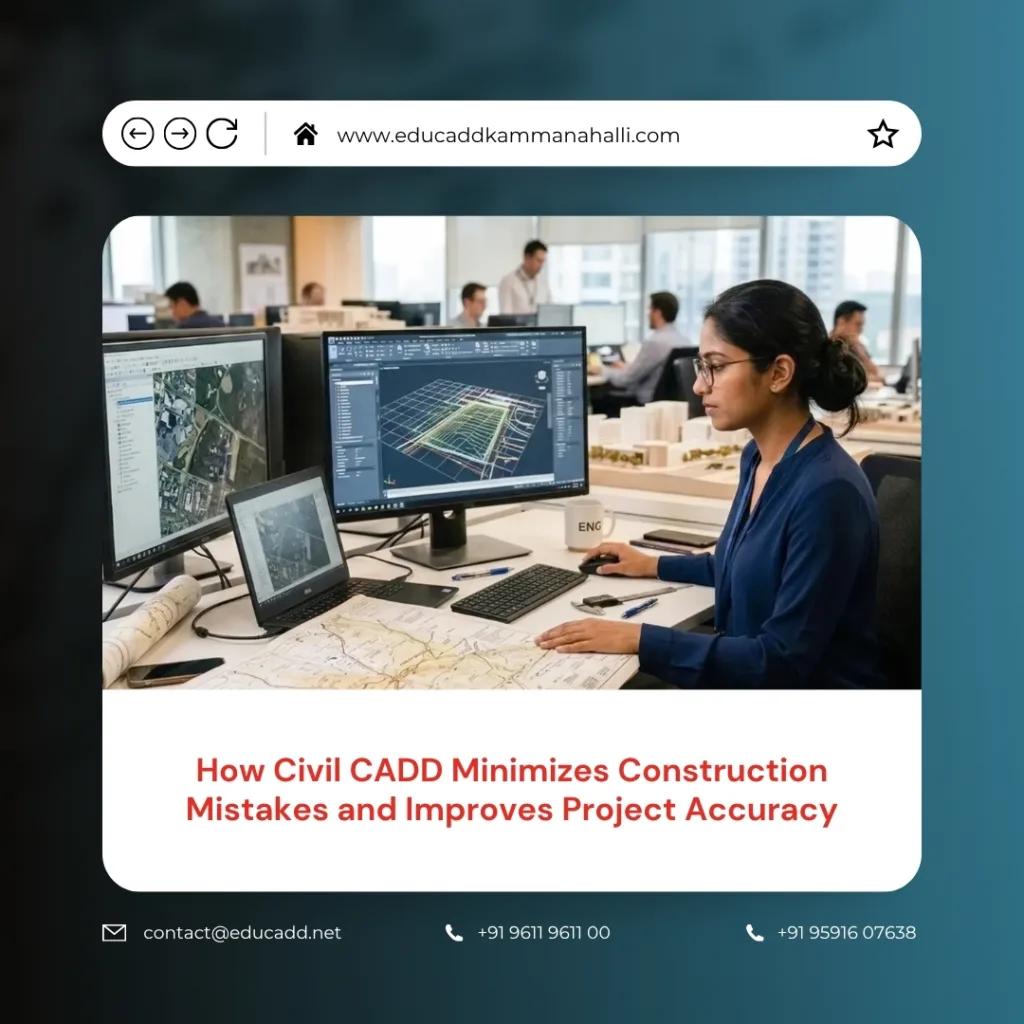
Civil CADD Construction Accuracy
In this blog, you will explore how Civil CADD helps reduce construction errors, improves coordination, enhances project visualization, and supports better decision-making throughout the construction lifecycle.
1. Civil CADD Improves Design Accuracy
Construction projects demand high levels of accuracy. Even a minor error in dimensions can create major structural problems later. Civil CADD software allows engineers and designers to prepare highly accurate technical drawings with exact measurements and detailed specifications.
Unlike manual drafting, Civil CADD reduces human calculation mistakes. Designers can edit layouts quickly without redrawing entire plans. This flexibility improves workflow and minimizes design inconsistencies.
Modern Civil CADD Construction Accuracy also provide automated tools for alignment, scaling, and measurements. These features ensure every component fits correctly within the project design. Consequently, construction teams receive reliable drawings that reduce confusion at the site.
Additionally, accurate digital models help professionals visualize the project before construction begins. This process prevents structural mismatches and improves planning efficiency.
2. Better Project Visualization Reduces Site Confusion
One of the biggest reasons for construction errors is poor visualization. Traditional 2D drawings often fail to provide complete project clarity. Civil CADD software solves this issue through advanced 2D and 3D modeling features.
Engineers and contractors can view roads, bridges, drainage systems, and structural elements from multiple perspectives. This clear visualization helps teams understand the project scope more effectively.
When workers understand the exact layout, they avoid mistakes during execution. As a result, projects move smoothly with fewer interruptions.
Moreover, 3D visualization allows clients to review the design before construction starts. This early approval process prevents late-stage modifications that usually increase project expenses.
Benefits of Better Visualization
- Improves understanding of complex structures
- Reduces design misunderstandings between teams
3. Clash Detection Prevents Costly Errors
Construction projects involve multiple systems such as plumbing, electrical, structural, and drainage networks. Without proper coordination, these systems may overlap or clash during installation.
Civil CADD tools identify these conflicts before construction begins. Engineers can detect design clashes digitally and make necessary corrections immediately.
For example, a drainage pipe may interfere with a foundation beam. If the issue remains unnoticed, contractors may need expensive rework later. Civil CADD software highlights such conflicts early and prevents construction delays.
This proactive approach saves both time and money. Additionally, it improves communication between departments because all teams work using synchronized project data.
4. Civil CADD Enhances Survey Accuracy
Land surveying forms the foundation of every construction project. Incorrect survey data can lead to alignment issues, uneven grading, and structural instability.
Civil CADD Construction Accuracy survey information with design plans. Engineers can import topographical data directly into the system and create accurate site layouts.
This integration reduces manual calculations and improves terrain analysis. Consequently, engineers can plan roads, drainage systems, and building foundations more effectively.
Furthermore, digital surveying tools improve precision in large infrastructure projects such as highways, railways, and urban developments. Accurate site information minimizes construction risks and supports efficient land utilization.
5. Faster Design Modifications Reduce Delays
Construction projects often require sudden design changes due to client demands or site conditions. Manual drafting methods make revisions time-consuming and difficult.
Civil CADD software simplifies this process through automated editing tools. Designers can modify dimensions, layouts, and structural elements instantly without recreating the entire drawing.
This capability reduces project downtime and helps teams adapt quickly to new requirements. Additionally, all connected drawings update automatically, which prevents inconsistencies across project documents.
Faster revisions improve project coordination and ensure construction teams always work with the latest approved designs.
6. Improved Team Coordination Enhances Productivity
Large construction projects involve architects, civil engineers, contractors, and project managers. Poor communication between these teams often causes construction mistakes.
Civil CADD creates a centralized platform where all stakeholders can access updated project information. Everyone works using the same digital files, which improves collaboration and reduces confusion.
Cloud-based Civil CADD systems further strengthen communication because teams can share updates in real time. This transparency prevents outdated drawings from reaching the construction site.
Better coordination also improves workflow efficiency. Teams complete tasks faster because they clearly understand project requirements and deadlines.
7. Accurate Quantity Estimation Minimizes Material Waste
Material estimation errors can significantly increase project costs. Overestimation creates waste, while underestimation delays construction activities.
Civil CADD software generates accurate quantity calculations directly from project drawings. Engineers can estimate materials such as concrete, steel, soil, and asphalt with greater precision.
These automated calculations reduce dependency on manual measurements and improve budgeting accuracy. As a result, contractors manage resources more efficiently.
Additionally, precise estimation supports sustainable construction practices because companies avoid unnecessary material consumption.
Advantages of Accurate Estimation
- Reduces construction material wastage
- Improves project budgeting and cost control
8. Civil CADD Strengthens Road and Infrastructure Planning
Road construction projects require detailed alignment planning, grading analysis, and drainage management. Small design mistakes can affect traffic flow and road durability.
Civil CADD software helps engineers design roads with accurate elevations, curves, and cross-sections. The software also supports terrain modeling and earthwork calculations.
These features reduce alignment errors and improve construction quality. Engineers can analyze multiple design alternatives and choose the most efficient solution.
Furthermore, infrastructure planners use Civil CADD for bridges, tunnels, airports, and railway systems. Accurate digital modeling ensures structural safety and long-term performance.
9. Better Documentation Prevents Miscommunication
Construction projects generate large volumes of technical documents. Missing or outdated drawings often create misunderstandings between teams.
Civil CADD software organizes project files systematically. Engineers can maintain standardized documentation with clear labels, revisions, and version tracking.
This organized workflow reduces confusion and ensures every department uses the latest design data. Proper documentation also helps contractors during inspections and compliance reviews.
Additionally, digital storage minimizes the risk of losing important project information.
10. Automation Reduces Human Errors
Manual drafting and calculations consume significant time and increase the possibility of mistakes. Civil CADD software automates many repetitive tasks, including dimensioning, scaling, and report generation.
Automation improves speed and accuracy simultaneously. Engineers can focus more on design quality instead of repetitive calculations.
For instance, automated contour generation helps survey engineers prepare site maps quickly with fewer errors. Similarly, automated layer management improves drawing organization.
Because of automation, companies achieve better productivity while maintaining consistent design standards.
11. Civil CADD Improves Construction Safety
Construction errors can compromise worker safety and create hazardous site conditions. Poor planning often leads to structural failures or unsafe installations.
Civil CADD software supports safer construction practices through accurate modeling and detailed planning. Engineers can analyze slopes, drainage systems, and load-bearing structures before construction starts.
This early analysis helps identify potential risks and improve safety measures. Contractors can also plan equipment movement and worker access routes more efficiently.
As a result, projects experience fewer safety incidents and better compliance with industry standards.
12. Real-Time Data Integration Enhances Decision-Making
Modern Civil CADD platforms integrate with GIS, BIM, and surveying technologies. This integration allows engineers to access real-time project data for better planning and execution.
Real-time information improves decision-making because teams can monitor project changes instantly. Engineers can evaluate site conditions, material usage, and design updates without delays.
This data-driven approach reduces uncertainty and helps project managers solve issues quickly. Additionally, accurate information improves forecasting and project scheduling.
Organizations that use integrated Civil CADD systems often complete projects with higher efficiency and fewer construction errors.
13. Civil CADD Supports Sustainable Construction
Sustainable construction has become a major focus in the modern building industry. Companies now aim to reduce environmental impact while maintaining project quality.
Civil CADD software supports sustainability through accurate planning and optimized resource management. Engineers can minimize material waste, improve drainage systems, and design energy-efficient infrastructure.
The software also helps planners analyze environmental conditions before starting construction. This process reduces ecological damage and improves land utilization.
Moreover, digital workflows reduce paper consumption because project files remain stored electronically.
14. Civil CADD Creates Better Career Opportunities
The increasing adoption of Civil CADD technology has created strong demand for skilled professionals. Construction companies actively seek engineers and designers who understand advanced drafting and modeling tools.
Students who learn Civil CADD gain practical industry skills that improve employability. Training programs teach software applications, project planning, surveying techniques, and infrastructure design.
Professionals with Civil CADD expertise can work in various sectors, including transportation, urban development, construction management, and structural engineering.
As the construction industry continues to modernize, Civil CADD knowledge will remain highly valuable for future career growth.
Conclusion
Civil CADD Construction Accuracy the construction industry by improving design accuracy, reducing project risks, and enhancing overall efficiency. From surveying and infrastructure planning to clash detection and quantity estimation, the software supports every stage of construction with greater precision.
Construction companies that use Civil CADD experience fewer errors, better coordination, and improved project quality. The ability to visualize designs, automate repetitive tasks, and manage real-time data allows teams to complete projects more confidently and efficiently.
Moreover, Civil CADD plays an important role in promoting sustainable construction and improving workplace safety. As technology continues to evolve, the demand for accurate digital construction solutions will continue to rise.
For students, engineers, architects, and contractors, learning Civil CADD is no longer optional. It has become an essential skill for delivering successful construction projects in today’s competitive industry.

