
Civil CADD Applications in Real-World Construction: Transforming Modern Infrastructure with Digital Precision
The construction industry has experienced a massive transformation over the past two decades. Traditional drafting tables, paper blueprints, and manual calculations have gradually been replaced by intelligent digital systems. Among these innovations, Civil CADD applications stand out as one of the most powerful tools shaping modern infrastructure. From highways and bridges to residential layouts and smart cities, Civil CADD Construction Applications help engineers design, analyze, and execute projects with remarkable accuracy.
In today’s competitive construction environment, speed and precision are not optional—they are essential. Engineers must deliver complex projects within strict timelines and budgets. Therefore, digital drafting and design tools have become fundamental to success. Civil CADD applications provide structured workflows, detailed drawings, 3D visualization, and seamless coordination between teams. As a result, project delays decrease, errors reduce, and overall efficiency improves.
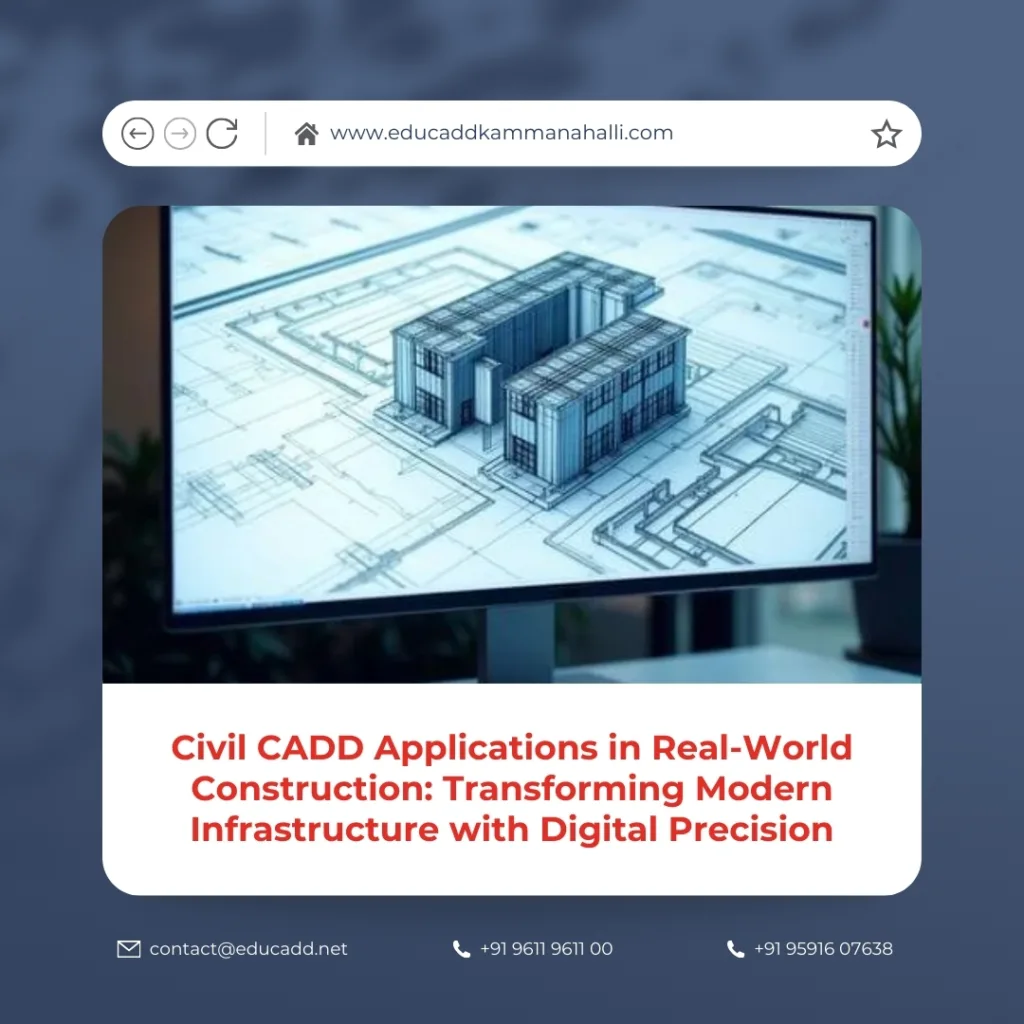
Civil CADD Construction Applications
This comprehensive guide explores Civil CADD applications in real-world construction. It explains how these tools influence planning, design, execution, cost control, and quality assurance. Furthermore, it highlights their role in shaping the future of infrastructure development.
1. Understanding Civil CADD Applications in Modern Engineering
Civil CADD Construction Applications refer to computer-aided drafting and design tools specifically developed for civil engineering projects. These applications allow engineers to create accurate 2D drawings and detailed 3D models for infrastructure projects. Unlike manual drafting, digital systems ensure consistency, speed, and precision.
Engineers use Civil CADD applications to design roads, drainage systems, water supply networks, land development layouts, and structural foundations. Because these tools integrate measurement accuracy with visual clarity, project teams can detect design flaws early. Consequently, costly rework is minimized.
Moreover, Civil CADD applications enable better documentation management. Every revision can be tracked, saved, and modified easily. This structured approach improves coordination between architects, structural engineers, surveyors, and contractors. Therefore, collaboration becomes smoother across departments.
In real-world construction, time often determines project profitability. Civil CADD applications significantly reduce drafting time. Designers can reuse templates, modify existing drawings, and apply automated calculations. Hence, productivity increases without compromising quality.
2. Role of Civil CADD Applications in Road and Highway Design
Road infrastructure forms the backbone of economic development. Designing highways requires careful planning, precise alignment, and accurate elevation profiles. Civil CADD applications simplify this complex process.
Engineers use these tools to create horizontal alignments, vertical curves, and cross-sectional views. In addition, they generate detailed grading plans and earthwork calculations. Because Civil CADD applications automate many calculations, designers can evaluate multiple alignment options quickly.
For example, while planning a highway bypass, engineers can simulate different route alternatives. They can analyze slope gradients, drainage patterns, and terrain conditions. As a result, they choose the most efficient and cost-effective alignment.
Furthermore, Civil CADD applications help in preparing construction drawings for contractors. Clear annotations, dimensioning, and standardized symbols improve understanding on-site. Consequently, field errors reduce significantly.
Highway projects involve coordination with environmental regulations. Designers can incorporate buffer zones, drainage channels, and safety barriers within the digital model. Therefore, compliance becomes easier and more transparent.
3. Application in Land Development and Site Planning
Land development projects require detailed planning before construction begins. Engineers must consider topography, soil conditions, utility networks, and zoning regulations. Civil CADD Construction Applications play a crucial role in this stage.
Using survey data, designers create contour maps and terrain models. These models help determine cut and fill volumes accurately. As a result, developers can estimate earthwork costs more reliably.
Civil CADD applications also support layout planning for residential colonies, commercial complexes, and industrial parks. Engineers design road networks, plot divisions, drainage systems, and utility alignments within a single digital environment. Consequently, project visualization improves.
In addition, these tools enable 3D site modeling. Stakeholders can view how the developed site will appear after construction. Therefore, decision-making becomes faster and more confident.
Coordination between civil and utility engineers becomes smoother because all design elements exist in one integrated platform. Hence, conflicts between pipelines, cables, and foundations can be resolved during the planning stage.
4. Structural Drafting and Foundation Design
Structural components form the core of any construction project. Foundations, columns, beams, and slabs must be designed accurately to ensure safety and stability. Civil CADD applications assist engineers in creating detailed structural drawings.
These tools allow precise dimensioning of reinforcement details, footing layouts, and structural sections. Designers can quickly modify drawings when load requirements change. As a result, flexibility increases.
Moreover, Civil CADD applications help in preparing bar bending schedules and reinforcement detailing. Because calculations are integrated into the drafting environment, errors reduce significantly.
Foundation design often depends on soil test reports. Engineers incorporate these parameters into the digital model. Consequently, they optimize foundation dimensions and reduce material wastage.
On construction sites, clear structural drawings prevent misunderstandings between engineers and contractors. Therefore, project execution becomes more efficient and reliable.
5. Integration with Surveying and Topographical Analysis
Survey data forms the foundation of every civil engineering project. Accurate site information ensures precise design outputs. Civil CADD applications integrate seamlessly with survey instruments and data files.
Engineers import topographical data directly into the software. Contour lines, spot levels, and boundary coordinates appear within seconds. As a result, manual data entry errors are eliminated.
Using this data, designers create digital terrain models. These models help analyze slopes, drainage flow, and elevation changes. Therefore, grading plans become more accurate.
Civil CADD applications also assist in preparing setting-out drawings for construction teams. Surveyors can use these digital references to mark positions on-site precisely.
Furthermore, integration with GPS and total station equipment enhances field coordination. Survey updates can be reflected in the design model quickly. Consequently, adjustments are implemented without delays.
6. Drainage and Water Supply Network Planning
Efficient drainage and water supply systems ensure public health and infrastructure durability. Designing these networks requires careful slope calculations and pipe alignment planning. Civil CADD applications simplify these complex tasks.
Engineers use these tools to design stormwater drains, sewer lines, and water distribution networks. They calculate pipe diameters, flow velocities, and gradient levels within the software. As a result, hydraulic efficiency improves.
Moreover, Civil CADD applications allow 3D visualization of underground utilities. Designers can identify clashes between pipelines and structural elements. Therefore, excavation conflicts are reduced.
Municipal projects benefit greatly from digital drafting systems. Authorities can review layouts and approve designs more efficiently. Consequently, project approvals move faster.
Detailed documentation produced through Civil CADD applications ensures accurate implementation during construction. Hence, maintenance and future upgrades become easier.
7. Quantity Estimation and Cost Control
Cost management determines project success in the construction industry. Civil CADD applications assist engineers in accurate quantity take-offs and material estimation.
Because drawings are created with precise dimensions, software tools can extract area, volume, and length data automatically. As a result, estimation becomes faster and more reliable.
Contractors use these calculations to prepare cost budgets and procurement plans. Therefore, financial planning improves significantly.
Civil CADD applications also reduce material wastage. Engineers can optimize dimensions before construction begins. Consequently, unnecessary expenses decrease.
Moreover, digital documentation provides transparency during project audits. Clients can verify quantities directly from approved drawings. Hence, disputes reduce.
8. Enhancing Collaboration Between Project Stakeholders
Modern construction projects involve multiple professionals. Architects, structural engineers, MEP engineers, and contractors must coordinate effectively. Civil CADD applications create a common digital platform for collaboration.
Design files can be shared across teams easily. Engineers can review and comment on drawings in real time. As a result, communication gaps decrease.
Revision management becomes more organized. Every update is documented within the system. Therefore, accountability improves.
Additionally, Civil CADD applications support interoperability with other software platforms. Teams can integrate structural analysis tools and project management systems. Consequently, workflow efficiency increases.
Effective collaboration reduces project delays and rework. Hence, overall project performance improves.
9. Supporting Sustainable Construction Practices
Sustainability has become a central focus in modern infrastructure development. Engineers must design projects that minimize environmental impact. Civil CADD applications contribute significantly to this objective.
Designers can analyze terrain and drainage to prevent soil erosion. They can also optimize road alignments to reduce tree cutting. As a result, environmental damage decreases.
Moreover, accurate material estimation reduces construction waste. Civil CADD applications help engineers design energy-efficient layouts and water conservation systems. Therefore, sustainability goals are achieved more effectively.
Digital models also allow simulation of environmental scenarios. Engineers can evaluate flood risks and stormwater behavior. Consequently, resilient infrastructure is developed.
10. Improving Construction Documentation and Compliance
Construction projects require detailed documentation for approvals and inspections. Civil CADD applications generate professional drawings that meet industry standards.
Engineers can include standardized symbols, annotations, and legends. Therefore, regulatory compliance becomes easier.
Because revisions are tracked digitally, audit trails remain clear. Authorities can review changes quickly. As a result, approval processes become smoother.
Accurate documentation also improves quality control during construction. Contractors follow clear guidelines, reducing execution errors.
11. Training and Skill Development in Civil CADD Applications
The demand for skilled professionals in digital drafting continues to grow. Engineers trained in Civil CADD applications gain a competitive advantage in the job market.
Training programs focus on practical project-based learning. Students work on real-world scenarios, such as road design and site planning. As a result, they gain hands-on experience.
Moreover, familiarity with Civil CADD applications enhances productivity in professional environments. Employers prefer candidates who can deliver accurate drawings efficiently.
Continuous learning ensures professionals stay updated with evolving technologies. Therefore, career growth becomes sustainable.
12. Future Trends in Civil CADD Applications
Technology continues to evolve rapidly. Civil CADD applications are integrating with Building Information Modeling (BIM) and cloud-based platforms.
This integration allows real-time collaboration and data sharing. Engineers can access project files from anywhere. As a result, remote coordination improves.
Artificial intelligence is also influencing design automation. Software can suggest optimized layouts based on input parameters. Consequently, design processes become smarter.
As infrastructure projects grow more complex, digital tools will become even more essential. Therefore, Civil CADD applications will remain central to construction innovation.
Conclusion
Civil CADD Construction Applications have revolutionized real-world construction by introducing precision, efficiency, and collaboration into every stage of project development. From road design and land development to drainage planning and structural detailing, these tools empower engineers to deliver high-quality results within tight deadlines.
Furthermore, Civil CADD applications reduce errors, optimize costs, and support sustainable practices. They enhance coordination among stakeholders and streamline documentation processes. As technology advances, integration with BIM and intelligent automation will further strengthen their capabilities.
In an industry where accuracy determines safety and profitability, digital drafting systems are no longer optional—they are indispensable. Professionals who master Civil CADD applications position themselves at the forefront of modern construction. Ultimately, these applications are not just software tools; they are catalysts driving the future of infrastructure development.

