
Mastering Modern Infrastructure Design: Powerful Skills You Gain from a Civil CADD Course
Infrastructure projects today demand precision, speed, and intelligent planning. Manual drafting methods are no longer sufficient for complex civil engineering requirements. Digital design tools now drive highways, bridges, buildings, drainage systems, and urban layouts. A Civil CADD Course Skills prepares aspiring engineers, diploma holders, and construction professionals to meet these industry expectations with confidence. The program blends engineering fundamentals with advanced computer-aided drafting and design tools so learners can create accurate technical drawings, 3D models, and project documentation efficiently.
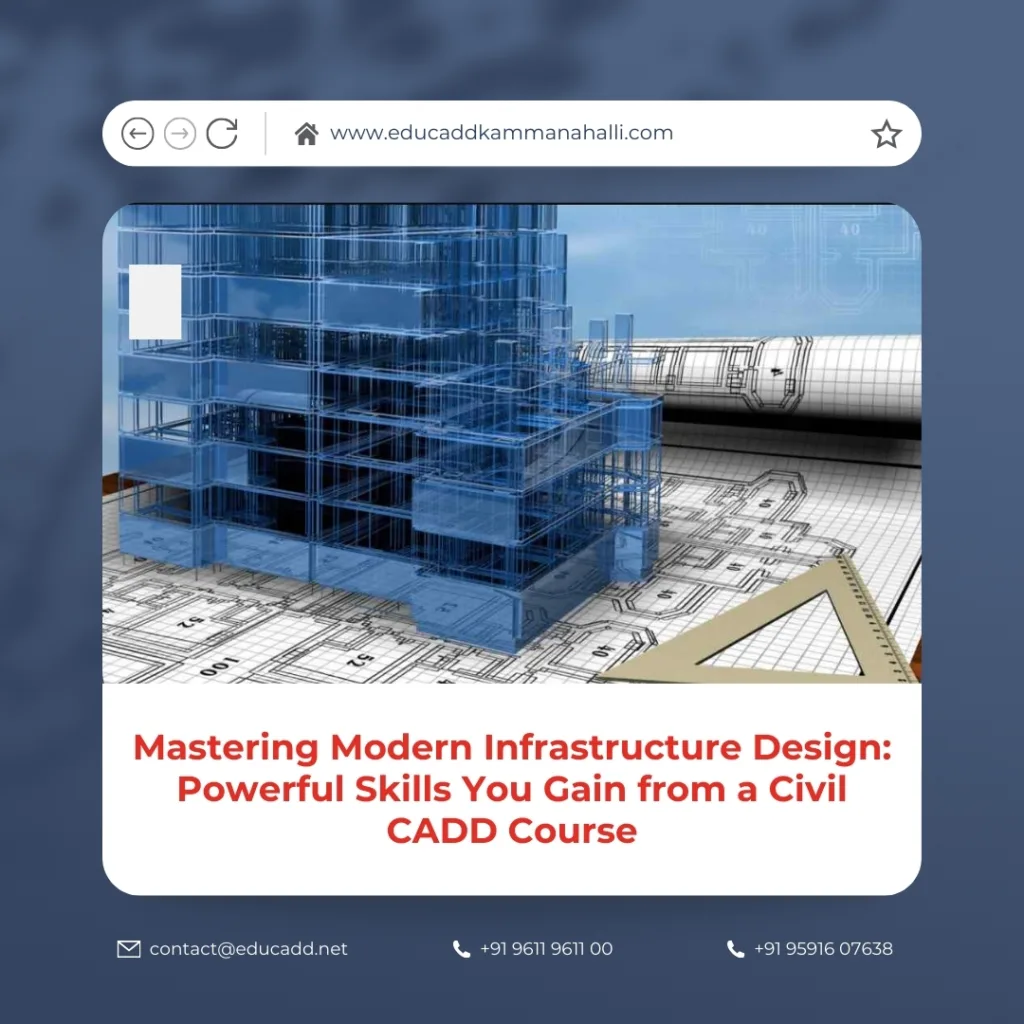
Civil CADD Course Skills
Professionals who complete a Civil CADD Course gain practical expertise that aligns with real construction workflows. From planning layouts to producing structural drawings, learners develop job-ready technical abilities that improve employability in design firms, construction companies, and infrastructure consultancies. The course also builds problem-solving skills, visualization abilities, and software mastery essential for modern civil engineering careers.
Understanding the Role of a Civil CADD Course in Modern Engineering
A Civil CADD Course Skills acts as the foundation for digital civil engineering design. Traditional drafting boards have been replaced by intelligent software capable of producing precise drawings, layered plans, and automated calculations. This transformation has increased the demand for professionals trained in computer-aided civil drafting and modeling.
Students begin by learning how digital drafting improves project efficiency and reduces human error. They understand coordinate systems, engineering scales, dimensioning standards, and drawing management practices. These basics ensure that every drawing created during the Civil CADD Course follows industry norms and can be easily interpreted by architects, engineers, and contractors.
The course also introduces workflow structuring. Learners understand how initial survey data transforms into final construction drawings through systematic steps. This structured approach improves clarity, reduces rework, and enhances project coordination across teams.
Key learning outcomes include:
• Understanding digital drafting principles
• Interpreting engineering drawings accurately
• Managing drawing layers and annotations
• Applying global drafting standards
• Structuring project files professionally
These competencies ensure learners build a strong technical base before advancing to specialized civil design software.
Mastering AutoCAD for Professional Civil Drafting
AutoCAD forms the backbone of most Civil CADD Course Skills programs. This powerful drafting software allows students to create detailed 2D drawings used in construction documentation. Learners begin with basic commands and gradually advance to complex drafting tools.
Students practice creating lines, arcs, polylines, hatches, and dimensions with high precision. They also learn coordinate entry methods that improve drafting speed. As proficiency increases, they work on floor plans, elevation drawings, site layouts, and structural detailing.
A Civil CADD Course also teaches drawing organization techniques. Proper layering systems, annotation styles, and block libraries make professional drawings easy to edit and share. These practices are essential for working on large-scale infrastructure projects.
Practical skills developed include:
• Creating accurate 2D construction drawings
• Using advanced modification tools efficiently
• Managing layers for organized drafting
• Developing reusable block libraries
• Preparing drawings for plotting and printing
By mastering AutoCAD, learners become capable of producing precise technical drawings used in real engineering environments.
Developing 3D Modeling Skills for Civil Structures
Modern construction projects rely heavily on visualization before execution. A Civil CADD Course introduces 3D modeling tools that help students convert 2D plans into realistic structural models. This capability improves design understanding and prevents costly construction errors.
Learners develop spatial visualization abilities while creating terrain models, building structures, bridge components, and road profiles. They understand extrusion, surface modeling, and solid modeling techniques that give life to technical drawings.
3D models also assist in client presentations and approvals. Stakeholders can easily interpret project outcomes through visual simulations rather than complex drawings. This improves communication between engineers and non-technical decision makers.
Students gain expertise in:
• Converting 2D drawings into 3D models
• Creating realistic terrain surfaces
• Modeling structural components accurately
• Applying materials and rendering basics
• Generating sectional and isometric views
These modeling skills enhance the practical value of a Civil CADD Course and prepare learners for advanced design responsibilities.
Learning Building Information Modeling (BIM) Fundamentals
Building Information Modeling integrates design, data, and project coordination into a unified digital process. A Civil CADD Course Skills introduces BIM concepts that transform how infrastructure projects are planned and managed.
Students learn how intelligent models contain both graphical and non-graphical information. Every element in a BIM model holds data related to dimensions, materials, cost, and scheduling. This data-driven approach improves decision-making during project planning.
The course emphasizes collaborative workflows where multiple professionals work on shared project models. Engineers, architects, and contractors can detect design clashes early and reduce execution delays.
Core BIM skills include:
• Understanding intelligent modeling concepts
• Coordinating multidisciplinary project data
• Detecting clashes before construction
• Extracting quantity and cost information
• Managing model revisions effectively
BIM exposure significantly increases the industry relevance of a Civil CADD Course.
Road Design and Highway Engineering Software Training
Transportation infrastructure requires specialized design tools. A Civil CADD Course covers road and highway design software that helps engineers plan safe and efficient transport networks.
Learners understand alignment design, road profiles, cross-section creation, and pavement detailing. They also work with topographical survey data to create accurate roadway layouts that consider terrain conditions.
The course explains geometric design standards used in national and international highway projects. Students learn curve design, gradient planning, superelevation, and drainage alignment techniques essential for safe road construction.
Technical abilities developed include:
• Designing road alignments accurately
• Creating longitudinal and cross-section profiles
• Analyzing terrain using survey data
• Applying highway geometric standards
• Preparing road construction documentation
These skills enable learners to contribute to transportation infrastructure projects confidently.
Structural Drafting and Detailing Expertise
Structural drafting plays a vital role in construction safety. A Civil CADD Course trains learners to prepare reinforcement drawings, column layouts, beam sections, and foundation details accurately.
Students understand load transfer mechanisms and reinforcement placement principles. They learn to draft RCC detailing drawings that guide on-site engineers during construction execution.
Professional standards and codes are emphasized to ensure structural drawings meet safety guidelines. Clear detailing reduces ambiguity and ensures precise material usage.
Learners gain capabilities such as:
• Drafting reinforcement detailing accurately
• Preparing column and beam layouts
• Designing foundation plan drawings
• Applying structural drawing standards
• Coordinating architectural and structural plans
This expertise ensures Civil CADD Course graduates can support structural engineering teams effectively.
Quantity Surveying and Estimation Skills
Cost estimation is essential for project feasibility. A Civil CADD Course teaches quantity takeoff and estimation techniques that help professionals predict material and labor costs accurately.
Students learn to extract measurements from drawings and calculate quantities for concrete, steel, bricks, plastering, and earthwork. They also understand rate analysis and budgeting fundamentals.
Digital tools simplify estimation processes and reduce calculation errors. Learners prepare Bills of Quantities (BOQ) used in tender documentation.
Important estimation skills include:
• Performing accurate material quantity takeoffs
• Preparing cost estimation sheets
• Conducting rate analysis for materials
• Creating professional BOQ documents
• Supporting project budgeting processes
These financial planning skills add strong professional value to a Civil CADD Course.
Land Survey Data Integration and Mapping Skills
Surveying forms the starting point of civil engineering projects. A Civil CADD Course teaches learners how to import and interpret land survey data for mapping and planning.
Students work with contour maps, topographic data, and geospatial inputs. They learn coordinate plotting, boundary marking, and elevation mapping techniques.
Mapping accuracy ensures proper planning of drainage systems, roads, buildings, and utilities. Learners understand how terrain affects design decisions and construction feasibility.
Skills acquired include:
• Importing survey data into design software
• Creating contour and topographic maps
• Plotting coordinates precisely
• Preparing land development layouts
• Analyzing terrain impact on construction
Survey integration strengthens the planning abilities developed through a Civil CADD Course.
Construction Planning and Project Scheduling Basics
Efficient planning reduces delays and cost overruns. A Civil CADD Course introduces construction scheduling fundamentals that help professionals manage project timelines effectively.
Students learn task sequencing, milestone planning, and activity dependencies. They understand Gantt charts, resource allocation methods, and workflow optimization strategies.
Planning tools help project managers track progress and adjust schedules dynamically. Learners gain insights into coordination between design and execution teams.
Key competencies include:
• Creating construction schedules
• Allocating resources efficiently
• Monitoring project progress
• Coordinating multiple work activities
• Reducing project delays through planning
These management fundamentals expand the practical scope of a Civil CADD Course.
Enhancing Visualization and Presentation Techniques
Technical skills must be supported by effective presentation abilities. A Civil CADD Course Skills trains students to create professional project presentations that communicate design intent clearly.
Learners develop layout composition skills, annotation clarity, and visual hierarchy principles. They also create rendered views and walkthroughs for client approvals.
Professional presentation improves stakeholder confidence and increases approval speed. Engineers who present visually appealing designs gain competitive advantages.
Presentation capabilities include:
• Creating clean and readable layouts
• Producing realistic rendered views
• Developing walkthrough animations
• Annotating drawings professionally
• Communicating design ideas effectively
These creative skills make Civil CADD Course professionals more versatile.
Improving Accuracy, Speed, and Productivity
Manual drafting consumes time and increases error probability. A Civil CADD Course trains learners to use automation tools that enhance productivity without compromising accuracy.
Students use template libraries, automated dimension tools, and smart editing commands. These features reduce repetitive tasks and accelerate project completion.
Improved efficiency allows engineers to handle multiple projects simultaneously. Time saved during drafting can be invested in design optimization and quality improvements.
Productivity benefits include:
• Reducing manual drafting errors
• Accelerating drawing production speed
• Using automated design tools
• Standardizing project documentation
• Increasing overall workflow efficiency
Efficiency improvement remains a core advantage of completing a Civil CADD Course.
Understanding Industry Standards and Documentation Practices
Construction projects follow strict documentation standards. A Civil CADD Course teaches learners to prepare drawings that comply with professional engineering norms.
Students understand title block standards, dimensioning rules, symbol libraries, and revision tracking systems. Organized documentation ensures smooth communication among project stakeholders.
Standardized drawings reduce misinterpretation and legal complications. Professionals who follow documentation protocols gain trust within engineering organizations.
Documentation expertise includes:
• Applying global drafting standards
• Maintaining revision control systems
• Preparing professional title blocks
• Using standard engineering symbols
• Organizing project drawing sets
These practices enhance the professional credibility of Civil CADD Course graduates.
Career Opportunities After Completing a Civil CADD Course
Technical proficiency gained through a Civil CADD Course opens diverse career pathways across construction and infrastructure industries. Companies actively seek skilled CAD professionals who can support planning and execution teams.
Graduates can work in architectural firms, infrastructure consultancies, urban planning agencies, and government development departments. The course also enables freelance drafting opportunities.
Common job roles include:
• Civil CAD Draftsman
• Structural Drafting Engineer
• BIM Technician
• Quantity Surveyor
• Highway Design Engineer
• Site Planning Coordinator
These roles offer stable career growth, competitive salaries, and opportunities to work on large infrastructure projects.
Why Industry Demands Civil CADD Professionals
Rapid urbanization and smart city initiatives have increased infrastructure development worldwide. Engineering firms require skilled professionals who can produce accurate digital designs quickly.
A Civil CADD Course equips learners with practical software expertise aligned with industry needs. Employers prefer candidates who require minimal training and can contribute immediately to live projects.
Digital design professionals help organizations reduce project costs, improve efficiency, and maintain documentation accuracy. Their contribution strengthens planning, coordination, and execution phases.
Industry demand continues rising due to:
• Growth in infrastructure megaprojects
• Increased adoption of digital design workflows
• Need for precise technical documentation
• Demand for BIM-based project coordination
• Expansion of transportation networks
These trends make a Civil CADD Course a valuable investment for aspiring civil engineers.
Conclusion
A Civil CADD Course Skills transforms beginners into skilled design professionals capable of handling modern infrastructure challenges. The program builds strong drafting foundations, advanced modeling abilities, estimation expertise, and professional documentation skills. Learners gain hands-on software training that mirrors real engineering workflows, making them industry-ready from day one.
The course also enhances visualization skills, project planning knowledge, and presentation techniques that improve professional confidence. As construction technologies evolve, digital design expertise becomes essential rather than optional. Completing a Civil CADD Course ensures long-term career stability, diverse job opportunities, and continuous professional growth in the expanding civil engineering sector.

