
How Civil CADD Improves Accuracy in Construction Drawings
Building Precision: Transforming Construction Documentation with Civil CADD
Accuracy defines the success of every construction project. From residential buildings to complex infrastructure, even minor drawing errors can lead to cost overruns, delays, and structural issues. In today’s competitive construction environment, professionals must rely on advanced digital tools to ensure every line, dimension, and annotation reflects real-world conditions with clarity and precision. That is where Civil CADD Drawing Accuracy plays a transformative role.
How Civil CADD improves accuracy in construction drawings has become a crucial topic for engineers, architects, contractors, and project managers. Traditional drafting methods often leave room for manual errors, miscalculations, and inconsistencies between plans. However, Civil CADD integrates design automation, precise measurement tools, and real-time editing capabilities to eliminate guesswork and enhance reliability. As projects grow in scale and complexity, digital drafting ensures standardized outputs and improved coordination among stakeholders.
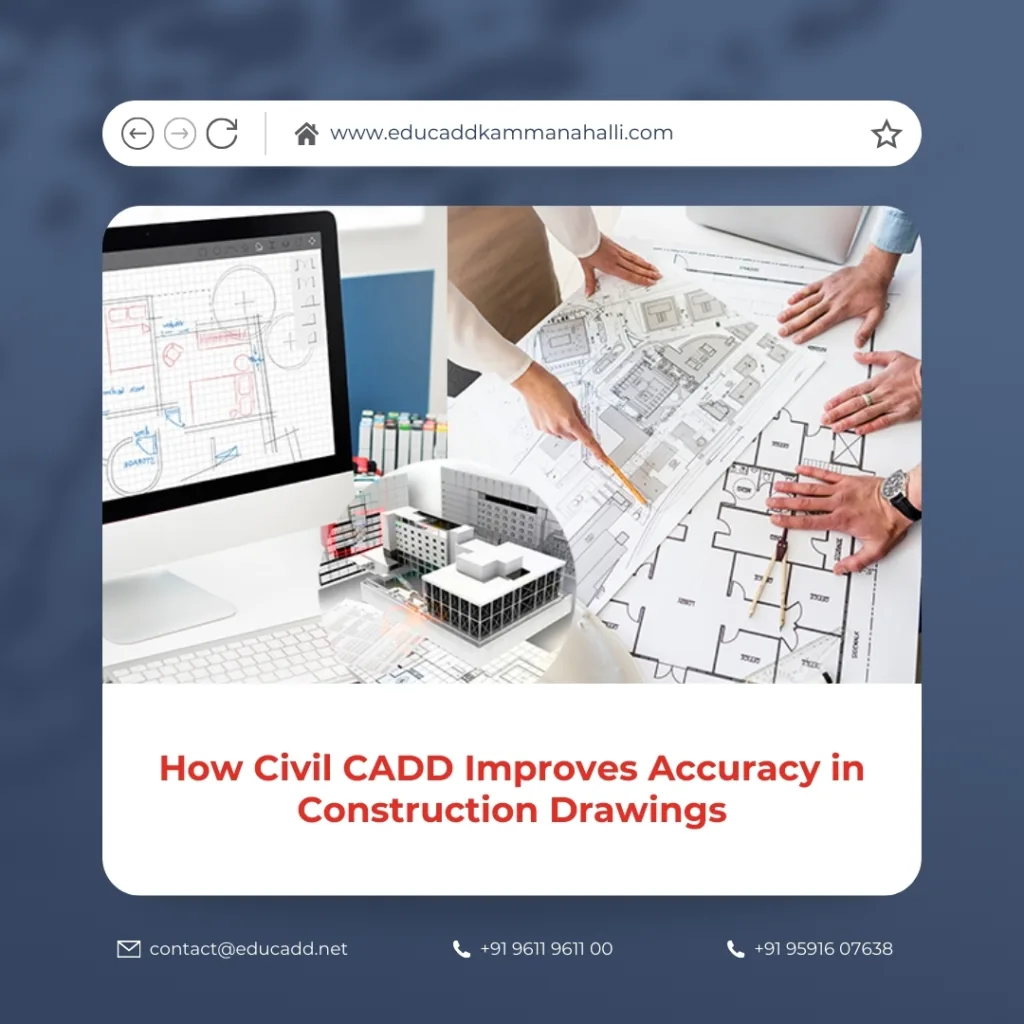
Civil CADD Drawing Accuracy
This comprehensive guide explores how Civil CADD improves accuracy in construction drawings by examining its tools, workflows, benefits, and practical applications. Through detailed explanations and structured insights, you will understand how Civil CADD enhances precision, reduces errors, and improves construction outcomes across industries.
1. Understanding the Importance of Accuracy in Construction Drawings
Civil CADD Drawing Accuracy serve as the foundation of any project. They communicate design intent, technical specifications, dimensions, materials, and structural details. When drawings lack precision, contractors misinterpret instructions, leading to incorrect implementations. As a result, the project suffers delays and additional expenses.
In earlier times, manual drafting relied heavily on human calculation and hand-drawn measurements. Although skilled drafters maintained high standards, minor inaccuracies often slipped into the drawings. Scaling errors, misaligned dimensions, and inconsistent annotations created confusion on-site. Therefore, maintaining uniformity across multiple sheets became challenging.
Today, the industry demands flawless documentation. Structural stability, safety regulations, and client expectations require exact measurements. How Civil CADD improves accuracy in construction drawings becomes evident when comparing digital precision with traditional techniques. Civil CADD allows designers to input exact dimensions, ensuring consistency across all drawings. Every modification automatically updates connected elements, which significantly reduces coordination errors.
Moreover, construction projects involve collaboration among various departments. Architects, structural engineers, and MEP consultants must align their drawings precisely. Civil CADD enhances synchronization, ensuring that changes reflect instantly throughout the design. This digital integration forms the backbone of accurate project execution.
2. What Is Civil CADD and Why It Matters
Civil CADD refers to Computer-Aided Design and Drafting tools tailored specifically for civil engineering and construction projects. It combines drafting, modeling, detailing, and documentation into a unified digital environment. These tools enable engineers to create site layouts, road alignments, drainage systems, building plans, and structural details with exceptional precision.
Unlike general drafting software, Civil CADD includes specialized features for civil infrastructure. These include contour mapping, surface modeling, grading design, and utility alignment tools. Consequently, professionals can design projects that reflect accurate topographical and environmental conditions.
Understanding how Civil CADD improves accuracy in construction drawings requires recognizing its intelligent design capabilities. The software operates on mathematical precision. Every line, arc, and dimension follows coordinate-based calculations rather than manual estimation. This approach ensures geometric accuracy and eliminates scaling inconsistencies.
Furthermore, Civil CADD supports layered drafting. Designers can separate structural elements, electrical layouts, plumbing lines, and landscaping features into organized layers. This structured system prevents overlapping errors and enhances clarity. When teams access drawings, they can isolate specific components without affecting the entire plan.
Therefore, Civil CADD serves as more than a drafting tool. It acts as a precision-driven platform that strengthens project accuracy from concept to execution.
3. Automated Dimensioning for Error-Free Measurements
One of the strongest ways how Civil CADD improves accuracy in construction drawings lies in automated dimensioning. Manual measurement often results in discrepancies due to rounding errors or misreading scales. However, Civil CADD calculates dimensions based on exact coordinates.
When a designer draws a wall or structural component, the software automatically determines its precise length and angle. If the element shifts, the dimensions update instantly. This dynamic adjustment eliminates mismatched values between plans and sections.
Additionally, Civil CADD supports associative dimensions. These remain linked to the object they represent. Therefore, any modification automatically updates all related dimensions. This feature prevents inconsistencies that often arise when revising drawings manually.
Engineers also benefit from precise scaling tools. They can set units in millimeters, meters, or feet without losing accuracy. The software converts measurements seamlessly, which ensures uniform standards across international projects.
Through automated calculations and intelligent updates, Civil CADD significantly reduces dimensional errors. As a result, contractors receive reliable drawings that align with real-world requirements.
4. Layer Management for Organized and Accurate Drafting
Complex construction projects contain multiple components. Structural systems, plumbing layouts, electrical wiring, and landscaping details must coexist within the same project. Without organization, drawings become cluttered and prone to errors.
Civil CADD addresses this challenge through advanced layer management. Designers assign different elements to specific layers. For example, foundation plans can remain separate from reinforcement details. This separation prevents accidental edits and improves visibility.
When examining how Civil CADD improves accuracy in construction drawings, layer control plays a crucial role. It allows teams to isolate and review individual systems without interference. Therefore, errors become easier to detect and correct before construction begins.
Moreover, layers can carry predefined properties such as line types, colors, and thickness. This standardization ensures consistency throughout the documentation. When contractors interpret drawings, they immediately recognize different components based on visual coding.
By organizing data logically and maintaining structural clarity, Civil CADD enhances drafting accuracy and project coordination.
5. Precise Topographical and Site Modeling
Site conditions influence construction accuracy significantly. Incorrect elevation data or contour representation can disrupt foundation levels and drainage systems. Civil CADD integrates topographical modeling tools that capture real-world terrain accurately.
Designers can import survey data directly into the software. The system converts coordinates into digital terrain models. These models reflect slopes, contours, and elevation changes with mathematical precision.
How Civil CADD Drawing Accuracy in construction drawings becomes evident in grading and leveling tasks. Engineers can simulate earthwork calculations and evaluate cut-and-fill volumes before actual excavation. This predictive analysis minimizes on-site adjustments.
Additionally, drainage planning benefits from accurate slope modeling. Water flow directions, stormwater systems, and road gradients align precisely with terrain data. Consequently, construction teams avoid costly rework.
Through digital terrain integration, Civil CADD ensures that construction drawings align with real environmental conditions.
6. Error Detection and Revision Control
Revisions often introduce mistakes. Manual corrections can create inconsistencies between drawing sheets. However, Civil CADD includes built-in validation tools that highlight discrepancies.
Designers can track revisions using version control systems. Every update maintains a digital history, which reduces confusion during collaboration. Therefore, project teams remain aware of modifications at each stage.
When analyzing how Civil CADD improves accuracy in construction drawings, error detection stands out. Clash detection tools identify overlapping components or conflicting alignments. For example, underground pipelines should not intersect structural foundations. Civil CADD flags such conflicts early.
Furthermore, annotation checks ensure that text and symbols remain aligned with objects. This verification prevents misinterpretation on-site. By addressing potential issues before printing drawings, Civil CADD strengthens documentation reliability.
7. Standardization and Compliance with Industry Codes
Construction drawings must adhere to national and international standards. Inconsistent formatting leads to approval delays and regulatory complications. Civil CADD supports standardized templates that follow building codes and drafting conventions.
Engineers can apply predefined title blocks, dimension styles, and annotation rules. This uniformity ensures that every drawing meets professional standards. Consequently, authorities review submissions efficiently.
How Civil CADD improves accuracy in construction drawings also relates to compliance. The software integrates structural and environmental guidelines within its workflows. Designers can verify load calculations and alignment standards digitally.
Through standardized outputs and built-in compliance checks, Civil CADD enhances trust in construction documentation.
8. Improved Collaboration and Coordination
Modern projects involve multidisciplinary collaboration. Architects, civil engineers, and contractors must align their plans accurately. Civil CADD enables file sharing and synchronized editing, which strengthens teamwork.
Cloud integration allows real-time access to updated drawings. When one team modifies a component, others see the change immediately. This transparency reduces miscommunication.
Understanding how Civil CADD improves accuracy in construction drawings involves recognizing collaborative precision. Shared digital platforms eliminate redundant drafting. Therefore, teams avoid conflicting revisions.
Clear coordination ensures that final construction drawings reflect unified project intentions.
9. 3D Visualization for Enhanced Accuracy
Two-dimensional drawings sometimes fail to convey spatial relationships. Civil CADD incorporates 3D modeling features that enhance visualization.
Engineers can generate three-dimensional views of structures, roads, and utilities. These models reveal potential design flaws that remain hidden in flat drawings. Consequently, teams detect spatial conflicts before construction begins.
When exploring how Civil CADD improves accuracy in construction drawings, 3D visualization plays a vital role. It provides realistic representation, which improves decision-making and client communication.
Accurate visualization reduces guesswork and ensures structural alignment with design intent.
10. Time Efficiency and Reduced Rework
Accuracy and efficiency go hand in hand. When drawings contain errors, rework consumes valuable time and resources. Civil CADD streamlines drafting processes, which minimizes repetitive corrections.
Automated commands accelerate layout creation. Designers can replicate components using precise duplication tools. This method ensures consistency without manual redrawing.
By examining how Civil CADD improves accuracy in construction drawings, it becomes clear that time-saving automation reduces human error. Faster drafting allows engineers to review designs thoroughly before final approval.
Consequently, projects progress smoothly with fewer on-site adjustments.
11. Integration with Modern Construction Technologies
Construction technology continues to evolve. Civil CADD integrates seamlessly with Building Information Modeling (BIM) and project management software. This integration enhances data accuracy.
Engineers can export detailed drawings into project tracking systems. Quantity estimations and cost calculations derive directly from precise design data. Therefore, financial planning becomes more reliable.
How Civil CADD improves accuracy in construction drawings extends beyond drafting. It connects design with execution, ensuring consistency across digital platforms.
This interconnected ecosystem supports smarter construction management.
12. Enhanced Quality Control and Review Processes
Quality control ensures that drawings meet technical standards. Civil CADD simplifies review procedures through digital markups and validation tools.
Supervisors can annotate changes directly within the software. This feature eliminates misinterpretation during feedback cycles. Designers implement corrections accurately without rewriting entire sheets.
Additionally, scaling and alignment checks confirm geometric precision. Through systematic review workflows, Civil CADD strengthens drawing reliability.
Understanding how Civil CADD improves accuracy in construction drawings highlights the importance of structured quality checks in delivering flawless documentation.
13. Practical Applications Across Infrastructure Projects
Civil CADD Drawing Accuracy diverse construction projects, including highways, bridges, residential complexes, and drainage systems. Each project demands precision.
For road design, alignment tools ensure correct curvature and gradient transitions. For structural projects, reinforcement detailing maintains dimensional consistency. Utility planning benefits from accurate pipe routing and slope calculations.
How Civil CADD improves accuracy in construction drawings becomes evident across these applications. The software adapts to various project requirements while maintaining consistent precision.
Such versatility reinforces its value in modern engineering.
14. Long-Term Impact on Construction Success
Accuracy influences every phase of construction. Precise drawings reduce disputes, improve budgeting, and enhance safety compliance. Civil CADD contributes significantly to these outcomes.
By minimizing drafting errors, the software strengthens trust among stakeholders. Contractors rely on accurate documentation to execute tasks confidently. Clients appreciate predictable project timelines and reduced costs.
Examining how Civil CADD improves accuracy in construction drawings reveals its long-term strategic importance. It fosters efficiency, reliability, and professional excellence in the construction industry.
Conclusion
Civil CADD Drawing Accuracy remains the cornerstone of successful construction projects. As complexity increases, digital solutions become indispensable. Civil CADD empowers engineers and designers to produce precise, consistent, and standardized drawings that reflect real-world conditions accurately.
Throughout this comprehensive discussion, we have explored how Civil CADD improves accuracy in construction drawings through automated dimensioning, layered drafting, topographical modeling, revision control, compliance integration, and collaborative workflows. Each feature contributes to minimizing errors and enhancing documentation reliability.
Ultimately, Civil CADD transforms construction drafting from a manual, error-prone process into a streamlined digital system driven by precision and efficiency. Organizations that adopt Civil CADD gain a competitive advantage by delivering accurate projects on time and within budget. In an industry where even small mistakes carry significant consequences, Civil CADD stands as a powerful tool for building with confidence and clarity.

