
Mastering Civil CADD for Residential Structural Design: The Complete Guide to Smart, Accurate, and Future-Ready Homes
Civil CADD Residential Design has transformed the way engineers, architects, and construction professionals plan and execute housing projects. In today’s competitive construction landscape, precision, speed, and coordination determine project success. Traditional drafting methods often led to delays, rework, and communication gaps. However, Civil CADD for Residential Structural Design provides a digital framework that enhances clarity, reduces errors, and ensures structural safety.
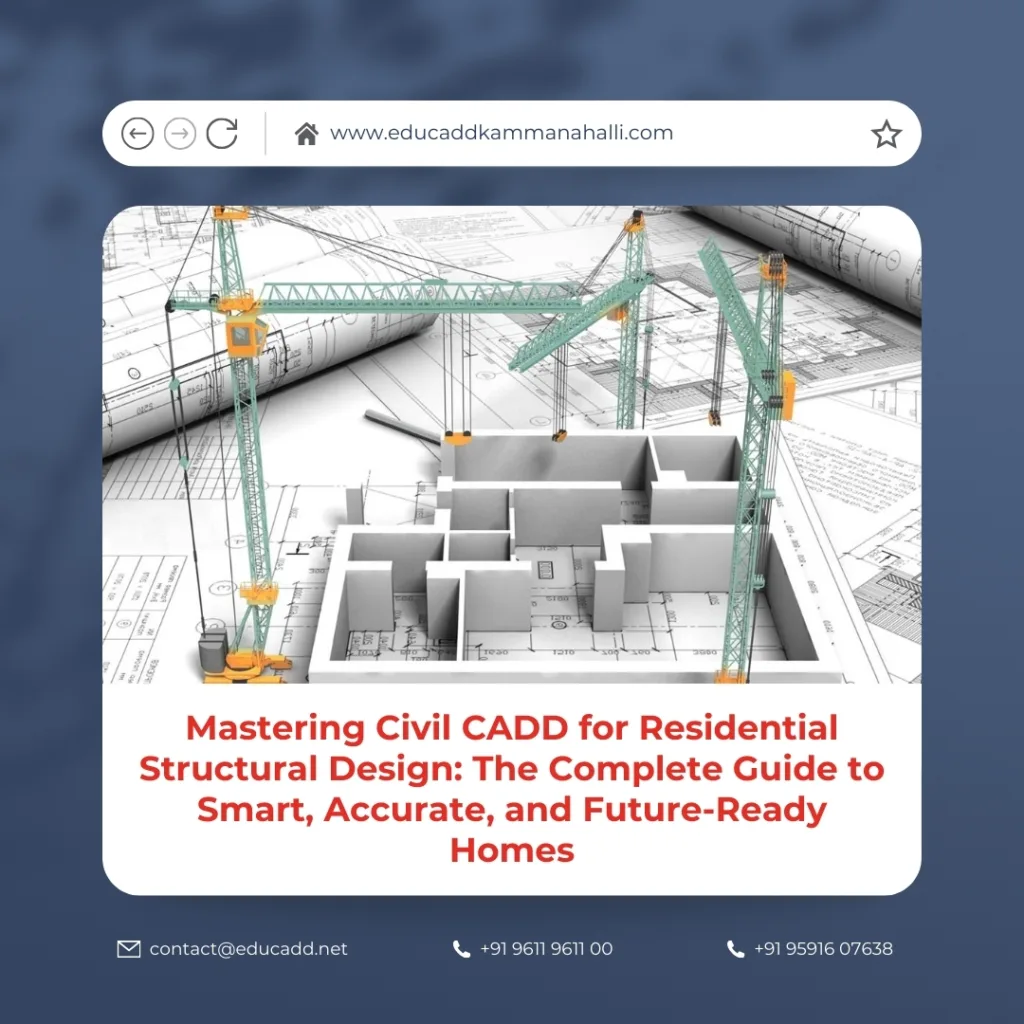
Civil CADD Residential Design
As residential buildings become more complex and client expectations continue to rise, professionals must rely on technology that delivers both accuracy and efficiency. Civil CADD Residential Design not only simplifies structural detailing but also improves collaboration between teams. From foundation planning to roof detailing, every structural element can be visualized, tested, and refined before construction begins. This comprehensive guide explores every essential aspect of Civil CADD for Residential Structural Design and explains how it supports modern residential development.
1. Understanding the Core of Civil CADD for Residential Structural Design
Civil CADD Residential Design refers to the use of computer-aided drafting and design software to create precise structural drawings for houses and residential buildings. It enables engineers to develop digital blueprints that include structural layouts, reinforcement details, load calculations, and material specifications.
Unlike manual drafting, Civil CADD for Residential Structural Design allows quick modifications and consistent accuracy. Designers can adjust beam sizes, slab thickness, or column spacing without redrawing the entire layout. This flexibility ensures faster revisions and better decision-making. Moreover, digital drawings reduce human error and provide clear documentation. As a result, engineers can maintain quality standards throughout the project lifecycle.
2. Importance of Structural Accuracy in Residential Projects
Structural stability determines the safety and longevity of any home. Therefore, Civil CADD for Residential Structural Design plays a critical role in ensuring every load-bearing element performs correctly. Engineers analyze dead loads, live loads, and environmental forces before finalizing structural plans.
With Civil CADD for Residential Structural Design, professionals can simulate real-world conditions and verify structural strength. This approach prevents costly mistakes during construction. Additionally, accurate detailing minimizes material wastage. Builders receive clear instructions, which reduces confusion at the site. Consequently, projects progress smoothly and maintain structural integrity from foundation to roof.
3. Software Tools Used in Civil CADD for Residential Structural Design
Several advanced tools support Civil CADD for Residential Structural Design. Programs such as AutoCAD, STAAD.Pro, ETABS, and SAFE assist engineers in drafting and structural analysis. These tools provide powerful features for modeling beams, slabs, footings, and reinforcement details.
Civil CADD for Residential Structural Design integrates drafting with analysis. Engineers can generate 2D plans and 3D models simultaneously. This capability enhances visualization and coordination. Furthermore, structural calculations can be verified instantly within the software environment. As technology evolves, these tools continue to improve performance and user experience.
4. Planning Foundations Using Civil CADD for Residential Structural Design
The foundation supports the entire structure. Therefore, proper planning remains essential. Civil CADD for Residential Structural Design enables engineers to design isolated footings, combined footings, raft foundations, and pile foundations with precision.
Engineers can calculate soil bearing capacity and adjust foundation dimensions accordingly. Civil CADD for Residential Structural Design also helps generate reinforcement drawings for footings. Clear detailing ensures proper placement of steel bars at the construction site. As a result, the building gains a strong base that resists settlement and structural failure.
5. Column and Beam Layout Optimization
Columns and beams form the skeleton of residential buildings. Civil CADD for Residential Structural Design allows engineers to optimize column spacing and beam sizes to achieve cost efficiency without compromising strength.
Using digital tools, designers can check load transfer paths and identify stress concentration areas. Civil CADD for Residential Structural Design supports accurate reinforcement detailing, which enhances structural durability. Additionally, layout modifications can be implemented quickly if architectural changes occur. This adaptability ensures seamless collaboration between architects and structural engineers.
6. Slab Design and Reinforcement Detailing
Slabs distribute loads across beams and columns. Therefore, slab design demands careful analysis. Civil CADD for Residential Structural Design simplifies slab thickness calculation and reinforcement planning.
Engineers can design one-way or two-way slabs using integrated software tools. Civil CADD for Residential Structural Design generates clear bar bending schedules, which guide contractors during steel placement. Because drawings remain precise and organized, site execution becomes efficient. Furthermore, optimized reinforcement reduces construction costs while maintaining structural safety.
7. Staircase and Roof Structural Planning
Staircases and roofs require specialized structural attention. Civil CADD for Residential Structural Design provides detailed modeling options for these components. Engineers can design dog-legged, open-well, or spiral staircases with accurate load calculations.
Similarly, roof slabs or truss systems can be planned effectively using Civil CADD for Residential Structural Design. Structural members are analyzed to withstand environmental loads such as wind or rainfall. Clear sectional drawings improve construction accuracy. Consequently, residential buildings achieve both functionality and durability.
8. Load Analysis and Structural Calculations
Load analysis remains one of the most important aspects of Civil CADD for Residential Structural Design. Engineers calculate dead loads from structural elements and live loads from occupancy. Environmental loads such as wind and seismic forces are also considered.
Modern software integrated with Civil CADD for Residential Structural Design performs automatic calculations. Engineers can evaluate stress distribution and deflection values quickly. This analytical capability ensures compliance with building codes and safety standards. Because of accurate load assessment, residential structures remain stable even under extreme conditions.
9. Compliance with Building Codes and Standards
Every residential project must follow local building regulations. Civil CADD for Residential Structural Design helps engineers align drawings with national and international standards.
Design parameters such as minimum reinforcement, beam depth, and column dimensions can be verified within the software. Civil CADD for Residential Structural Design also enables documentation of compliance reports. This organized approach reduces approval delays from authorities. As a result, projects move forward without regulatory obstacles.
10. Enhancing Collaboration Between Design Teams
Modern residential projects require collaboration among architects, structural engineers, and contractors. Civil CADD Residential Design promotes seamless communication through shared digital models.
When architectural modifications occur, structural drawings can be updated quickly. Civil CADD for Residential Structural Design ensures consistency between layout plans and structural details. Cloud-based platforms further improve coordination. Therefore, teams can access updated drawings in real time. This collaborative workflow minimizes misunderstandings and accelerates project timelines.
11. Cost Efficiency and Material Optimization
Construction costs depend heavily on structural design decisions. Civil CADD for Residential Structural Design helps engineers optimize material usage while maintaining strength requirements.
Through accurate analysis, unnecessary reinforcement can be avoided. Civil CADD for Residential Structural Design also generates quantity take-offs and material estimates. Builders can plan budgets more effectively. Additionally, reduced material wastage supports sustainable construction practices. Consequently, homeowners benefit from both financial savings and durable structures.
12. Error Reduction and Quality Control
Manual drafting often resulted in inconsistencies and overlooked details. Civil CADD for Residential Structural Design significantly reduces such errors. Digital tools provide alignment checks, dimension verification, and clash detection features.
Engineers can review every structural element in detail before construction begins. Civil CADD for Residential Structural Design allows instant correction of drafting mistakes. This proactive approach enhances quality control. As a result, site execution becomes smoother, and costly rework is minimized.
13. Career Opportunities in Civil CADD for Residential Structural Design
The demand for skilled professionals in Civil CADD for Residential Structural Design continues to grow. Construction companies seek engineers and designers who can operate advanced drafting and analysis software.
Professionals trained in Civil CADD for Residential Structural Design can work as structural designers, CAD technicians, or project coordinators. They play a crucial role in ensuring residential safety and compliance. Furthermore, expertise in this field increases employability and career growth potential. As urban development expands, opportunities in residential structural design remain strong.
14. Future Trends in Civil CADD for Residential Structural Design
Technology continues to reshape the construction industry. Civil CADD for Residential Structural Design now integrates with Building Information Modeling (BIM) systems. This integration enhances 3D visualization and project coordination.
Artificial intelligence and automation also improve structural analysis efficiency. Civil CADD for Residential Structural Design tools are becoming smarter and more intuitive. Cloud-based collaboration allows remote teamwork and faster project delivery. In the future, sustainable design features and energy-efficient structures will rely heavily on advanced CADD technologies. Therefore, staying updated with technological advancements remains essential for professionals in this field.
Conclusion
Civil CADD Residential Design stands at the center of modern residential construction. It improves accuracy, strengthens collaboration, reduces costs, and enhances structural safety. From foundation planning to roof detailing, every component benefits from digital precision. Engineers can analyze loads, optimize materials, and ensure regulatory compliance with confidence.
As the residential sector continues to expand, the role of Civil CADD for Residential Structural Design will become even more significant. Professionals who embrace this technology can deliver efficient, safe, and sustainable housing solutions. Ultimately, Civil CADD for Residential Structural Design does not simply replace manual drafting; it elevates structural engineering to a higher standard of excellence.

