
Civil CADD for Smart City Projects: Designing the Blueprint of Tomorrow’s Urban Excellence
Cities across the world are expanding at an unprecedented pace. Rapid urbanization demands intelligent planning, efficient infrastructure, and sustainable development. Governments and private developers now focus on creating smart cities that integrate technology, sustainability, and efficient design. In this evolving landscape, Civil CADD Smart Cities has emerged as a critical tool that transforms traditional planning into a precise, data-driven process.
Civil CADD for Smart City Projects empowers engineers, architects, planners, and project managers to visualize, design, and manage complex infrastructure systems with accuracy. Instead of relying on manual drafting methods, professionals now use advanced software to create detailed layouts, simulations, and construction-ready drawings. As cities become more complex, the role of Civil CADD for Smart City Projects continues to expand.
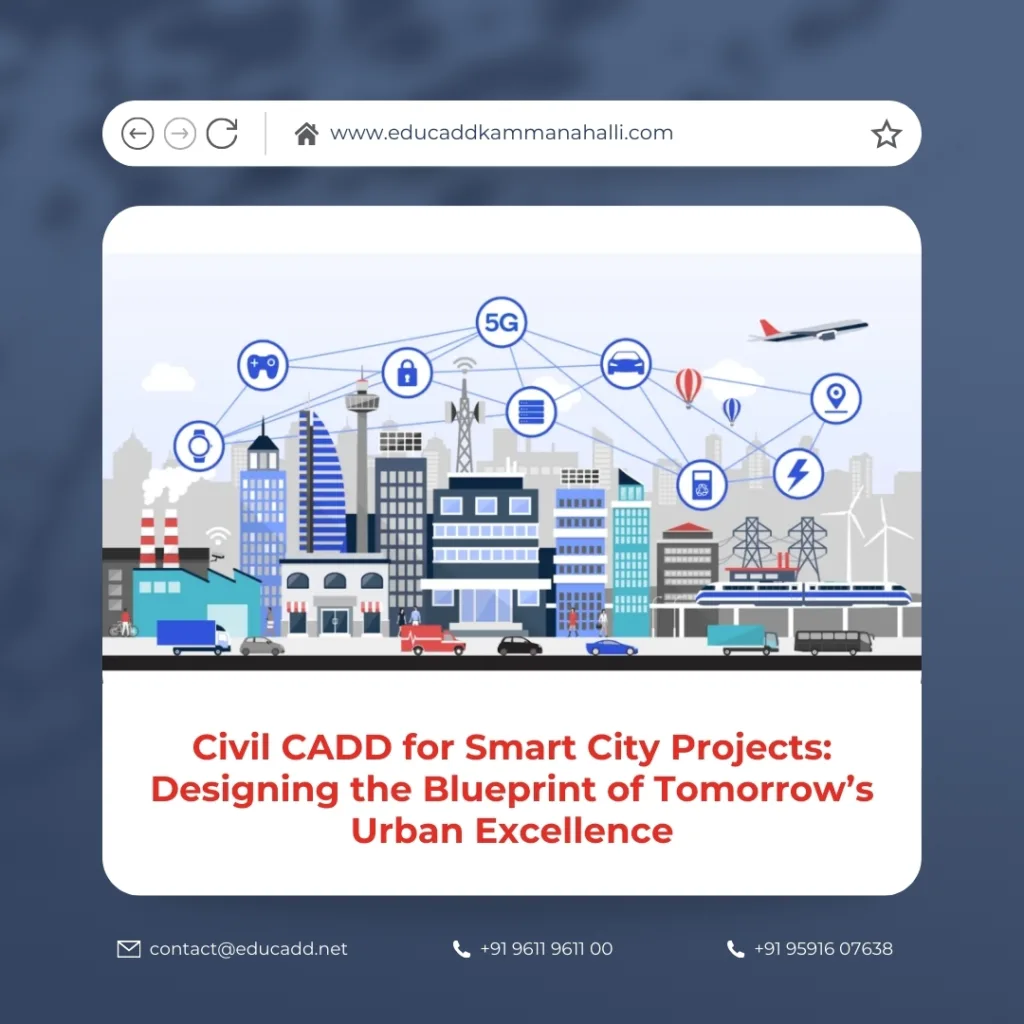
Civil CADD Smart Cities
This blog explores how Civil CADD Smart Cities Projects supports planning, design, infrastructure development, sustainability, and long-term urban growth. It highlights practical applications, benefits, technologies, and future opportunities.
1. Understanding the Concept of Smart Cities
Smart cities combine technology, infrastructure, and governance to improve urban living. They integrate digital systems with physical infrastructure to optimize resources and enhance services. Efficient transportation, smart utilities, sustainable housing, and digital connectivity form the backbone of these cities.
Civil CADD Smart Cities Projects plays a foundational role in this ecosystem. Engineers use it to design roads, drainage systems, water supply networks, and structural layouts. With accurate modeling and digital simulations, planners can predict challenges before construction begins. Consequently, projects move forward with greater confidence and clarity.
Moreover, smart city development requires collaboration among multiple stakeholders. Civil CADD for Smart City Projects ensures that architects, structural engineers, and urban planners work on coordinated designs. This coordination reduces conflicts and improves efficiency. As a result, the planning process becomes streamlined and transparent.
2. Role of Civil CADD in Urban Infrastructure Planning
Urban infrastructure includes roads, bridges, drainage systems, water supply lines, sewage networks, and public facilities. Designing these systems requires precision and foresight. Civil CADD for Smart City Projects enables engineers to create accurate site plans and cross-sections.
Through digital drafting tools, professionals can calculate elevations, slopes, and alignments with precision. Therefore, infrastructure projects meet safety and compliance standards. In addition, Civil CADD for Smart City Projects allows planners to analyze traffic flow and road geometry before execution.
Transitioning from 2D drafting to intelligent modeling improves decision-making. Engineers can simulate load distribution and identify potential design conflicts early. This proactive approach reduces costly revisions during construction. Hence, Civil CADD for Smart City Projects supports efficient infrastructure planning and execution.
3. Enhancing Road and Transportation Network Design
Transportation networks define the functionality of any smart city. Efficient road design ensures smooth traffic movement and reduced congestion. Civil CADD for Smart City Projects assists in designing highways, flyovers, intersections, and metro corridors with precision.
Engineers use digital terrain models to study land contours and align roadways accordingly. Consequently, they optimize earthwork and minimize environmental impact. Civil CADD for Smart City Projects also helps design drainage systems alongside roads, ensuring proper water flow.
Furthermore, planners integrate pedestrian pathways, cycling tracks, and public transport systems within the same digital framework. This integration supports sustainable mobility. By using Civil CADD for Smart City Projects, transportation planning becomes accurate, coordinated, and future-ready.
4. Water Supply and Drainage System Planning
Water management remains a crucial aspect of smart city development. Cities must ensure clean water supply and effective wastewater management. Civil CADD for Smart City Projects simplifies the design of pipelines, reservoirs, and treatment plants.
Engineers can map water distribution networks accurately using digital tools. They calculate pressure, flow rates, and pipe diameters efficiently. Therefore, the water supply system operates smoothly and reliably. Civil CADD for Smart City Projects also assists in designing stormwater drainage networks to prevent flooding.
By analyzing topographical data, planners determine natural flow paths. As a result, drainage systems align with the terrain. This method improves resilience during heavy rainfall. Civil CADD for Smart City Projects ensures sustainable and reliable water infrastructure.
5. Structural Design Integration for Smart Buildings
Smart cities include intelligent buildings equipped with advanced systems. Structural design must align with architectural and utility plans. Civil CADD for Smart City Projects supports the creation of detailed structural drawings and reinforcement layouts.
Engineers use precise drafting tools to design foundations, beams, columns, and slabs. Consequently, structural components integrate seamlessly with utility systems. Civil CADD for Smart City Projects also enhances collaboration between civil and structural teams.
With accurate modeling, professionals detect clashes between structural elements and service lines early. This early detection reduces construction delays. Therefore, Civil CADD for Smart City Projects strengthens building design coordination and quality.
6. Sustainable Urban Planning with Civil CADD
Sustainability forms the core of smart city development. Planners must consider green spaces, renewable energy integration, and efficient land use. Civil CADD for Smart City Projects enables sustainable site planning and land analysis.
Engineers can evaluate sun paths, wind directions, and environmental constraints digitally. As a result, designs optimize natural lighting and ventilation. Civil CADD for Smart City Projects also assists in planning rainwater harvesting systems and green corridors.
By integrating environmental data into the design process, cities reduce carbon footprints. Therefore, Civil CADD for Smart City Projects contributes significantly to eco-friendly development. Sustainable planning becomes practical and measurable.
7. Utility Coordination and Underground Network Design
Smart cities rely on integrated utility systems. Electrical lines, communication cables, gas pipelines, and sewage networks must align accurately. Civil CADD Smart Cities Projects facilitates underground utility mapping and coordination.
Engineers create layered drawings that represent each utility system clearly. Consequently, conflicts between pipelines and cables are minimized. Civil CADD for Smart City Projects improves accuracy during trench planning and excavation.
Moreover, digital documentation supports long-term maintenance. Utility agencies can refer to precise layouts for repairs and upgrades. Hence, Civil CADD for Smart City Projects ensures organized and efficient utility management.
8. Project Visualization and Stakeholder Communication
Clear communication accelerates project approvals and funding. Civil CADD for Smart City Projects enhances visualization through detailed layouts and 3D representations.
Stakeholders can understand design concepts easily when presented visually. Therefore, decision-making becomes faster and more confident. Civil CADD for Smart City Projects bridges the gap between technical experts and policymakers.
Additionally, digital renderings allow communities to visualize proposed developments. Public engagement improves because citizens can see how infrastructure will impact their surroundings. Thus, Civil CADD for Smart City Projects strengthens collaboration and transparency.
9. Integration with GIS and Data Analytics
Smart cities rely on real-time data and geographic information systems. Civil CADD for Smart City Projects integrates seamlessly with GIS platforms.
Engineers can overlay design drawings with geographic data. Consequently, they analyze land use patterns and population density effectively. Civil CADD for Smart City Projects supports data-driven planning decisions.
Furthermore, integration with analytics tools helps predict traffic trends and infrastructure demands. By combining digital drafting with geospatial data, planners develop resilient and scalable solutions. Therefore, Civil CADD for Smart City Projects enhances strategic urban planning.
10. Cost Optimization and Resource Management
Budget management remains critical in large-scale urban projects. Civil CADD for Smart City Projects helps estimate materials and quantities accurately.
Engineers calculate earthwork volumes, concrete requirements, and reinforcement quantities directly from digital drawings. As a result, cost estimation becomes precise. Civil CADD for Smart City Projects reduces material wastage and avoids overestimation.
Moreover, accurate planning prevents rework and delays. Therefore, project timelines remain controlled. Civil CADD for Smart City Projects supports financial efficiency and responsible resource utilization.
11. Compliance with Standards and Regulations
Urban projects must comply with building codes and environmental regulations. Civil CADD for Smart City Projects assists engineers in maintaining compliance throughout the design phase.
Digital tools include standardized templates and drafting guidelines. Consequently, engineers adhere to regulatory norms effortlessly. Civil CADD for Smart City Projects also simplifies documentation for approval authorities.
By maintaining organized and accurate drawings, teams reduce approval delays. Therefore, Civil CADD for Smart City Projects enhances regulatory alignment and project credibility.
12. Improving Construction Accuracy and Execution
Accurate construction depends on detailed drawings. Civil CADD for Smart City Projects generates precise construction documents and layout plans.
Contractors rely on digital outputs for setting out dimensions and alignments. Consequently, construction errors decrease significantly. Civil CADD for Smart City Projects ensures that site execution matches design intent.
Furthermore, digital revisions can be updated quickly. Teams share updated drawings instantly, preventing confusion. Thus, Civil CADD for Smart City Projects improves construction coordination and quality control.
13. Future Trends in Civil CADD for Smart City Projects
Technology continues to evolve rapidly. Civil CADD for Smart City Projects now integrates with Building Information Modeling and cloud collaboration platforms.
Engineers access drawings remotely and collaborate in real time. Consequently, project management becomes more agile. Civil CADD for Smart City Projects also incorporates automation and artificial intelligence for enhanced efficiency.
As cities embrace digital transformation, demand for skilled Civil CADD professionals increases. Therefore, learning Civil CADD for Smart City Projects offers strong career opportunities and industry relevance.
14. Skill Development and Career Opportunities
The growth of smart cities creates new professional pathways. Engineers trained in Civil CADD for Smart City Projects gain competitive advantages in the job market.
Organizations seek professionals who can manage digital drafting, infrastructure modeling, and project coordination. Consequently, specialized training programs attract aspiring engineers and working professionals. Civil CADD for Smart City Projects enhances technical competence and practical expertise.
Moreover, professionals who master these tools contribute directly to sustainable urban development. Therefore, Civil CADD for Smart City Projects not only supports infrastructure growth but also shapes rewarding careers.
Conclusion
Smart cities represent the future of urban living. They demand precise planning, sustainable infrastructure, and integrated systems. In this context, Civil CADD Smart Cities stands as a transformative force that modernizes design and execution.
From transportation networks to water management systems, Civil CADD for Smart City Projects enables accurate planning and efficient coordination. It reduces errors, optimizes resources, and improves collaboration among stakeholders. Moreover, it supports sustainable practices and regulatory compliance.
As urban challenges grow more complex, digital tools will define success. Civil CADD for Smart City Projects equips engineers with the capabilities needed to design resilient and intelligent cities. Ultimately, it shapes the blueprint for a smarter, more connected, and sustainable urban future.

