
How Data Science Powers Smarter Business Decisions in the Digital Age
In today’s highly competitive and data-driven environment, businesses are no longer relying solely on intuition or past experiences to make decisions. Instead, they are turning toward Data Science Business Decisions as a strategic asset that enables informed, accurate, and timely decision-making. From small startups to global enterprises, the ability to collect, process, and analyze vast amounts of data has become a defining factor for success. Data science integrates statistical methods, advanced analytics, and machine learning to extract meaningful insights from raw data, helping organizations identify trends, predict outcomes, and optimize operations.
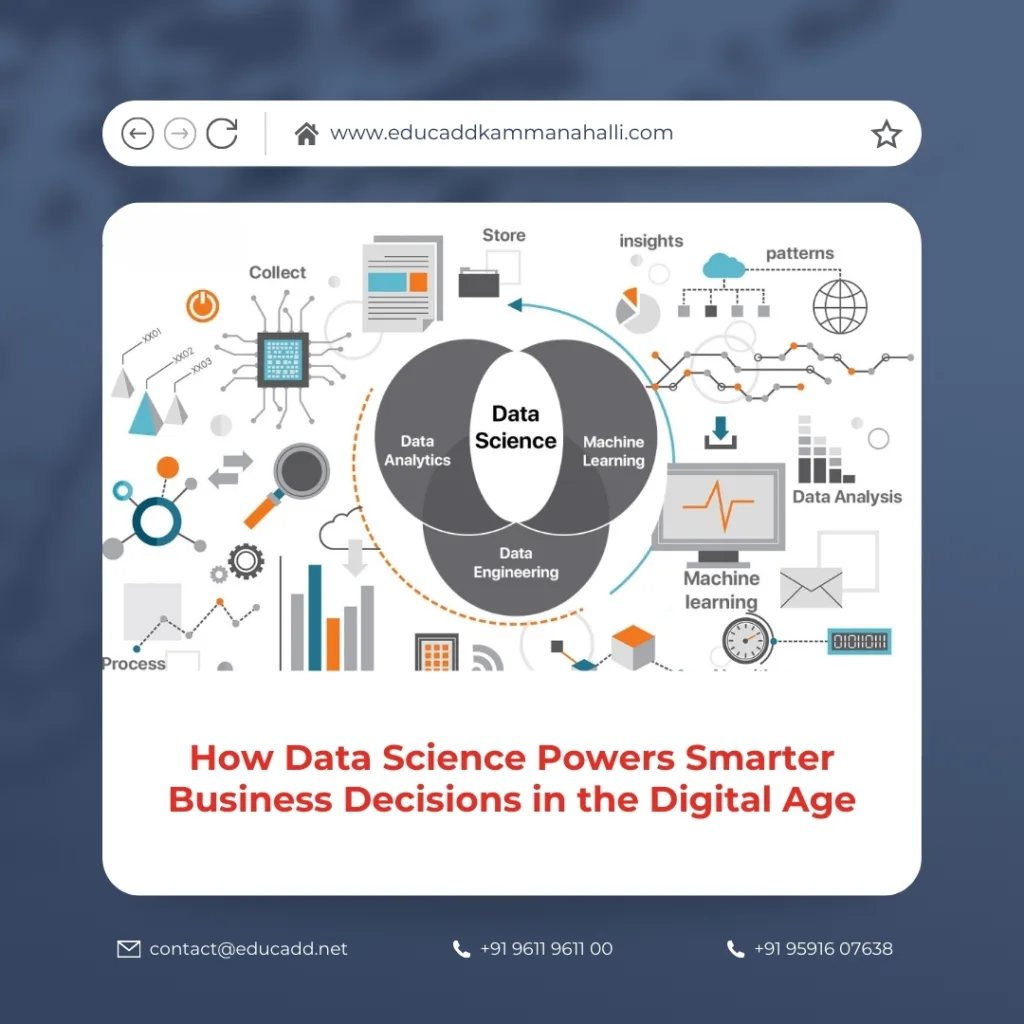
Data Science Business Decisions
Moreover, as digital transformation accelerates across industries, the importance of data science continues to grow. Organizations that leverage data effectively can respond quickly to market changes, understand customer behavior more deeply, and gain a significant competitive advantage. This blog explores how data science drives business decision-making, highlighting its impact across various functions and its role in shaping the future of modern enterprises.
1. Understanding the Foundation of Data Science in Business
Data Science Business Decisions serves as the backbone of modern decision-making by transforming raw data into actionable insights. It combines disciplines such as statistics, computer science, and domain expertise to uncover patterns that are otherwise hidden. Businesses generate enormous volumes of data every day through customer interactions, transactions, and digital activities. Without proper analysis, this data remains underutilized.
By implementing data science techniques, organizations can clean, structure, and analyze this information effectively. As a result, decision-makers gain a clear understanding of operational performance and market dynamics. Furthermore, this foundation ensures that strategies are based on evidence rather than assumptions, which significantly reduces risks and enhances overall efficiency.
2. Enhancing Strategic Planning Through Data Insights
Strategic planning becomes more precise when supported by data science. Companies can evaluate historical performance and identify trends that influence future outcomes. Instead of relying on guesswork, executives can make decisions grounded in data-backed insights.
Additionally, predictive analytics allows businesses to forecast demand, anticipate challenges, and plan resources accordingly. This proactive approach ensures that organizations stay ahead of competitors. Consequently, data science not only improves planning accuracy but also enables long-term growth by aligning strategies with market realities.
3. Improving Customer Understanding and Personalization
Understanding customers is essential for any successful business. Data science enables organizations to analyze customer behavior, preferences, and purchasing patterns in detail. By leveraging these insights, companies can create personalized experiences that resonate with their target audience.
For instance, recommendation systems and targeted marketing campaigns are driven by data analysis. Customers receive relevant offers and content, which enhances engagement and satisfaction. As a result, businesses can build stronger relationships and increase customer loyalty while boosting revenue.
4. Driving Operational Efficiency and Cost Reduction
Operational efficiency is a critical factor in maintaining profitability. Data science helps organizations identify inefficiencies in processes and optimize resource utilization. By analyzing workflows and performance metrics, businesses can pinpoint areas that require improvement.
Moreover, automation powered by data science reduces manual effort and minimizes errors. This leads to faster operations and lower costs. Over time, these improvements contribute to better productivity and a more streamlined business model.
5. Enabling Real-Time Decision-Making
In a fast-paced business environment, timely decisions are crucial. Data science provides real-time analytics that allow organizations to respond quickly to changing conditions. Whether it is adjusting pricing strategies or managing supply chains, real-time data ensures that decisions are both relevant and effective.
Furthermore, dashboards and visualization tools present data in an easily understandable format. Decision-makers can monitor key performance indicators and take immediate action when necessary. This agility gives businesses a significant advantage in dynamic markets.
6. Supporting Risk Management and Fraud Detection
Risk management is an essential aspect of business operations. Data science plays a vital role in identifying potential risks and mitigating them before they escalate. By analyzing historical data and patterns, organizations can detect anomalies that indicate potential threats.
In addition, fraud detection systems rely heavily on data science algorithms. These systems can identify unusual transactions and flag them for further investigation. As a result, businesses can protect their assets and maintain trust among stakeholders.
7. Transforming Marketing Strategies with Data
Marketing has evolved significantly with the integration of data science. Businesses can now analyze campaign performance, customer engagement, and conversion rates in detail. This enables marketers to refine their strategies and allocate resources more effectively.
Key benefits include:
-
Improved targeting through audience segmentation
-
Higher return on investment with data-driven campaigns
By leveraging these insights, organizations can create impactful marketing initiatives that deliver measurable results. Consequently, marketing efforts become more efficient and aligned with business goals.
8. Optimizing Supply Chain Management
Supply chain management involves complex processes that require precise coordination. Data science helps businesses optimize these processes by analyzing demand patterns, inventory levels, and logistics operations.
For example, predictive models can forecast product demand, ensuring that inventory levels are maintained appropriately. This reduces the risk of overstocking or stockouts. Additionally, route optimization algorithms improve delivery efficiency, saving time and costs.
9. Facilitating Innovation and Product Development
Innovation is a key driver of business growth. Data science provides valuable insights that guide product development and innovation strategies. By analyzing customer feedback and market trends, organizations can identify gaps and opportunities.
Moreover, data-driven experimentation allows businesses to test new ideas and measure their effectiveness. This approach reduces uncertainty and increases the likelihood of success. As a result, companies can develop products that meet customer needs and stand out in the market.
10. Empowering Human Resource Decisions
Human resource management also benefits from data science. Organizations can analyze employee performance, engagement levels, and retention rates to make informed decisions. This helps in identifying top talent and addressing issues that affect productivity.
Additionally, predictive analytics can forecast employee turnover and suggest strategies to improve retention. By leveraging data, HR teams can create a more supportive and efficient work environment, ultimately contributing to organizational success.
11. Strengthening Financial Decision-Making
Financial decisions require accuracy and precision. Data science enables businesses to analyze financial data, track expenses, and forecast revenue. This helps organizations maintain financial stability and plan for future growth.
Important advantages include:
-
Accurate budgeting and financial forecasting
-
Improved investment decision-making
By utilizing these insights, companies can minimize risks and maximize returns. Consequently, financial strategies become more robust and sustainable.
12. Enhancing Competitive Advantage
In a competitive market, gaining an edge is crucial. Data science provides businesses with the insights needed to outperform competitors. By analyzing market trends and competitor strategies, organizations can identify opportunities for differentiation.
Furthermore, data-driven decision-making ensures that businesses remain adaptable and responsive to changes. This continuous improvement process helps companies stay relevant and maintain a strong market position.
13. Integrating Artificial Intelligence for Advanced Insights
Artificial intelligence and data science work together to deliver advanced analytics capabilities. Machine learning algorithms can process large datasets and uncover complex patterns that traditional methods cannot detect.
As a result, businesses can automate decision-making processes and gain deeper insights. From chatbots to predictive maintenance, AI-driven applications enhance efficiency and innovation. This integration represents the future of business intelligence and decision-making.
14. Overcoming Challenges in Data-Driven Decision-Making
Despite its advantages, implementing data science comes with challenges. Organizations must address issues such as data quality, privacy concerns, and skill gaps. Without proper management, these challenges can hinder the effectiveness of data-driven strategies.
However, by investing in the right tools and talent, businesses can overcome these obstacles. Establishing clear data governance policies and fostering a data-driven culture are essential steps. With the right approach, organizations can fully realize the benefits of data science.
Conclusion
Data Science Business Decisions has transformed the way businesses make decisions, shifting the focus from intuition to evidence-based strategies. By leveraging data analytics, organizations can enhance efficiency, improve customer experiences, and drive innovation. From strategic planning to risk management, every aspect of business operations benefits from data-driven insights.
As technology continues to evolve, the role of data science will become even more significant. Companies that embrace this transformation will be better equipped to navigate uncertainties and seize new opportunities. Ultimately, data science is not just a tool but a powerful enabler of smarter, faster, and more effective business decision-making in the modern world.

