
Digital Construction Management BIM: Transforming the Future of Smart Building and Project Delivery
Introduction: A New Era of Digital Construction
The construction industry is moving beyond traditional drawings, manual calculations, and disconnected project records. Today, technology helps engineers, architects, contractors, and project managers plan buildings with greater accuracy and control. One of the most valuable developments in this transformation is Digital Construction Management BIM. It combines digital tools, intelligent 3D models, project data, and coordinated workflows to improve the way construction teams plan, build, and manage projects.
In the past, construction professionals often worked with separate drawings, spreadsheets, schedules, and cost reports. This approach could create confusion, delays, and expensive mistakes. However, digital construction methods bring important project information into a connected environment. Teams can review designs, identify problems, track progress, and make informed decisions before small issues become major challenges. As a result, BIM supports better communication and more efficient project delivery. Whether you are an aspiring civil engineer, architect, project planner, or construction manager, understanding this technology can help you prepare for the changing demands of the building industry.
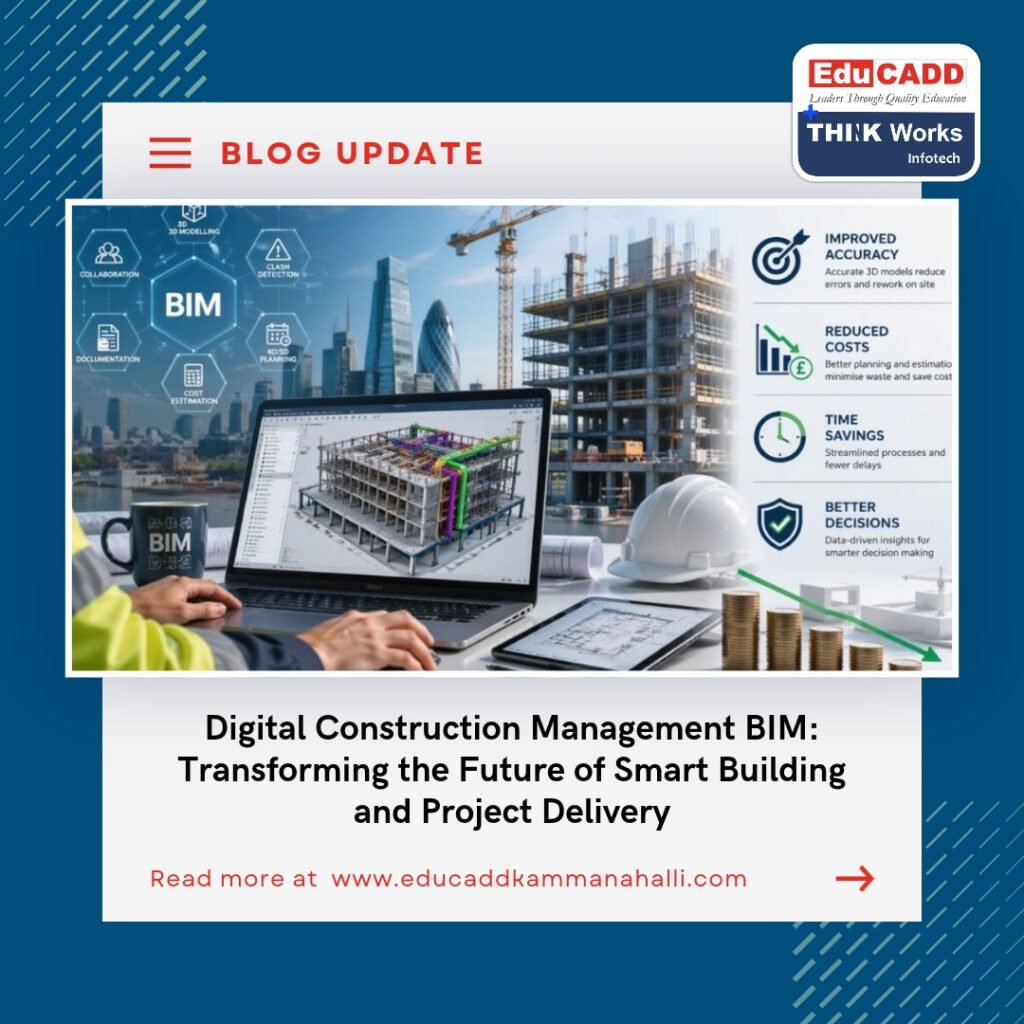
Digital Construction Management
Understanding Digital Construction Management BIM
Digital Construction Management BIM refers to the use of Building Information Modeling and digital project management tools to plan, coordinate, monitor, and manage construction activities. BIM creates an intelligent digital representation of a building or infrastructure project. Unlike a basic 3D drawing, this model can contain valuable information about building components, materials, dimensions, quantities, costs, and performance.
For example, a BIM model of a commercial building may include walls, doors, windows, electrical systems, plumbing networks, and structural elements. Each component can contain information that supports design reviews, quantity calculations, scheduling, and maintenance planning. Therefore, project teams can understand both the appearance of a building and the information behind its construction.
Digital construction management also connects BIM with other technologies, such as cloud platforms, scheduling software, cost management systems, drones, and project dashboards. These tools help teams share information and monitor project activities. Consequently, they can identify risks earlier and respond to changes with greater confidence.
Most importantly, BIM does not replace professional knowledge. Instead, it gives construction professionals better information to support their decisions. When teams use accurate models and follow clear processes, they can reduce uncertainty and improve project outcomes.
Why the Construction Industry Needs Digital Transformation
Construction projects involve many people, materials, systems, and deadlines. Even a small design change can affect several activities. For instance, moving a staircase may influence structural design, electrical routing, plumbing layouts, material quantities, and the construction schedule.
Traditional workflows often make it difficult to communicate these changes quickly. A team may update one drawing while another team continues working with an older version. This can lead to rework, wasted materials, and avoidable costs.
Digital transformation helps address these challenges by improving access to project information. Teams can work with coordinated models, updated documents, and shared project records. In addition, digital workflows support faster reviews and clearer communication between departments.
The major reasons construction companies are adopting digital methods include:
-
Better coordination: Teams can identify design conflicts before construction begins.
-
Improved planning: Project managers can connect design information with construction schedules.
-
Cost control: Accurate quantities and updated information support better budgeting.
-
Reduced rework: Early problem detection helps prevent costly corrections on-site.
-
Clear communication: Shared information makes it easier for stakeholders to understand project requirements.
-
Better documentation: Digital records support progress tracking, quality checks, and future maintenance.
These benefits become especially important in large commercial buildings, residential developments, industrial facilities, hospitals, airports, and infrastructure projects. As project complexity increases, coordinated digital information becomes more valuable.
The Role of BIM in Modern Construction Project Management
Digital Construction Management BIM supports project managers throughout the construction process. It helps them connect design information with real project activities, from early planning to final handover. Instead of relying only on separate reports, managers can use model-based information to understand how different parts of a project affect one another.
For example, a project manager working on a multi-storey building can review floor layouts, structural elements, service routes, and construction sequences. This makes it easier to coordinate teams and plan upcoming work. Furthermore, managers can use digital dashboards to monitor progress, review reported issues, and communicate decisions to the right people.
BIM also supports more informed decision-making. When a design change affects material quantities or construction activities, the team can review the related information before approving the change. However, the accuracy of these results depends on model quality, timely updates, and clear project responsibilities.
According to Autodesk, BIM supports planning, design, construction, and building operations through connected information and collaborative workflows.
How 3D, 4D, and 5D BIM Improve Project Delivery
BIM offers different levels of information integration. Understanding these dimensions helps construction professionals identify how digital models can support their daily responsibilities.
3D BIM: Better Design and Visualization
3D BIM creates a detailed digital model of a building or infrastructure project. Architects, structural engineers, and MEP professionals can review their designs in a shared visual environment.
This helps stakeholders understand building layouts and identify possible conflicts. For example, engineers can check whether a ventilation duct clashes with a beam before the installation team starts work. Therefore, the team can resolve design issues earlier and reduce unnecessary changes on-site.
4D BIM: Time and Schedule Management
4D BIM connects the 3D model with construction scheduling information. It allows teams to visualize how a project will develop over time.
Project managers can review the construction sequence, plan equipment movement, and coordinate different trades. They can also identify activities that may overlap or create delays.
For instance, a 4D simulation can show when a floor must be completed before electrical installation begins. This makes project schedules easier to understand and helps teams prepare for upcoming tasks.
5D BIM: Cost Estimation and Budget Control
5D BIM links model information with construction costs. It can support quantity take-offs, material estimation, budget preparation, and cost reviews.
When designers update model elements, connected quantity information may also change, depending on the software and model setup. Cost professionals can then assess how these changes affect the project budget.
The key benefits include:
-
More consistent quantity calculations.
-
Better visibility into material requirements.
-
Improved cost comparison between design options.
-
Earlier identification of potential budget changes.
-
Stronger communication between estimators and project managers.
However, teams must verify quantities, pricing, and assumptions before using model-based estimates for financial decisions. BIM improves the process, but it does not remove the need for professional review.
Clash Detection and Multidisciplinary Coordination
One of the most valuable applications of BIM in construction management is clash detection. A construction project often involves architectural, structural, electrical, plumbing, and mechanical designs. When these systems are developed separately, their components may occupy the same space or interfere with one another.
For example, a plumbing pipe may pass through a structural beam, or an electrical cable tray may conflict with an air-conditioning duct. If workers discover these problems during installation, the team may need to stop work, revise drawings, and purchase additional materials.
BIM coordination tools help teams combine discipline models and identify many geometric conflicts before construction begins. Coordinators can assign issues to the responsible professionals and track them until resolution.
A successful coordination process generally includes:
-
Collecting the latest architectural and engineering models.
-
Combining the models in a shared coordination environment.
-
Running clash detection checks.
-
Reviewing and prioritizing identified issues.
-
Assigning responsibilities to relevant team members.
-
Updating models and confirming that conflicts have been resolved.
As a result, construction teams gain a clearer understanding of design requirements. The UK Health and Safety Executive also highlights how coordinated models can help reduce on-site adjustments and support safer construction planning.
Digital Construction Management BIM for Site Execution
Digital construction management becomes especially useful when design information reaches the construction site. Site engineers and supervisors need accurate drawings, installation details, inspection records, and progress updates to complete their work correctly.
With Digital Construction Management BIM, teams can access approved digital information through suitable mobile devices and project platforms. They can compare planned work with site conditions, report issues, and coordinate activities with the project office.
For example, a site engineer installing electrical services can review the coordinated model to understand the required route and location of equipment. If an unexpected site condition creates a problem, the engineer can report it for review rather than making an unapproved change.
Digital tools can also support site inspections, quality checks, safety reviews, and progress documentation. In addition, photographs and issue records can help managers understand the current status of work.
Nevertheless, teams must use approved information and follow site procedures. A digital model should support construction decisions, not replace engineering approvals, safety rules, or physical verification.
How BIM Supports Quality, Safety, and Sustainability
Construction quality depends on accurate information, skilled workers, and consistent inspection. BIM technology helps teams understand design requirements and coordinate work before installation. It can also support the preparation of inspection plans and the tracking of defects.
For example, a project team can use model information to identify components that require special installation checks. If inspectors discover a defect, they can record the issue, assign corrective action, and monitor its status.
BIM can also contribute to safer project planning. Teams may use models to review site access, equipment movement, work sequences, and potential hazards. When combined with suitable safety procedures, this approach can help professionals identify risks before work begins.
Sustainability is another important advantage. Model-based analysis can help teams compare material options, examine energy performance, and assess design alternatives. Accurate quantity information may also help reduce unnecessary material orders and construction waste.
These outcomes are not automatic. They depend on reliable data, appropriate analysis tools, and decisions that reflect actual site conditions. Even so, integrating digital information into project workflows creates more opportunities to improve quality, safety, and resource efficiency.
Essential Software Skills for BIM Professionals
Professionals who want to build a career in digital construction should understand both BIM processes and the software used to support them. Each platform serves a different purpose, so the right combination depends on the job role and project requirements.
Some commonly used tools include:
-
Autodesk Revit: Supports information-rich building models and multidisciplinary design.
-
Navisworks: Helps teams review combined models and identify coordination clashes.
-
Autodesk Construction Cloud: Supports connected construction information and project collaboration.
-
Primavera P6: Supports project scheduling, activity planning, and progress control.
-
Microsoft Excel: Helps professionals organize project data, reports, quantities, and budgets.
-
Synchro 4D: Supports construction sequencing and model-based schedule visualization.
Learning these tools can help aspiring professionals understand how design, scheduling, coordination, and site execution work together. However, software knowledge alone is not enough. Employers also value technical understanding, communication, problem-solving, and the ability to interpret construction documents.
A structured BIM training course can help learners develop these skills through guided exercises, coordinated models, and practical project examples.
Career Opportunities in Digital Construction Management BIM
The growing use of digital project workflows creates opportunities for professionals who understand BIM and construction management. Architects, civil engineers, mechanical engineers, electrical engineers, and construction graduates can explore different career paths based on their interests and experience.
Potential roles include:
-
BIM Modeler: Develops digital building models from design information.
-
BIM Coordinator: Coordinates discipline models and manages design issues.
-
BIM Engineer: Supports model development, technical documentation, and coordination.
-
4D BIM Planner: Connects construction models with schedules and sequences.
-
5D BIM Specialist: Supports model-based quantities and cost management.
-
Digital Construction Manager: Oversees digital workflows, coordination, and project information.
-
BIM Manager: Develops BIM standards, manages teams, and oversees model delivery.
To prepare for these roles, learners should focus on practical skills rather than software commands alone. Understanding construction drawings, project stages, coordination methods, and information management can make their technical knowledge more valuable.
Additionally, a portfolio containing well-organized models, coordination examples, and project simulations can help candidates demonstrate their abilities to potential employers. Career progression will depend on experience, qualifications, communication skills, and the needs of individual employers.
Challenges in Adopting Digital Construction Management BIM
Although Digital Construction Management BIM offers significant benefits, organizations may face challenges when introducing it into their workflows. Software costs, staff training, inconsistent data, and resistance to change can slow adoption.
Smaller firms may also struggle to establish clear BIM standards or coordinate information across different software platforms. Furthermore, a poorly maintained model can create confusion instead of improving project delivery.
Construction companies can address these challenges through a practical implementation strategy.
First, they should define clear objectives, such as reducing coordination issues or improving quantity reporting. Next, they should select suitable software and establish consistent naming, modelling, and information-sharing standards. Training should focus on real project tasks, allowing employees to understand how digital workflows support their responsibilities.
Finally, organizations should review their results regularly. Tracking coordination issues, revision delays, rework, and information quality can help teams identify areas for improvement.
A gradual approach allows businesses to develop their skills and processes before expanding BIM across larger projects.
The Future of Digital Construction Management BIM
The future of digital construction management will involve greater integration between BIM, artificial intelligence, cloud collaboration, reality capture, and digital twins. These technologies can help construction professionals connect planned designs with actual project conditions.
For instance, drones and laser scanning can capture site information for comparison with digital models. Artificial intelligence may assist with selected tasks, such as identifying patterns in project data or flagging potential risks. Meanwhile, digital twins can connect asset models with operational information to support monitoring and maintenance.
These technologies will not eliminate every construction challenge. Their value depends on data quality, suitable workflows, skilled professionals, and clear project objectives.
Nevertheless, construction teams that embrace digital methods can improve their ability to coordinate complex projects and respond to changing requirements. As a result, BIM knowledge is becoming an important part of modern construction education and professional development.
Conclusion: Build a Smarter Career with Digital Construction Management BIM
Digital Construction Management BIM is changing how construction professionals plan, coordinate, and deliver building projects. By connecting intelligent models with schedules, costs, site information, and project records, it helps teams improve visibility and make more informed decisions.
From 3D visualization and clash detection to 4D scheduling and 5D cost management, BIM supports better coordination across the construction lifecycle. It can also contribute to quality control, safer planning, reduced waste, and more effective building maintenance when teams apply it correctly.
For students and working professionals, learning BIM offers an opportunity to develop skills that connect engineering knowledge with modern project delivery. The best starting point is to understand the fundamentals, practise with industry-relevant software, and apply those skills to realistic construction scenarios.
Ultimately, successful digital construction depends on more than technology. It requires accurate information, teamwork, continuous learning, and a clear understanding of construction processes. By developing these capabilities, aspiring professionals can prepare for a more connected and data-driven construction industry.

