
Digital Prototyping in Mechanical Engineering: Transforming Design into Reality with Speed and Precision
Digital Prototyping Mechanical Engineering has revolutionized the way products are imagined, designed, tested, and brought to market. In today’s competitive environment, engineers are expected to deliver innovative solutions faster while maintaining accuracy and cost efficiency. Traditional prototyping methods often required physical models, extensive testing, and repeated iterations, which consumed both time and resources. However, with the emergence of digital tools, the entire product development lifecycle has undergone a major transformation.
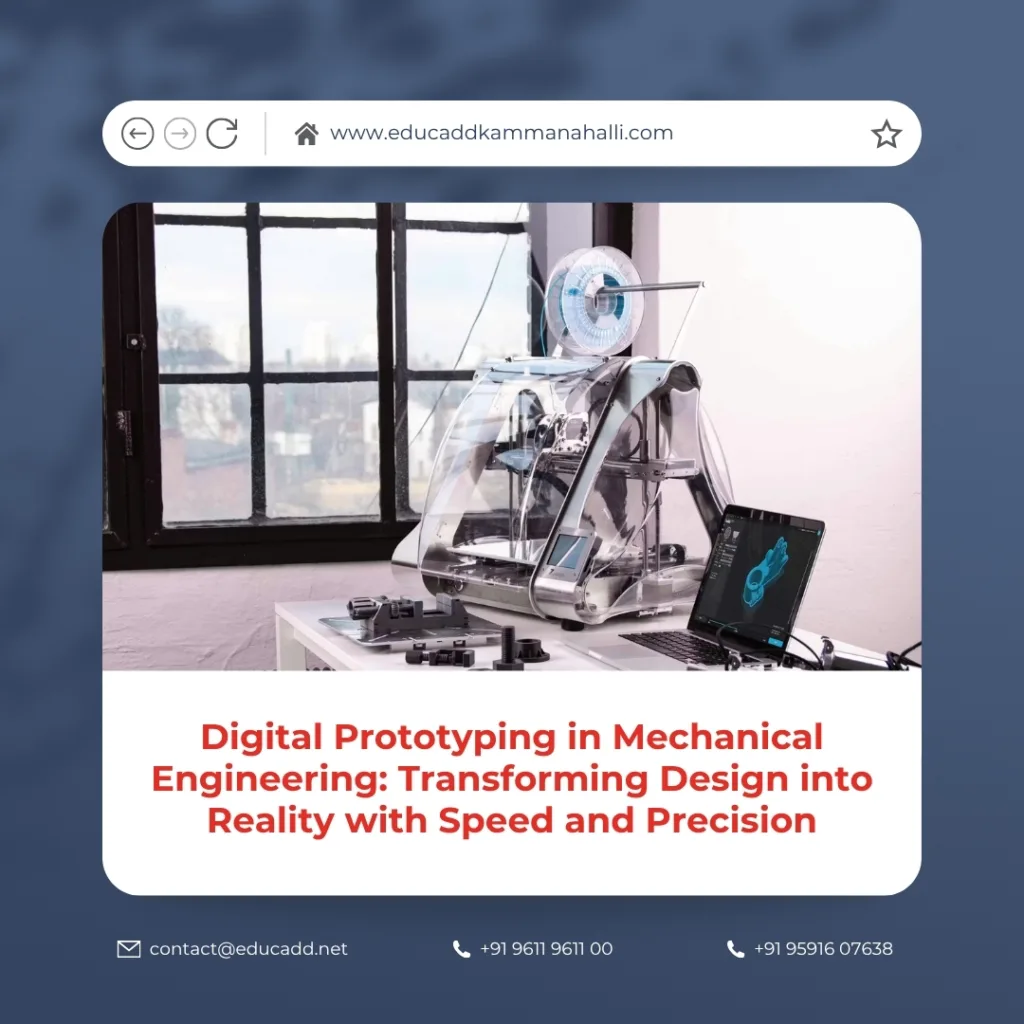
Digital Prototyping Mechanical Engineering
This blog explores how digital prototyping enhances productivity, reduces errors, and accelerates innovation in mechanical engineering. It also highlights its impact on design validation, collaboration, sustainability, and future technological trends.
1. Understanding Digital Prototyping in Mechanical Engineering
Digital Prototyping Mechanical Engineering refers to the process of creating and testing virtual models of a product using advanced software before building a physical prototype. Engineers use computer-aided design (CAD), simulation tools, and visualization technologies to evaluate performance, functionality, and feasibility.
Unlike traditional methods, digital prototyping allows engineers to analyze multiple design iterations without physically manufacturing each version. As a result, design errors can be identified early, and improvements can be made quickly. This approach significantly reduces development costs and shortens the product lifecycle.
Moreover, digital prototyping enhances communication between teams. Designers, engineers, and stakeholders can review the same virtual model, ensuring alignment and clarity throughout the development process.
2. Evolution from Traditional to Digital Prototyping
The shift from traditional prototyping to digital solutions has been driven by technological advancements. In the past, engineers relied heavily on physical mock-ups and manual calculations. These methods were not only time-consuming but also prone to human error.
With the introduction of digital tools, engineers can now simulate real-world conditions with high accuracy. This evolution has enabled faster decision-making and improved design quality. Furthermore, digital prototyping supports iterative development, allowing engineers to refine designs continuously.
As industries demand quicker turnaround times, the adoption of digital prototyping has become essential. It empowers organizations to stay competitive and meet customer expectations efficiently.
3. Key Technologies Powering Digital Prototyping
Several technologies play a crucial role in digital prototyping. These tools enable engineers to create, simulate, and analyze designs effectively.
- Computer-Aided Design (CAD) software for 3D modeling
- Computer-Aided Engineering (CAE) tools for simulation and analysis
In addition to these, technologies like finite element analysis (FEA) and computational fluid dynamics (CFD) provide deeper insights into structural and fluid behavior. These tools help engineers predict how a product will perform under various conditions.
Consequently, engineers can make informed decisions and optimize designs before manufacturing begins.
4. Benefits of Digital Prototyping in Product Development
Digital Prototyping Mechanical Engineering offers numerous advantages that enhance the overall product development process. One of the most significant benefits is cost reduction. Since fewer physical prototypes are required, material and manufacturing costs decrease substantially.
Another advantage is improved accuracy. Digital models allow engineers to detect design flaws early, reducing the risk of costly errors. Additionally, the ability to simulate real-world conditions ensures that products meet performance standards.
Furthermore, digital prototyping accelerates time-to-market. Companies can launch products faster, gaining a competitive edge in the industry.
5. Enhancing Design Accuracy and Innovation
Digital prototyping enables engineers to experiment with innovative ideas without the fear of failure. Since changes can be made easily in a virtual environment, engineers are encouraged to explore creative solutions.
Moreover, simulation tools provide detailed insights into how designs will behave under stress, heat, or motion. This level of precision ensures that products are reliable and efficient.
As a result, companies can deliver high-quality products that meet customer expectations while maintaining innovation.
6. Role of Simulation in Digital Prototyping
Simulation is a core component of digital prototyping. It allows engineers to test designs under various conditions without physical trials. For example, stress analysis can determine whether a component can withstand external forces.
Additionally, thermal simulations help evaluate how a product performs under temperature variations. These analyses ensure that designs are robust and safe.
By using simulation, engineers can reduce the need for physical testing, saving both time and resources.
7. Improving Collaboration Across Teams
Digital prototyping fosters better collaboration among teams. Engineers, designers, and project managers can work on the same digital model, ensuring consistency and transparency.
Cloud-based platforms further enhance collaboration by allowing real-time access to design data. Team members can review, modify, and approve designs from different locations.
This collaborative approach improves efficiency and reduces misunderstandings, leading to smoother project execution.
8. Reducing Time-to-Market
One of the most critical advantages of digital prototyping is the reduction in product development time. Engineers can quickly create and test multiple design iterations, eliminating delays associated with physical prototyping.
Moreover, automated processes streamline workflows, enabling faster decision-making. This efficiency allows companies to respond quickly to market demands.
Ultimately, reduced time-to-market leads to increased profitability and customer satisfaction.
9. Cost Efficiency and Resource Optimization
Digital prototyping significantly reduces costs by minimizing the need for physical materials and manufacturing processes. Engineers can identify and fix design issues early, avoiding expensive modifications later.
- Reduced material waste through virtual testing
- Lower manufacturing costs due to fewer prototypes
Additionally, optimized designs lead to better resource utilization. Companies can allocate resources more effectively, improving overall productivity.
10. Applications Across Various Industries
Digital prototyping is widely used across multiple industries, including automotive, aerospace, and manufacturing. In the automotive sector, engineers use digital models to design and test vehicle components.
In aerospace, digital prototyping ensures that aircraft components meet strict safety standards. Similarly, manufacturing industries use these tools to optimize production processes.
The versatility of digital prototyping makes it an essential tool in modern engineering practices.
11. Integration with Advanced Manufacturing Technologies
Digital prototyping integrates seamlessly with advanced manufacturing technologies such as additive manufacturing and CNC machining. Engineers can directly convert digital models into physical products using these technologies.
This integration streamlines the transition from design to production. It also ensures that the final product matches the digital prototype accurately.
As a result, companies can achieve higher efficiency and consistency in manufacturing.
12. Challenges in Digital Prototyping
Despite its advantages, digital prototyping presents certain challenges. One of the main issues is the high initial investment in software and training. Companies need skilled professionals to operate advanced tools effectively.
Additionally, data management can be complex, especially for large projects. Engineers must ensure that design data is accurate and up-to-date.
However, with proper planning and training, these challenges can be overcome, allowing organizations to fully leverage digital prototyping.
13. Future Trends in Digital Prototyping
The future of digital prototyping looks promising, with advancements in artificial intelligence and machine learning. These technologies will enhance simulation capabilities and automate design processes.
Furthermore, virtual reality (VR) and augmented reality (AR) will provide immersive design experiences. Engineers will be able to interact with digital models in real time, improving visualization and decision-making.
As technology continues to evolve, digital prototyping will become even more efficient and accessible.
14. Sustainability and Environmental Impact
Digital prototyping contributes to sustainability by reducing material waste and energy consumption. Since fewer physical prototypes are required, the environmental impact of manufacturing decreases.
Moreover, optimized designs lead to more efficient products, which consume less energy during operation. This approach aligns with global efforts to promote sustainable engineering practices.
By adopting digital prototyping, companies can achieve both economic and environmental benefits.
Conclusion
Digital Prototyping Mechanical Engineering has transformed the way products are designed, tested, and manufactured. It offers numerous advantages, including improved accuracy, reduced costs, faster development, and enhanced collaboration. By leveraging advanced technologies such as CAD, simulation tools, and AI, engineers can create innovative solutions with greater efficiency.
Although challenges exist, the benefits far outweigh the limitations. As technology continues to advance, digital prototyping will play an even more significant role in shaping the future of engineering. Companies that embrace this approach will be better positioned to innovate, compete, and succeed in an ever-evolving market.

