
Electrical CADD vs Manual Drafting: Why Modern Designers Are Choosing Digital Precision Over Traditional Methods
The electrical design industry has undergone a remarkable transformation over the last few decades. Before computers became common in engineering offices, professionals relied entirely on manual drafting techniques to create electrical drawings, wiring diagrams, and system layouts. Engineers and draftsmen spent countless hours using drawing boards, scales, pencils, templates, and erasers to produce accurate technical drawings. While manual drafting played a vital role in shaping modern infrastructure, technological advancements have introduced a more efficient alternative known as Electrical CADD vs Manual Drafting.
Electrical CADD vs Manual Drafting has revolutionized the way engineers create, modify, and manage electrical designs. Today, industries such as construction, manufacturing, power generation, automation, and telecommunications rely heavily on digital drafting tools to improve productivity and accuracy. The shift from traditional drafting methods to Electrical CADD is not merely a trend; it represents a significant evolution in engineering practices.
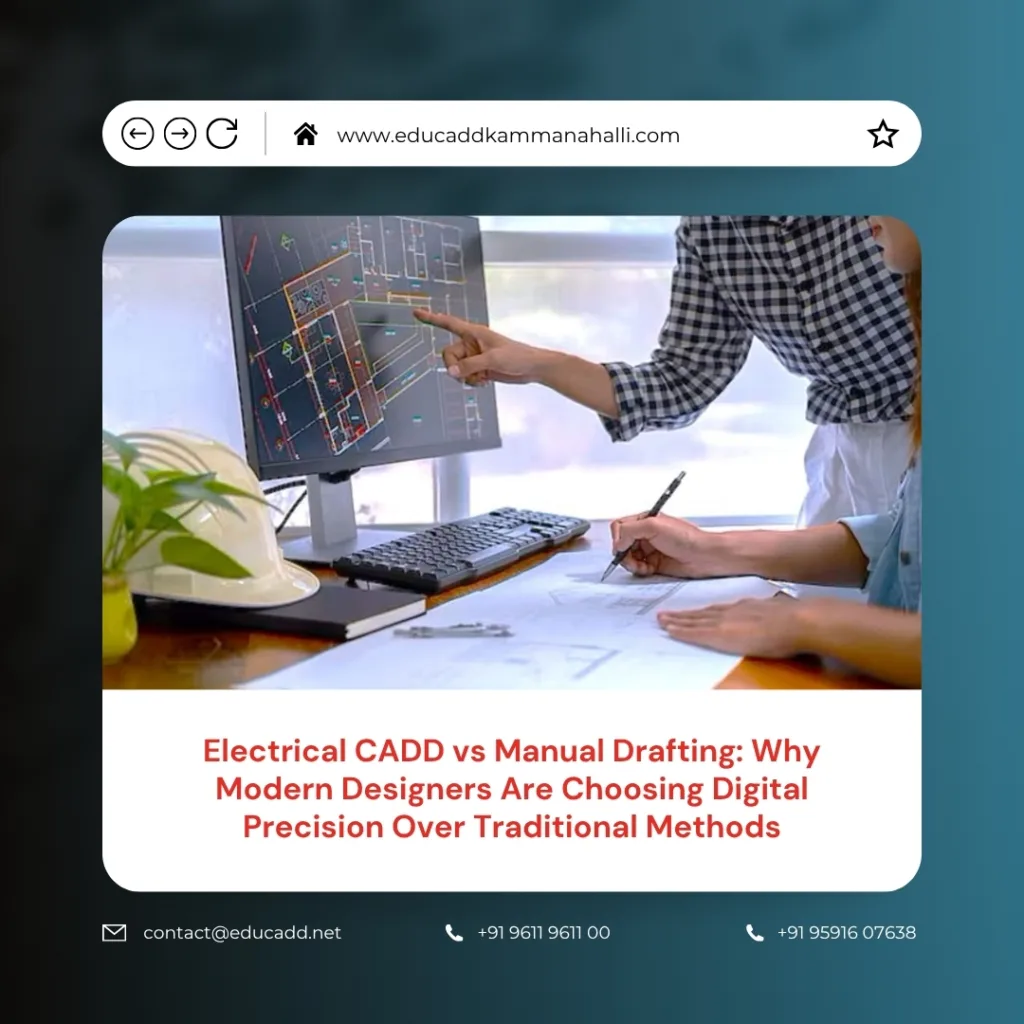
Electrical CADD vs Manual Drafting
As projects become more complex and deadlines become tighter, organizations increasingly prefer professionals who possess Electrical CADD skills. Understanding the differences between Electrical CADD vs Manual Drafting helps students, engineers, and industry professionals recognize the advantages of modern design technologies. This comparison highlights how digital drafting has transformed workflows, improved collaboration, and enhanced project quality across various industries.
Understanding Manual Drafting in Electrical Design
Manual drafting refers to the traditional method of creating electrical drawings by hand using drafting instruments. Engineers and draftsmen use tools such as drawing boards, T-squares, protractors, compasses, and technical pens to prepare detailed electrical plans. Every line, symbol, and annotation must be carefully drawn and checked to ensure accuracy.
For many years, manual drafting served as the foundation of electrical engineering documentation. Electrical layouts, circuit diagrams, cable schedules, and equipment placement drawings were all prepared manually. Although skilled draftsmen could produce highly detailed drawings, the process required substantial effort and concentration. Even a small design modification often demanded significant redrawing, which increased project timelines and labor costs.
Despite its historical importance, manual drafting faces limitations in today’s fast-paced engineering environment. Modern projects demand rapid updates, precise coordination, and seamless data sharing, making traditional methods less practical for large-scale developments.
What Is Electrical CADD and How Does It Work?
Electrical CADD is the use of computer software to create, edit, analyze, and manage electrical drawings and documentation. Specialized software platforms enable engineers and designers to develop highly accurate electrical plans while reducing manual effort. These tools provide extensive libraries of electrical symbols, automated functions, and intelligent design features.
Unlike manual drafting, Electrical CADD allows users to make modifications instantly. Designers can zoom into intricate sections, duplicate components, apply standard templates, and generate multiple views without recreating drawings from scratch. This capability significantly improves design efficiency and consistency.
Modern Electrical CADD software also integrates with engineering calculations, project management systems, and building information modeling platforms. As a result, electrical professionals can create comprehensive designs that support better decision-making throughout the project lifecycle.
Accuracy and Precision: A Major Difference
One of the most significant differences between Electrical CADD and manual drafting is the level of accuracy achieved. Manual drafting relies heavily on human precision. Even experienced draftsmen can encounter minor measurement errors, alignment issues, or inconsistencies in symbols and annotations.
Electrical CADD minimizes these risks through automated precision tools. Designers can define exact dimensions, coordinates, and scales within the software environment. Every element aligns accurately according to project specifications.
The benefits of improved accuracy include:
- Reduced design errors and rework.
- Better compliance with engineering standards and regulations.
When projects involve complex electrical systems, even small inaccuracies can lead to costly mistakes. Therefore, the precision offered by Electrical CADD becomes a critical advantage for engineering organizations.
Speed and Productivity in Design Development
Project deadlines continue to shrink as industries seek faster construction and implementation schedules. In this environment, productivity plays a crucial role in project success. Manual drafting often requires considerable time because every drawing component must be created individually.
Electrical CADD dramatically increases design speed. Engineers can reuse templates, copy standard components, automate repetitive tasks, and update multiple drawing views simultaneously. These capabilities reduce drafting time and allow teams to complete projects more efficiently.
Furthermore, designers can generate revisions quickly without affecting overall drawing quality. Instead of redrawing entire sections, they can modify specific components and automatically update related documentation. This efficiency helps organizations deliver projects on schedule while maintaining high standards of quality.
Handling Design Revisions and Modifications
Engineering projects rarely remain unchanged throughout their lifecycle. Clients frequently request modifications, equipment specifications may change, and regulatory requirements can evolve. Managing these revisions manually presents significant challenges.
In traditional drafting environments, revisions often require extensive erasing and redrawing. This process consumes valuable time and increases the possibility of introducing new errors into the design.
Electrical CADD simplifies revision management. Designers can update drawings within minutes and maintain version histories for future reference. Software systems often include revision tracking features that help teams monitor changes effectively. Consequently, project stakeholders remain informed while ensuring document consistency throughout the design process.
Storage and Document Management Capabilities
Physical drawing storage has always been a challenge in manual drafting environments. Large projects generate hundreds of sheets that require secure storage and organization. Over time, paper drawings may become damaged, misplaced, or difficult to retrieve.
Electrical CADD eliminates many of these concerns through digital document management. Drawings can be stored electronically, organized systematically, and accessed whenever needed. Cloud-based systems further enhance accessibility by enabling authorized users to retrieve files from different locations.
Organizations benefit from improved document security, faster retrieval times, and reduced storage costs. Digital archives also support long-term project maintenance by preserving valuable engineering information for future use.
Collaboration and Team Coordination
Modern engineering projects involve multiple disciplines working together simultaneously. Electrical engineers must coordinate with mechanical engineers, civil engineers, architects, contractors, and project managers. Effective collaboration is essential for project success.
Manual drafting makes collaboration more difficult because physical drawings must be shared and updated manually. Delays often occur when team members work from outdated versions.
Electrical CADD enhances collaboration by enabling real-time sharing of design files. Team members can review drawings, provide feedback, and coordinate changes efficiently. This collaborative environment reduces communication gaps and improves overall project performance.
As engineering projects become increasingly interdisciplinary, digital collaboration tools provide a substantial competitive advantage.
Cost Implications of Both Approaches
Many organizations evaluate drafting methods based on cost considerations. At first glance, manual drafting may appear less expensive because it requires fewer technological investments. However, long-term operational costs often tell a different story.
Manual drafting can increase expenses due to:
- Longer project completion times.
- Higher likelihood of design corrections and revisions.
Electrical CADD requires software licenses and training investments, but it significantly reduces labor hours and error-related costs. Faster project delivery and improved efficiency often generate substantial savings over time.
Consequently, most organizations view Electrical CADD as a strategic investment rather than an operational expense.
Standardization and Consistency in Drawings
Consistency is critical in electrical engineering documentation. Drawings must follow established standards to ensure clarity, compliance, and effective communication among stakeholders.
Manual drafting depends heavily on individual drafting skills. Different draftsmen may produce variations in symbols, line styles, and annotation formats, which can create inconsistencies within project documentation.
Electrical CADD promotes standardization through predefined templates, symbol libraries, and automated formatting tools. These features ensure that all drawings adhere to organizational and industry standards. As a result, project documentation becomes easier to interpret and maintain.
Standardization also supports quality assurance processes and improves client confidence in engineering deliverables.
Learning Curve and Skill Requirements
Both manual drafting and Electrical CADD require technical knowledge and attention to detail. However, the skills needed for each approach differ significantly.
Manual drafting emphasizes hand-drawing techniques, geometric construction, and drafting instrument proficiency. While these skills remain valuable for understanding engineering fundamentals, industry demand has shifted toward digital competencies.
Electrical CADD professionals must understand software functionality, digital workflows, and modern design practices. They also need knowledge of electrical engineering principles to create effective system designs.
Educational institutions and training centers increasingly focus on Electrical CADD because employers seek candidates who can contribute immediately to modern engineering projects.
Industry Demand and Career Opportunities
The employment landscape has changed considerably with the widespread adoption of digital technologies. Organizations across industries now prioritize candidates who possess Electrical CADD expertise.
Electrical CADD professionals find opportunities in sectors such as power distribution, building services, renewable energy, industrial automation, telecommunications, and infrastructure development. Their ability to create accurate digital designs makes them valuable assets to engineering teams.
Although manual drafting knowledge remains useful, most employers consider Electrical CADD proficiency an essential qualification. Individuals who master modern drafting software often enjoy stronger career prospects and greater professional growth opportunities.
Environmental Impact and Sustainability
Sustainability has become an important consideration for businesses worldwide. Traditional drafting methods consume significant quantities of paper, printing materials, and storage resources. Large engineering projects can generate extensive physical documentation throughout their lifecycle.
Electrical CADD supports environmentally responsible practices by reducing dependence on paper-based processes. Digital documentation minimizes printing requirements and decreases resource consumption.
Organizations that adopt digital workflows contribute to sustainability initiatives while simultaneously improving operational efficiency. This combination of environmental responsibility and productivity enhancement strengthens the appeal of Electrical CADD in modern engineering environments.
Future Trends in Electrical Design Technology
Technology continues to reshape the electrical design industry. Electrical CADD platforms increasingly incorporate advanced features such as artificial intelligence, automation, cloud collaboration, and building information modeling integration. These innovations further enhance productivity and design quality.
Future developments will likely enable even greater automation of repetitive tasks, improved design validation, and more sophisticated simulation capabilities. Engineers will benefit from intelligent systems that assist with decision-making and error prevention.
As digital transformation accelerates, Electrical CADD will continue evolving to meet the growing demands of complex engineering projects. Professionals who embrace these technologies will remain well-positioned for future opportunities.
Why Electrical CADD Is Becoming the Preferred Choice
The growing preference for Electrical CADD reflects its ability to address the limitations of traditional drafting methods. Modern projects require speed, accuracy, flexibility, collaboration, and cost efficiency. Electrical CADD delivers these benefits while supporting increasingly sophisticated engineering requirements.
Organizations that adopt Electrical CADD gain competitive advantages through improved productivity, reduced errors, and enhanced project coordination. Designers can focus more on engineering solutions and less on repetitive drafting tasks.
As industries continue embracing digital technologies, Electrical CADD has established itself as an indispensable tool for electrical engineering professionals worldwide.
Conclusion
The comparison between Electrical CADD vs Manual Drafting clearly demonstrates how engineering practices have evolved over time. Manual drafting played a crucial role in the development of electrical engineering and provided the foundation for many modern design standards. However, its limitations in speed, flexibility, collaboration, and document management make it less suitable for today’s demanding project environments.
Electrical CADD offers superior accuracy, faster design development, efficient revision management, enhanced collaboration, and long-term cost benefits. It also supports sustainability initiatives while preparing organizations for future technological advancements. As a result, Electrical CADD has become the preferred choice for engineers, designers, and companies seeking to improve productivity and maintain high-quality standards.
For students and professionals aiming to build successful careers in electrical design, mastering Electrical CADD is no longer optional. It is a valuable skill that opens doors to diverse opportunities and ensures relevance in an increasingly digital engineering landscape.

