
Electrical Design Documentation for Tender & Execution: The Complete Blueprint for Project Success
Electrical Design Tender Documentation forms the backbone of every successful construction and infrastructure project. Whether it is a commercial building, an industrial facility, a residential complex, or a large-scale infrastructure development, accurate and comprehensive documentation ensures that every electrical system is planned, priced, installed, and commissioned without confusion. Electrical design documentation for tender & execution plays a critical role in aligning consultants, contractors, project managers, and clients under one clear technical framework.
Without structured documentation, projects often face cost overruns, technical disputes, delays, and safety risks. On the other hand, well-prepared documentation strengthens transparency during bidding and ensures smooth execution at site. Therefore, understanding the process, components, and best practices of electrical design documentation for tender & execution is essential for engineers, contractors, and project stakeholders.
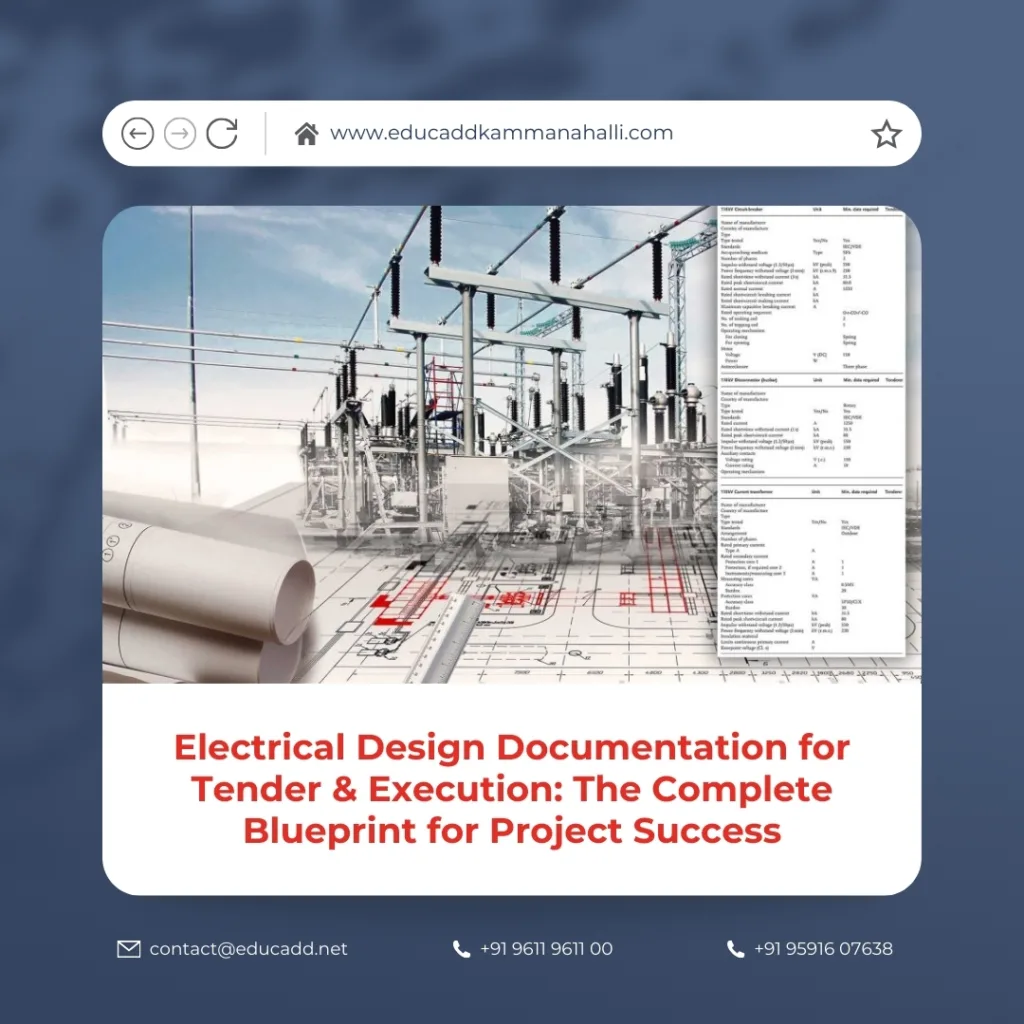
Electrical Design Tender Documentation
In this detailed guide, we will explore every aspect of electrical design documentation for tender & execution, including drawings, specifications, BOQs, compliance standards, coordination processes, and execution guidelines.
1. Understanding Electrical Design Documentation for Tender & Execution
Electrical Design Tender Documentation & execution refers to the complete set of technical drawings, specifications, calculations, schedules, and contractual documents required to invite bids and execute electrical works successfully. It bridges the gap between concept design and on-site implementation.
During the tender stage, documentation must clearly define the scope of work so that contractors can quote accurately. During execution, the same documents guide installation teams and quality inspectors. Therefore, clarity and consistency must be maintained across all documents.
Moreover, documentation must reflect project requirements, statutory codes, and safety regulations. It should eliminate ambiguity. When every cable size, panel rating, and lighting level is defined properly, disputes are minimized. Consequently, project timelines improve and cost control becomes easier.
Electrical design documentation for tender & execution also supports coordination between electrical, mechanical, plumbing, and civil teams. Since modern projects involve integrated systems, documentation must align across disciplines.
2. Importance of Accurate Documentation in Tendering
Tendering is a competitive process. Contractors analyze the documentation to estimate quantities, material specifications, labor costs, and timelines. If electrical design documentation for tender & execution lacks detail, contractors may either overprice the project or underquote and later raise claims.
Accurate documentation ensures fair comparison between bids. When the scope remains identical for all bidders, the evaluation process becomes transparent. Furthermore, clients can select contractors based on technical competence and realistic pricing.
Clear documentation also reduces post-award variations. Since electrical systems involve panels, transformers, cables, lighting, earthing, and backup power systems, even small ambiguities can result in costly changes. Therefore, well-prepared documentation protects both the client and the contractor.
In addition, proper documentation improves financial forecasting. Project budgets become more predictable. As a result, stakeholders gain confidence in project planning.
3. Key Components of Electrical Design Documentation for Tender & Execution
Electrical Design Tender Documentation & execution typically includes several essential components. Each component serves a specific purpose and must align with others.
a. Electrical Drawings – These include single-line diagrams (SLD), layout drawings, panel schedules, cable routing drawings, lighting layouts, and earthing layouts.
b. Technical Specifications – Specifications describe materials, equipment standards, installation methods, and testing procedures.
c. Bill of Quantities (BOQ) – BOQ provides item-wise quantity details for pricing.
d. Load Calculations – These define electrical demand, diversity factors, and transformer sizing.
e. Compliance Documents – These ensure adherence to national and international codes.
Each element must remain consistent. For instance, cable sizes shown in drawings must match the BOQ and calculations. Otherwise, execution challenges arise.
4. Electrical Drawings: The Core Technical Reference
Electrical drawings form the heart of electrical design documentation for tender & execution. They visually communicate the entire system design. Engineers, site supervisors, and contractors rely heavily on these drawings.
Single-line diagrams provide an overview of power distribution. They show transformers, panels, circuit breakers, and feeder connections. Lighting layouts indicate fixture positions and lux levels. Power layouts display socket outlets and equipment connections.
Furthermore, cable routing drawings define pathways and tray systems. Proper routing prevents clashes with HVAC ducts and plumbing lines. Coordination drawings, therefore, become essential in complex buildings.
Clear legends, notes, and revision histories must be included in every drawing. In addition, each drawing must carry a unique identification number for traceability. Proper version control ensures that site teams always use the latest revision.
5. Technical Specifications and Material Standards
While drawings provide visuals, technical specifications define performance expectations. Electrical design documentation for tender & execution must include detailed specifications for cables, switchgear, transformers, lighting fixtures, and earthing systems.
Specifications should mention voltage ratings, insulation types, IP protection classes, short-circuit ratings, and testing standards. Instead of generic descriptions, they must define measurable performance criteria.
Moreover, specifications must align with recognized codes such as IEC or national electrical standards. By doing so, safety and compliance are maintained. Contractors also gain clarity about approved brands or equivalent options.
Precise specifications eliminate quality disputes during execution. When testing standards are clearly mentioned, inspection teams can verify installations objectively.
6. Load Calculations and System Sizing
Load calculation forms a technical backbone of electrical design documentation for tender & execution. It ensures that transformers, generators, cables, and panels are sized correctly.
Engineers calculate connected load, maximum demand, and diversity factors. They evaluate future expansion capacity. Proper calculations prevent system overloading and reduce energy losses.
Additionally, voltage drop calculations help maintain efficiency. If cable lengths are long, voltage drop must remain within permissible limits. Short-circuit calculations ensure protective devices can withstand fault conditions.
Accurate calculations not only enhance safety but also optimize costs. Oversized systems increase capital expenditure, while undersized systems cause failures. Therefore, balanced design is essential.
7. Bill of Quantities and Cost Transparency
The BOQ translates design into measurable quantities. Electrical design documentation for tender & execution must include a detailed BOQ listing cables, conduits, panels, fixtures, and accessories.
Each item should include unit description, quantity, and measurement basis. Clear BOQ structure helps contractors price accurately. Moreover, it supports financial tracking during execution.
When site conditions change, variation orders can be evaluated against BOQ references. Thus, project managers maintain cost control effectively.
Additionally, BOQ items must align with drawings. Cross-verification prevents discrepancies and ensures smooth billing processes.
8. Compliance with Codes and Regulations
Electrical systems must comply with statutory requirements. Electrical design documentation for tender & execution must reference applicable electrical codes, fire safety norms, and energy efficiency standards.
Compliance ensures safety for occupants and maintenance staff. It also prevents legal complications during inspections.
Engineers should clearly specify grounding methods, protection devices, and fire alarm integration as per regulatory guidelines. Proper documentation helps obtain approvals from local authorities.
Furthermore, documentation must address environmental and sustainability considerations. Energy-efficient lighting, power factor correction, and renewable integration enhance long-term performance.
9. Coordination with Other Disciplines
Modern construction projects require multidisciplinary coordination. Electrical design documentation for tender & execution must align with architectural, structural, and mechanical designs.
For example, panel rooms must match structural load capacities. Cable trays should not conflict with HVAC ducts. Lighting layouts must align with ceiling designs.
Regular coordination meetings improve integration. Clash detection software also supports coordination in large projects. When coordination occurs early, rework is minimized.
Therefore, documentation must include updated coordination drawings and combined service layouts.
10. Execution Drawings and Shop Drawings
After tender award, contractors prepare shop drawings based on approved documentation. Electrical design documentation for tender & execution serves as a reference for these drawings.
Shop drawings detail installation methods, support structures, and routing specifics. Consultants review and approve them before site execution.
Clear documentation speeds up approvals. Since execution timelines are tight, delays in drawing approval can impact progress.
Additionally, as-built drawings must be prepared after completion. These drawings reflect actual site conditions and help in future maintenance.
11. Testing, Commissioning, and Documentation Control
Electrical systems require thorough testing before handover. Electrical design documentation for tender & execution must define testing procedures and acceptance criteria.
Testing includes insulation resistance checks, earth resistance measurement, load testing, and functional verification. Commissioning ensures systems operate as intended.
Proper documentation of test results strengthens accountability. Clients receive test certificates and operation manuals.
Moreover, document control systems ensure that all revisions are tracked. Digital documentation platforms improve accessibility and reduce errors.
12. Risk Management and Quality Assurance
Risk management becomes easier when electrical design documentation for tender & execution is comprehensive. Clear documentation reduces ambiguity and prevents unsafe practices.
Quality assurance procedures must be defined in specifications. Inspection checklists help verify installations. Regular audits ensure compliance with approved designs.
Furthermore, risk assessments should identify potential hazards such as short circuits or overload conditions. Preventive design strategies minimize these risks.
Therefore, documentation acts as both a technical and risk management tool.
13. Role of Digital Tools in Documentation
Digital tools have transformed electrical design documentation for tender & execution. Software platforms enable 3D modeling, load simulation, and automated quantity extraction.
Building Information Modeling (BIM) enhances coordination. Engineers can visualize cable routes and detect clashes early.
Cloud-based document management systems improve collaboration. Stakeholders can access updated documents instantly.
Digital workflows also reduce paperwork and enhance version control. As technology advances, documentation becomes more accurate and efficient.
14. Best Practices for Effective Electrical Documentation
To ensure excellence in electrical design documentation for tender & execution, certain best practices should be followed.
First, maintain clarity and consistency across drawings and specifications. Second, perform rigorous cross-checking between BOQ and calculations. Third, update documents promptly when revisions occur.
Additionally, involve experienced engineers during preparation. Peer review enhances quality. Clear communication between design and execution teams strengthens implementation.
Finally, always prioritize safety, compliance, and future maintenance considerations. Comprehensive documentation not only supports construction but also ensures long-term reliability.
Conclusion
Electrical Design Tender Documentation & execution serves as the foundation of every successful electrical project. It ensures transparent tendering, accurate cost estimation, efficient coordination, and safe installation. When documentation is detailed, consistent, and compliant, projects move forward smoothly without unnecessary disputes or delays.
From drawings and specifications to BOQ and commissioning records, every component plays a vital role. Moreover, digital tools have elevated documentation standards, making processes faster and more reliable. By following best practices and maintaining strict quality control, engineers and contractors can deliver projects that meet technical, financial, and safety expectations.
Ultimately, strong electrical design documentation for tender & execution transforms complex engineering concepts into practical, executable systems that power modern infrastructure efficiently and safely.

