
Power Up Your Career with Electrical Estimation Training That Builds Industry-Ready Skills
Introduction
Electrical projects need more than technical knowledge. They also need accurate planning, budgeting, and cost control. This is where Electrical Estimation Training becomes highly valuable. It helps learners understand how to calculate project costs, estimate material needs, and prepare professional electrical estimates.
Today, companies want professionals who can work with both technical drawings and project budgets. Therefore, estimation skills can give electrical engineers and diploma holders an added advantage. With the right training, learners can improve their technical confidence and prepare for real project requirements.
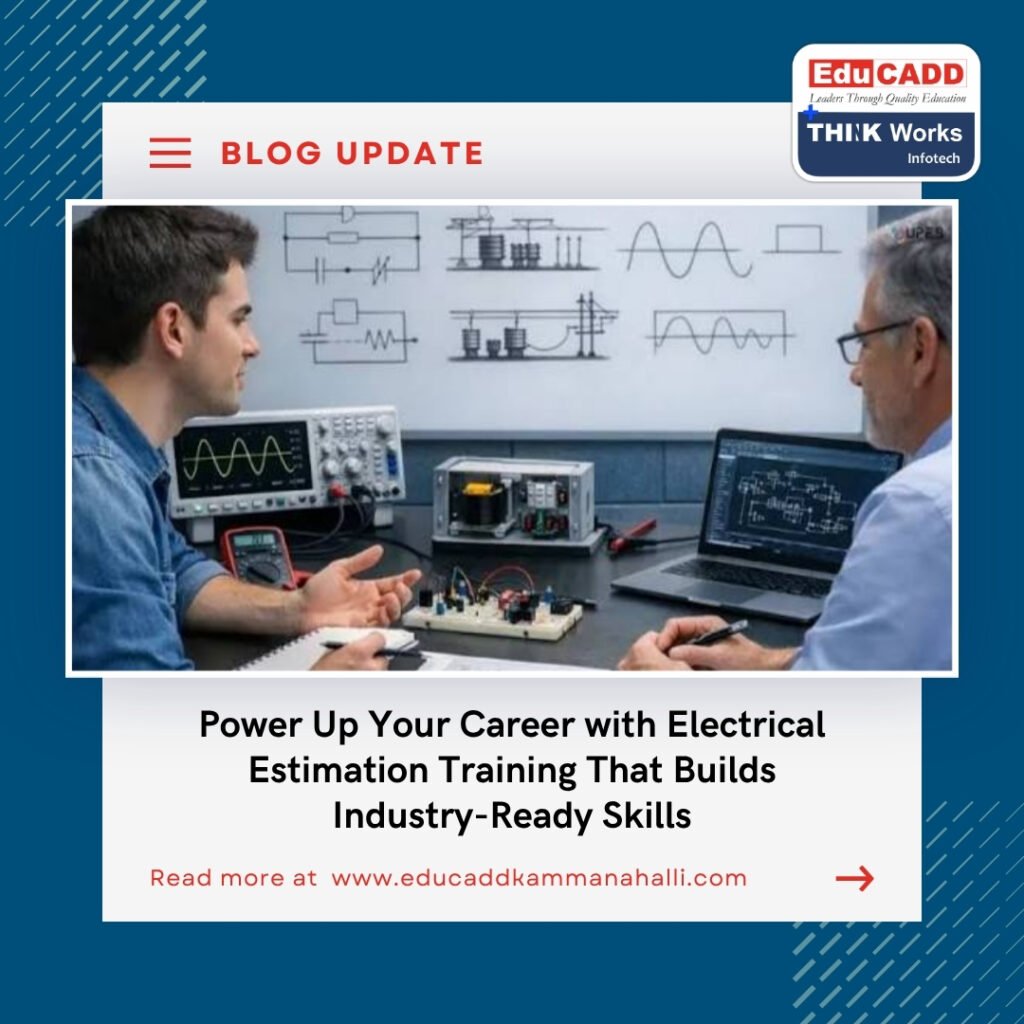
Electrical Estimation Training
Electrical Estimation Training also helps students understand how electrical systems are planned before installation begins. It connects classroom concepts with practical project work. As a result, learners can develop skills that support careers in electrical contracting, construction, consulting, and project management.
What Is Electrical Estimation?
Electrical estimation is the process of calculating the materials, labour, equipment, and other costs required for an electrical project. It starts with understanding the project drawings and specifications. Then, the estimator identifies the required electrical components and calculates their quantities.
A good estimate should be accurate and easy to understand. It should also consider project requirements, material prices, labour costs, wastage, and other expenses. Even a small calculation error can affect the final project budget.
Through Electrical Estimation Training, learners can understand this process step by step. They can learn how to read drawings, prepare quantity lists, calculate costs, and create professional estimates.
The training also introduces learners to common electrical components. These may include cables, conduits, switches, sockets, distribution boards, circuit breakers, lighting fixtures, and earthing materials.
Why Electrical Estimation Skills Matter Today
Electrical construction projects require careful financial planning. Clients want accurate budgets before approving a project. Contractors also need reliable estimates to control expenses and maintain profit margins.
Therefore, skilled electrical estimators play an important role in project planning. Their work supports purchasing, budgeting, tender preparation, and execution.
The demand for these skills can be found across several industries. These include residential construction, commercial buildings, factories, infrastructure projects, and electrical contracting companies.
Professionals who complete Electrical Estimation Training can also understand how technical decisions affect project costs. This broader knowledge can help them communicate better with engineers, contractors, suppliers, and clients.
What Will You Learn in Electrical Estimation Training?
A structured course covers several practical areas. Each topic helps learners build stronger estimation skills.
Key learning areas can include:
- Reading electrical drawings and layouts
- Understanding electrical symbols
- Preparing material quantity estimates
- Calculating cable requirements
- Estimating conduit and wiring materials
- Calculating lighting and power points
- Understanding distribution boards
- Estimating electrical accessories
- Preparing material take-off sheets
- Calculating labour requirements
- Preparing project cost estimates
- Understanding tender documents
- Preparing quotations and bills
- Using estimation software and spreadsheets
- Understanding project-based costing
These topics help learners understand the complete estimation workflow. More importantly, practical exercises allow them to apply each concept.
Learn to Read Electrical Drawings with Confidence
Electrical drawings provide important project information. They show circuits, connections, equipment locations, cable routes, and electrical points.
However, beginners may find these drawings difficult at first. They contain several symbols and technical details. Proper training makes this process easier.
During Electrical Estimation Training, learners can practice reading different types of electrical drawings. They can identify lighting points, power outlets, panels, cables, conduits, and other components.
Once the drawing is understood, the estimator can prepare a material list. This creates a strong connection between design and costing.
Good drawing-reading skills can also reduce estimation errors. Therefore, this skill is essential for anyone who wants to work in electrical estimation.
Master Quantity Take-Off and Material Calculation
Quantity take-off is one of the most important parts of electrical estimation. It involves identifying and measuring the materials required for a project.
For example, an estimator may need to calculate the quantity of cables required for a building. They may also need to calculate conduits, switches, sockets, lighting fixtures, and distribution boards.
A proper quantity take-off should be systematic. The estimator must review the drawings carefully. They should also consider project specifications and installation requirements.
Electrical Estimation Training helps learners develop this practical approach. They can learn how to organize quantities and prepare clear material schedules.
Accurate quantity calculations can reduce material shortages. They can also help prevent unnecessary purchases. As a result, businesses can improve project cost control.
Understand Labour Cost and Project Expenses
Material cost is only one part of an electrical estimate. Labour also has a major impact on the final project cost.
An estimator must understand the work involved in installation. They should consider the number of workers, project duration, installation complexity, and site conditions.
Other project expenses may also need attention. These can include transportation, equipment, testing, wastage, overheads, and contingency costs.
Training helps learners understand how these factors influence the final estimate. It also teaches them to organize costs clearly.
This knowledge becomes useful when preparing quotations for clients. It helps professionals create estimates that are practical and commercially realistic.
Build Skills with Estimation Software
Technology has changed the way electrical projects are estimated. Many companies use digital tools to improve speed and accuracy.
Spreadsheets are commonly used for quantity calculations and cost summaries. Specialized software can also help manage large projects.
Therefore, learners should understand how digital tools support estimation work. Electrical Estimation Training can introduce practical methods for organizing project data digitally.
Software skills can also make repetitive calculations easier. They can help professionals update material prices and quantities quickly.
However, software alone does not create an accurate estimate. The professional must understand the technical requirements first. Then, digital tools can make the process faster and more efficient.
Gain Practical Project Experience
Theory provides a foundation. Practical experience develops confidence.
A strong Electrical Estimation Training program should include project-based learning. Learners should work with sample drawings and realistic project requirements.
For example, a learner could estimate the electrical requirements for a residential building. They may calculate lighting points, power points, cables, conduits, switches, and distribution boards.
Another exercise could involve a commercial building. Such a project may include more circuits, larger electrical loads, and additional equipment.
These practical activities help learners understand how estimation works in real situations. They also teach learners to identify errors and improve their calculations.
Who Can Benefit from Electrical Estimation Training?
Electrical estimation skills can benefit different types of learners and professionals.
The training can be useful for:
- Electrical engineering students
- Diploma holders
- Electrical engineers
- Site engineers
- Electrical contractors
- Project engineers
- Quantity surveyors
- Construction professionals
- CAD professionals
- MEP professionals
- Professionals planning a career change
Fresh graduates can use the training to strengthen their resumes. Working professionals can use it to expand their technical responsibilities.
Similarly, contractors can improve their ability to prepare project quotations. Therefore, the benefits extend beyond entry-level careers.
Career Opportunities After Electrical Estimation Training
Electrical estimation can support several career paths. The exact role depends on experience, qualifications, and technical skills.
Possible job roles include:
- Electrical Estimator
- Junior Electrical Estimator
- Electrical Quantity Surveyor
- Estimation Engineer
- Electrical Project Engineer
- MEP Estimation Engineer
- Electrical Costing Engineer
- Tendering Engineer
- Electrical Planning Engineer
Professionals may work with construction companies, electrical contractors, engineering consultancies, infrastructure companies, and MEP firms.
With experience, professionals can take responsibility for larger projects. They may also become involved in tender management, budgeting, procurement, and project planning.
How Training Can Improve Your Professional Value
Technical education is important. Yet, employers often look for practical skills that can be used immediately.
Electrical Estimation Training can help bridge the gap between academic knowledge and workplace requirements. Learners can understand how electrical concepts influence project costs.
They can also learn how to communicate technical information clearly. This matters when working with clients, suppliers, contractors, and project teams.
Furthermore, estimation knowledge can support better decision-making. Professionals can compare material options, identify cost differences, and understand project budgets.
As a result, estimation skills can become a valuable addition to an electrical professional’s career profile.
What Makes Good Electrical Estimation Training?
Not every course provides the same learning experience. Learners should look for training that focuses on practical skills.
A strong program should include:
- Experienced trainers
- Practical project exercises
- Electrical drawing interpretation
- Quantity take-off practice
- Material costing
- Labour costing
- Tender preparation
- Quotation preparation
- Software-based estimation
- Realistic project examples
It is also useful to choose training that explains concepts in a simple manner. Clear examples can make complex calculations easier to understand.
Practical assignments are equally important. They allow learners to apply what they have learned.
Tips to Become Better at Electrical Estimation
Consistent practice can improve estimation skills. Beginners should start with simple projects and gradually move toward complex buildings.
Always study the drawings before calculating quantities. Keep material descriptions clear. Maintain organized calculation sheets.
You should also check your calculations more than once. Compare quantities with drawings and project specifications.
Keep track of current material prices whenever possible. Market prices can change, so estimates should use reliable and updated information.
Finally, improve your software skills. Digital tools can save time and reduce repetitive work.
Why Practical Learning Gives You an Advantage
The electrical industry values accuracy. A theoretical understanding alone may not be enough for professional estimation work.
Practical learning allows students to experience common project situations. They can work with drawings, quantities, rates, and costing sheets.
Electrical Estimation Training can therefore help learners develop a more complete understanding of electrical projects.
It also allows them to learn from mistakes. When learners identify an incorrect quantity or missing component, they understand how to avoid similar errors later.
This hands-on approach can improve both technical knowledge and professional confidence.
Take the Next Step Toward an Electrical Estimation Career
Electrical estimation combines engineering knowledge, calculation, planning, and commercial understanding. It plays an important role in the success of construction and infrastructure projects.
Professionals with strong estimation skills can support better budgeting and project planning. They can also communicate more effectively with project teams.
Choosing Electrical Estimation Training can be a practical step for students and professionals who want to strengthen their career skills.
The right course should provide practical exercises, industry-focused knowledge, and exposure to real project workflows. With consistent learning and practice, you can build a stronger foundation for a career in electrical estimation and project management.
Conclusion
Electrical projects depend on accurate planning. Estimation helps transform technical drawings into realistic project budgets. It also supports purchasing, tendering, execution, and cost control.
Electrical Estimation Training gives learners an opportunity to understand this complete process. From drawing interpretation to quantity take-off and costing, each skill has practical value.
For electrical engineers, diploma holders, contractors, and aspiring professionals, these skills can open new career possibilities. With practical training, regular practice, and strong technical knowledge, you can become more confident in handling electrical estimation tasks.
The electrical industry continues to evolve. Therefore, professionals who combine technical expertise with estimation skills can stay better prepared for changing project requirements. Start building these valuable skills today and take a confident step toward a career-ready future in electrical estimation.

