
Engineering Drawings Explained for Beginners: A Complete Guide to Reading, Understanding, and Creating Technical Blueprints
Engineering Drawings for Beginners of every successful construction, manufacturing, and product design project. From towering skyscrapers to precision mechanical components, professionals rely on engineering drawings to communicate ideas clearly and accurately. Without them, teams would struggle to interpret dimensions, materials, tolerances, and assembly instructions.
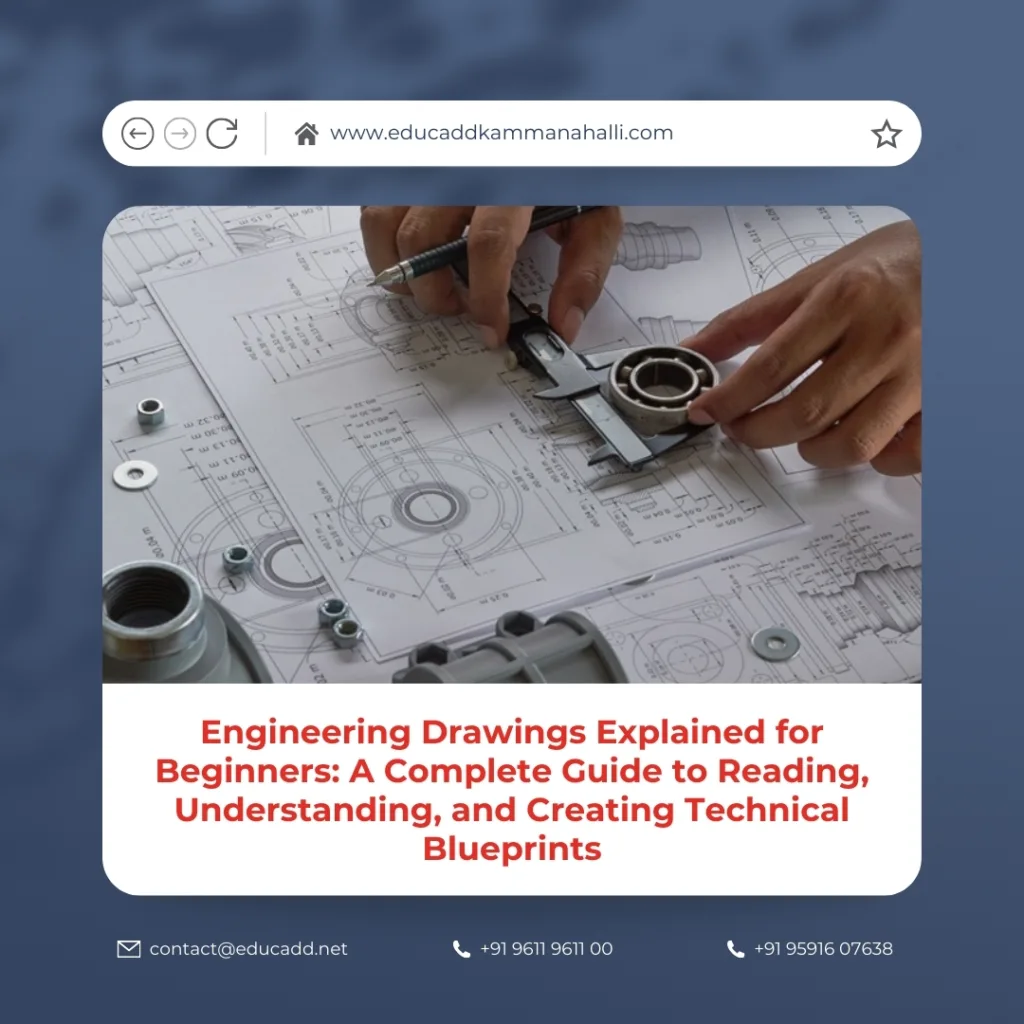
Engineering Drawings for Beginners
Engineering Drawings for Beginners may look complex and overwhelming. However, once you understand the structure, symbols, and standards, everything starts to make sense. This comprehensive guide explains engineering drawings in a clear and practical way. It breaks down essential concepts, tools, types, and techniques so that you can confidently read and create technical blueprints. By the end of this guide, you will understand how engineering drawings translate ideas into reality.
1. What Are Engineering Drawings?
Engineering Drawings for Beginners are technical representations that describe the shape, size, materials, and specifications of an object or structure. They communicate detailed information that words alone cannot convey. Designers, engineers, architects, and manufacturers use engineering drawings to ensure accuracy and consistency.
Unlike artistic sketches, engineering drawings follow strict rules and standardized conventions. Every line, symbol, and dimension carries specific meaning. For example, solid lines represent visible edges, while dashed lines show hidden features. Dimensions define the exact size of components. Notes clarify materials, finishes, and manufacturing processes.
Engineering drawings eliminate ambiguity. They ensure that everyone involved in a project understands the same details. As a result, errors decrease and efficiency improves. Beginners should first recognize that engineering drawings serve as a universal technical language.
2. The Importance of Engineering Drawings in Industry
Engineering drawings play a critical role in multiple industries. Construction companies rely on them to build safe structures. Manufacturing firms use them to produce accurate parts. Automotive and aerospace industries depend on engineering drawings for high precision.
Without engineering drawings, production teams would rely on assumptions. This approach would cause costly mistakes and safety risks. Instead, technical drawings define every measurement and specification clearly. They reduce confusion between designers and production teams.
Furthermore, Engineering Drawings for Beginners help maintain quality standards. Inspectors compare finished products against original drawings. If a component does not match specifications, corrections take place immediately. Therefore, engineering drawings support quality control and regulatory compliance.
In addition, engineering drawings document project details for future reference. Maintenance teams use them to repair or upgrade systems. Because of this, engineering drawings provide long-term value beyond initial production.
3. Types of Engineering Drawings
Different industries use different types of engineering drawings. However, the core purpose remains the same: clear technical communication.
First, mechanical drawings describe machine parts and assemblies. They include detailed dimensions and tolerances.
Second, architectural drawings represent buildings and infrastructure. These engineering drawings show floor plans, elevations, and sections.
Third, electrical drawings illustrate wiring systems, circuits, and power distribution. Symbols represent switches, transformers, and components.
Fourth, civil drawings focus on roads, bridges, and land development projects. They include topographic and structural details.
Finally, structural drawings highlight load-bearing elements such as beams and columns.
Each type of engineering drawing uses specific standards. However, they all share common principles such as scale, dimensioning, and line types. Beginners should explore these categories to understand industry applications.
4. Basic Elements of Engineering Drawings
Every engineering drawing includes several essential elements. Understanding these components helps beginners interpret information accurately.
Title Block: The title block appears at the bottom corner. It contains the drawing name, scale, date, and author. It also includes revision history.
Drawing Scale: Scale defines the ratio between the drawing and real-life size. For example, 1:100 means one unit on paper equals 100 units in reality.
Lines: Different lines convey different meanings. Thick lines represent visible edges. Dashed lines show hidden parts. Centerlines indicate symmetry.
Dimensions: Dimensions specify exact measurements. They include length, width, height, and diameter.
Notes and Symbols: Symbols represent standardized components. Notes provide additional instructions.
By recognizing these elements, beginners can read engineering drawings with greater confidence.
5. Understanding Drawing Views and Projections
Engineering drawings often show objects from multiple perspectives. These views ensure complete understanding of complex shapes.
The most common method is orthographic projection. It presents front, top, and side views separately. This technique displays accurate dimensions without distortion.
Another method is isometric projection. It shows a three-dimensional representation on a two-dimensional surface. Although dimensions are not exact, visualization improves.
Section views reveal internal features by cutting through an object. These engineering drawings help clarify hidden details.
Detail views enlarge small features for better clarity.
By learning projection methods, beginners can visualize components accurately. Consequently, interpretation errors decrease significantly.
6. Dimensioning and Tolerancing in Engineering Drawings
Dimensioning defines the size and location of features. Proper dimensioning ensures that parts fit together correctly. Engineers place dimensions strategically to avoid confusion.
Tolerancing specifies allowable variations in measurements. For example, a shaft may measure 50 mm ±0.02 mm. This tolerance allows minor variation while maintaining functionality.
Engineering drawings use standardized symbols to represent tolerances. Geometric Dimensioning and Tolerancing (GD&T) provides precise control over form, orientation, and position.
Without tolerancing, manufacturing would become impractical. No process achieves absolute perfection. Therefore, engineering drawings define acceptable limits. Beginners must understand that dimensioning and tolerancing ensure both accuracy and practicality.
7. Standard Symbols and Conventions
Engineering drawings use internationally recognized symbols. These symbols reduce language barriers and improve clarity.
For instance, surface finish symbols indicate roughness requirements. Welding symbols describe joint types and sizes. Electrical diagrams use standardized circuit symbols.
Organizations such as ISO and ANSI establish these standards. By following conventions, engineers ensure consistency across projects.
Beginners should study commonly used symbols. With practice, recognizing them becomes easier. As familiarity grows, reading engineering drawings becomes faster and more intuitive.
8. Tools Used to Create Engineering Drawings
Traditionally, engineers created drawings using drafting boards, pencils, and rulers. Today, digital tools dominate the industry.
Computer-Aided Design (CAD) software enables precise and efficient drawing creation. Programs such as AutoCAD and SolidWorks help engineers design complex models. These tools automatically generate engineering drawings from 3D models.
Digital platforms improve accuracy and collaboration. Teams can share files instantly and update revisions quickly. Moreover, software reduces manual calculation errors.
Despite technological advances, understanding manual drafting principles remains valuable. Beginners should learn both traditional and digital methods to build strong foundational skills.
9. Reading Engineering Drawings Step by Step
When reviewing engineering drawings, follow a systematic approach. First, check the title block. Identify the drawing name and scale.
Next, examine the overall views. Understand the object’s shape and orientation.
Then, analyze dimensions carefully. Confirm measurements and tolerances.
After that, review notes and symbols. Pay attention to materials and finishes.
Finally, verify revision history. Ensure that you use the latest version.
This structured process prevents oversight. Over time, beginners develop confidence and speed while interpreting engineering drawings.
10. Common Mistakes Beginners Make
Beginners often overlook scale. Misinterpreting scale leads to incorrect measurements.
Another common mistake involves ignoring tolerances. Even small variations can affect assembly.
Some beginners focus only on one view. However, engineering drawings require analysis of multiple perspectives.
Additionally, misunderstanding symbols causes confusion. Therefore, studying standard conventions is essential.
By recognizing these mistakes early, learners can improve quickly and build strong technical understanding.
11. The Role of Engineering Drawings in Project Lifecycle
Engineering drawings support every stage of a project. During the design phase, engineers use them to develop concepts. During production, teams rely on them for fabrication.
Quality control departments compare final products with engineering drawings. Maintenance teams reference them for repairs.
Furthermore, regulatory authorities review engineering drawings for compliance. Because of this, drawings must remain clear and accurate.
From start to finish, engineering drawings act as the backbone of technical projects.
12. How to Start Creating Engineering Drawings
Beginners should begin with simple objects. Practice drawing basic shapes using correct line types and dimensions.
Next, learn projection techniques. Create front, top, and side views.
After mastering basics, explore CAD software. Start with simple 2D drafting before moving to 3D modeling.
Consistency matters. Always follow standards and maintain clarity. Engineering drawings must communicate effectively. Therefore, neatness and precision remain essential.
Regular practice strengthens understanding and technical accuracy.
13. Future Trends in Engineering Drawings
Technology continues to transform engineering drawings. 3D modeling and Building Information Modeling (BIM) integrate design and data.
Cloud-based collaboration improves teamwork across locations. Artificial intelligence assists with design validation.
Despite these advancements, fundamental drawing principles remain unchanged. Engineers still depend on clear documentation.
As industries evolve, engineering drawings will integrate more digital intelligence. However, their core purpose will continue to guide design and production.
14. Why Mastering Engineering Drawings Matters
Mastering engineering drawings opens career opportunities in design, construction, and manufacturing. Employers value professionals who can interpret technical documents accurately.
Strong drawing skills enhance problem-solving abilities. They improve communication between teams.
Moreover, engineering drawings build technical confidence. When you understand drawings, you understand how products and structures come together.
For beginners, investing time in learning engineering drawings creates long-term professional advantages.
Conclusion
Engineering Drawings for Beginners represent far more than technical sketches. They serve as the universal language of engineering and construction. Through standardized symbols, dimensions, projections, and tolerances, engineering drawings transform ideas into precise instructions.
Although beginners may initially find engineering drawings complex, consistent study and practice simplify the process. By understanding core elements, learning projection methods, and applying dimensioning standards, anyone can develop strong technical interpretation skills.
In every industry, from manufacturing to architecture, engineering drawings ensure accuracy, efficiency, and safety. As technology advances, digital tools enhance drawing capabilities. Nevertheless, fundamental principles remain essential.
Mastering engineering drawings equips you with the ability to communicate ideas clearly and confidently. With dedication and practical application, you can turn technical concepts into tangible results.

