
Master Structural Excellence with ETABS Certification: Build Smarter, Design Stronger
The construction industry is evolving rapidly with the adoption of advanced structural engineering software. Among the most trusted tools used by structural engineers worldwide, ETABS has become a preferred choice for designing and analyzing buildings with precision. An ETABS Certification Course Training equips civil engineering students with practical skills that align with industry expectations and prepare them for real-world structural engineering projects. As infrastructure development continues to expand globally, professionals with ETABS expertise are in high demand. This blog explains the importance of ETABS Certification, its benefits, career opportunities, essential learning modules, and how it helps students build a successful career in structural engineering.
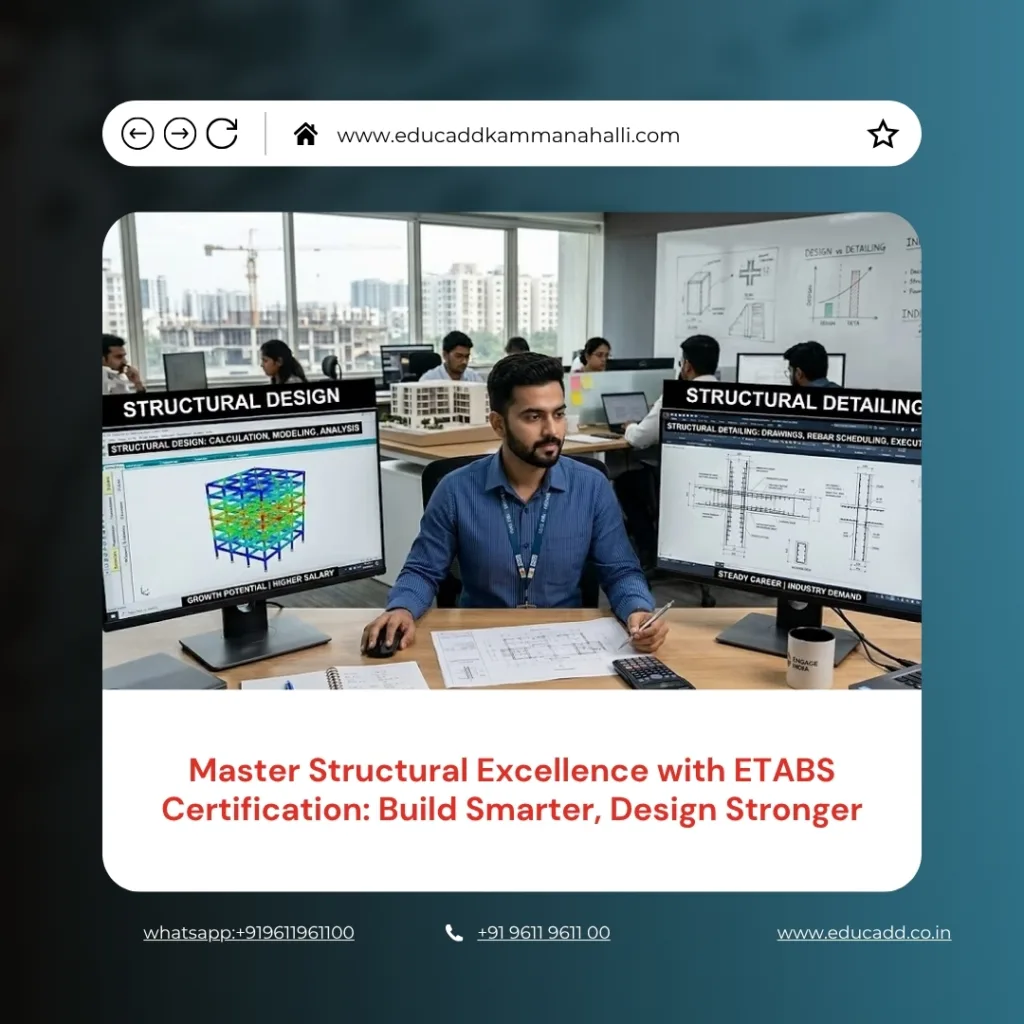
ETABS Certification Course Training
Why ETABS Certification Matters in Modern Structural Engineering
Structural engineering has transformed significantly with the introduction of intelligent software solutions. ETABS Certification enables civil engineering students to understand how modern buildings are analyzed and designed using professional engineering tools. Unlike traditional manual calculations, ETABS simplifies complex structural computations while improving design accuracy. Students who complete ETABS Certification gain practical knowledge that bridges the gap between academic concepts and industry applications.
Furthermore, employers value candidates who possess software expertise because they require minimal training after recruitment. As a result, certified professionals often stand out during campus placements and job interviews.
Understanding the Fundamentals of ETABS Software
ETABS is a specialized structural analysis and building design software developed for multi-story structures. It allows engineers to create three-dimensional models, apply loads, analyze structural behavior, and generate detailed reports. During ETABS Certification training, students learn how beams, columns, slabs, shear walls, and foundations interact under different loading conditions. Besides simplifying calculations, the software provides graphical visualizations that improve design understanding. Consequently, learners develop confidence while working on complex engineering projects. Strong software knowledge also improves technical decision-making and reduces design errors during project execution.
Core Skills Developed Through ETABS Certification
An ETABS Certification program focuses on developing practical engineering skills rather than theoretical concepts alone. Students learn structural modeling, load calculations, seismic analysis, wind analysis, design validation, and report generation. They also understand relevant design codes used in engineering projects. Practical assignments strengthen analytical thinking and encourage problem-solving abilities.
Moreover, regular project work enhances software proficiency while improving confidence. Since employers seek candidates with practical exposure, these skills significantly increase employability. Therefore, ETABS Certification becomes an essential qualification for aspiring structural engineers.
Learning Structural Modeling with Industry Standards
Structural modeling forms the foundation of every successful engineering project. ETABS Certification teaches students how to create accurate digital models of residential, commercial, and industrial buildings. Every structural element must be modeled correctly to achieve reliable analysis results. Students learn grid creation, member properties, material definitions, floor systems, and load assignments using industry-standard methods. Additionally, they understand how incorrect modeling affects structural performance. Practical exercises allow learners to identify mistakes and improve modeling efficiency. Consequently, students become capable of developing professional structural models suitable for real engineering applications.
Mastering Structural Analysis for Safe Building Design
Safety remains the highest priority in structural engineering. ETABS Certification introduces students to various structural analysis techniques that evaluate building performance under multiple loading conditions. Learners perform dead load, live load, wind load, earthquake load, and combination load analysis according to engineering standards. They also interpret bending moments, shear forces, axial loads, displacement, and drift results.
Furthermore, visualization tools help students understand structural behavior more effectively. Practical interpretation of analysis reports enables future engineers to design safer and more economical buildings while meeting regulatory requirements.
Seismic and Wind Load Analysis Using ETABS
Modern buildings must withstand natural forces that may affect structural stability. ETABS Certification provides comprehensive training in seismic and wind load analysis based on national and international design codes. Students learn how earthquakes influence structural response and how wind pressure impacts tall buildings. They also understand response spectrum analysis, dynamic analysis, and load combinations for various structural systems. Regular practice improves accuracy while strengthening conceptual understanding. Consequently, certified learners become well-prepared to participate in projects requiring earthquake-resistant and wind-resistant structural design.
Designing Reinforced Concrete Structures Efficiently
Reinforced concrete structures dominate today’s construction industry because of their strength and durability. ETABS Certification helps students design reinforced concrete beams, columns, slabs, and shear walls using optimized engineering methods. The software automatically checks member adequacy and identifies sections requiring modification. Students also learn reinforcement detailing and design optimization for material efficiency. Besides reducing manual effort, ETABS minimizes calculation errors and accelerates project completion. Therefore, certified students acquire practical experience that closely matches professional engineering practices followed across the construction sector.
Importance of Practical Projects During ETABS Certification
Practical learning plays a vital role in mastering engineering software. ETABS Certification emphasizes project-based training where students design complete building structures from start to finish. These projects simulate real construction scenarios and encourage independent problem-solving. Students prepare structural models, apply loading conditions, perform analysis, optimize designs, and generate engineering reports.
Moreover, instructors provide valuable feedback that improves technical understanding. By completing multiple projects, learners develop confidence and become familiar with professional workflows. This practical exposure significantly strengthens their readiness for industry challenges.
Career Opportunities After ETABS Certification
The demand for structural engineering professionals continues to grow as urban development expands worldwide. ETABS Certification opens opportunities in structural design firms, infrastructure companies, construction organizations, engineering consultancies, real estate developers, and government departments. Certified professionals may work as Structural Design Engineers, Civil Design Engineers, BIM Structural Modelers, Structural Analysts, Project Engineers, or Design Consultants.
Furthermore, software expertise supports career advancement into senior technical positions over time. Employers recognize ETABS Certification as evidence of practical competence, making certified candidates highly competitive in today’s engineering job market.
How ETABS Certification Supports Higher Education and Research
Students planning postgraduate education also benefit significantly from ETABS Certification. Research involving structural dynamics, earthquake engineering, high-rise buildings, and advanced construction technologies frequently requires structural analysis software. ETABS enables students to validate research findings through simulation and analytical modeling. Additionally, software proficiency supports academic projects, dissertations, and technical publications. Universities increasingly encourage practical software knowledge because it complements theoretical learning. Consequently, ETABS Certification strengthens both academic performance and future research capabilities for aspiring civil engineers.
Industry Demand for ETABS Certified Professionals
Rapid urbanization has increased the need for qualified structural engineers capable of designing safe and sustainable buildings. Construction companies actively seek professionals who possess ETABS Certification because software expertise reduces project timelines and improves design accuracy. Engineering consultants also prefer candidates who can immediately contribute to ongoing projects without extensive training. Besides technical competence, certified professionals demonstrate commitment to continuous learning and professional development. Therefore, obtaining ETABS Certification significantly improves employability while increasing long-term career stability in the construction industry.
Tips to Succeed in ETABS Certification Training
Success in ETABS Certification depends on consistent practice and conceptual understanding. Students should first strengthen their knowledge of structural engineering fundamentals before learning software operations. Regular practice with different building models improves confidence and analytical skills.
Additionally, reviewing design codes helps learners understand engineering standards more effectively. Participating in live projects and solving practical assignments further enhances software proficiency. Asking questions during training and continuously exploring advanced software features also contribute to long-term success. Persistent learning eventually transforms beginners into competent structural design professionals.
Building a Successful Engineering Career with ETABS Certification
An ETABS Certification Course Training serves as more than a software qualification because it prepares students for the realities of modern structural engineering. Civil engineering students gain valuable technical expertise, improve analytical thinking, and develop industry-relevant practical skills through comprehensive training. From structural modeling and analysis to reinforced concrete design and seismic evaluation, every learning module contributes to professional growth.
As construction technologies continue advancing, certified professionals remain well-positioned for rewarding career opportunities. Investing in ETABS Certification today creates a strong foundation for a successful future in structural engineering and enables students to contribute confidently to safe, innovative, and sustainable building projects.
Conclusion
ETABS Certification Course Training is an excellent investment for civil engineering students who aspire to build a successful career in structural engineering. It combines theoretical knowledge with practical software skills, enabling learners to analyze, design, and optimize building structures with confidence. As the construction industry increasingly relies on digital engineering tools, professionals with ETABS expertise enjoy better career prospects and greater industry recognition.
Moreover, hands-on training, real-world projects, and exposure to current design standards prepare students to meet professional expectations from the very beginning of their careers. By earning an ETABS Certification, students not only strengthen their technical capabilities but also position themselves as valuable assets in the evolving world of structural design and construction.

