
The Critical Role of Accuracy: Importance of Dimensioning in Mechanical Drawings
The Importance of Mechanical Dimensioning Drawings cannot be overstated in modern engineering and manufacturing. Mechanical drawings serve as the primary language of engineers, designers, machinists, and manufacturers. Without clear dimensions, even the most detailed sketch becomes incomplete and unreliable. Dimensioning transforms a simple drawing into a precise technical instruction that guides production, inspection, and assembly. It eliminates ambiguity, reduces costly errors, and ensures that every component fits and functions as intended.
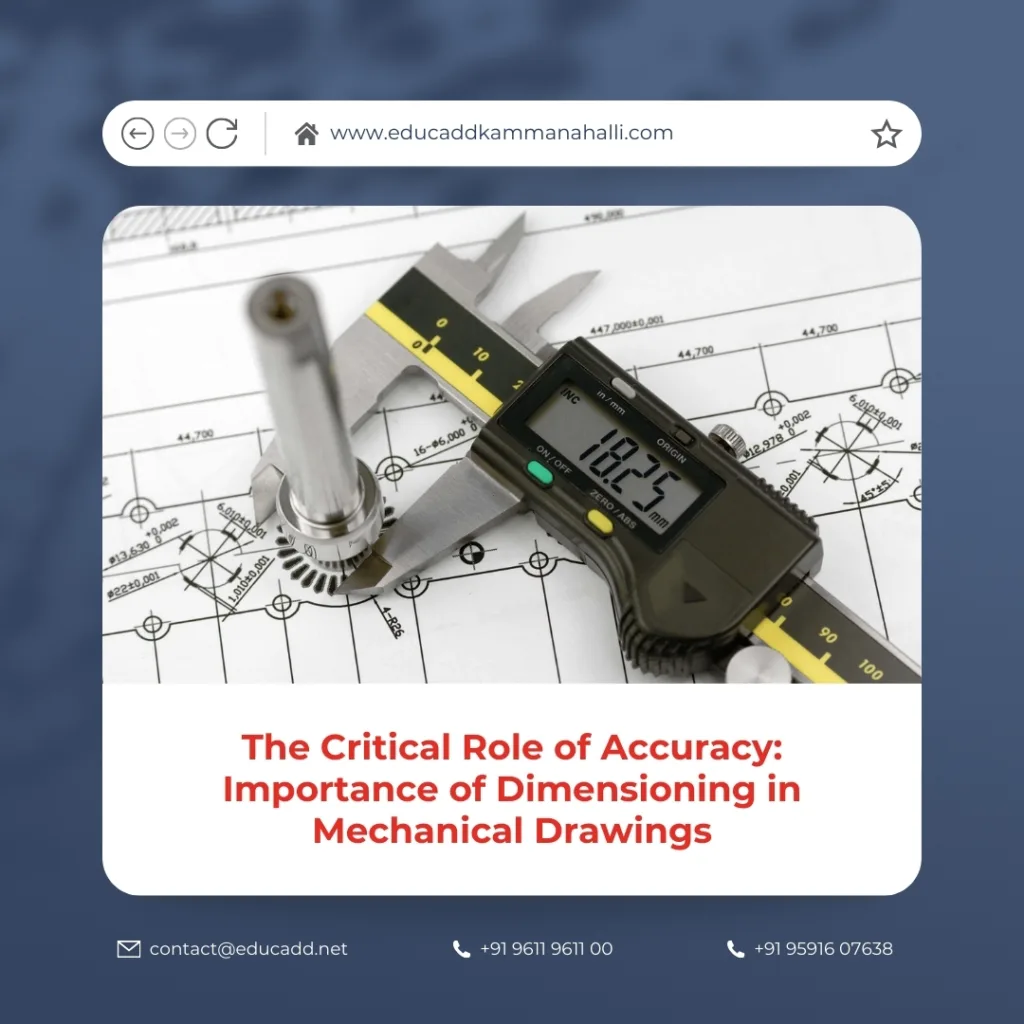
Importance of Mechanical Dimensioning
When professionals understand the Importance of Dimensioning in Mechanical Drawings, they create designs that move smoothly from concept to production. In this comprehensive guide, you will explore how dimensioning influences accuracy, communication, manufacturing efficiency, quality control, cost reduction, safety, and global standardization.
1. Foundation of Technical Communication
The Importance of Mechanical Dimensioning Drawings begins with communication. Mechanical drawings act as a bridge between the design team and the production floor. While shapes and outlines show geometry, dimensions provide measurable data. They specify length, width, height, diameter, angle, and depth. Without them, manufacturers would rely on assumptions, which often lead to incorrect parts.
Clear dimensioning ensures that everyone interprets the drawing the same way. Designers express their intent precisely, and machinists understand the exact requirements. As a result, production teams avoid confusion and rework. Furthermore, effective dimensioning supports collaboration across departments. Engineers, inspectors, and quality managers can verify specifications without guesswork. Therefore, the Importance of Dimensioning in Mechanical Drawings lies in its ability to create a universal technical language that eliminates uncertainty.
2. Ensuring Manufacturing Accuracy
Manufacturing accuracy depends heavily on proper dimensioning. Machines such as lathes, milling machines, and CNC systems rely on precise numerical input. If a drawing lacks accurate dimensions, operators cannot program machines correctly. Consequently, parts may fail to meet specifications.
The Importance of Mechanical Dimensioning Drawings becomes evident when producing high-precision components. For example, even a small deviation of 0.1 mm can affect performance in aerospace or automotive systems. Accurate dimensions guide machinists in selecting tools, setting tolerances, and verifying output. Additionally, consistent dimensioning reduces trial-and-error processes. When measurements are clear and complete, production runs proceed smoothly. This reliability saves both time and materials, strengthening overall operational efficiency.
3. Defining Tolerances and Limits
Dimensioning does not only specify size; it defines allowable variation. Tolerances indicate how much a dimension may vary without affecting functionality. The Importance of Dimensioning in Mechanical Drawings increases when tolerances are applied properly because they determine product reliability.
Engineers assign tolerances based on function and fit. Tight tolerances improve precision but increase manufacturing costs. On the other hand, loose tolerances reduce costs but may compromise performance. Through balanced dimensioning, designers achieve optimal functionality. Clear tolerance information also helps quality inspectors measure parts accurately. Therefore, the Importance of Dimensioning in Mechanical Drawings extends beyond measurement; it directly influences quality control and performance standards.
4. Supporting Proper Assembly
Mechanical systems often consist of multiple interconnected components. If one part is incorrectly dimensioned, the entire assembly may fail. The Importance of Dimensioning in Mechanical Drawings becomes critical during assembly processes.
Accurate dimensions ensure correct alignment, spacing, and fit between parts. For instance, holes must align precisely with bolts or shafts. If dimensions are incorrect, workers may struggle during assembly, leading to delays or damage. Proper dimensioning reduces the need for adjustments or modifications. Moreover, it improves workflow efficiency because technicians assemble components without hesitation. Thus, dimensioning plays a key role in ensuring that complex systems function as designed.
5. Minimizing Production Errors
Production errors often arise from unclear or incomplete drawings. The Importance of Dimensioning in Mechanical Drawings lies in preventing such costly mistakes. When dimensions are logically placed and clearly labeled, operators interpret instructions accurately.
Ambiguous dimensioning may result in misalignment, incorrect hole placement, or improper part thickness. These errors waste materials and increase production costs. However, well-organized dimensioning minimizes risk. It reduces misunderstandings and prevents repeated manufacturing cycles. Additionally, consistent dimensioning standards improve workflow reliability. By prioritizing the Importance of Dimensioning in Mechanical Drawings, organizations protect themselves from unnecessary financial losses.
6. Enhancing Quality Control Processes
Quality control teams rely on dimensions to inspect and verify parts. Without clearly defined measurements, inspection becomes impossible. The Importance of Dimensioning in Mechanical Drawings is directly connected to product validation.
Inspectors use tools such as calipers, micrometers, and coordinate measuring machines to check compliance. They compare actual measurements with specified dimensions. If discrepancies appear, they identify defects early. As a result, companies prevent defective products from reaching customers. Furthermore, accurate dimensioning supports traceability. When drawings provide detailed measurements, quality records remain consistent and transparent. Therefore, dimensioning strengthens accountability and customer satisfaction.
7. Facilitating Standardization and Compliance
Engineering industries follow international standards such as ISO and ASME. The Importance of Dimensioning in Mechanical Drawings aligns closely with these regulatory frameworks. Standardized dimensioning practices ensure consistency across projects and countries.
When engineers follow recognized standards, global manufacturers can interpret drawings correctly. This consistency promotes international collaboration and trade. Moreover, compliance with standards reduces legal risks. Organizations demonstrate professionalism by maintaining uniform dimensioning methods. Consequently, the Importance of Dimensioning in Mechanical Drawings supports both technical excellence and regulatory adherence.
8. Improving Design Clarity and Simplicity
Clarity remains a central aspect of good design. Overcrowded or poorly arranged dimensions create confusion. The Importance of Dimensioning in Mechanical Drawings includes presenting measurements in a logical and readable manner.
Designers must avoid duplication and unnecessary complexity. Instead, they should group related dimensions and maintain consistent spacing. Clear layouts improve readability and reduce interpretation time. In addition, simplified dimensioning enhances collaboration during design reviews. Engineers can quickly identify potential improvements or errors. Therefore, structured dimensioning contributes to both aesthetic clarity and functional precision.
9. Reducing Manufacturing Costs
Cost efficiency represents a major goal in engineering. The Importance of Dimensioning in Mechanical Drawings directly affects budgeting and resource allocation. Inaccurate drawings often lead to scrap materials and machine downtime.
Precise dimensioning eliminates unnecessary rework. It ensures that materials are cut and shaped correctly the first time. Furthermore, optimized tolerances prevent excessive machining efforts. By aligning design intent with production capability, companies maintain cost control. Consequently, dimensioning becomes a strategic factor in financial planning and operational sustainability.
10. Supporting Advanced Manufacturing Technologies
Modern industries increasingly rely on automation and digital manufacturing. CNC machining, 3D printing, and robotic assembly systems require exact dimensional data. The Importance of Dimensioning in Mechanical Drawings grows even stronger in digital environments.
Computer-aided design software translates dimensions directly into production instructions. If dimensioning contains errors, automated systems replicate those errors consistently. However, accurate dimensioning ensures seamless integration between digital models and physical components. Additionally, parametric modeling depends on precise numerical input. Therefore, dimensioning supports innovation and technological advancement in modern engineering practices.
11. Strengthening Safety and Reliability
Safety plays a vital role in mechanical design. Incorrect dimensions can compromise structural integrity and system stability. The Importance of Dimensioning in Mechanical Drawings includes protecting users and operators from potential hazards.
For example, insufficient wall thickness may cause structural failure under stress. Improper shaft diameter may lead to vibration or overheating. Accurate dimensioning prevents these issues by defining exact requirements. Engineers calculate load capacity, stress limits, and clearance values carefully. As a result, finished products perform reliably under operating conditions. Through precise dimensioning, organizations build trust and safeguard human life.
12. Enhancing Product Lifecycle Management
Mechanical components pass through several stages, including design, production, maintenance, and replacement. The Importance of Dimensioning in Mechanical Drawings extends across this entire lifecycle.
Maintenance technicians rely on drawings to replace worn-out parts accurately. Clear dimensions help them source or manufacture replacements quickly. Furthermore, updated dimensioning records support future redesigns and upgrades. When documentation remains precise and organized, companies maintain continuity across generations of products. Thus, proper dimensioning contributes to long-term operational efficiency and asset management.
13. Encouraging Professional Engineering Practices
Professional engineering demands discipline and precision. The Importance of Dimensioning in Mechanical Drawings reflects the engineer’s commitment to excellence. Careful dimensioning demonstrates attention to detail and technical competence.
Educational institutions emphasize dimensioning standards because they shape future professionals. Students learn how to place dimensions logically and avoid redundancy. Over time, these habits become part of their design culture. Moreover, organizations that prioritize accurate drawings build a reputation for reliability. Therefore, dimensioning reinforces professional identity and ethical responsibility within the engineering community.
14. Driving Innovation Through Precision
Innovation often depends on precision. Advanced machinery, robotics, and aerospace systems require exact measurements to function effectively. The Importance of Dimensioning in Mechanical Drawings becomes evident when engineers push technological boundaries.
Precise dimensioning allows designers to experiment confidently. They can test prototypes, analyze performance, and refine specifications systematically. Without reliable dimensions, innovation would remain unpredictable. Furthermore, detailed drawings support research and development by documenting improvements accurately. As industries evolve, dimensioning continues to serve as a foundation for creativity and progress.
Conclusion
In summary, the Importance of Mechanical Dimensioning Drawings extends far beyond basic measurement. It forms the backbone of technical communication, manufacturing accuracy, quality assurance, cost efficiency, and safety. Clear and precise dimensions guide production teams, reduce errors, and ensure reliable assembly. They support regulatory compliance, technological advancement, and lifecycle management. Moreover, dimensioning strengthens professional engineering standards and fosters innovation. When organizations recognize the Importance of Dimensioning in Mechanical Drawings, they create designs that move confidently from concept to reality. Accurate dimensioning does not simply complete a drawing; it transforms it into a dependable blueprint for success.

