
Interior Design Course Curriculum Explained: A Complete Roadmap to Building a Creative Career
Interior design attracts creative minds who want to shape spaces that inspire, function, and tell stories. However, many aspiring designers often feel confused about what they will actually study. That is where Interior Design Course Curriculum becomes essential. When you clearly understand the structure of a program, you can choose the right institute, prepare better, and build a strong career foundation.
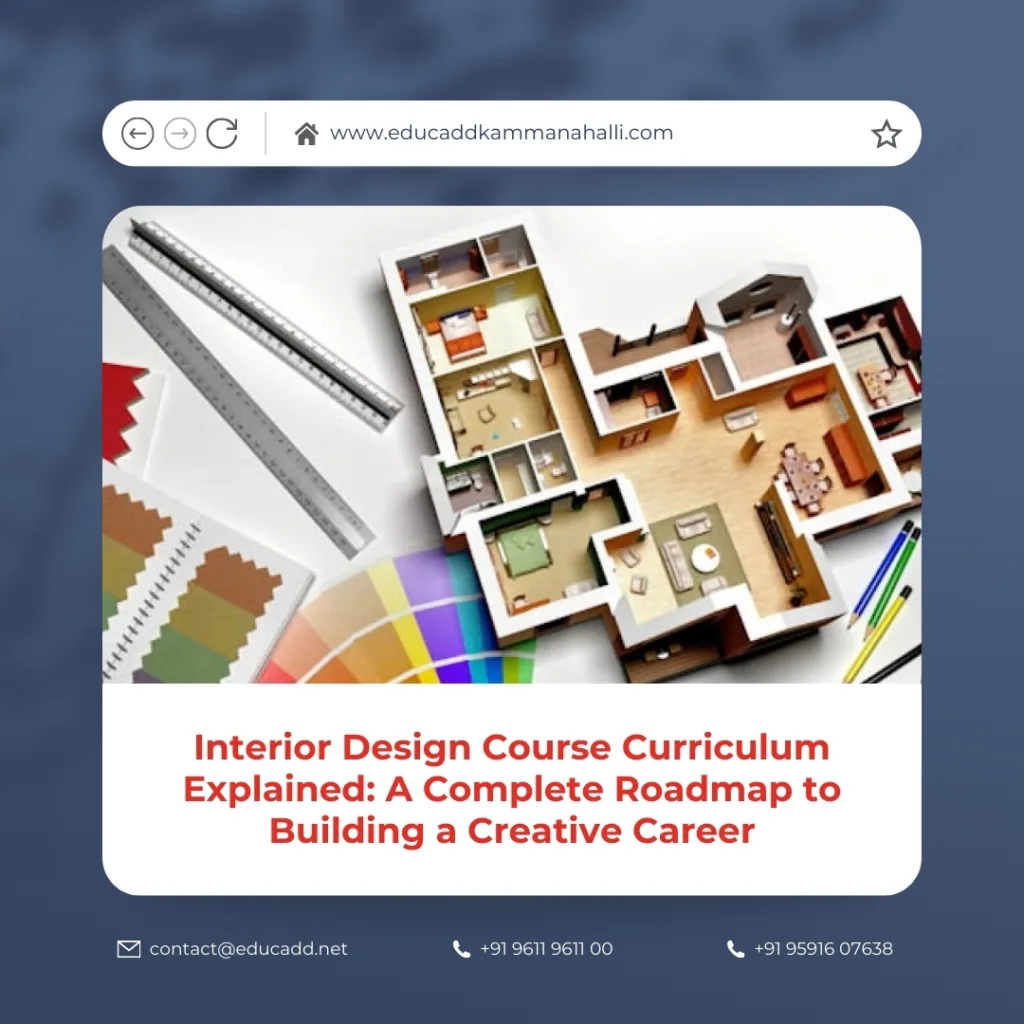
Interior Design Course Curriculum
This detailed guide on Interior Design Course Curriculum will walk you through every important subject, practical component, technical skill, and professional exposure included in a standard program. By the end, you will know exactly how an interior design course transforms beginners into confident design professionals.
1. Foundation of Design Principles
A strong base defines every successful designer. In the early stage of Interior Design Course Curriculum Explained, students focus on design fundamentals. These core subjects shape creative thinking and visual understanding.
You will study elements such as line, form, texture, color, and balance. These elements form the backbone of spatial aesthetics. Students learn how proportion and scale affect perception. In addition, instructors train students to create harmony and contrast within spaces.
This stage of Interior Design Course Curriculum Explained also builds observation skills. You analyze existing interiors and understand why certain spaces feel comfortable. Moreover, you begin sketching simple compositions to express ideas clearly.
Without mastering fundamentals, advanced topics feel overwhelming. Therefore, design principles remain the most important starting point.
2. Drawing and Visual Communication
Drawing plays a central role in Interior Design Course Curriculum Explained. Designers must communicate ideas visually before execution begins. Hence, institutes dedicate significant hours to sketching and rendering.
Students practice freehand drawing to improve hand control. Perspective drawing helps you show depth and dimensions accurately. Technical drawing introduces floor plans, elevations, and sections.
You also learn presentation techniques. Marker rendering, shading, and digital illustration enhance visual appeal. As a result, your concepts become easier for clients to understand.
Visual communication strengthens confidence. When you can explain a design through drawings, clients trust your expertise. That is why this module remains crucial in Interior Design Course Curriculum Explained.
3. History of Interior Design and Architecture
Understanding the past shapes better design decisions. A comprehensive Interior Design Course Curriculum Explained always includes design history.
Students explore classical Greek and Roman styles. Then they move to Gothic, Renaissance, Baroque, and Victorian eras. Modern movements such as Bauhaus and Art Deco follow.
This historical knowledge sharpens design awareness. You learn how culture, climate, and technology influenced interiors. Furthermore, you recognize recurring patterns in global trends.
History also helps you develop a unique style. Instead of copying trends blindly, you draw inspiration from timeless concepts. Therefore, design history remains a valuable part of Interior Design Course Curriculum Explained.
4. Space Planning and Layout Design
Space planning forms the heart of professional practice. In Interior Design Course Curriculum Explained, this subject teaches functional arrangement.
Students learn to measure spaces accurately. They analyze circulation paths and zoning techniques. Each area must serve a clear purpose. For example, living spaces require comfort, while workspaces demand efficiency.
You practice designing residential layouts first. Later, you move to commercial and retail spaces. This progression improves your technical thinking.
Space planning also develops problem-solving skills. You learn how to maximize small areas creatively. Consequently, this section of Interior Design Course Curriculum Explained builds practical expertise.
5. Materials and Construction Techniques
Interior design does not rely only on creativity. It also depends on technical knowledge. Therefore, Interior Design Course Curriculum Explained includes material studies.
Students examine wood, metal, glass, stone, and composite materials. You understand durability, maintenance, and cost factors. In addition, you learn how different materials interact with light.
Construction basics also form part of the curriculum. Wall systems, ceilings, flooring, and partitions receive detailed attention. This knowledge ensures you design realistically.
When you understand materials deeply, you avoid costly mistakes. Hence, this module strengthens both creativity and responsibility in Interior Design Course Curriculum Explained.
6. Furniture Design and Ergonomics
Furniture defines comfort and functionality. A structured Interior Design Course Curriculum Explained dedicates a full module to furniture and ergonomics.
Students explore furniture history and styles. Then they design custom pieces based on user needs. Ergonomics ensures that designs support the human body correctly.
You learn anthropometric measurements. These measurements guide chair heights, desk dimensions, and kitchen layouts. As a result, interiors feel comfortable and practical.
This section also introduces joinery techniques and furniture detailing. Therefore, furniture design becomes both an artistic and technical discipline in Interior Design Course Curriculum Explained.
7. Lighting Design Concepts
Lighting transforms ordinary spaces into dynamic environments. In Interior Design Course Curriculum Explained, lighting receives special focus.
Students learn about natural and artificial lighting. You understand color temperature and light intensity. Moreover, you explore task, ambient, and accent lighting.
Lighting plans require technical precision. Designers calculate spacing and placement carefully. Good lighting enhances mood and improves productivity.
By mastering lighting design, you elevate your projects significantly. Hence, lighting remains a key element in Interior Design Course Curriculum Explained.
8. Color Theory and Application
Color influences emotion and perception. Therefore, Interior Design Course Curriculum Explained includes detailed color studies.
Students learn about the color wheel and harmony schemes. You explore complementary and analogous combinations. Additionally, you understand psychological effects of colors.
Practical exercises allow you to create mood boards. These boards help visualize concepts clearly. Through experimentation, you gain confidence in color selection.
Color theory helps designers communicate themes effectively. Thus, it plays a vital role in Interior Design Course Curriculum Explained.
9. Computer-Aided Design (CAD) and Software Training
Technology drives modern design practice. A strong Interior Design Course Curriculum Explained integrates digital tools early.
Students learn AutoCAD for drafting. SketchUp supports 3D modeling. Many institutes also teach 3ds Max, Revit, or similar software.
Rendering software enhances presentations. Digital tools save time and increase accuracy. Clients expect realistic visuals before approving projects.
Software proficiency improves employability. Companies prefer candidates who handle both creativity and technology. Therefore, CAD training stands as a core pillar of Interior Design Course Curriculum Explained.
10. Sustainable and Green Design
Sustainability shapes the future of design. Hence, Interior Design Course Curriculum Explained includes eco-friendly principles.
Students learn energy-efficient planning strategies. You explore sustainable materials and waste reduction techniques. Designers must consider ventilation and daylight optimization.
Green certifications and environmental standards receive attention. Awareness of climate impact improves responsible decision-making.
Sustainable design benefits clients and the planet. Consequently, this module strengthens ethical responsibility in Interior Design Course Curriculum Explained.
11. Project Management and Professional Practice
Design talent alone cannot ensure success. Business knowledge also matters. Therefore, Interior Design Course Curriculum Explained includes professional practice.
Students learn budgeting and cost estimation. You understand vendor coordination and contract documentation. Time management also receives focus.
Communication skills play a significant role. Designers must negotiate confidently with clients and contractors. Legal aspects such as permits and agreements require clarity.
This module prepares students for real-world challenges. As a result, professional practice forms a strategic part of Interior Design Course Curriculum Explained.
12. Portfolio Development and Presentation Skills
A portfolio defines your career opportunities. In Interior Design Course Curriculum Explained, students work consistently on portfolio creation.
Each project becomes part of your presentation record. Faculty guide you in layout design and visual storytelling. You learn how to highlight strengths effectively.
Presentation skills build confidence. Clear explanation impresses clients and recruiters. Moreover, mock presentations prepare students for interviews.
A strong portfolio increases job prospects significantly. Thus, portfolio development stands central in Interior Design Course Curriculum Explained.
13. Internship and Industry Exposure
Practical exposure bridges theory and reality. Therefore, Interior Design Course Curriculum Explained includes internships.
Students work with design firms or architects. You experience site visits and client meetings. Real projects enhance technical knowledge quickly.
Internships also expand professional networks. Many students secure placements through these connections. Exposure to deadlines improves discipline.
Industry training transforms students into professionals. Hence, internships complete the practical side of Interior Design Course Curriculum Explained.
14. Final Year Project and Specialization
The final project showcases your expertise. In Interior Design Course Curriculum Explained, this stage reflects growth and confidence.
Students choose a specialization such as residential, commercial, hospitality, or retail design. You conduct research and develop detailed drawings. Faculty mentors guide the process.
The project includes concept development, material selection, lighting plans, and 3D visualization. Each component demonstrates technical and creative skills.
This final presentation represents your professional identity. Therefore, the capstone project concludes Interior Design Course Curriculum Explained with strong impact.
Conclusion
A well-structured program shapes creative talent into professional expertise. Through this detailed overview of Interior Design Course Curriculum, you can see how each subject builds essential skills step by step. From design fundamentals to advanced software training, every module plays a strategic role. Moreover, internships and final projects provide real-world confidence.
When you understand Interior Design Course Curriculum Explained, you make informed decisions about your education and career path. The curriculum does not simply teach decoration. Instead, it builds problem-solving ability, technical precision, and business awareness. Ultimately, this structured journey transforms passion into a sustainable profession in the dynamic world of interior design.

