
Master Machine Design Certification: Turn Engineering Ideas into Industry-Ready Innovations
Modern engineering demands more than technical knowledge. It requires the ability to transform ideas into accurate, practical, and manufacturable products. From automotive components to industrial machinery, every successful product begins with thoughtful design. This is where a strong Machine Design Certification Course can make a meaningful difference. It helps learners develop design knowledge, software skills, problem-solving ability, and industry awareness.
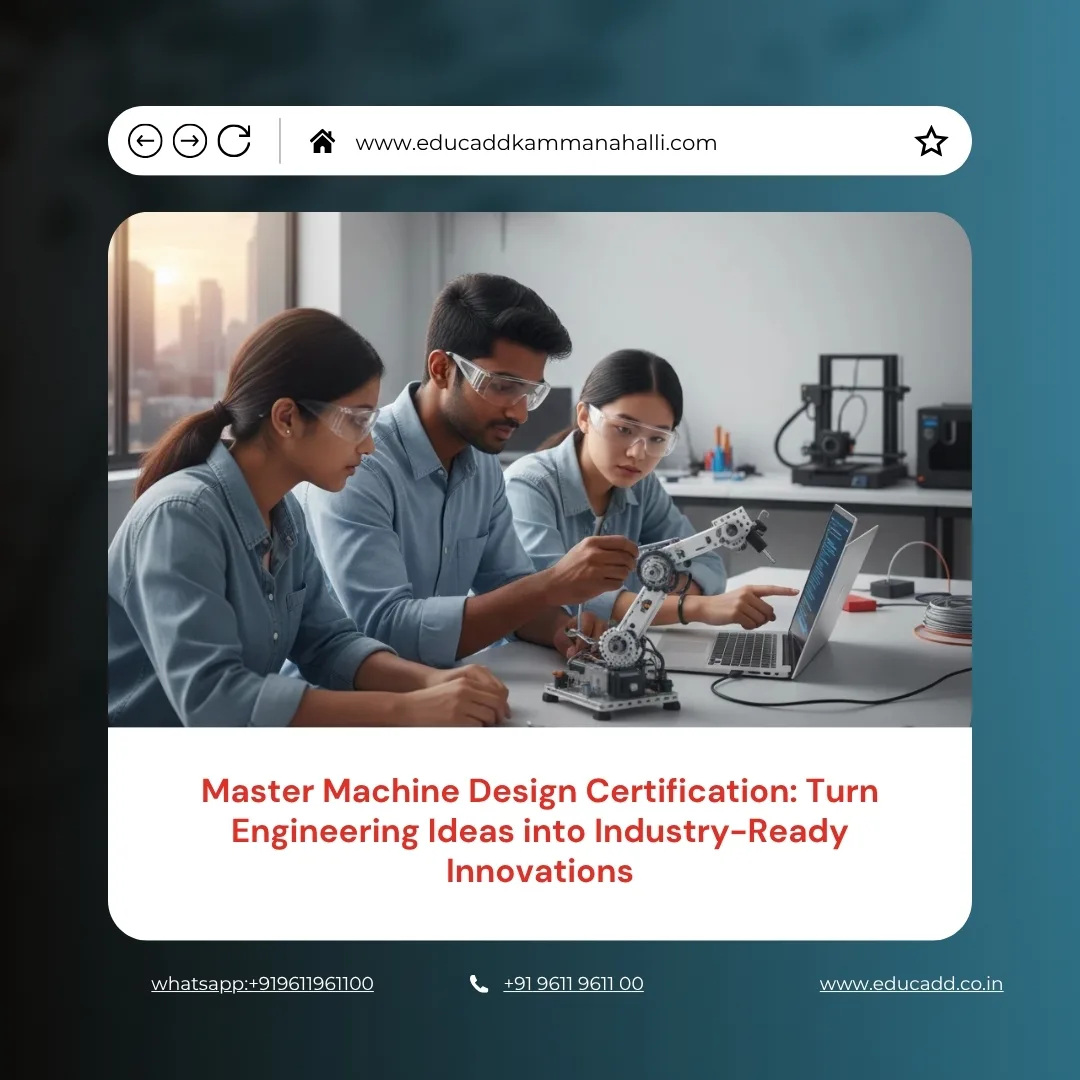
Machine Design Certification Course
Moreover, certification can strengthen a professional profile and demonstrate commitment to technical growth. Whether you are a student, graduate, designer, or working engineer, the right training can help you move from basic concepts to confident machine design practice.
Build a Strong Foundation in Machine Design
Machine design starts with understanding how individual components work together. A designer must consider forces, motion, materials, dimensions, safety, and manufacturing methods before creating a final model. Therefore, learning the fundamentals is essential for anyone planning a career in this field. A quality Machine Design Certification Course introduces these core principles through structured learning.
Students can understand topics such as engineering mechanics, strength of materials, machine elements, tolerances, and design calculations. This foundation supports better decision-making during real projects. As learners progress, they can connect theoretical concepts with practical design situations and develop a stronger engineering mindset.
Transform Concepts into Practical Designs
A great machine designer does more than create attractive 3D models. The design must work efficiently under real operating conditions. It should also remain economical and easy to manufacture. During professional training, learners can explore how an initial idea becomes a detailed engineering solution. They can study component selection, assembly planning, design constraints, and performance requirements.
A Machine Design Certification Course can provide this practical direction by connecting design theory with real-world applications. As a result, learners gain a clearer understanding of why each design decision matters. This approach also improves confidence when handling complex engineering assignments.
Master Industry-Relevant Design Software
Computer-aided design has become an essential part of modern engineering. Designers use advanced software to create accurate models, assemblies, drawings, and technical documentation. Learning these tools can significantly improve productivity and design accuracy. A well-structured Machine Design Certification can introduce learners to widely used CAD platforms and their professional workflows.
Training may cover sketching, part modelling, assembly creation, drafting, dimensioning, and design modifications. Furthermore, learners can understand how digital models support the later stages of product development. With regular practice, software skills become faster, more precise, and more reliable.
Understand Materials and Manufacturing Requirements
A successful design must suit the material and manufacturing process. Choosing the wrong material can increase costs, reduce product life, or create safety concerns. Similarly, a complex design may become difficult or expensive to manufacture. Machine design training helps learners understand these important relationships. Through a Machine Design Certification, students can explore material properties, manufacturing methods, machining considerations, and component selection.
They can also learn how design decisions influence production. This knowledge encourages engineers to think beyond the computer screen. Instead, they begin to consider how each component will perform, move, fit, and finally reach the production floor.
Develop Precision Through Engineering Drawings
Engineering drawings remain an important communication tool within manufacturing and design teams. A detailed drawing communicates dimensions, tolerances, materials, finishes, and manufacturing requirements. Even a small error can create major problems during production. Therefore, designers must develop strong drafting skills alongside modelling capabilities. A Machine Design Certification can help learners understand drawing standards, sectional views, annotations, tolerances, and documentation practices.
In addition, students can learn how to convert 3D models into accurate production drawings. These skills make communication easier between designers, engineers, machinists, suppliers, and quality teams. Precision becomes a professional habit rather than an occasional requirement.
Strengthen Problem-Solving and Design Thinking
Engineering often involves challenges that do not have one simple answer. A component may need to become lighter without losing strength. A machine may require better performance without increasing production costs. Such situations require structured thinking and careful evaluation. Professional design training encourages learners to analyse problems before developing solutions.
With a Machine Design Certification, candidates can improve their ability to identify design constraints, compare alternatives, and refine concepts. They also learn to balance performance, safety, cost, and manufacturability. Consequently, certification becomes more than a qualification. It supports the development of practical thinking that engineers can apply throughout their careers.
Explore Applications Across Multiple Industries
Machine design skills can support careers across several engineering sectors. Automotive companies require designers for vehicle components and mechanical systems. Manufacturing industries need professionals who can develop machinery, tools, fixtures, and production equipment. Aerospace, robotics, energy, consumer products, and industrial automation also depend on mechanical design expertise.
A Machine Design Certification can help learners understand these diverse applications. Exposure to different industries can also help candidates identify areas that match their interests. For example, someone interested in automation may explore robotic assemblies, while an automotive enthusiast may focus on vehicle components. This flexibility can create multiple career pathways.
Improve Your Understanding of Product Development
Product development involves much more than creating a single component. Designers often work through several stages before a product reaches production. These stages may include concept development, modelling, analysis, prototyping, testing, modification, and final documentation. Understanding this workflow helps professionals work more effectively with multidisciplinary teams.
A Machine Design Certification can introduce learners to this complete development cycle. They can understand how design changes influence testing, manufacturing, cost, and product performance. This broader perspective prepares learners for professional responsibilities. It also helps them appreciate the importance of collaboration throughout the engineering process.
Learn the Importance of Tolerances and Standards
Precision plays a major role in mechanical engineering. Components must fit correctly and operate safely within specified limits. This makes tolerances, fits, standards, and geometric requirements extremely important. Without proper control, even accurately modelled components may fail during assembly or operation. Through a Machine Design Certification, learners can gain practical knowledge of dimensional tolerances, fits, standard components, and engineering conventions.
They can also understand why designers must follow established standards. Such knowledge reduces errors and improves consistency. More importantly, it helps designers create drawings and models that manufacturing teams can interpret accurately.
Build a Portfolio That Demonstrates Your Skills
Employers often want to see evidence of practical ability. A certificate can support a profile, but a strong portfolio can demonstrate what a candidate can actually create. Therefore, learners should develop projects during their training. These projects may include machine components, assemblies, mechanisms, fixtures, or complete product concepts. A Machine Design Certification can provide a structured environment for building such practical work.
Candidates can document their design process, software techniques, calculations, and final outcomes. This portfolio can become a valuable addition to a resume. It also gives candidates useful material to discuss during technical interviews.
Prepare for Modern Engineering Workplaces
Engineering workplaces continue to adopt digital workflows and advanced technologies. Designers now collaborate through shared digital models, cloud platforms, simulation tools, and integrated product development systems. Therefore, professionals must remain adaptable and willing to learn. A modern Machine Design Certification can help candidates develop this adaptability through practical exposure.
It can also encourage learners to understand how CAD connects with simulation, manufacturing, documentation, and project coordination. By developing a broader digital mindset, professionals can respond better to changing industry expectations. Continuous learning then becomes an important part of long-term career development.
Increase Career Opportunities with Specialized Skills
Specialized skills can help candidates stand apart in a competitive engineering job market. Employers often seek professionals who can contribute to projects with limited supervision. Strong machine design knowledge can support roles such as mechanical designer, CAD engineer, product design engineer, design engineer, and drafting professional. A Machine Design Certification Course can strengthen a candidate’s technical profile by showing focused training in a specific engineering discipline.
However, certification should work alongside practical knowledge, communication skills, and project experience. When these strengths come together, candidates can present a more complete professional profile to potential employers.
Choose Training That Connects Learning with Practice
Not every training program provides the same level of practical exposure. Learners should look for programs that combine theory, software training, projects, technical guidance, and industry-oriented exercises. Practical assignments can make concepts easier to understand and remember. Mentorship can also help learners identify and correct design mistakes. A strong Machine Design Certification Course should therefore focus on application rather than memorisation alone.
Before choosing a course, candidates should consider the curriculum, software coverage, project opportunities, trainer expertise, and learning support. Selecting the right training environment can make the learning journey more productive and career-focused.
Start Your Journey Toward Engineering Excellence
Machine design offers an exciting path for people who enjoy engineering, creativity, technology, and problem-solving. The field allows professionals to turn concepts into functional products that support modern industries. However, success requires consistent learning and practical experience.
A Machine Design Certification can provide a structured starting point for developing these capabilities. It can strengthen technical understanding, improve software proficiency, and support project-based learning. Most importantly, it can help learners build confidence in applying engineering principles to real design challenges. With dedication and continuous practice, aspiring designers can prepare themselves for meaningful opportunities in the mechanical engineering sector.
Turn Technical Knowledge into Career Potential
The future of engineering will continue to depend on professionals who can design smarter, safer, and more efficient products. Machine designers have an important role in this transformation. From concept development to manufacturing documentation, their decisions influence product quality and performance. Therefore, investing in the right education can create a strong foundation for long-term growth.
A Machine Design Certification Course can help bridge the gap between classroom knowledge and professional expectations. When combined with hands-on projects, software expertise, design thinking, and continuous learning, it can become a valuable career asset. Start building your skills today, develop a strong portfolio, and move confidently toward a future in machine design.
Conclusion
Machine design is at the heart of modern engineering innovation. It combines creativity, technical knowledge, precision, and practical problem-solving. Therefore, developing the right skills can open the door to exciting opportunities across automotive, manufacturing, automation, aerospace, and other engineering industries. A Machine Design Certification Course can provide the structured knowledge and practical exposure needed to build these skills. It can also strengthen your professional profile and improve your confidence in handling real-world design challenges.
However, certification is only the beginning. Continuous practice, hands-on projects, software proficiency, and industry awareness are equally important for long-term success. By combining these strengths, aspiring designers can transform their engineering knowledge into valuable professional expertise. If you are ready to turn your ideas into accurate, innovative, and production-ready designs, now is the right time to start your journey toward becoming a skilled machine design professional

