
Build the Future of Engineering with a Mechanical CADD Certification Course in India
Engineering has transformed rapidly with the rise of digital design and advanced manufacturing technologies. Today, companies expect professionals to create precise designs, analyze products, and collaborate using industry-standard software.
- This shift has made Computer-Aided Design and Drafting (CADD) an essential skill for aspiring mechanical engineers and working professionals. Enrolling in a Mechanical CADD Certification India provides the technical knowledge and practical experience needed to meet modern industry demands. Whether you are a student, diploma holder, or experienced engineer, this certification helps you improve your design capabilities, strengthen your portfolio, and unlock better career opportunities in manufacturing, automotive, aerospace, construction, and product development.
The Growing Importance of Mechanical CADD in Modern Engineering
Mechanical engineering is no longer limited to traditional drafting techniques. Industries now depend on digital models to design products, simulate performance, and improve manufacturing efficiency. A Mechanical CADD Certification Course in India equips learners with the latest software skills that employers actively seek. It also introduces industry workflows that simplify complex engineering projects. As organizations adopt automation and smart manufacturing, skilled CADD professionals continue to enjoy increasing demand across various sectors. Learning these technologies prepares students for both current and future engineering challenges.
Learn Industry-Standard Mechanical Design Software
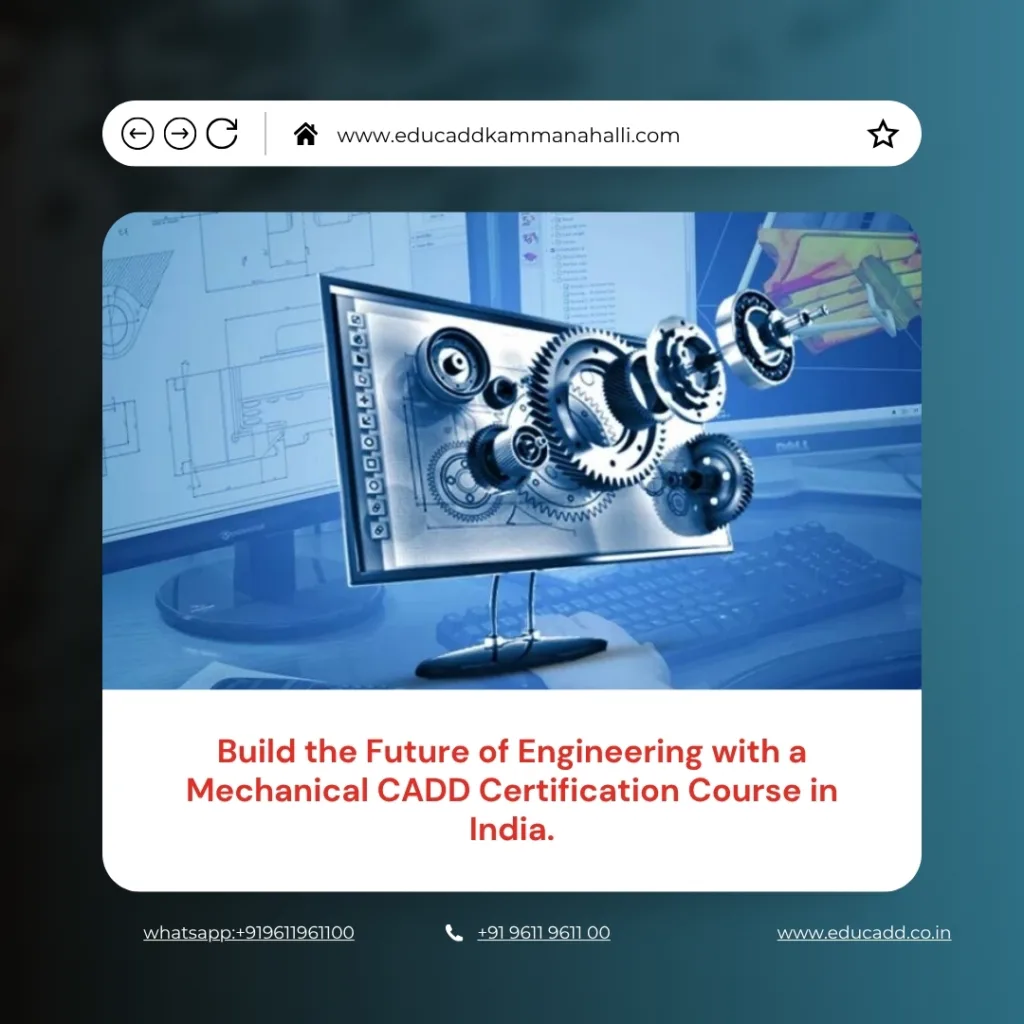
Mechanical CADD Certification India
A professional certification course focuses on the software tools widely used in engineering companies. Students gain practical experience in applications such as AutoCAD, SolidWorks, CATIA, Creo, Autodesk Inventor, NX CAD, and other leading design platforms. Each software serves a unique purpose in mechanical design and product development. Moreover, learners understand when and where to use each application effectively. Practical assignments strengthen software knowledge while improving confidence. As a result, graduates become capable of handling real industrial design projects with greater accuracy and efficiency.
Develop Strong Design and Drafting Fundamentals
Software knowledge alone cannot build a successful engineering career. Strong fundamentals remain equally important for producing accurate engineering drawings. A Mechanical CADD Certification Course in India teaches engineering graphics, dimensioning, tolerancing, geometric dimensioning and tolerancing (GD&T), assembly drawings, manufacturing drawings, and drafting standards. Students also understand material selection and production methods. These concepts improve design quality while reducing manufacturing errors. Therefore, learners develop a strong technical foundation that supports long-term career growth in mechanical engineering.
Practical Training Bridges the Gap Between Theory and Industry
Many engineering graduates understand theoretical concepts but struggle with practical implementation. Certification courses solve this problem through hands-on training and project-based learning. Students work on real engineering components, assemblies, and industrial case studies. They gain exposure to practical workflows followed by manufacturing companies. Furthermore, instructors guide learners through common design challenges and industry expectations. This practical experience builds confidence and prepares students for technical interviews. Consequently, graduates adapt quickly to professional work environments.
Gain Expertise in Mechanical CADD Certification Course
Modern engineering projects require professionals to master both 2D drafting and 3D modeling. During a Mechanical CADD Certification Course in India, students begin with technical drawings before progressing to advanced solid modeling techniques. They create machine components, sheet metal designs, assemblies, exploded views, and production drawings. Additionally, learners practice parametric modeling, which improves design flexibility. These skills allow engineers to modify designs efficiently while maintaining precision. Strong modeling capabilities significantly improve productivity in industrial design environments.
Understand Product Design and Manufacturing Processes
Mechanical design extends beyond creating attractive models. Engineers must understand how products move from concept to production. Certification programs introduce learners to manufacturing processes, machining principles, casting, forging, welding, and fabrication techniques. Students also study design for manufacturing and design optimization methods. This knowledge helps them create practical and cost-effective engineering solutions. Furthermore, understanding production requirements enables designers to reduce manufacturing costs while improving product quality and performance.
Build Real-Time Industrial Projects and Professional Portfolios
Employers prefer candidates who can demonstrate practical skills instead of theoretical knowledge alone. Therefore, many institutes include live projects in their curriculum. Students design industrial equipment, automotive components, production assemblies, and mechanical systems based on real engineering requirements. These projects become valuable additions to professional portfolios. Moreover, project experience showcases technical competence during interviews. A well-developed portfolio often creates a stronger impression than academic scores alone, increasing employment opportunities significantly.
Enhance Career Opportunities Across Multiple Industries
Mechanical CADD professionals enjoy excellent career prospects because nearly every manufacturing sector depends on engineering design. After completing a Mechanical CADD Certification Course in India, graduates can explore opportunities in automotive companies, aerospace industries, heavy machinery manufacturers, oil and gas organizations, renewable energy firms, consumer product companies, industrial automation businesses, and engineering consultancy firms. Since engineering design remains a critical function, skilled professionals continue to receive consistent employment opportunities across diverse industries. This flexibility makes Mechanical CADD an attractive career choice.
Improve Productivity with Mechanical CADD Certification Course
Engineering technology continues evolving through automation, simulation, and digital manufacturing. Modern certification courses introduce students to finite element analysis basics, product lifecycle management concepts, design validation, and digital engineering workflows. Learners also understand how advanced technologies improve product development speed and accuracy. Additionally, they gain awareness of Industry 4.0 practices that increasingly influence manufacturing environments. This exposure prepares professionals to work efficiently in technology-driven engineering organizations while remaining competitive in the job market.
Learn from Experienced Industry Professionals
Quality training depends heavily on experienced instructors who understand industrial practices. Most reputed training institutes employ professionals with extensive engineering backgrounds. Their practical knowledge helps students understand real workplace expectations rather than only textbook concepts. They share industry insights, project experiences, and problem-solving techniques gained from years of professional practice. Furthermore, personalized guidance helps learners improve technical skills more effectively. This mentorship accelerates learning while increasing confidence throughout the certification program.
Certification Adds Value to Your Professional Profile
Professional certification demonstrates commitment, technical expertise, and continuous learning. Employers often consider certified candidates more reliable because certification validates practical skills through structured training. A Mechanical CADD Certification Course in India enhances resumes by highlighting specialized software knowledge and engineering competencies. Moreover, certification supports career advancement by improving eligibility for higher-paying technical roles. Many organizations value certified professionals when selecting employees for specialized engineering projects and leadership opportunities.
Placement Assistance Supports Successful Career Growth
Several reputed Mechanical CADD training institutes provide dedicated placement support after course completion. Career services usually include resume preparation, mock interviews, technical assessments, aptitude training, and interview scheduling with partner companies. These services improve job readiness while reducing the challenges of entering the competitive engineering market. Furthermore, industry connections established by training institutes often create direct employment opportunities for deserving candidates. Effective placement assistance significantly increases the chances of securing rewarding engineering positions.
Selecting the right training institute plays a crucial role in achieving career success. Students should evaluate factors such as experienced faculty, updated curriculum, modern laboratories, industry-oriented projects, placement support, certification credibility, flexible schedules, and student reviews before enrolling. Visiting the training center also helps assess infrastructure and learning resources. Additionally, interacting with current students provides valuable insights into the quality of education. Careful evaluation ensures learners receive comprehensive training that aligns with industry requirements and career goals.Mechanical engineering continues evolving alongside technological innovation. Professionals who continuously upgrade their technical skills remain valuable in the employment market.
A Mechanical CADD Certification India represents a smart investment because it combines software expertise, practical knowledge, and industry exposure into one comprehensive learning experience. As engineering industries continue embracing digital transformation, certified professionals remain well-positioned for sustainable career growth. Continuous learning ensures long-term professional relevance while opening doors to leadership roles in engineering design.
Conclusion
A Mechanical CADD Certification Course in India provides much more than software training. It builds technical expertise, strengthens engineering fundamentals, develops practical problem-solving abilities, and prepares learners for real industrial challenges. Through hands-on projects, advanced design tools, experienced faculty, and placement support, students gain the confidence needed to excel in competitive engineering careers. Whether your goal is to secure your first engineering job, enhance your existing skills, or transition into high-demand design roles, this certification serves as a valuable stepping stone. Investing in professional Mechanical CADD training today equips you with future-ready skills that help you succeed in the rapidly evolving world of engineering and manufacturing.

