
The Role of Mechanical CADD in Modern Engineering Projects: Driving Precision, Efficiency, and Innovation
Engineering has undergone a remarkable transformation over the past few decades. What once relied heavily on manual drafting boards, pencils, and physical prototypes has evolved into a digital environment powered by advanced software and computational tools. Among the most influential technologies in this transformation is Mechanical CADD Engineering Projects. Mechanical CADD has become a fundamental part of modern engineering workflows, enabling engineers to design, visualize, test, and refine complex mechanical systems with unprecedented precision and speed.
In today’s highly competitive industrial landscape, engineering teams are expected to deliver accurate designs, reduce production time, minimize errors, and improve collaboration across departments. Mechanical CADD plays a vital role in achieving these objectives. It allows engineers to create detailed 2D drawings and sophisticated 3D models that accurately represent real-world mechanical components and systems. As industries such as automotive, aerospace, manufacturing, robotics, and energy continue to advance, Mechanical CADD remains an essential tool that supports innovation and operational efficiency.
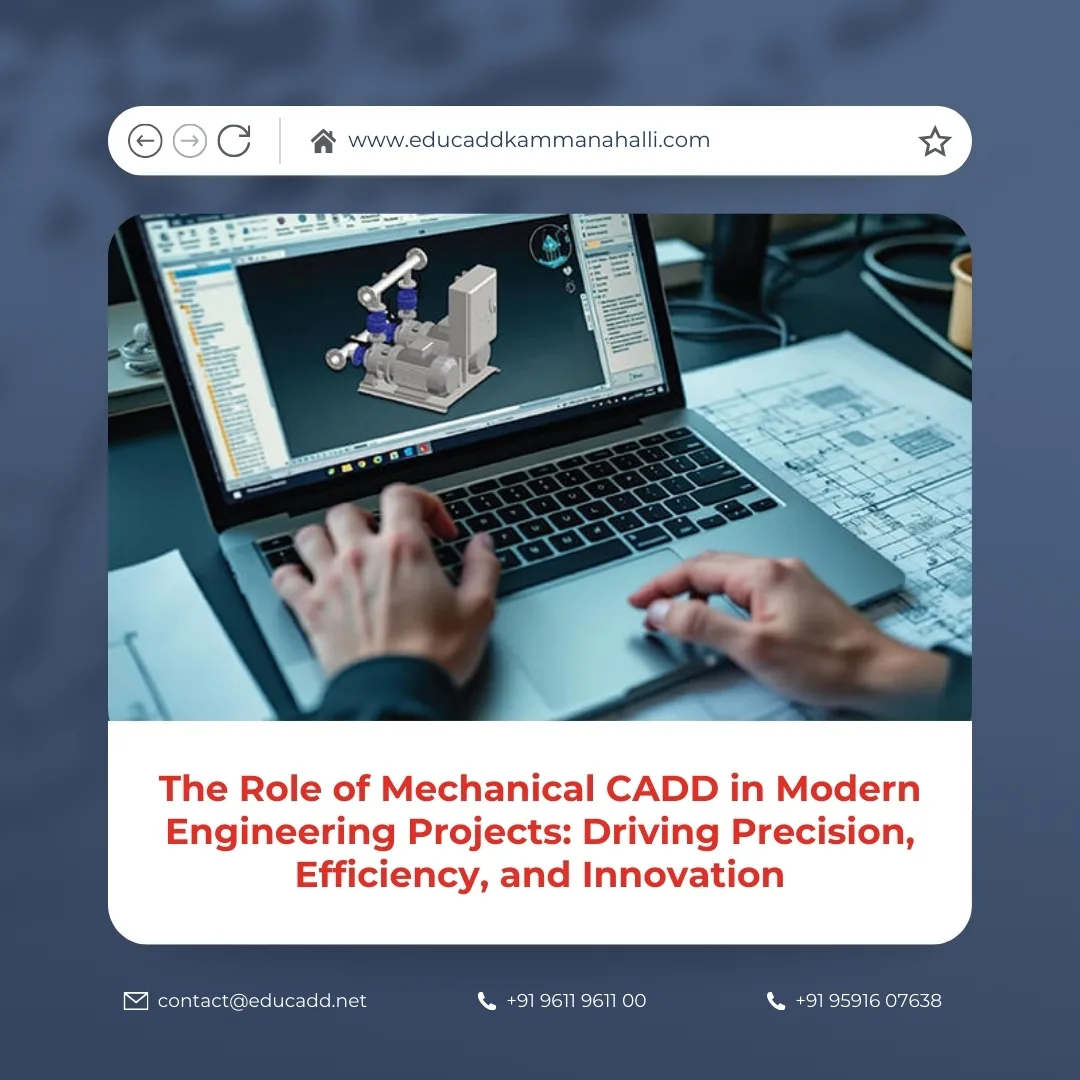
Mechanical CADD Engineering Projects
As industries move toward digital transformation, smart manufacturing, and Industry 4.0 technologies, the importance of Mechanical CADD continues to grow. From conceptual design to final production, Mechanical CADD supports every stage of the engineering lifecycle. This blog explores the Mechanical CADD Engineering Projects, highlighting how it improves accuracy, boosts productivity, enhances innovation, and supports efficient project execution across various industries.
Understanding Mechanical CADD in Engineering Design
Mechanical CADD refers to the use of specialized computer software to create, modify, analyze, and document mechanical designs. Unlike traditional drafting methods, Mechanical CADD provides engineers with digital tools that allow them to produce precise technical drawings and detailed 3D models. These models accurately represent the geometry, dimensions, materials, and mechanical properties of components.
One of the key advantages of Mechanical CADD is its ability to automate many repetitive design tasks. Engineers can quickly generate standard components, apply constraints, and maintain consistent dimensions throughout the design process. As a result, the design process becomes faster and more reliable.
Mechanical CADD also improves visualization. Engineers can view mechanical components from multiple perspectives and examine how different parts interact within an assembly. This level of visualization helps teams understand complex mechanisms and identify design improvements before manufacturing begins.
Additionally, Mechanical CADD supports digital documentation. Engineering drawings, part lists, and technical specifications can be generated automatically from the design model. These documents are essential for manufacturing, quality control, and maintenance operations. By using Mechanical CADD, organizations maintain accurate records that support efficient production and future design modifications.
Enhancing Design Accuracy and Precision
Accuracy is one of the most critical requirements in engineering design. Even a small error in a mechanical drawing can lead to manufacturing defects, assembly issues, or equipment failure. Mechanical CADD significantly improves design precision by allowing engineers to define exact dimensions, tolerances, and geometric relationships.
Digital drafting tools ensure that measurements remain consistent across the entire design. If a dimension is modified, the system automatically updates related components. This feature reduces the risk of inconsistencies that often occur in manual drafting processes.
Furthermore, Mechanical CADD allows engineers to apply engineering standards directly within the design environment. Standardized symbols, annotations, and dimensioning methods ensure that drawings meet international engineering guidelines. As a result, communication between design teams and manufacturing units becomes clearer and more reliable.
Precision modeling also allows engineers to test the fit and function of components within assemblies. Mechanical CADD helps designers identify potential interference issues or alignment problems early in the design stage. This proactive approach reduces costly design revisions during production.
Improving Design Efficiency and Productivity
Modern engineering projects often operate under tight deadlines and budget constraints. Mechanical CADD helps organizations improve productivity by accelerating the design process and reducing manual effort. Engineers can quickly create complex mechanical models using built-in design libraries and parametric modeling tools.
Parametric modeling allows designers to define relationships between different features of a component. When one parameter changes, the entire model updates automatically. This capability simplifies design modifications and allows engineers to explore multiple design alternatives efficiently.
Mechanical CADD also supports template-based drafting. Engineers can reuse previously developed designs and modify them according to project requirements. This practice reduces the time needed to develop new designs from scratch.
Automation features such as automatic dimensioning, bill-of-materials generation, and drawing updates further improve workflow efficiency. Engineers spend less time on repetitive tasks and more time focusing on innovation and problem-solving.
Supporting Advanced 3D Modeling and Visualization
One of the most powerful capabilities of Mechanical CADD is advanced 3D modeling. Traditional 2D drawings provide limited visualization of mechanical systems, but 3D models allow engineers to examine designs in a realistic environment.
Three-dimensional modeling helps designers understand how different parts interact within an assembly. Engineers can rotate models, zoom into specific components, and analyze complex mechanical structures from various angles. This enhanced visualization improves decision-making during the design stage.
Mechanical CADD also enables exploded views of assemblies. These views show how components fit together and how they should be assembled during manufacturing. Assembly visualization simplifies communication between design teams and production personnel.
Moreover, 3D visualization helps stakeholders who may not have strong technical backgrounds. Project managers, clients, and investors can easily understand design concepts when they see realistic models. This clarity improves project approval processes and supports better collaboration.
Facilitating Engineering Simulation and Analysis
Mechanical CADD systems often integrate simulation and analysis tools that allow engineers to evaluate design performance before physical prototypes are built. Simulation capabilities enable teams to test how components respond to forces, heat, vibration, and motion.
For example, stress analysis helps engineers determine whether a mechanical component can withstand operational loads. By simulating stress distribution across a design, engineers can identify weak points and improve structural integrity.
Motion simulation is another important feature. Engineers can analyze how moving parts interact within a mechanical system. This analysis helps ensure smooth operation and prevents mechanical interference.
Thermal analysis also plays a critical role in industries such as automotive and aerospace. Engineers can evaluate how heat affects materials and components, ensuring that products perform reliably under extreme conditions.
By integrating simulation with Mechanical CADD, organizations reduce the need for expensive physical prototypes. Engineers can test multiple design iterations digitally, leading to faster innovation and lower development costs.
Enabling Efficient Collaboration in Engineering Teams
Engineering projects involve multiple stakeholders, including designers, engineers, manufacturers, suppliers, and project managers. Effective collaboration is essential for project success, and Mechanical CADD provides tools that support seamless teamwork.
Digital design files can be shared easily among team members. Engineers working in different locations can access the same design models and contribute to the development process. Cloud-based CADD platforms further enhance collaboration by allowing real-time updates and version control.
Version management ensures that teams always work with the latest design files. Engineers can track design changes, review previous versions, and maintain a clear record of project development. This transparency prevents confusion and reduces errors.
Mechanical CADD also improves communication between design and manufacturing teams. Detailed digital models and drawings provide clear instructions for production processes. As a result, manufacturing teams can interpret designs accurately and produce components that meet engineering specifications.
Supporting Manufacturing and Production Processes
Mechanical CADD Engineering Projects in bridging the gap between design and manufacturing. Once engineers complete the design phase, the digital models created in Mechanical CADD software are used to guide production processes.
Computer-Aided Manufacturing (CAM) systems can directly use CADD models to generate machining instructions for CNC machines. This integration ensures that manufactured components match the original design precisely.
Mechanical CADD also supports the creation of detailed assembly drawings and production documentation. These documents include component dimensions, tolerances, materials, and assembly instructions. Manufacturers rely on this information to produce high-quality products.
Additionally, Mechanical CADD helps optimize manufacturing efficiency. Engineers can evaluate different design configurations to reduce material waste, simplify assembly processes, and improve product durability. This optimization leads to cost savings and higher production quality.
Reducing Design Errors and Development Costs
Errors in engineering design can result in costly production delays, product failures, and safety risks. Mechanical CADD helps minimize these risks by providing advanced design validation tools.
Design checking features automatically detect issues such as missing dimensions, overlapping components, or inconsistent constraints. Engineers receive alerts and can correct problems before the design moves to manufacturing.
Digital prototyping also reduces the need for physical testing. Instead of building multiple prototypes, engineers can evaluate performance through simulations. This approach saves both time and financial resources.
By preventing design errors early in the development process, Mechanical CADD helps organizations maintain project schedules and reduce overall development costs.
Enhancing Product Innovation and Creativity
Innovation is a key driver of success in modern engineering industries. Mechanical CADD provides engineers with the flexibility and tools needed to explore creative design solutions.
With parametric modeling, designers can quickly experiment with new shapes, materials, and configurations. Engineers can test different concepts without investing significant resources in physical prototypes.
Mechanical CADD also supports generative design technologies. These advanced tools use algorithms to generate optimized design solutions based on specific requirements such as weight, strength, and performance.
As a result, engineers can discover innovative solutions that may not have been considered using traditional design methods. Mechanical CADD encourages experimentation and accelerates the development of advanced mechanical systems.
Integrating Mechanical CADD with Industry 4.0 Technologies
The rise of Industry 4.0 has transformed manufacturing and engineering processes through digital connectivity, automation, and data integration. Mechanical CADD plays an important role in this technological ecosystem.
Digital models created using Mechanical CADD can be integrated with Product Lifecycle Management (PLM) systems. These systems manage product information throughout the entire lifecycle, from concept development to maintenance and disposal.
Mechanical CADD also supports digital twin technology. A digital twin is a virtual representation of a physical product that allows engineers to monitor performance in real time. By connecting digital models with operational data, organizations can improve product reliability and maintenance strategies.
Additionally, Mechanical CADD integrates with additive manufacturing technologies such as 3D printing. Engineers can design complex components that would be difficult to manufacture using traditional methods. This integration supports advanced manufacturing innovation.
Ensuring Compliance with Engineering Standards
Engineering designs must comply with strict industry standards and regulatory requirements. Mechanical CADD software helps engineers maintain compliance by incorporating standardized design tools and documentation formats.
Dimensioning standards, tolerance specifications, and annotation guidelines can be applied automatically within the design environment. This feature ensures that technical drawings meet international engineering standards.
Compliance is particularly important in industries such as aerospace, automotive, and medical device manufacturing. Mechanical CADD helps organizations document design decisions, track modifications, and maintain detailed records that support regulatory approval processes.
By ensuring compliance during the design phase, Mechanical CADD reduces the risk of legal issues and product recalls.
Improving Product Lifecycle Management
Mechanical CADD contributes significantly to Product Lifecycle Management by maintaining accurate digital records of design data. These records support the entire product lifecycle, including design updates, maintenance operations, and future upgrades.
When engineers need to modify an existing product, they can access the original CADD models and drawings. This access simplifies redesign efforts and ensures that changes remain consistent with the original design.
Maintenance teams also benefit from Mechanical CADD documentation. Detailed drawings help technicians understand equipment structures and perform repairs more efficiently.
Over time, organizations build a comprehensive digital library of engineering designs. This knowledge base supports continuous improvement and helps companies develop better products in the future.
Expanding Career Opportunities in Mechanical Engineering
The increasing adoption of Mechanical CADD has created new career opportunities for engineers and technical professionals. Many industries now require professionals who are skilled in advanced CADD tools and digital design methodologies.
Mechanical engineers, design engineers, and drafting specialists use CADD software to develop innovative products and mechanical systems. Professionals who master these tools become valuable assets to engineering organizations.
Educational institutions and training centers now offer specialized Mechanical CADD courses to prepare students for industry demands. These programs teach software skills, engineering drawing standards, and design principles that are essential for modern engineering careers.
As technology continues to evolve, the demand for skilled Mechanical CADD professionals will continue to grow across industries worldwide.
Conclusion
Mechanical CADD Engineering Projects has become an indispensable component of modern engineering projects. From conceptual design and detailed modeling to simulation, manufacturing integration, and lifecycle management, Mechanical CADD supports every stage of product development. By providing advanced design tools, precise modeling capabilities, and powerful collaboration features, it enables engineers to create high-quality mechanical systems efficiently and accurately.
Organizations that adopt Mechanical CADD benefit from improved design precision, reduced development costs, faster project completion, and enhanced product innovation. The technology allows engineering teams to visualize complex systems, identify potential issues early, and optimize designs before production begins. These capabilities significantly reduce risks and improve overall project outcomes.
As industries continue to embrace digital transformation and smart manufacturing, the role of Mechanical CADD will become even more significant. Integration with advanced technologies such as simulation tools, digital twins, additive manufacturing, and Industry 4.0 platforms will further expand its capabilities. Engineers will rely on Mechanical CADD not only as a drafting tool but also as a strategic platform for innovation and product development.
In the future, engineering success will depend heavily on digital design expertise and technological adaptability. Mechanical CADD stands at the center of this transformation, empowering engineers to buil

